Prompt engineering for researchers means writing instructions that define the task, evidence boundaries and review standards. A useful prompt makes an answer easier to examine. It cannot guarantee factual accuracy, prevent fabricated references or replace research judgment.
The practical aim is a checkable output: source locations for findings, visible uncertainty and clear decisions for human review. This guide explains how to build that workflow and provides five adaptable research prompt templates.
Why a good prompt is only the beginning
A model can follow formatting instructions while misunderstanding a study. A 2023 study by Walters and Wilder documented fabricated references and errors in genuine citations from earlier ChatGPT models. It identifies a historical failure mode, rather than current error rates for every system.
An expert role can clarify perspective, but does not confer expertise. Asking for citations creates an output requirement; it does not prove that the sources were retrieved or support the answer. Separate generating ideas, finding evidence and interpreting that evidence.
For a detailed checking procedure, use AOFIRS’ guide to verifying AI-generated answers and citations. Treat factual claims as provisional until their underlying support has been examined.
Match the task to accessible evidence
Confirm what the system can actually access. Asking it to search does not guarantee that a search tool is enabled or used. Providing a URL does not demonstrate that the page was opened.
| Working mode | Useful task | Required check |
|---|---|---|
| Chat without retrieval | Brainstorm concepts or search terms | Locate factual evidence independently |
| Chat with web search | Discover accessible sources | Open originals; check dates and claim support |
| Uploaded documents | Extract and compare supplied material | Check readable text, tables, completeness and locations |
| API with retrieval or tools | Repeatable extraction workflows | Inspect retrieved passages, tool results and validation records |
Retrieval-augmented generation, or RAG, incorporates retrieved material into generation. The foundational RAG paper reported benefits on evaluated tasks, not universal factual reliability. Retrieval can still miss a table, select an irrelevant passage or omit contrary evidence.
Ask the system to identify material used and inaccessible sections. Check the originals. Finding relevant papers does not establish completeness: retain database names, queries, search dates and screening decisions. For a bounded task, report findings “within the supplied documents” rather than implying field-wide coverage.
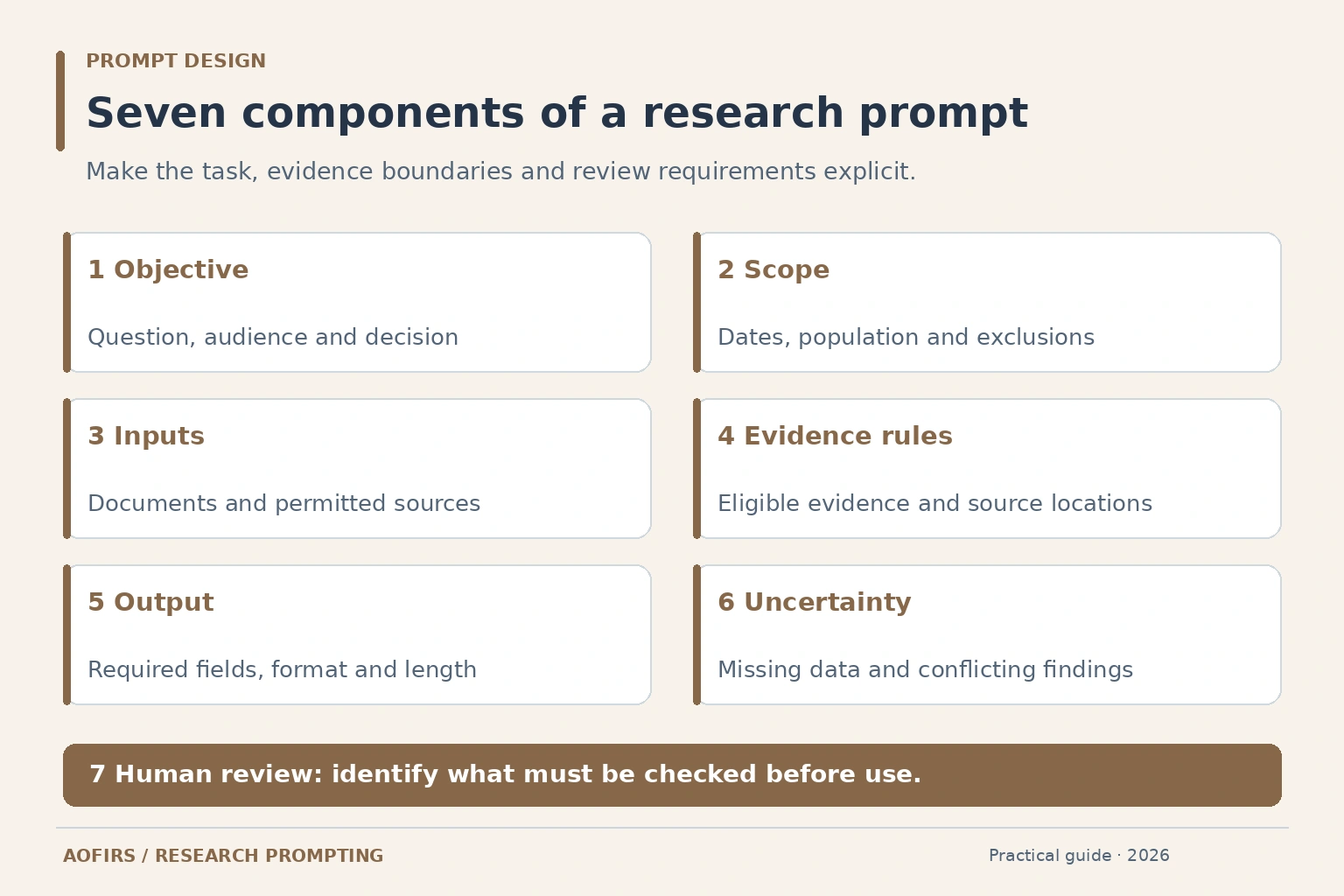
Build a research prompt with seven components
Start with the deliverable. Anthropic’s prompting guidance recommends defining success criteria and ways to test them before refining instructions.
- Objective and audience: State the question, decision and reader.
- Scope: Define dates, population, geography and exclusions.
- Inputs: Identify documents and permitted external sources.
- Evidence rules: Specify eligible designs and preprint labels.
- Output: Name fields, length and source-location format.
- Uncertainty: Keep missing information and disagreement visible.
- Human review: Identify checks required before use.
“Extract reported outcomes from these four papers” is more checkable than “explain what the literature shows.” Say whether external sources are allowed. For document-only tasks, instruct the model not to fill gaps from general knowledge.
Refine instructions through evidence checkpoints
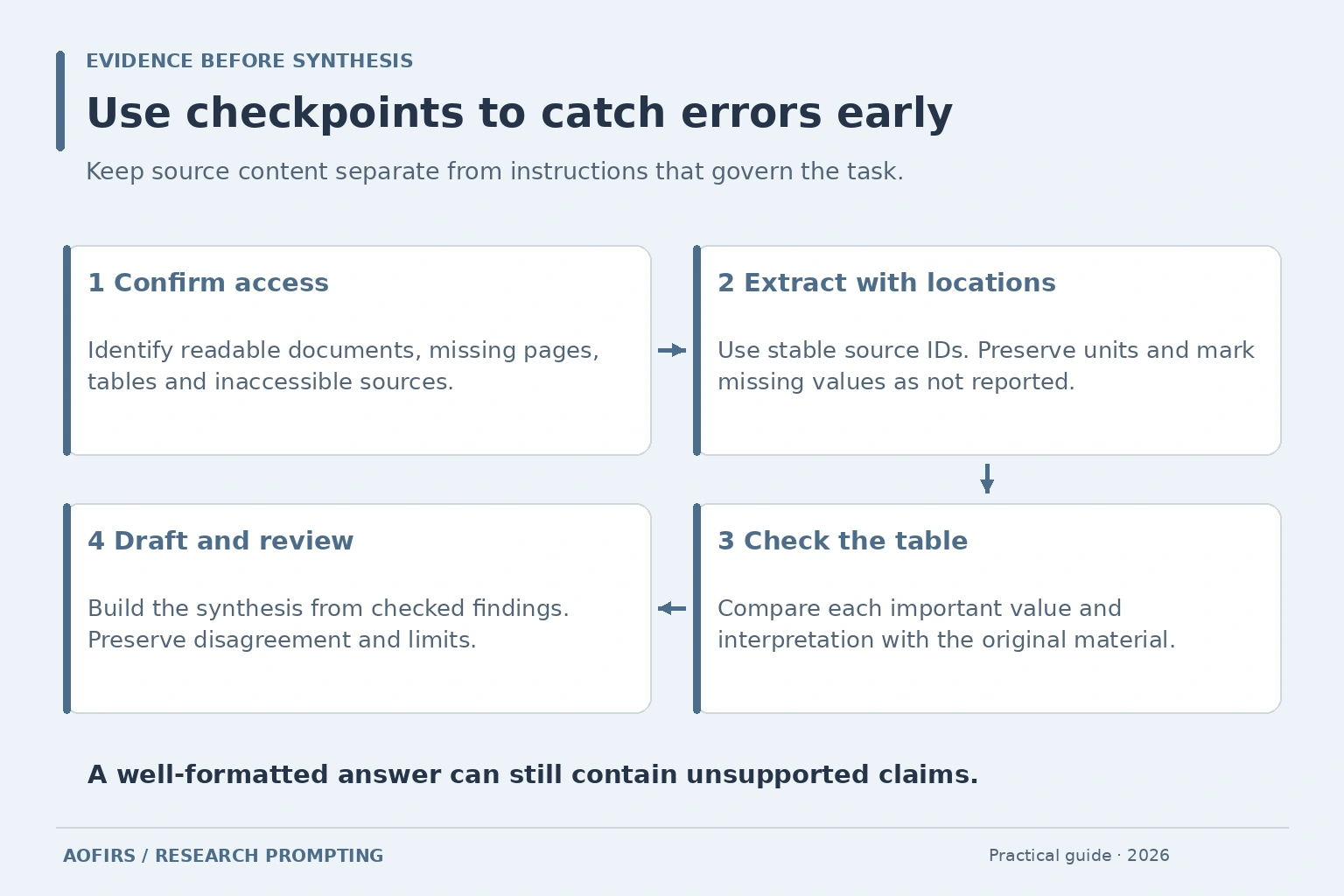
Use headings or separators for instructions, source material and examples. Assign stable document identifiers such as S1 and S2. If formatting is difficult, provide one correctly completed example that matches the required fields.
Separate planning, retrieval, screening, extraction, comparison and drafting. Inspect the evidence table before requesting a narrative synthesis, so extraction errors do not spread. Ask for concise evidence-based explanations, supporting locations, and calculation inputs and units.
OpenAI’s reasoning-model guidance favors clear, direct instructions and says explicit chain-of-thought prompting is unnecessary for those models. Follow guidance for the selected system rather than applying one prompting formula universally.
Change one important instruction at a time and test missing-data and conflicting-evidence cases. Diagnose whether failure comes from wording, unavailable sources, poor extraction or an unsuitable tool. Anthropic’s hallucination guidance includes allowing uncertainty and grounding responses in source quotations. These measures reduce risk without guaranteeing correctness.
Five copy-ready research prompt templates
Replace the bracketed fields before use. These are proposed workflows, not claims of measured model performance.
1. Develop a literature-search plan
Inputs: Question, population, dates and databases. Access: Database access is required to execute and validate searches.
Prepare a search plan for [question], covering [population/context] and [dates] in [databases]. Include concept groups, synonyms, candidate database-specific queries, inclusion/exclusion criteria and a search-log format. Separate suggested controlled vocabulary from verified terms. Do not invent papers or claim searches were executed. Flag syntax needing confirmation and ask about missing scope details.
Check operators against each database’s documentation. AOFIRS’ Search Query Matrix offers related guidance on adapting queries across search environments.
2. Extract findings into an evidence table
Inputs: Readable papers labeled S1–S5. Access: Document reading; scans may need OCR.
Using only [S1–S5], extract design, population, sample size, intervention/exposure, comparator, outcome definition, reported result, uncertainty interval and limitations. Use one row per study/outcome, with source ID and page, section or table. Preserve units and distinguish adjusted from unadjusted estimates. Use “not reported” for missing fields. Flag unreadable material. Do not infer or calculate missing results.
3. Compare studies and limitations
Inputs: Checked extraction table and original papers. Access: Both materials.
Compare [table] with [original studies]. Identify agreement, disagreement, methodological differences, populations and limitations. Attach source locations to factual statements. Separate authors’ conclusions from your interpretation. Do not pool incompatible outcomes or treat association as causation. Identify missing information and comparisons that cannot be supported.
4. Support qualitative coding
Inputs: Approved, de-identified excerpts and optional codebook. Access: An institution-approved processing environment.
Suggest provisional codes for [excerpts] using [codebook/inductive approach]. Include excerpt ID, a short exact supporting quotation, proposed code, interpretation and ambiguity. Preserve contradictory cases and distinguish descriptive codes from inferred themes. Do not infer identities, motives or prevalence beyond the material. Mark unclear passages. Treat codes as suggestions for researcher review.
5. Audit claims and citations
Inputs: Draft, bibliography and source files or URLs. Access: Browsing or document reading.
Audit [draft] against [sources]. Return claim, citation, source identity, supporting location and status: supported, partly supported, contradicted or unverified. Check names, dates, numbers and quotation context. Distinguish source existence from claim support. Do not invent replacement references. Mark inaccessible material unverified and list checks still needed. Keep the audit provisional until a qualified person reviews the evidence.
Worked example: turn a broad question into a checkable task
Illustrative scenario: A researcher investigates remote work and productivity. No study findings or model-test results are asserted here.
Weak prompt: “Prove that remote work improves productivity.” It assumes the conclusion, leaves productivity undefined and omits source boundaries.
Improved prompt: Using only the five supplied studies, examine how remote or hybrid work relates to measured employee productivity among adult office workers. Include studies published January 2020–October 15, 2026. Extract design, setting, productivity measure, comparator, findings and limitations with source locations. Separate self-reported productivity from recorded output. Identify null or negative findings. Explain exclusions and studies that cannot answer the question. Do not generalize beyond these studies.
Verification: Check eligibility, outcome definitions and reported values against the originals. Assess whether designs support causal conclusions. Request synthesis only after checking the table, preserving differences in measures, populations and methods.
Evaluate outputs and preserve a research record
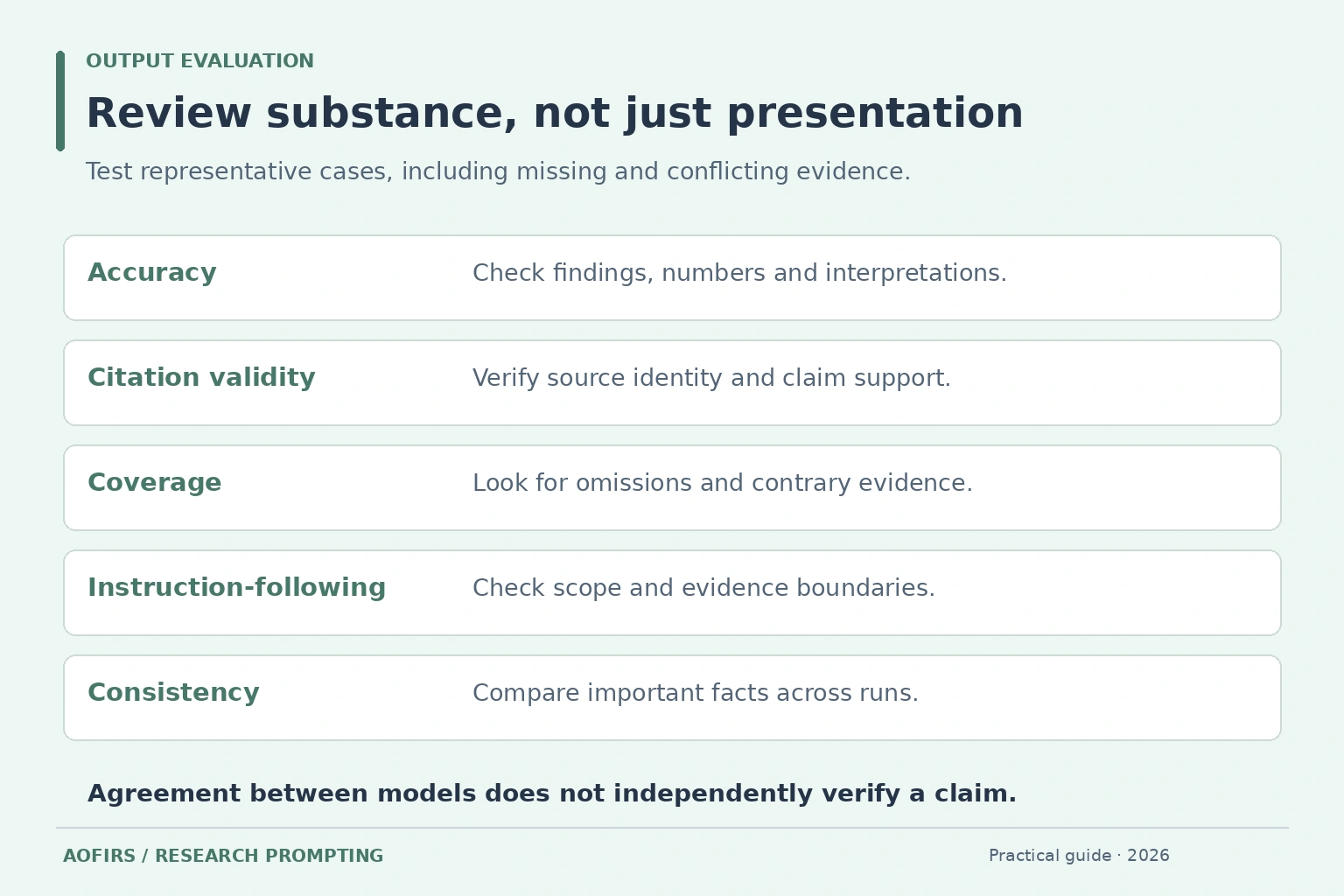
Build a review set with established answers and difficult cases. OpenAI’s evaluation guidance recommends task-specific assessments, logging and human feedback to calibrate automated scoring.
- Accuracy: Check findings, numbers and interpretation.
- Citation validity: Verify source identity and attached claim support.
- Coverage: Look for missing documents and contrary findings.
- Instruction-following: Check scope and evidence boundaries.
- Consistency: Compare important facts across repeated runs.
Set acceptance criteria before comparing prompt versions. For extraction, require values to match their source and missing fields to remain visible. For synthesis, require supported claims and fair treatment of contrary evidence. These are suggested review standards, not universally validated thresholds.
Record prompt version, service/model, visible version, run date, inputs, enabled tools, retrieval results, relevant settings, output and human corrections. Mark undisclosed versions or settings explicitly. Repeated answers or agreement between models do not independently establish truth.
These records help explain outcomes even when exact reproduction is impossible. AOFIRS’ report on verification debt in online research discusses the work created by accumulating unchecked AI claims.
Protect research integrity and sensitive information
Ask neutral questions and invite evidence against the starting hypothesis. Before uploading materials, check consent, confidentiality, institutional requirements and service data-use and retention terms. Remove unnecessary identifiers. Consumer, enterprise and API controls may differ.
Retrieved pages and files can carry instructions intended to redirect a model. OWASP describes indirect prompt injection as a security risk. Treat sources as evidence, not authority to change the task or disclose data. Separators organize text; they are not a security guarantee. Restrict tool permissions and require human approval for consequential actions.
Follow applicable institutional and publisher disclosure rules. In medical publishing, ICMJE’s author guidance calls for disclosure of AI assistance. Document the tool, purpose, material processed and checks actually performed. Do not claim expert validation that did not occur.
Frequently asked questions
Can a prompt guarantee reliable AI outputs?
No. Reliability still requires accessible evidence, appropriate methods and human verification.
Should I always assign an expert role?
Use a role to clarify perspective or audience. Define the task and evidence standards; the label does not validate an answer.
Does uploading a PDF make answers trustworthy?
No. Check that relevant text and tables were readable, then verify cited locations and interpretations.
How can I reduce invented references?
Supply verified sources, limit answers to accessible material and require locations. Independently confirm identity and claim support.
Are longer prompts better?
Only when added detail resolves ambiguity. Remove contradictions and test additions against representative cases.
Can AI perform a systematic review?
It can assist stages. Researchers must design, execute, validate and report the methods; a generated overview alone is insufficient.
What if sources disagree?
Compare methods, populations, outcomes, dates and limitations. Preserve unresolved disagreement.
What should I save when revising prompts?
Save versions, inputs, outputs, tool settings, source checks and human corrections so changes can be assessed.