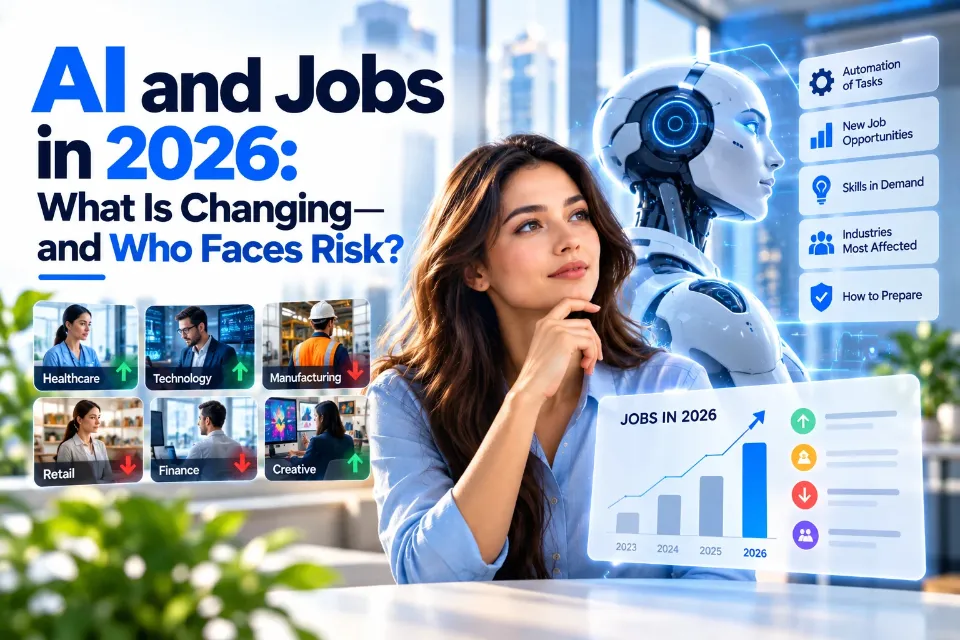
AI is changing work, hiring requirements, and the skills employers seek. Effects vary by occupation, workplace, and career stage. The studies discussed here show changes within jobs and concerning patterns for some entry-level workers. They do not provide a precise global tally proving that jobs transformed outnumber jobs displaced in 2026.
A job title can remain the same while its tasks change. Employers may keep existing staff but reduce new hiring. Productivity gains may support business growth, changes in staffing, or both.
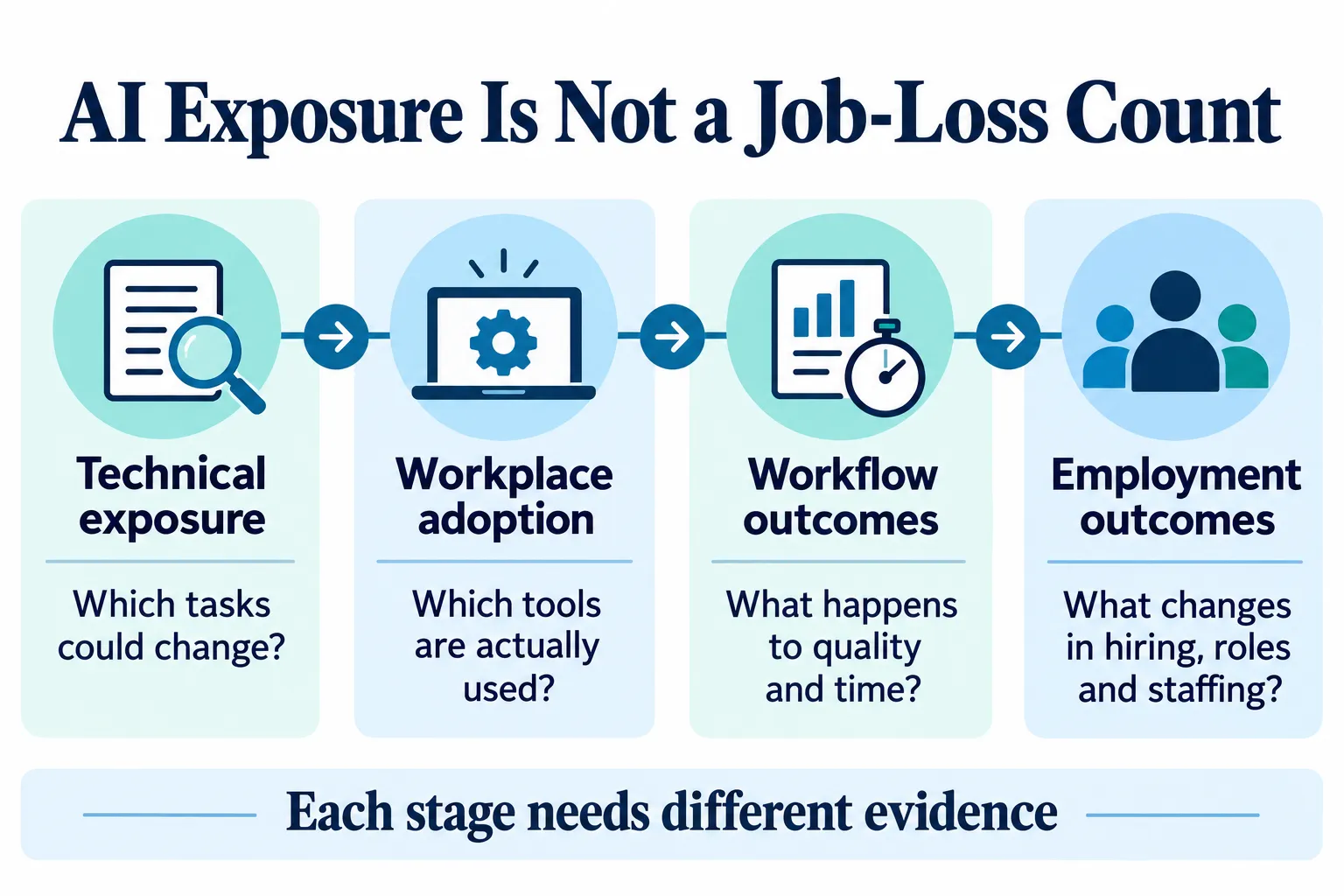
To understand AI and employment, ask what the technology can do, where it is used, how it affects completed work, and how employers respond.
Comparing those questions provides a stronger basis for understanding job trends than declaring entire occupations either obsolete or safe.
What Does It Mean for AI to Reshape a Job?
A job is a set of tasks, a set of responsibilities, a set of people you work with and a set of lines of accountability. The automation of one element of a job doesn’t necessarily mean the job itself is gone.
Think of a hypothetical research analyst. The AI might be used to help organize the documents, suggest search terms and draft a first pass at a summary. The analyst would still be responsible for defining the research question, assessing the credibility of the sources, reconciling any contradictory evidence, and explaining the significance of the findings.
Several terms help distinguish these changes:
- Task automation: software carrying out an activity that a person used to do.
- Worker augmentation: AI assists the worker, the worker remains responsible for the work.
- Job redesign: an employer changes the job’s responsibilities or the way the job is done.
- Job displacement: a worker loses their job as the demand for that type of work falls or shifts.
- Job creation: Employers are adding roles to meet new or growing requirements.
There can be a number of outcomes in a single organization. One employer for instance could automate their document preparation, reassign their staff to more complex work, create new roles specifically around AI and then reduce or stop recruitment in certain areas.
This combination of effects is precisely why progress at the task level doesn’t simply map onto an aggregate figure of job loss.
What the Evidence Says About AI and Employment
Occupational exposure measures potential change
In May 2025, the ILO and Poland’s NASK estimated that about one in four jobs worldwide was in an occupation with some potential exposure to generative AI.
Their assessment flagged clerical work as particularly vulnerable, with increasing levels of vulnerability in the digitized occupations of software, media and finance. Exposure is what the technology can affect, it’s not a measure of actual job losses.
As reported in ILO exposure study, the researchers judged transformation within jobs more likely than complete replacement because many occupations retain tasks requiring human involvement. Adoption also depends on infrastructure, skills, costs, and organizational decisions.
The right implication is that the ‘AI-exposed’ occupations should be looked at in detail. That in itself, though, is not enough to tell you whether there will be an increase or a decrease in employment in those sectors.
Global job forecasts include forces beyond AI
The World Economic Forum’s Future of Jobs Report 2025 projected 170 million jobs created and 92 million displaced by 2030, for a net gain of 78 million.
Those forecasts cover multiple forces, including technology, economic conditions, demographics, and the green transition. They are neither AI-only estimates nor observed employment outcomes for 2026.
A positive global employment outlook doesn’t in itself mean that those people out of jobs will be able to move into the new jobs that are being created. There will be a number of factors that could prevent the new jobs from being the right jobs for the people who are out of work; location, the skills required, the pay package and the timing being the principal ones.
Productivity improvements are specific to the setting
A study published in The Quarterly Journal of Economics in February 2025 examined an AI assistant used by 5,172 customer-support agents. Access increased issues resolved per hour by 15% on average, with benefits varying by experience and skill.
The tool suggested responses while agents retained control over conversations. The result shows benefits in a defined workplace, not a universal productivity improvement or a prediction of eventual staffing needs.
Organizations are advised to evaluate their own operational outcomes rather than relying on external productivity metrics as the basis for staffing decisions.
Entry-Level Jobs Deserve Particular Attention
Disruption associated with artificial intelligence may manifest as a reduction in entry pathways to certain occupations, even when incumbent employees retain their positions.
Stanford Digital Economy Lab’s August 2026 revision of Canaries in the Coal Mine? analyzed US payroll data through June 2026. It found no widespread economy-wide displacement, but employment among workers ages 22–25 in highly AI-exposed occupations was about 19% below a benchmark based on similarly aged, less-exposed peers. The divergence appeared primarily through reduced hiring.
The authors describe early, descriptive patterns, not causal estimates. Education controls reduce the gaps; some trends predate widespread generative AI, and the ADP sample differs from national survey benchmarks. The result cannot establish how much of the divergence AI caused.
This development raises a critical management consideration. If software systems assume responsibility for foundational assignments, organizations must address how new employees will acquire the experiential learning necessary for progression to more advanced responsibilities.
Employers can maintain developmental opportunities by implementing supervised case reviews, rotational assignments, and tasks that require employees to articulate their decision-making processes. While the elimination of repetitive work may enhance efficiency, the absence of alternative learning pathways presents a distinct organizational challenge.
How AI Can Change Different Kinds of Work
The following table distinguishes research findings from illustrative workflow examples. The human responsibilities listed describe proposed areas of accountability, not guarantees that particular positions will remain unchanged.
| Work area | Tasks affected | Human responsibilities to preserve | Evidence and limits |
|---|---|---|---|
| Customer support | Suggested responses and access to relevant information | Resolving exceptions, understanding customer needs, checking answers | The QJE study measured gains in one deployment |
| Clerical work | Document preparation and other routine digital activities | Handling unusual cases, maintaining records, resolving discrepancies | ILO identifies high potential exposure; this is not a layoff count |
| Software development | Producing, modifying, and reviewing code | Defining requirements, testing behavior, assessing maintainability | METR findings show results depend on tools, tasks, and study design |
| Professional roles | Routine components of expert work | Judgment, communication, and responsibility for decisions | PwC’s 2026 analysis identifies differing occupational trajectories |
| Online research | Illustrative uses include search planning and draft synthesis | Verifying sources, checking dates, assessing evidence | Workflow recommendation; no employment forecast is implied |
A rigorous assessment begins with a detailed examination of the actual work performed before drawing conclusions regarding the future of a given occupation.
Tasks that appear repetitive may, in practice, involve exceptions necessitating significant expertise. Conversely, tasks perceived as complex may incorporate standardized elements amenable to technological assistance. Job titles often obscure these underlying distinctions.
AI Coding Tools Show Why Results Need Context
Software development illustrates how quickly evidence can become outdated.
METR’s early-2025 randomized study found that experienced open-source developers took 19% longer on assigned tasks when allowed to use AI tools. That result concerned a small group working in familiar repositories with tools available at the time.
In its February 24, 2026 update, METR said a later experiment could not reliably establish the current productivity effect. Participation and task-selection problems complicated interpretation. Researchers considered newer tools likely more beneficial, but the data did not support a reliable current estimate.
The principal recommendation is to assess contemporary tools using representative tasks reflective of actual workplace requirements.
For instance, when evaluating a coding assistant, teams should determine whether the implemented changes function as intended, whether reviewers can effectively interpret the output, and whether the modifications introduce maintenance challenges. Accelerated draft production is advantageous only if it results in measurable improvements across the entire workflow.
This evaluative principle extends to research, reporting, and customer service functions. It is essential to assess the final output, accounting for the resources expended on verification and correction.
Which Skills Matter as Jobs Change?
PwC’s June 2026 Global AI Jobs Barometer analyzed more than one billion job advertisements across 27 countries and territories. It described different trajectories for roles where AI emphasizes human expertise and roles where it makes tasks easier for nonexperts.
The report also found changing expectations for junior workers, including demand for judgment and leadership. Its associations support attention to professional capability alongside tool familiarity, but do not prove that AI alone caused employment or wage changes.
An effective professional development strategy integrates three core capabilities.
Know the work: understand its standards, constraints, and consequences well enough to assess whether an AI-generated result is valid.
Use tools deliberately: supply appropriate context, divide complex assignments into manageable tasks, and identify missing information.
Verify outcomes: check claims against evidence, test calculations, examine assumptions, and explain uncertainty.
These practices can make professional contributions clearer and more accountable. They do not guarantee employment or a pay increase.
What AI Agents Change About Workplace Design
In this context, an AI agent refers to a system designed to execute a series of actions using various tools to achieve a specified objective. This configuration introduces distinct workflow considerations compared to soliciting a single response from a chatbot.
For example, a research agent may be tasked with document retrieval, data extraction, synthesis of findings, and draft preparation. Each procedural step presents an opportunity for erroneous assumptions to propagate through subsequent stages of the workflow.
Before delegating such a sequence of tasks, teams should establish clear protocols regarding the following considerations:
- Which sources and systems the agent may access.
- Which actions require human review.
- How unsupported findings will be identified.
- Who accepts responsibility for the finished output.
These constitute workflow recommendations and do not serve as evidence that autonomous systems have supplanted entire occupational categories.
The central employment consideration is the extent to which work can be completed reliably, taking into account the requirements for supervision, exception handling, and corrective action.
What Workers Should Do Next
Start with a task inventory. Record your main activities, the time spent on each, and the consequences of errors.
Choose a narrow activity for a pilot, such as organizing public documents or drafting an outline. Establish a baseline and compare the complete process with and without AI.
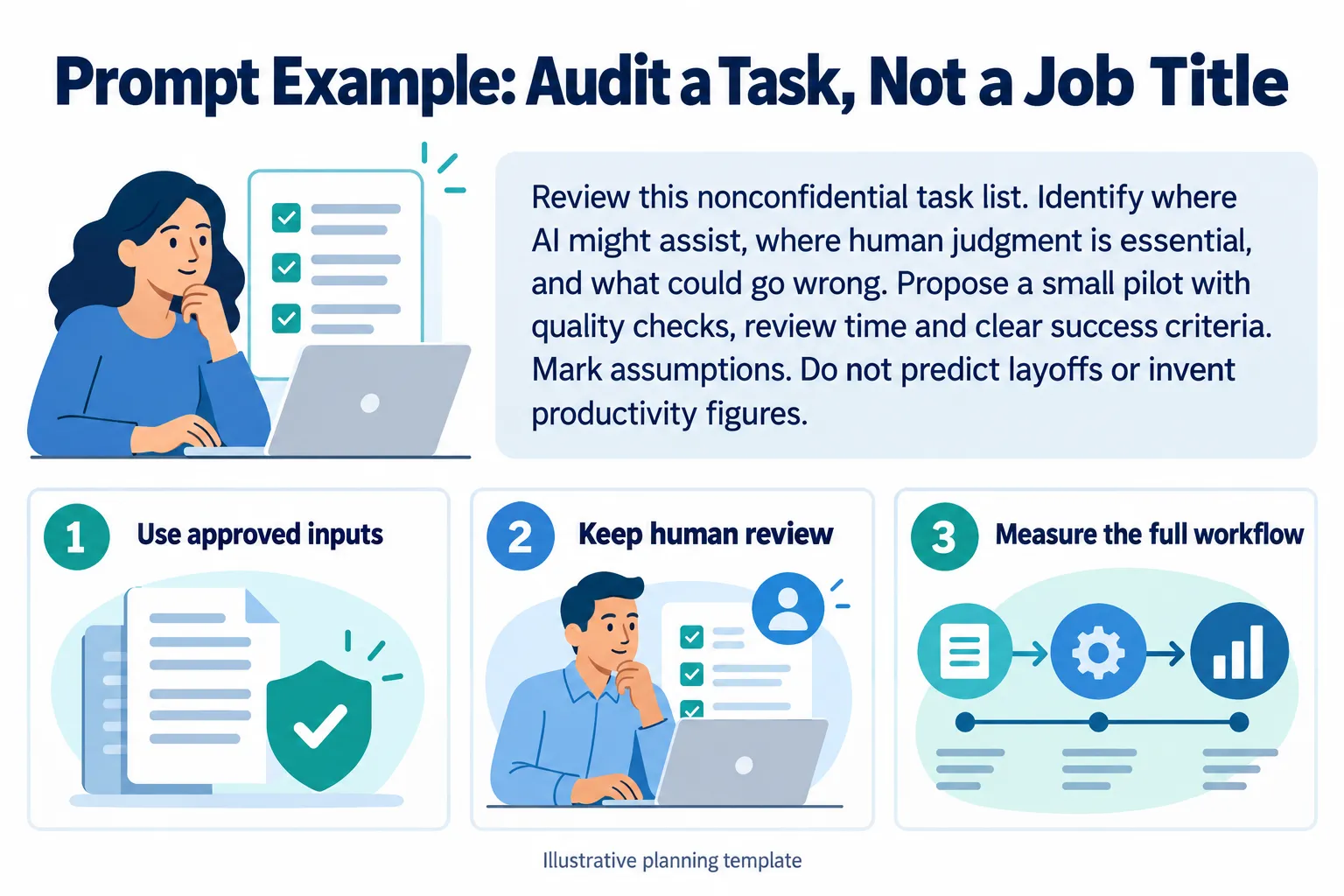
Task audit prompt: Review this nonconfidential task list. Identify where AI might assist, where human judgment is essential, and what could go wrong. Propose a small pilot with quality checks, review time, and clear success criteria. Mark assumptions. Do not predict layoffs or invent productivity figures.
Measure quality as well as time. Check for missing qualifications, false citations, and extra review work that could offset drafting gains.
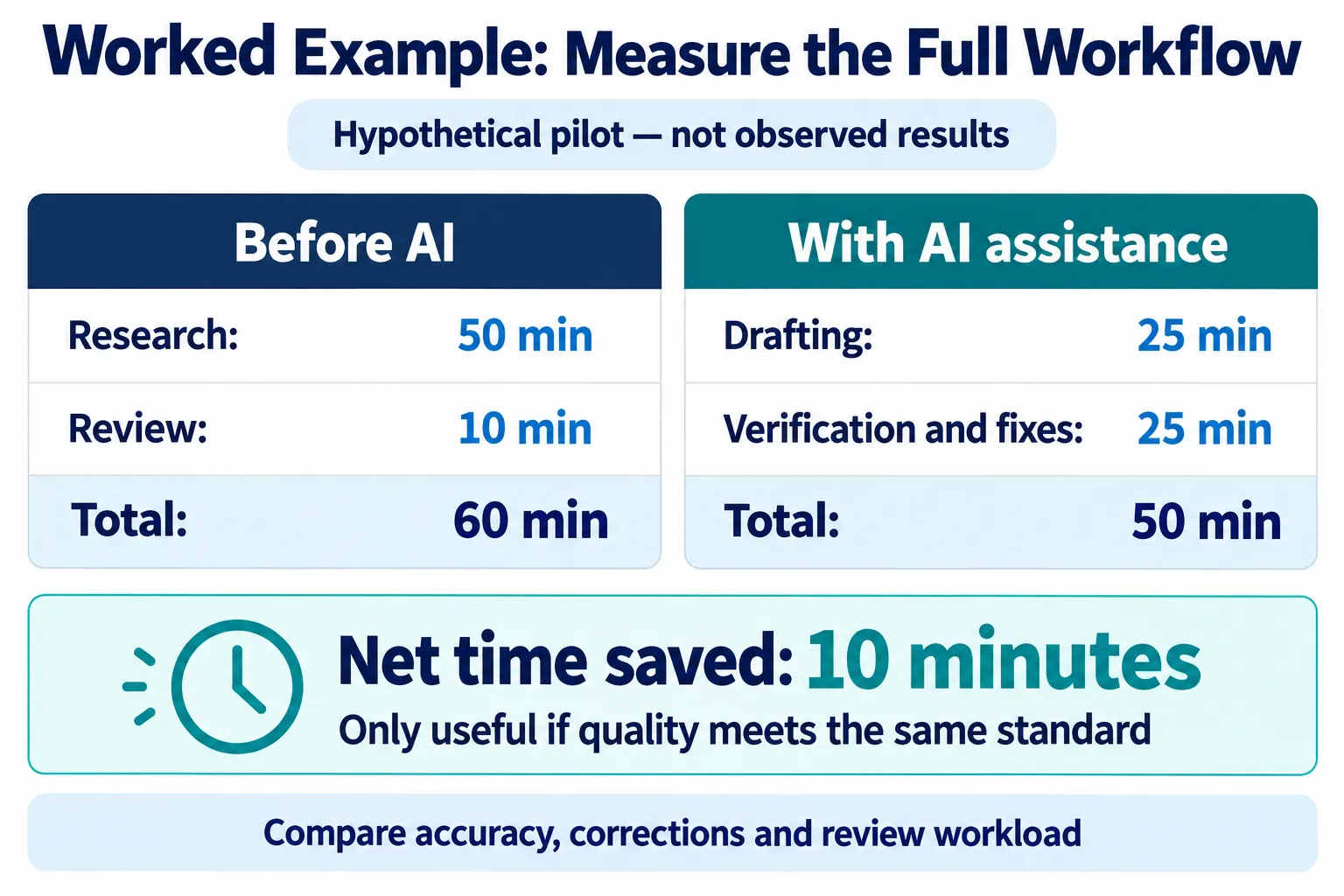
Illustrative calculation: Before AI: 50 minutes research + 10 minutes review = 60 minutes. With AI assistance: 25 minutes drafting + 25 minutes verification and fixes = 50 minutes. Net time saved is 10 minutes, provided the finished work meets the same quality standard. These are hypothetical figures, not study findings.
Build work samples that show judgment: document the question, evidence selected, errors corrected, and reasons for the final conclusion.
For research professionals, that approach connects naturally with verifying AI-generated answers and citations. The ability to explain why a finding is trustworthy is a concrete contribution.
Finally, engage in structured discussions with management regarding evolving responsibilities. Inquire about prioritized outcomes, available training resources, and the criteria by which performance will be evaluated as technological tools are integrated into standard workflows.
What Employers Should Do Next
Employers are advised to articulate the specific organizational challenge prior to selecting and implementing technological solutions.
For example, a customer service team experiencing a backlog must determine whether delays are attributable to information retrieval inefficiencies, ambiguous policies, limited decision-making authority, or other operational constraints. Automating an inappropriate process step may fail to address the root cause of the issue.
Conduct a controlled pilot program with clearly defined success metrics. Evaluate the volume of completed work, frequency of corrections, customer outcomes, and the effort required for review. Ensure participation from employees with expertise in complex cases, rather than limiting evaluation to routine scenarios.
Develop a comprehensive training and development plan concurrent with technology deployment. If responsibilities for junior staff are restructured, establish alternative pathways for supervised skill acquisition. Where employees are tasked with validating AI-generated output, allocate sufficient time and authority for thorough review and rejection when necessary.
Assess the distributional impacts of technological changes. Aggregate improvements in team performance may obscure increased workloads for reviewers or diminished training opportunities for new employees.
Implementing these measures transforms technology acquisition into a transparent and assessable organizational decision-making process.
What We Still Do Not Know
Current empirical evidence leaves multiple critical questions unresolved.
Exposure studies evaluate the technical potential for automation, workplace studies analyze specific implementation contexts, payroll data track employment trends, and job advertisements reflect recruitment intentions. Each data source provides valuable insights, yet none offers a comprehensive explanation of labor market dynamics in isolation.
The temporal scope of a study is as significant as its publication date. Reports published in 2026 may incorporate data from prior periods, and subsequent technological developments do not inherently validate or invalidate earlier findings.
National context is also a critical variable. Variations in infrastructure, training availability, investment levels, and alternative employment opportunities significantly influence how workers experience and adapt to comparable technologies.
Quantitative job counts do not fully capture the qualitative dimensions of working conditions. A restructured role may provide enhanced assignments, increased performance pressures, expanded oversight responsibilities, or a combination thereof. Both research and managerial decision-making should systematically evaluate these outcomes.
Conclusion
The employment effects of artificial intelligence in 2026 are characterized by significant variability. Empirical evidence indicates substantial intra-occupational changes and underscores risks that merit focused attention, especially with respect to entry-level positions.
The current body of evidence does not substantiate a precise global accounting of jobs transformed relative to those eliminated within the year.
Professionals can respond proactively by deepening domain expertise, rigorously evaluating technological tools in authentic assignments, and consistently demonstrating sound professional judgment. Employers play a critical role by systematically measuring end-to-end workflows, investing in targeted training, and preserving structured pathways into skilled roles.
These strategic decisions will shape the manner in which technological advancements are integrated into the daily realities of professional employment.
Frequently Asked Questions
Is AI replacing jobs in 2026?
AI can substitute for tasks and influence staffing decisions, but effects differ across workplaces and occupations. Evidence of occupational exposure should not be interpreted as a count of jobs already eliminated.
Does AI exposure mean an occupation will disappear?
No. Exposure indicates that some tasks may be affected. Actual employment outcomes depend on adoption, demand, costs, organizational choices, and the responsibilities that remain.
Are entry-level workers facing greater risks?
Some US research identifies concerning hiring patterns for young workers in exposed occupations. That finding warrants attention, but it does not establish that every junior role or country faces the same outcome.
Do AI tools always improve productivity?
No. Results depend on the task, tool, worker, and workflow. Evaluation should include checking and correction time, as well as the quality of completed work.
Which skills should workers develop?
A practical approach combines professional knowledge, effective tool use, and verification. Workers should be able to explain their decisions, identify errors, and demonstrate the quality of their output.