


“CIRS™ certification empowers you to think critically, search strategically, and research professionally, making you a leader in the evolving world of online intelligence.”
Why CIRS™ Matters
In today’s digital-first world, industries depend heavily on practical research skills and AI-powered tools. Holding a CIRS™ designation sets you apart as a trusted expert who can deliver accurate, efficient, and ethical research outcomes.
Career Advantages of CIRS™
Flexible Learning Options
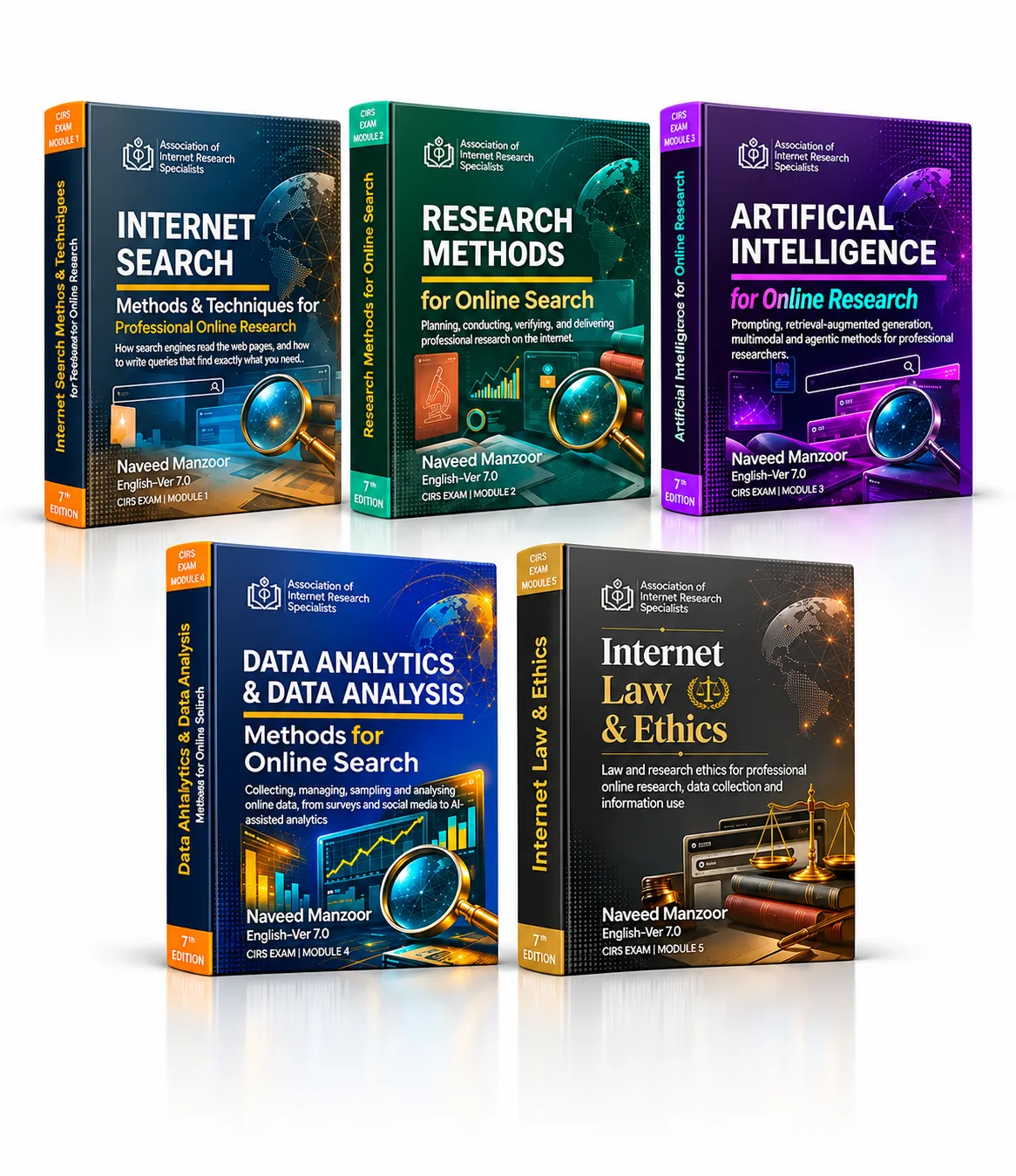
CIRS™ Self-Study Learning Package, 7th Edition
Prepare for the Certified Internet Research Specialist (CIRS™) certification with five updated training books covering advanced internet search, professional research methods, artificial intelligence, data analytics, and internet law and ethics.
Developed by the Association of Internet Research Specialists (AOFIRS), the 7th Edition provides structured, downloadable PDF learning materials for independent study and professional skill development.
Learn at your own pace, strengthen your online research skills, and prepare for the CIRS™ certification examinations.
Five Updated CIRS™ Training Books
Study the five core modules of the CIRS™ certification curriculum, with practical examples, research techniques, exercises, and reference materials.

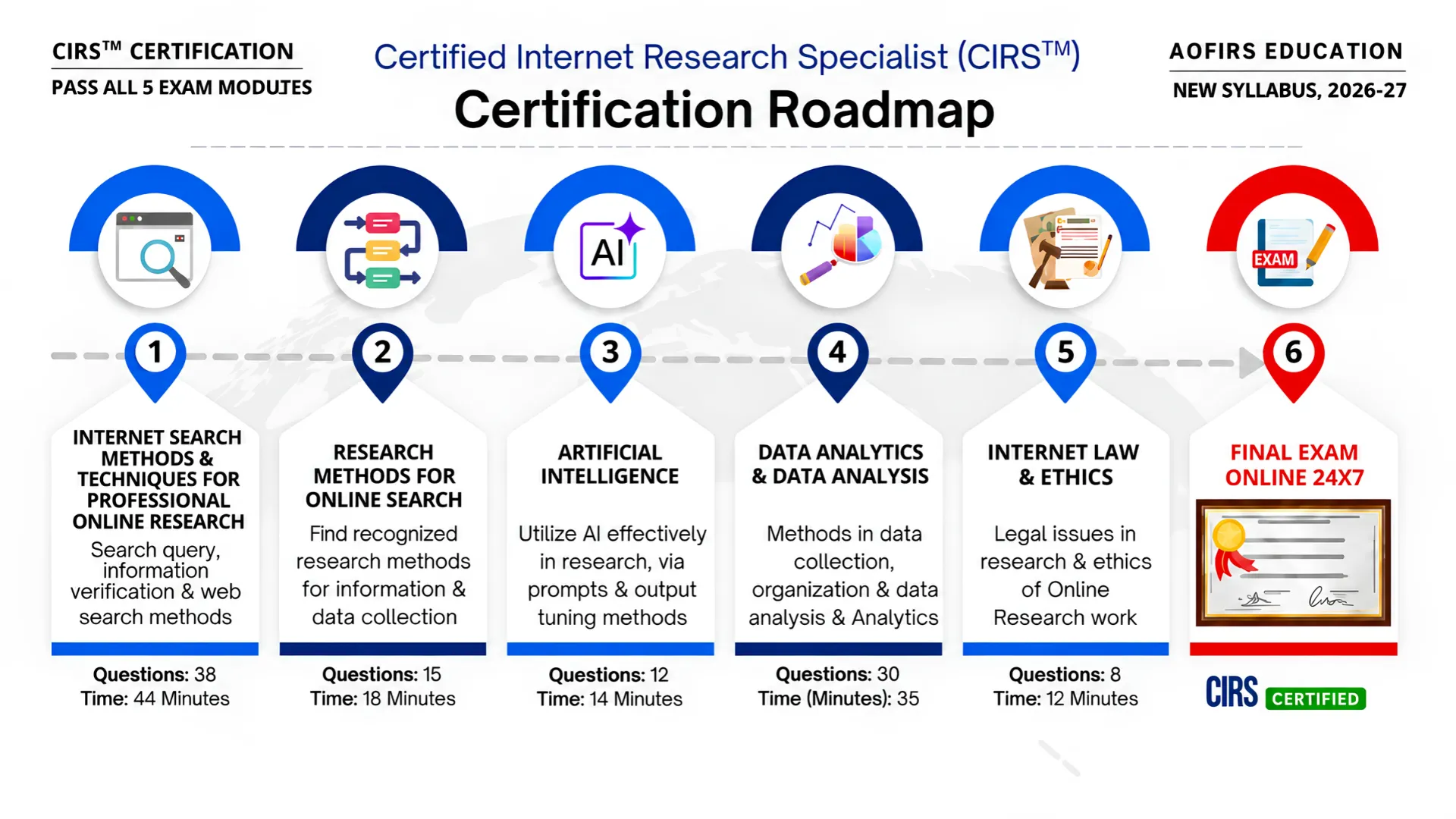
CIRS Certification Syllabus Overview
Internet Search Methods & Techniques
Objective:
To equip researchers with the skills to perform advanced internet searches using Google search operators, Boolean logic, semantic search principles, and professional research techniques. This module focuses on understanding how search engines interpret information, constructing precise search queries, and locating relevant online sources efficiently.
Key Learning Outcomes:
- Understanding Website Structure & Search Engines: Learn how search engines crawl and index web pages, interpret HTML elements, and use titles, metadata, headings, and URLs to identify searchable information.
- Semantic Search & Keyword Strategies: Understand search intent, natural language processing, synonyms, and contextual search. Develop effective keyword and search phrase strategies using primary, secondary, short-tail, and long-tail terms.
- Boolean Logic & Proximity Searching: Apply Boolean operators, quotation marks, exclusions, wildcards, and proximity search techniques, including AROUND(n) where supported, to refine results and improve search precision.
- Advanced Google Search Operators & Complex Queries: Construct targeted searches using intitle:, inurl:, intext:, site:, and filetype:. Combine operators to locate information within specific websites, domains, document formats, and indexed page content.
- Search Results, Domain & Date Research: Analyse search engine results and snippets, locate information through domain and file-type searches, and apply date filters to investigate publications, news, and historical information while checking source relevance and accuracy.
Research Methods and Online Search
Objective:
To equip researchers with a practical understanding of online research methods and research methodology, including how to plan, conduct, evaluate, and deliver reliable internet-based research. This module emphasizes research planning, qualitative and quantitative methods, information verification, and ethical research practices, helping learners produce accurate, evidence-based findings for academic, business, and professional applications.
Key Learning Outcomes:
- Foundations of Online Research Methods: Understand the principles of professional online research, including primary and secondary data, qualitative, quantitative, and mixed-method approaches, and the use of digital sources, databases, surveys, and online investigations.
- Research Planning & Methodology: Learn to develop clear research questions, objectives, and research plans, define project scope, identify target audiences, select appropriate information sources, and establish research timelines and documentation.
- Managing Online Research Challenges: Identify and address information overload, search engine bias, misinformation, disinformation, and AI-generated content. Understand how personalisation, language barriers, and misleading online information can influence research findings.
- Information Verification & Source Evaluation: Develop effective fact-checking and online source evaluation skills using credibility assessments, lateral reading, cross-referencing, and source verification techniques. Learn to assess information reliability, relevance, copyright permissions, and research risks.
- Professional Research Practice & Business Applications: Apply online research methods to market research, competitive intelligence, business investigations, and professional consulting. Understand research project scoping, client requirements, pricing, reporting, confidentiality, and ethical delivery of research findings.
Artificial Intelligence (AI) in Online Research
Objective:
To equip researchers with the knowledge and practical skills to integrate Artificial Intelligence (AI) into professional online research. This module explores generative AI, large language models (LLMs), prompt engineering, retrieval-augmented generation (RAG), and AI-powered research tools, teaching learners how to combine traditional search methods with AI to improve research efficiency, evaluate evidence, and produce accurate, verifiable findings.
Key Learning Outcomes:
- Understanding AI Tools for Research: Build a practical understanding of artificial intelligence, machine learning, neural networks, generative AI, and large language models (LLMs). Explore how AI systems work, their research applications, and the differences between traditional search engines, AI-powered search, and generative AI tools.
- AI-Assisted Research & Information Retrieval: Learn to combine traditional search techniques with AI research tools for source discovery, literature reviews, document summarisation, information extraction, web data collection, sentiment analysis, and research synthesis. Understand how retrieval-augmented generation (RAG) supports source-grounded research.
- Prompt Engineering for Research: Develop effective AI prompt engineering skills using structured prompts, clear research instructions, context, constraints, and reusable templates. Learn to refine prompts, generate search strategies, compare sources, extract structured information, and produce research outputs that can be checked against original evidence.
- Multimodal AI, Research Agents & Deep Research: Explore multimodal AI research involving text, images, audio, video, documents, and charts. Understand how AI agents and deep research tools support multi-step research, automated information retrieval, and evidence synthesis, while learning to supervise their workflows and evaluate their findings.
- AI Verification, Research Ethics & Accountability: Recognise and address AI hallucinations, fabricated citations, algorithmic bias, misinformation, privacy risks, and prompt injection. Learn to verify AI-generated claims, trace evidence to original sources, document AI use, and prepare accurate, transparent, and ethically responsible research reports.
Data Analysis and Data Analytics for Research Work
Objective:
To equip researchers with the knowledge and practical skills to collect, manage, analyse, and interpret online research data using data analysis, data analytics, statistical methods, and AI-assisted research tools. This module focuses on transforming quantitative and qualitative data into reliable, evidence-based findings through data collection, sampling, data management, data visualisation, and responsible analytics practices.
Key Learning Outcomes:
- Foundations of Data Analysis & Analytics: Understand the principles of data analysis and data analytics, including the four types of analytics: descriptive, diagnostic, predictive, and prescriptive. Learn how researchers use analytical methods to identify patterns, evaluate trends, and support informed decisions.
- Research Data Types & Data Management: Distinguish between quantitative and qualitative data, structured and unstructured information, and different levels of measurement. Develop practical knowledge of data cleaning, data quality, metadata, governance, security, and data provenance to manage research information responsibly.
- Data Collection & Sampling Methods: Explore probability and non-probability sampling, sample-size considerations, questionnaire design, online surveys, interviews, and focus groups. Learn to collect research data through web scraping, APIs, social media platforms, online polls, and digital data sources, while recognising sampling bias and data-quality limitations.
- Statistical Analysis, Visualisation & AI-Powered Analytics: Develop skills in descriptive and inferential statistics, hypothesis testing, regression analysis, data visualisation, and research dashboards. Explore machine learning, sentiment analysis, topic modelling, thematic analysis, and AI-assisted data analysis, including methods for validating automated research findings.
- Research Data Ethics, Privacy & Reporting: Understand data privacy, informed consent, data protection regulations, and ethical online research practices, including relevant principles of GDPR and CCPA. Learn to verify analytical results, document research methods, assess uncertainty, disclose AI use, and produce transparent, reproducible, and evidence-based research reports.
Internet Law & Ethics
Objective:
To equip researchers with a practical understanding of internet law, cyber law, and research ethics in professional online research. This module explores intellectual property rights, online privacy laws, data protection, cybercrime, and emerging AI regulations, helping learners understand legal responsibilities, evaluate ethical risks, and apply responsible practices when collecting, analysing, and sharing digital information across jurisdictions.
Key Learning Outcomes:
- Understanding Internet Law & Cyber Regulations: Develop foundational knowledge of internet law, cyber law, legal jurisdiction, and international regulations affecting online research. Learn to recognise legal risks involving unauthorised access, web scraping, APIs, platform terms of service, and cross-border research activities.
- Intellectual Property Rights & Copyright Laws: Understand copyright, trademarks, patents, trade secrets, and intellectual property protection in digital environments. Explore fair use, fair dealing, Creative Commons licensing, public domain materials, and content reuse, including legal considerations involving AI-generated content and text and data mining.
- Online Privacy Laws & Data Protection: Explore data privacy, personal information protection, GDPR, CCPA, and international privacy frameworks. Learn the principles of lawful data collection, informed consent, confidentiality, data minimisation, secure storage, and cross-border data transfers in professional research.
- Cybercrime, Digital Evidence & Legal Risk Management: Understand legal issues involving cybercrime, identity theft, unauthorised access, online fraud, and digital information misuse. Learn how researchers assess legal risks, respect contractual restrictions, preserve digital evidence, document source authenticity, and consider defamation and publication responsibilities.
- Research Ethics & Emerging AI Challenges: Apply ethical online research principles, including informed consent, privacy, research integrity, accurate attribution, transparency, and professional accountability. Examine AI ethics, algorithmic bias, fabricated citations, deepfakes, AI regulation, and responsible information use, while developing practical approaches to ethical decision-making and research documentation.
CIRS™ Certification Exams
The CIRS™ examination is conducted entirely online and is structured into five (5) separate modules, each taken individually and in sequence.
Exam Structure
Flexibility & Accessibility
Passing Requirements

What Our Members are Saying?
Our members consistently highlight the value of belonging to a community that blends learning, collaboration, and innovation. From gaining practical skills in advanced search and AI-driven research to connecting with professionals across industries, members appreciate the exclusive opportunities that help them grow in their careers. Many emphasize how the network fosters knowledge-sharing, inspires new ideas, and provides the confidence to stay ahead in the fast-changing world of digital research.





