
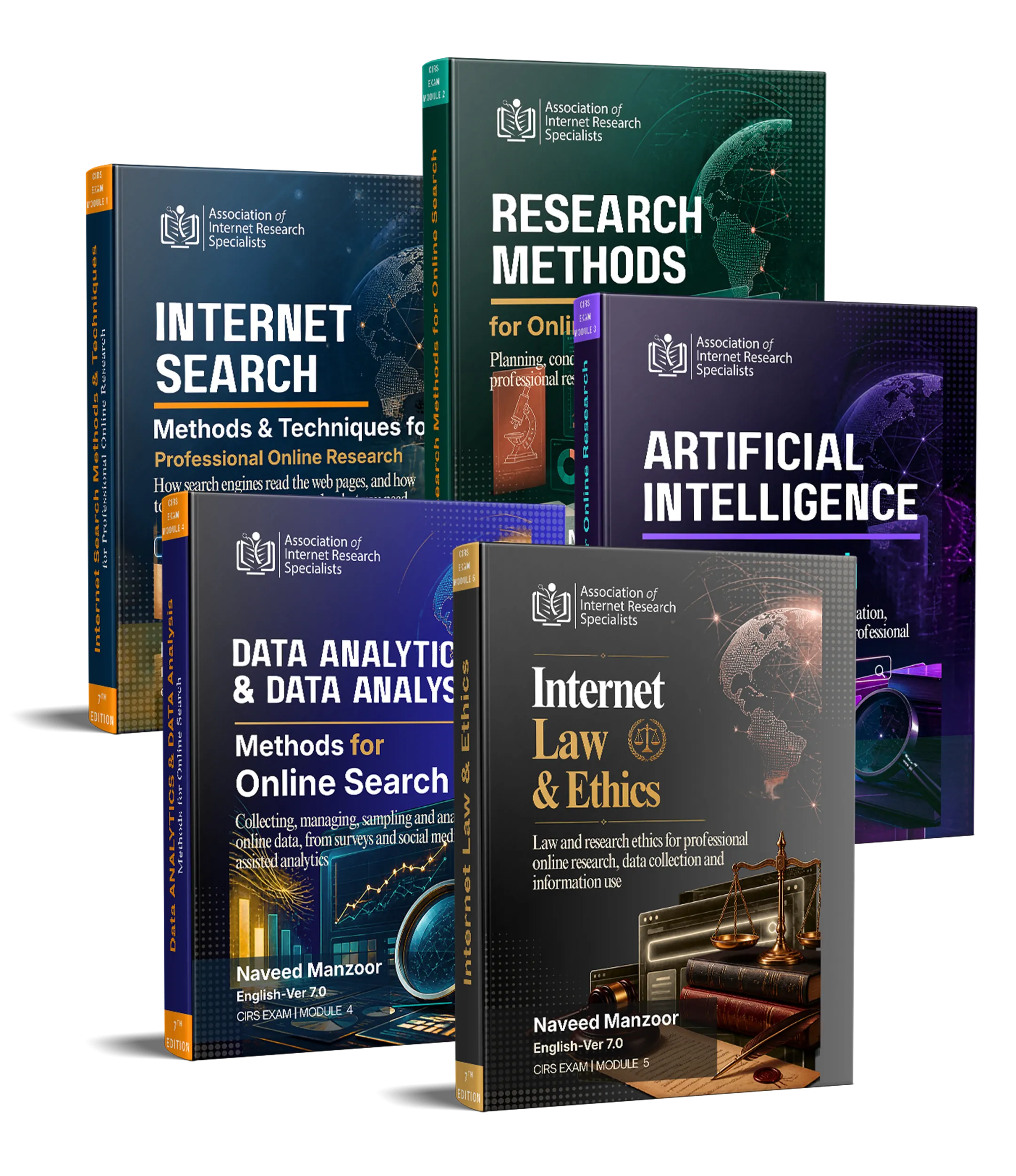
Certified Internet Research Specialist (CIRS™) Self-Study Kit 7th Edition
Master Online Research, AI Tools, and Ethical Practices. Learn, Practice, and Get Certified at Your Own Pace.
$199.95
Master professional online research with the CIRS Self-Study Learning Package 2026 (7th Edition). This comprehensive bundle includes all five Certified Internet Research Specialist (CIRS™) training manuals, covering internet search techniques, research methodology, artificial intelligence, data analytics, and internet law and ethics. Learn at your own pace with practical examples, research workflows, knowledge checks, and professional guidance.

About CIRS Self-Study Learning Package
The CIRS Self-Study Learning Package 2026 (7th Edition) is a comprehensive collection of five professional online research training manuals developed by the Association of Internet Research Specialists (AOFIRS®) for individuals preparing for the Certified Internet Research Specialist (CIRS™) certification and professionals seeking to strengthen their research capabilities.
The modern research environment has changed dramatically. Traditional search engines now operate alongside artificial intelligence, generative AI, deep research agents, advanced data analytics, digital databases, and automated information retrieval systems. Researchers must not only know how to find information but also how to evaluate its credibility, analyze complex evidence, protect sensitive data, and communicate defensible findings.
This complete CIRS Certification Self-Study Learning Package brings together five essential disciplines in a structured training program:
- Internet Search Methods and Techniques
- Research Methods, Planning, and Information Verification
- Artificial Intelligence in Online Research
- Data Analytics and Data Analysis for Online Research
- Internet Law, Privacy, and Research Ethics
Written by Naveed Manzoor, the 7th Edition provides a practical, evidence-focused approach to professional online research. The training materials introduce foundational concepts, advanced methodologies, real-world research scenarios, worked examples, and knowledge checks.
The package is designed for independent, self-paced learning. Readers can follow the five modules in sequence or revisit particular subjects according to their professional needs.
Whether you are a student, academic researcher, investigator, journalist, analyst, librarian, consultant, or aspiring internet research specialist, the package provides a structured way to develop the knowledge required for accurate, responsible, and professional online research.
What’s Included in the CIRS Self-Study Learning Package
The 2026 7th Edition contains all five CIRS™ certification training modules, organized to take readers from understanding how search engines work to conducting and evaluating sophisticated AI-assisted research projects.
Each module covers a distinct area of professional research. Together, they support the complete research process, from finding sources and planning investigations to analyzing information and addressing legal and ethical responsibilities.
The Five CIRS Certification Training Modules
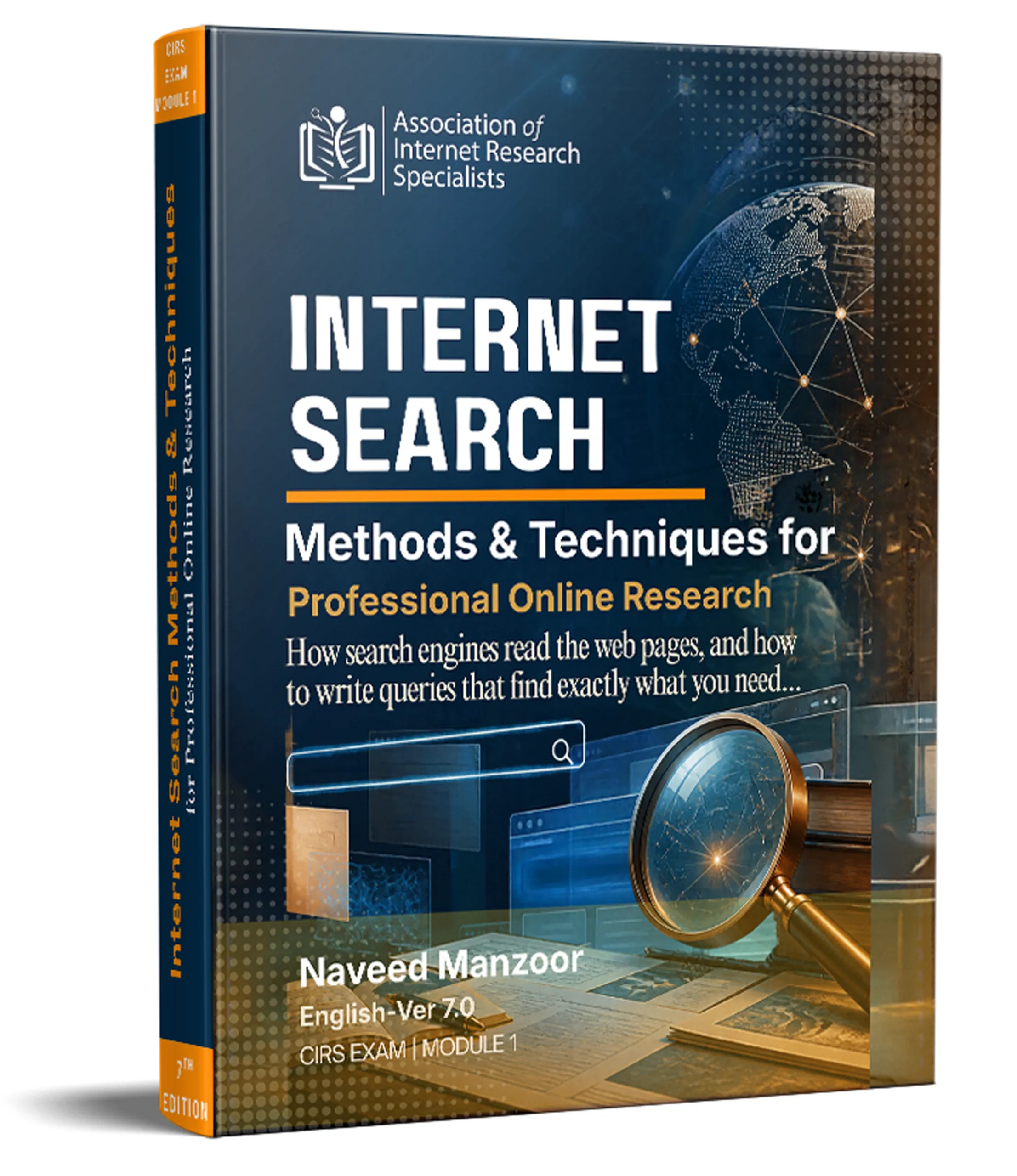
Module 1: Internet Search Methods & Techniques for Professional Online Research
Master Advanced Internet Search Techniques and Precision Search Queries
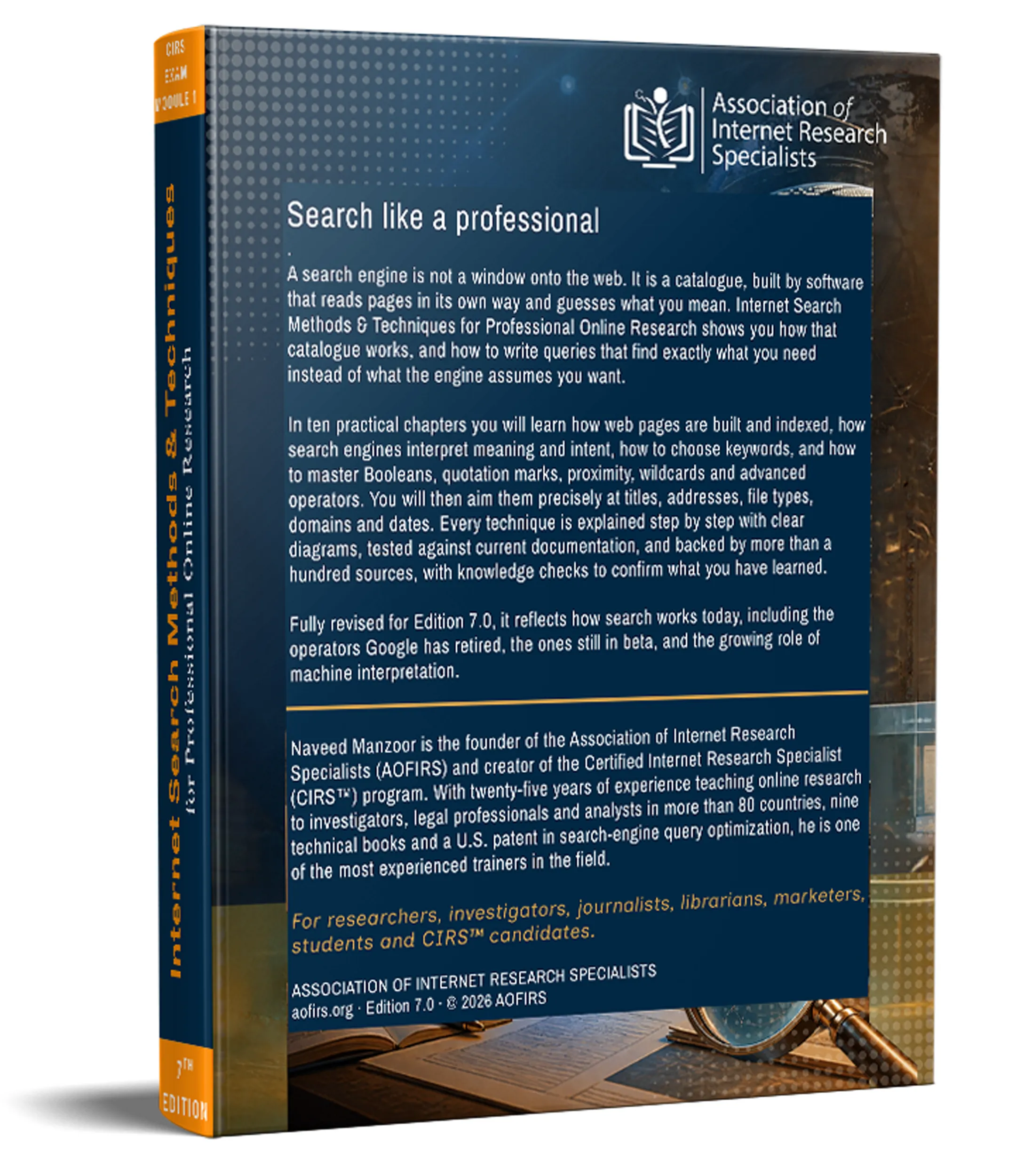
This module provides a detailed foundation in how search engines discover, interpret, index, and retrieve online information.
Rather than treating Google Search as a simple keyword tool, the manual explains the underlying principles that allow professional researchers to construct more targeted and effective queries.
Key subjects covered:
- Understanding website structure, HTML, metadata, and search engine indexing
- Search engine crawling and the organization of online information
- Semantic intelligence, natural language processing, and search intent
- Primary, secondary, short-tail, and long-tail keyword strategies
- Boolean search logic, exact phrase searching, and search exclusions
- Proximity searching, wildcards, and advanced query construction
- Advanced Google search operators and their practical applications
- Searching webpage titles, URLs, and indexed text
- Finding PDF documents, spreadsheets, presentations, and other file formats
- Domain-specific searching and targeted website research
- Date-restricted searches and timeline investigations
- Understanding retired, undocumented, and changing Google operators
What you will learn: How to create more precise search queries, identify relevant online sources, reduce irrelevant results, and apply advanced internet search techniques to professional research assignments.
This module establishes the essential search skills used throughout the remaining CIRS training books.
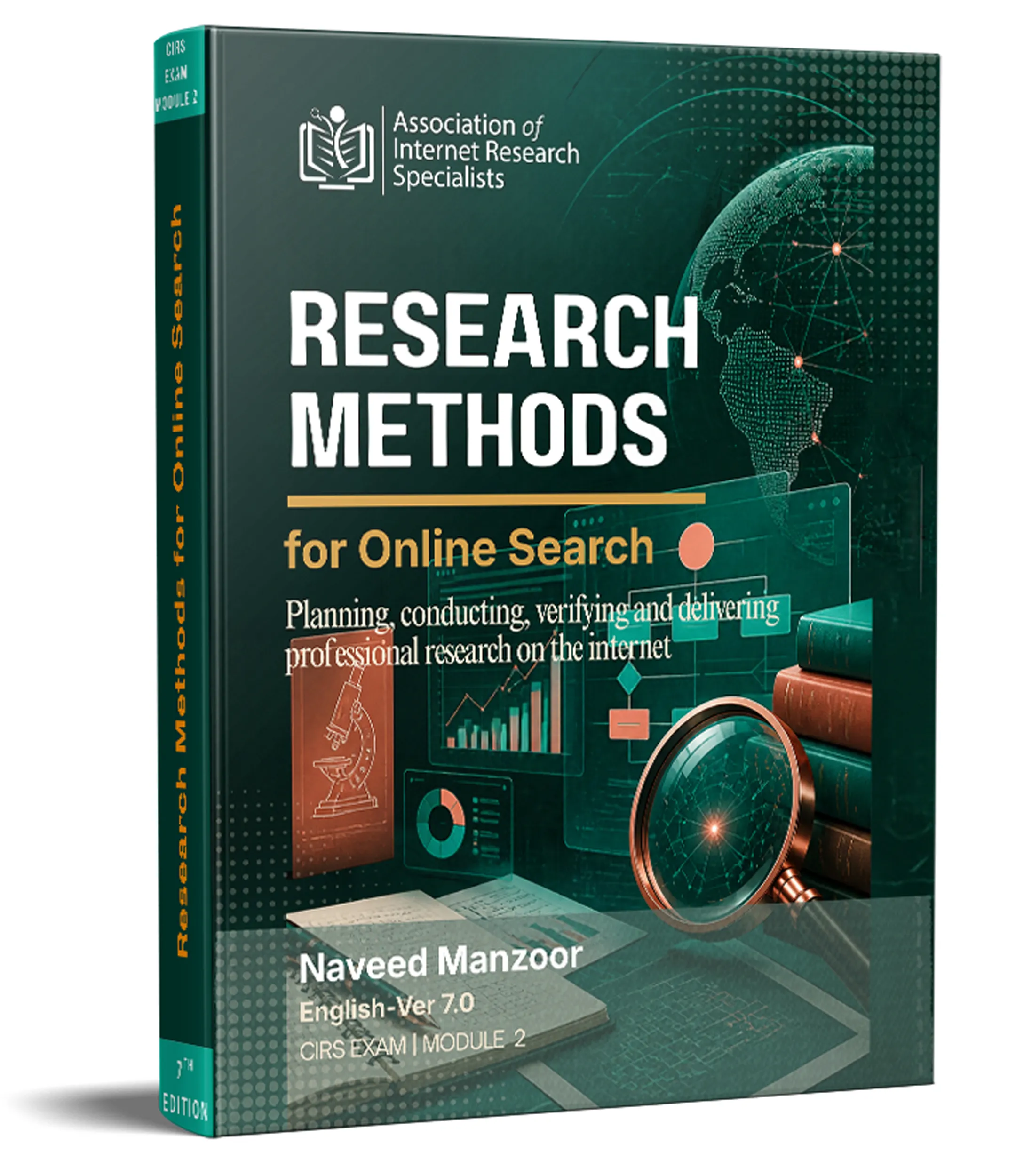
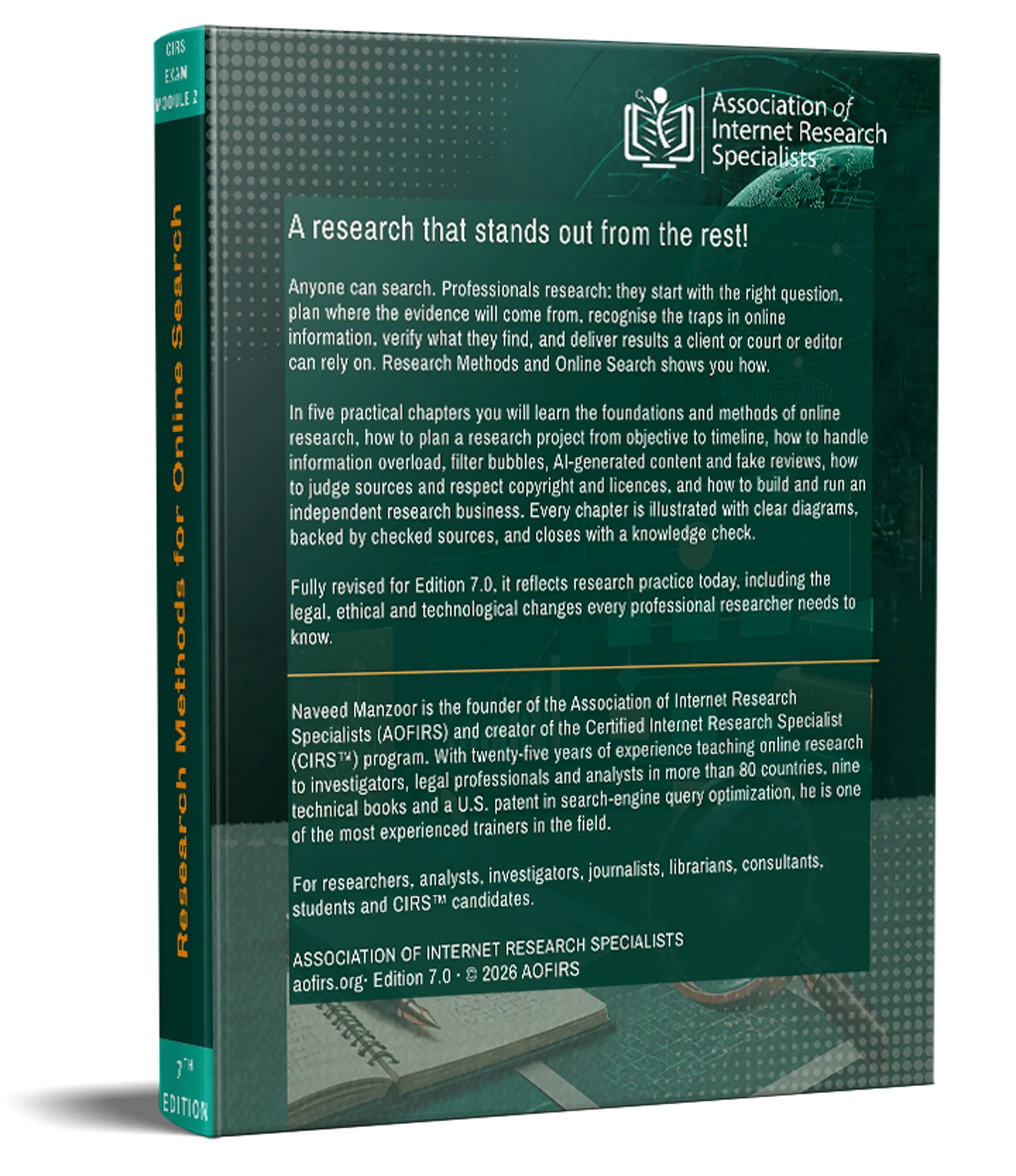
Module 2: Research Methods and Online Search
Plan, Conduct, Verify, and Deliver Professional Research
Effective research begins long before the first search query and continues after information has been collected.
Module 2 explains the systematic methods used to define research objectives, formulate research questions, select information sources, verify findings, and produce professional research deliverables.
It also explores the challenges associated with modern online information, including misinformation, search personalization, synthetic media, and unreliable digital sources.
Key subjects covered:
- Foundations of online research and professional research methodology
- Primary and secondary research
- Qualitative and quantitative research approaches
- Research objectives and question development
- Research project planning and scope definition
- Understanding client requirements and information needs
- Search planning, timelines, and research documentation
- Information overload and the limitations of internet sources
- Search personalization, filter bubbles, and contextual search
- Misinformation, disinformation, and misleading digital information
- Evaluating source credibility and research relevance
- Lateral reading and structured source verification
- Fact-checking AI-generated and synthetic content
- Copyright, licensing, and appropriate information use
- Research business setup, project estimation, pricing, and client relationships
What you will learn: How to transform a broad topic into a focused research project, identify the right evidence, evaluate online information, document research findings, and deliver more reliable professional results.
This module also introduces the practical considerations of offering independent research services.
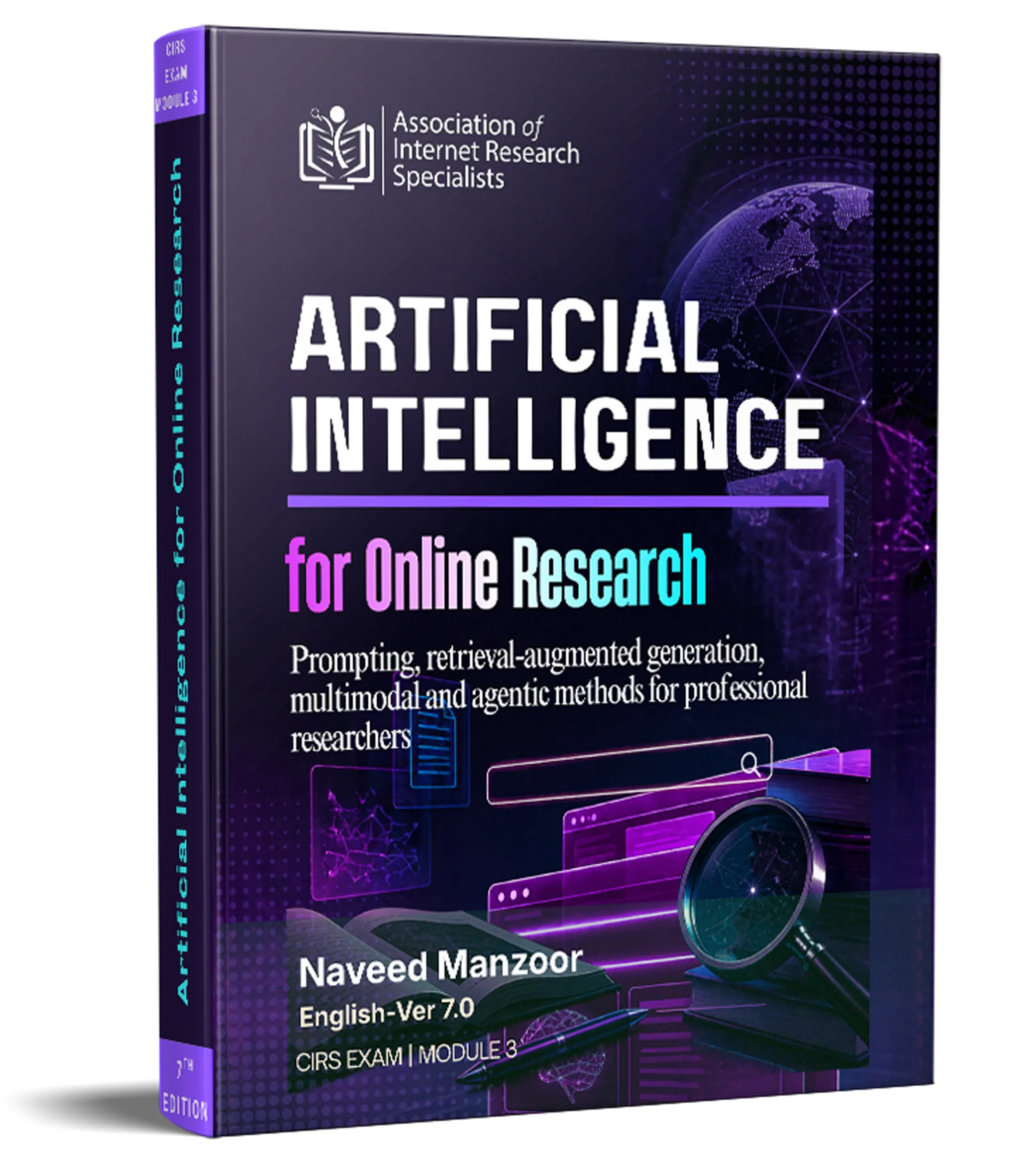
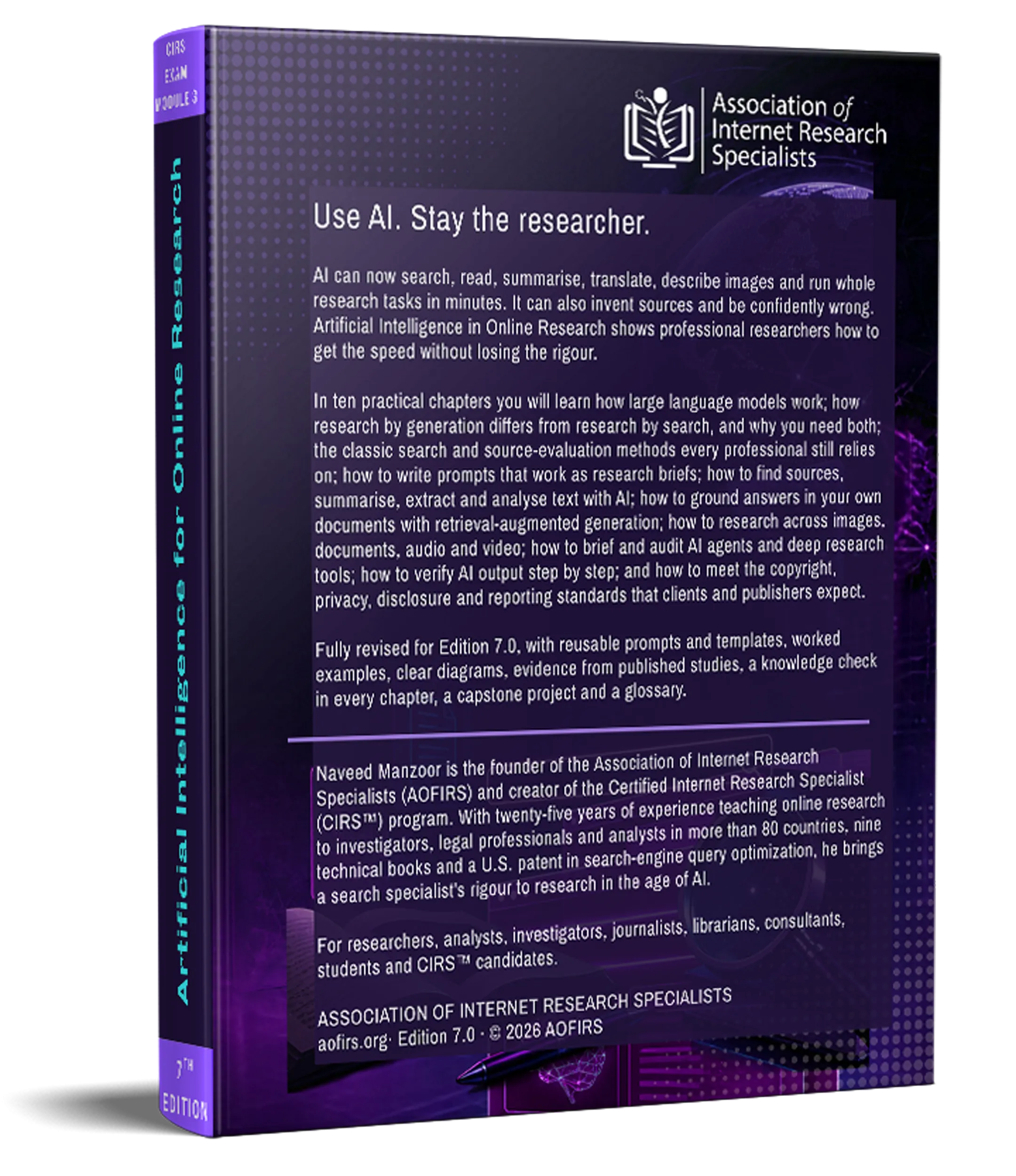
Module 3: Artificial Intelligence in Online Research
Master AI-Powered Research, Prompt Engineering, RAG, and Deep Research Methods
Artificial intelligence has transformed how researchers discover information, summarize documents, analyze text, and investigate complex questions.
However, AI systems can also produce fabricated citations, incorrect interpretations, biased outputs, and unsupported conclusions.
Module 3 explains both the capabilities and limitations of modern AI research technologies. It emphasizes combining traditional search skills with AI-assisted workflows while maintaining human responsibility for the accuracy of research findings.
Key subjects covered:
- Foundations of artificial intelligence and large language models
- How tokens, embeddings, attention, and transformer systems work
- Differences between search engines and generative AI systems
- Traditional information retrieval compared with AI-generated answers
- Prompt engineering techniques for professional research
- Research prompt templates, structured outputs, and prompt evaluation
- AI-assisted information retrieval and document summarization
- Scholarly AI tools and AI-assisted literature reviews
- Named entity recognition and structured information extraction
- Text analysis, sentiment analysis, and topic modeling
- Retrieval-augmented generation (RAG)
- Hybrid retrieval, vector search, reranking, and grounded responses
- Multimodal research involving documents, images, audio, and video
- AI agents, deep research tools, and automated research workflows
- Verifying AI-generated claims, quotations, citations, and references
- Identifying hallucinations, misinformation, and synthetic content
- Responsible AI use, privacy, copyright, disclosure, and research integrity
- Professional standards for AI-assisted research reports
What you will learn: How to use AI tools as research assistants without treating generated answers as verified evidence.
The module helps readers write effective research prompts, supervise AI-supported workflows, evaluate source quality, and integrate AI into professional research responsibly.
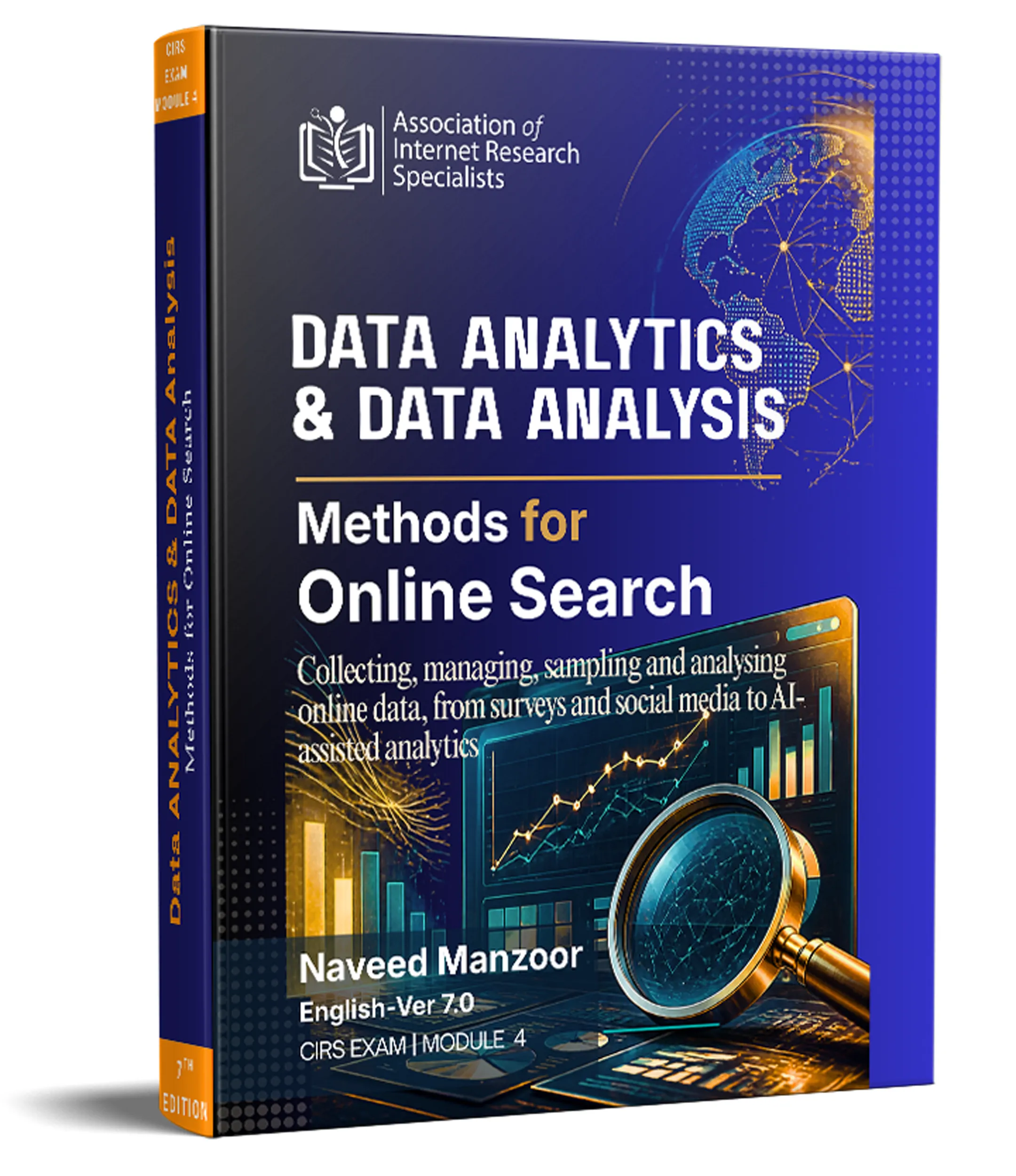
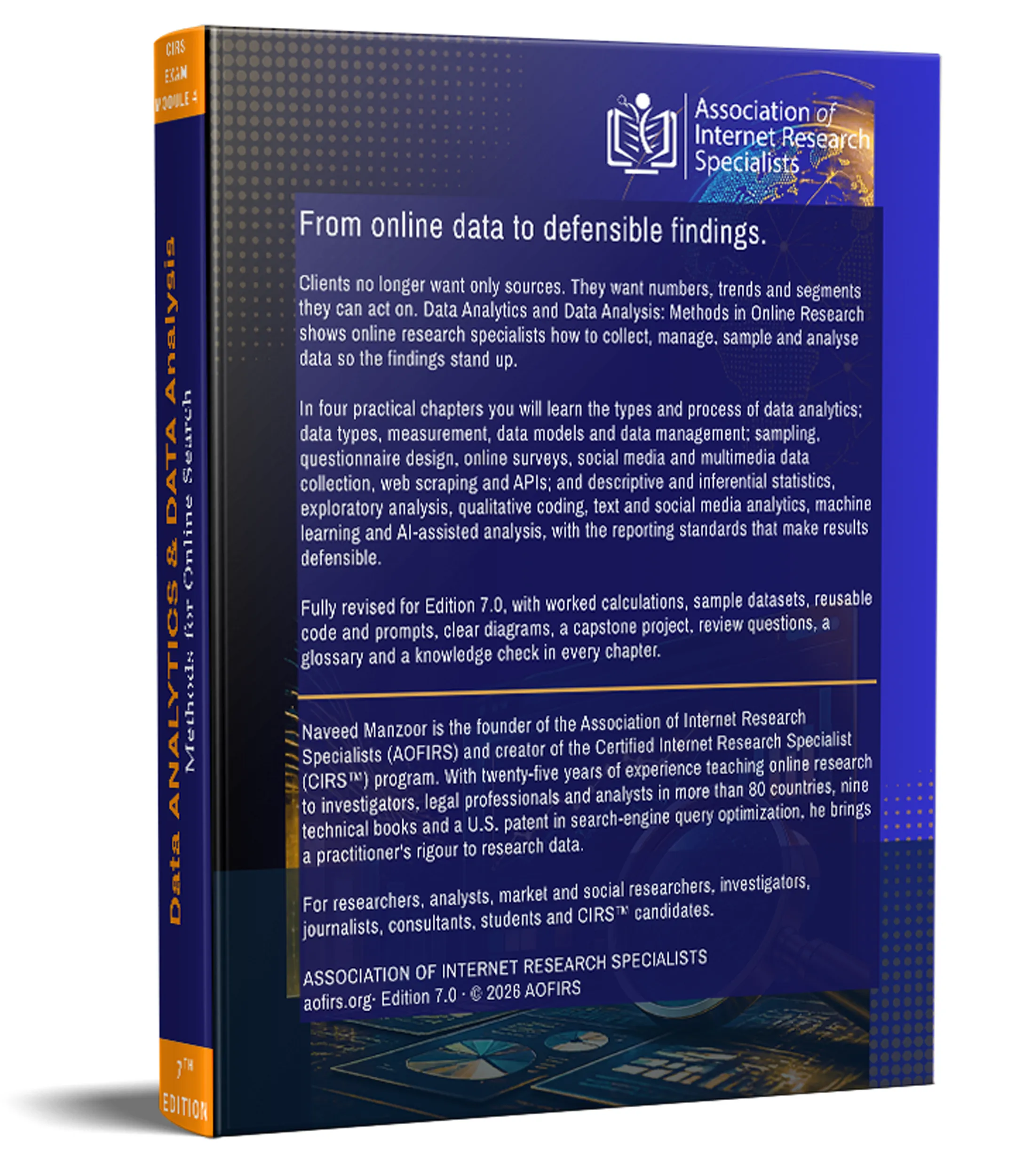
Module 4: Data Analytics and Data Analysis: Methods in Online Research
Turn Online Data Into Meaningful, Evidence-Based Findings
Professional research increasingly involves analyzing information rather than simply locating it.
Organizations need researchers who can collect, organize, interpret, and communicate data from surveys, websites, social media, documents, digital platforms, and other online sources.
Module 4 introduces the principles of data analysis and data analytics, including statistical reasoning, research sampling, data management, visualization, and AI-assisted analytical methods.
The training progresses from foundational concepts to applied research techniques and reporting.
Key subjects covered:
- Foundations of data analysis and data analytics
- Descriptive, diagnostic, predictive, and prescriptive analytics
- Qualitative, quantitative, and mixed-methods research data
- Data types, levels of measurement, and data structures
- Structured, semi-structured, and unstructured information
- Research databases, data models, and metadata
- Data quality, provenance, governance, and lifecycle management
- Data collection strategies and research sampling methods
- Probability and non-probability sampling
- Sample-size considerations and survey representativeness
- Online surveys, questionnaires, interviews, and focus groups
- Social media and multimedia data collection
- Web scraping, APIs, and ethical data access
- Data cleaning, preparation, and documentation
- Descriptive statistics and inferential statistics
- Hypothesis testing, correlation, regression, and analytical interpretation
- Data visualization, charts, dashboards, and data storytelling
- Qualitative coding, thematic analysis, and text analytics
- AI-assisted analysis, machine learning, and analytical tools
- Reporting research findings, uncertainty, and limitations
What you will learn: How to work with online datasets, choose appropriate collection and analysis methods, evaluate statistical findings, and communicate research results with greater confidence.
The module explains classic analytical methods alongside modern AI-assisted tools, emphasizing verification, reproducibility, and responsible interpretation.
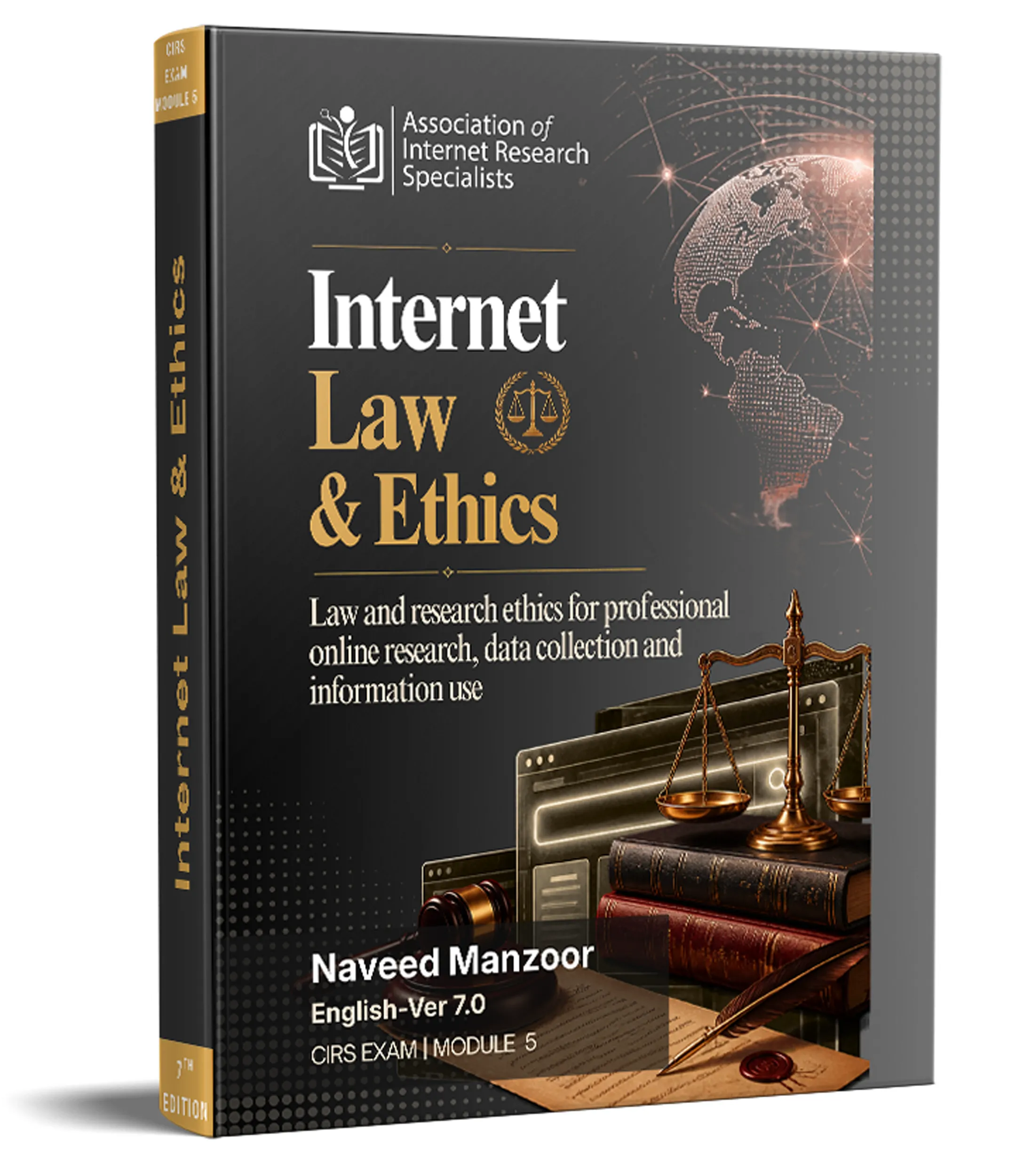
Module 5: Internet Law and Ethics
Understand the Legal and Ethical Responsibilities of Professional Online Research
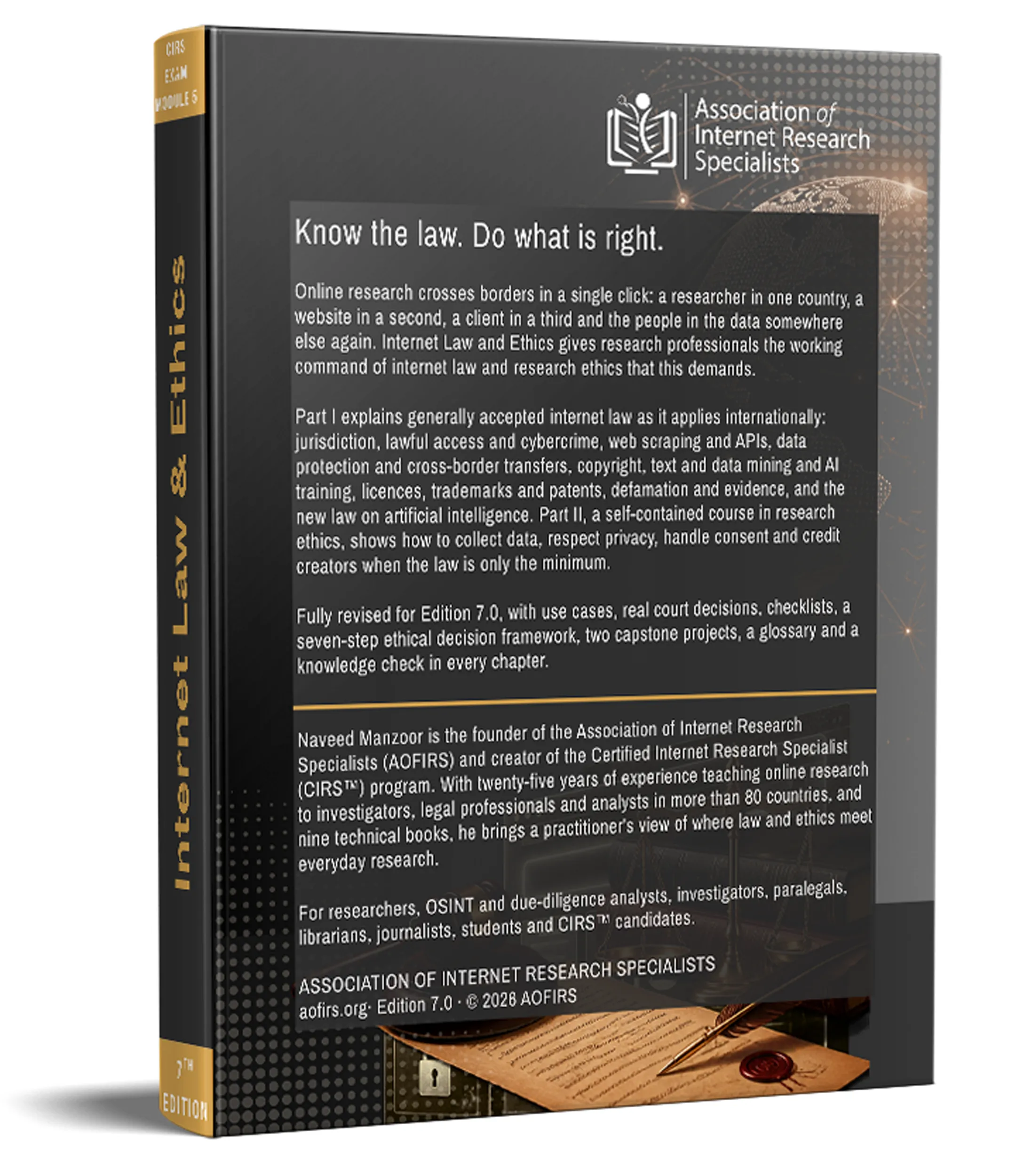
Information may be easy to find online, but its availability does not automatically mean that it can be collected, reproduced, analyzed, or published without restriction.
Module 5 provides an introduction to the legal frameworks and ethical principles that affect professional internet research.
It examines lawful access, data protection, intellectual property, jurisdiction, professional agreements, research ethics, and emerging legal issues involving artificial intelligence.
The book takes an international perspective while explaining why legal responsibilities depend on the circumstances and jurisdictions involved.
Key subjects covered:
- Foundations of internet law for online researchers
- Internet jurisdiction and cross-border legal responsibilities
- Lawful access and cybercrime-related restrictions
- Web scraping, APIs, platform terms, and automated data collection
- Personal data, privacy, and data protection principles
- GDPR and comparative international privacy regimes
- Cross-border data transfers and data security
- Research service agreements and contractual responsibilities
- Defamation, publication risks, and digital evidence
- AI regulation and legal risk management
- Copyright protection and intellectual property rights
- Fair use, fair dealing, public domain material, and licensing
- Creative Commons and open data licenses
- Text and data mining, AI training, and copyright considerations
- Trademarks, patents, and domain name disputes
- Trade secrets and confidential information
- Internet research ethics and professional conduct
- Informed consent and responsible data collection
- Privacy, anonymity, confidentiality, and minimizing harm
- Information integrity and ethical AI use
- Research accountability, disclosure, and ethical decision-making
What you will learn: How to identify legal and ethical issues before collecting or publishing online information, respect the rights of individuals and content creators, and apply responsible professional judgment.
This module reinforces the importance of conducting research that is not only effective, but also lawful, ethical, and defensible.
Additional Learning Tools
This package extends beyond the core modules to ensure practical skill development and exam readiness:
- CIRS Exam Preparation Workbook (2025 Edition)
Includes structured Q&A exercises, mock exams, and real-world case studies. - Online Practice Exams (24×7 Access)
Simulate official testing conditions anytime, anywhere.
Key Highlights and Updates (2026 Edition)
- AI and Deep Learning Integration: Updated with the latest AI tools for search automation and data analysis.
- New Module 3 – Data Analysis & Analytics: A complete rework emphasizing modern data literacy and analytical competency.
- Practical Orientation: Diagrams, charts, and illustrations simplify complex ideas for learners with non-technical backgrounds.
- Real-World Focus: Practical case studies, scenario-based exercises, and query simulations bridge theory and field application.
- Up-to-Date Internet Trends: Reflects the most recent advancements in search engine algorithms and online data behavior.
This is more than a study guide — it’s a technical manual for professional web searching that evolves with each new edition.
Key Features of Your Purchase
- High-Resolution, Printable Materials – All digital files are downloadable in print-ready, high-quality format.
- Free 12-Month Updates – Receive free updates for a full year to stay current with new tools and methodologies.
- Three Free CIRS Exam Attempts – Includes three complimentary attempts for the official CIRS™ certification exam.
Non-Refundable Digital Purchase – Once the Dropbox link is sent, all sales are final.
Key Details
- Product: CIRS Self-Study Learning Package 2026
- Edition: 7th Edition (7.0)
- Author: Naveed Manzoor
- Publisher: Association of Internet Research Specialists (AOFIRS®)
- Certification Curriculum: Certified Internet Research Specialist (CIRS™)
- Includes: Lifetime access + free 12-month updates
Become a Member and Save 20%
Join the Association of Internet Research Specialists (AOFIRS®) and enjoy exclusive member benefits — including 20% off all certification materials, workbooks, and training manuals.
Gain access to professional resources, networking opportunities, and continuous learning designed for today’s digital researchers.



