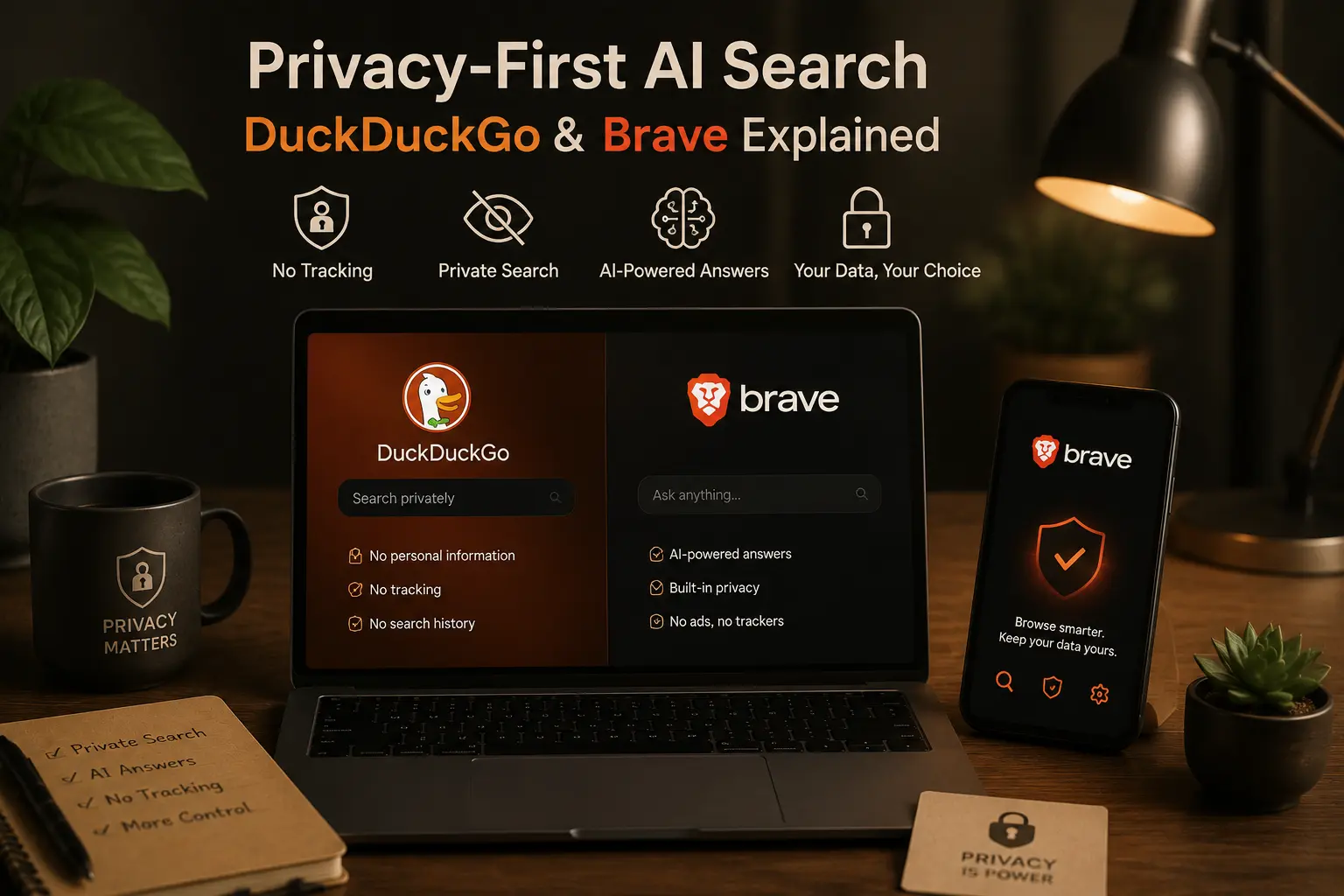
In today’s digital world, online privacy matters more than ever. People want search engines that give accurate results without tracking every click or storing personal data. That’s where privacy-first AI search engines come in, and DuckDuckGo and Brave Search are leading the way. They promise both privacy and intelligence, giving users relevant answers while keeping their information safe.
What Makes a Search Engine Privacy-First?
Most search engines collect data your location, search history, and browsing patterns to deliver targeted ads. Privacy-first search engines take a different approach. They don’t track you, store personal information, or create profiles based on your activity.
For users who care about anonymity, this means a safer, cleaner search experience. But privacy-first engines don’t stop at security they also use AI to make searches accurate and relevant, giving the best of both worlds.
DuckDuckGo: Simple, Private, and Smart
DuckDuckGo has become a favorite for anyone who values online privacy. Launched in 2008, it never stores your personal info and keeps searches anonymous.
What DuckDuckGo Offers:
- Anonymous Browsing: Searches are encrypted, and no personal data is collected.
- Bang Commands: Quickly search specific websites with shortcuts like !wikipedia climate change.
- AI-Powered Results: DuckDuckGo uses AI to understand queries and deliver relevant answers without tracking you.
- Tracker Blocking: Its browser and extensions block trackers across the web, protecting privacy beyond just search.
DuckDuckGo makes private searching easy, combining smart AI features with user-friendly design.
Brave Search: Independent and Transparent
Brave Search takes privacy a step further. Developed by the team behind the Brave browser, it uses its own independent web index, so it doesn’t rely on third-party data. This approach ensures unbiased and transparent results.
Brave Search Features:
- No Tracking: Searches are never linked to individual users.
- Independent Indexing: Results come from Brave’s own crawl of the web, avoiding bias from personalization.
- AI Enhancements: AI helps rank content and summarize information without compromising privacy.
- Seamless Browser Integration: Works natively with the Brave browser to block ads and trackers efficiently.
Brave ensures users get trustworthy results while maintaining full control over their data.
DuckDuckGo vs Brave Search: Quick Comparison
| Feature | DuckDuckGo | Brave Search |
| Data Tracking | None | None |
| AI Assistance | Yes | Yes |
| Independent Index | Partial | Full |
| Browser Integration | Optional | Native with Brave |
| Ad & Tracker Blocking | Blocks third-party trackers | Blocks ads and trackers natively |
| Custom Features | Bang commands | Transparent ranking and filters |
Both engines are strong choices for privacy-conscious users. DuckDuckGo is easy and accessible, while Brave emphasizes transparency and independence.
How AI Shapes Privacy-First Search
AI is essential for these search engines. It helps:
- Understand Queries: AI interprets questions accurately, even complex ones.
- Summarize Results: Gives key information directly on the results page.
- Reduce Spam and Bias: AI filters low-quality content while respecting privacy.
The combination of AI and privacy ensures that users get relevant answers without being tracked.
Why Privacy Matters
Data breaches, targeted ads, and online tracking make privacy crucial. Search engines that collect user data can inadvertently expose sensitive information or influence behavior. Privacy-first AI search engines protect users while still offering accurate, unbiased results.
Businesses can also benefit by conducting research without revealing competitive intelligence or personal browsing behavior.
Benefits for Users and Businesses
- Stronger Security: Personal data isn’t stored.
- Unbiased Results: Information is delivered based on relevance, not past activity.
- Better Research: Companies can use these tools for impartial data collection.
- Cleaner Browsing: Fewer ads and trackers improve focus and efficiency.
Privacy-first searches are more than a personal preference they improve online experience and business intelligence.
Challenges to Consider
- Smaller Indexes: May have fewer results compared to Google.
- Limited Integration: Some tools are optimized for larger search platforms.
- Adjustment Period: Users used to Google may need time to adapt.
Even with these minor drawbacks, the privacy benefits often outweigh the limitations.
Looking Forward
Privacy-first AI search is only gaining momentum. Both DuckDuckGo and Brave are adding new AI features, improving indexing, and enhancing browser integration. Future trends may include:
- Better voice search integration with privacy in mind.
- More ad-free and privacy-respecting business models.
- Secure AI-assisted research tools for professionals.
These developments could make privacy-first searches mainstream rather than niche.
Conclusion
Privacy-first AI search engines like DuckDuckGo and Brave are changing how we explore the web. They combine strong privacy protection with AI-driven intelligence, giving users reliable, unbiased results. For individuals, this means secure and effective searches. For businesses, it means safer research and clearer insights.
As online privacy becomes more critical, these platforms are helping users take control, navigate the web confidently, and get the information they need without compromise.