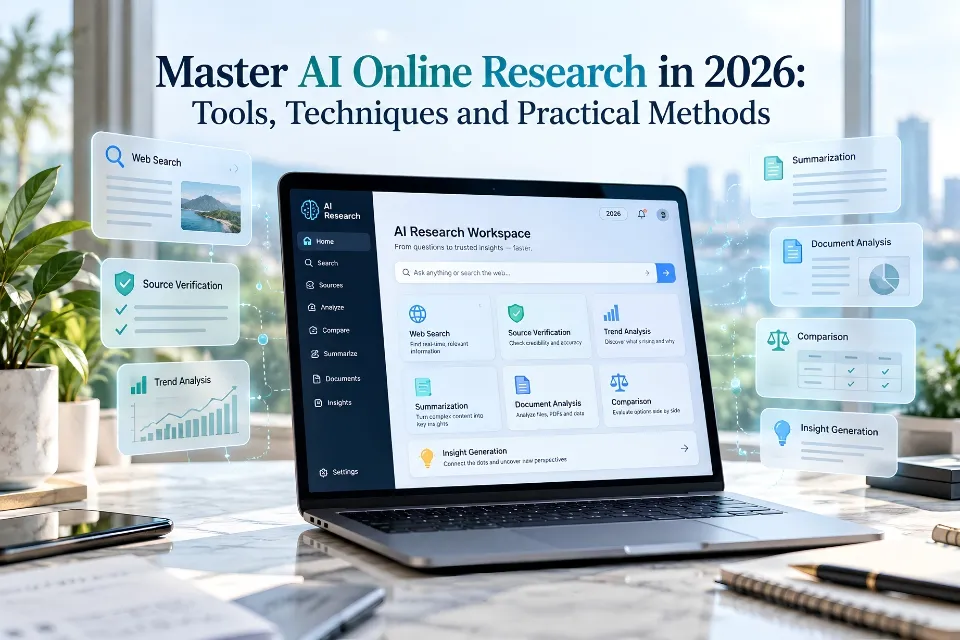
AI online research combines intelligent tools, advanced search techniques, reliable sources and human verification to produce evidence-based findings. In 2026, an effective approach uses AI to support discovery, document analysis and synthesis while researchers remain responsible for evaluating the evidence.
A researcher studying emerging technologies can search academic literature, examine official reports, compare documents and organize findings with complementary tools. These systems can reduce manual effort, but faster analysis does not necessarily produce more reliable conclusions.
The key ability lies in deciding which research method to employ, in creating effective questions, and in checking information for yourself at the appropriate time.
The guide describes how online research powered by AI functions, outlines the tools that are suitable for various research activities, and explains how to use a nine-step structured methodology when carrying out professional research projects.
What is AI-powered online research?
The use of artificial intelligence for online research involves carrying out a systematic process of discovering, gathering, assessing, analyzing, and presenting digital information with the help of artificial intelligence technologies.
It incorporates traditional information retrieval together with features such as natural language processing, semantic search, document summarization, pattern identification, and automated information extraction.
While ordinary web searching is not equivalent to AI-assisted research, the latter can assist researchers in working with a variety of sources, in comparing the results, and in forming structured explanations. Nevertheless, the outputs produced depend on the quality of the source material, on the extent to which the tools have access to information, and on the researcher’s instructions.
Three activities remain distinct:
- Information retrieval: Finding relevant websites, documents, datasets, and academic publications.
- Information analysis: Identifying relationships, differences, recurring themes, and gaps within collected evidence.
- Research verification: Checking that findings accurately represent trustworthy, independently assessed sources.
A research process that is to be carried out properly must include all three.
How artificial intelligence is changing internet research
To carry out traditional internet research, researchers have to construct queries, look at the search results, open up the documents, and then pick out the relevant information.
Artificial intelligence adds a further level, since such systems are able to interpret conversational questions, recognize related concepts, help with going through large amounts of material, and produce initial syntheses.
Google’s documentation explains that AI search features can use related queries to retrieve supporting information. Accessible, reliable source material remains essential.
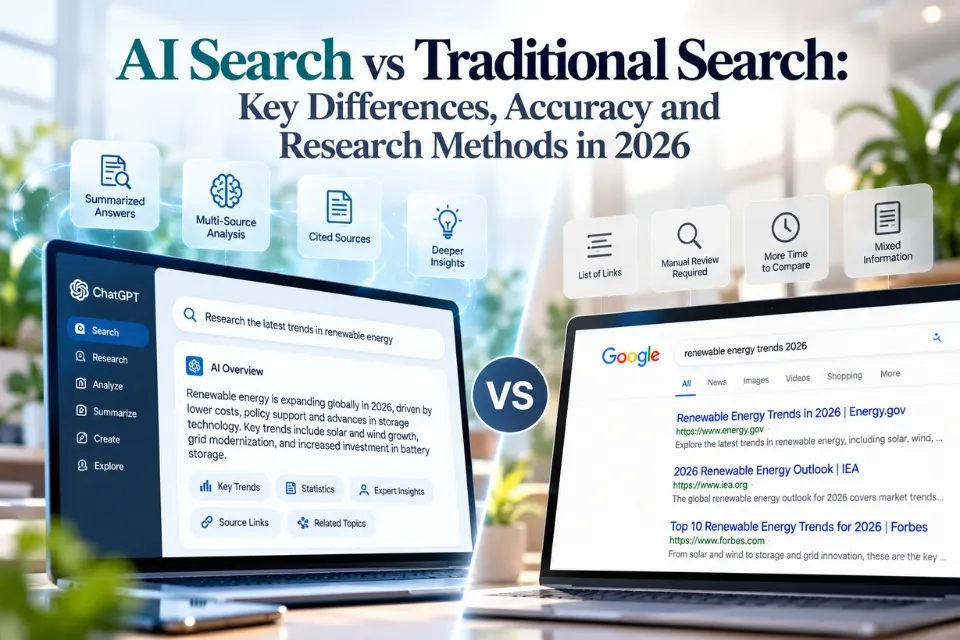
Traditional search versus AI-powered research
| Research activity | Traditional search | AI-assisted research |
|---|---|---|
| Query formulation | Keywords and operators | Natural-language questions and structured prompts |
| Discovery | Search result listings | Search results, semantic retrieval, and suggested sources |
| Document review | Manual reading | AI-assisted summarization and extraction |
| Comparison | Manual notes and tables | AI-generated comparisons requiring review |
| Evidence checking | Original source examination | Automated assistance plus original source examination |
| Final interpretation | Researcher judgment | Researcher judgment supported by AI |
The two methods are most effective when used in combination.
With traditional search methods, researchers are given better insight into individual documents and the search results. The use of AI aids in organizing and interpreting the material gathered, especially in cases where there are a large number of sources.
For instance, a market researcher might use Google Search to find official industry reports, use an academic discovery platform to locate relevant studies, and employ a language model to produce a comparison table of the evidence.
The researcher should still look at the original documents before accepting the conclusions.
Essential AI research tools in 2026
Various research tools have different purposes; some are mainly used for retrieving information whereas others are geared toward document analysis, academic discovery, or multi-stage synthesis.
The selection of the appropriate tool will vary according to the research question and the kind of evidence needed.
| Tool | Main purpose | Strength | Important limitation |
|---|---|---|---|
| ChatGPT | General analysis and multi-stage research | Flexible explanations, document analysis, and research reports | AI-generated claims and citations require checking |
| Google Search and Gemini | Web discovery and AI-assisted search | Discovering websites and exploring related questions | Search visibility and AI summaries do not establish source credibility |
| Perplexity | Web-based question answering | Source-linked answers and follow-up questions | Source selection and interpretations require verification |
| Claude | Document understanding and synthesis | Reviewing supplied text and comparing arguments | Access to external information depends on available features |
| Microsoft Copilot | General research and productivity | Useful within supported Microsoft workflows | Access and functionality vary by product and account |
| Elicit | Academic literature workflows | Identifying and extracting information from research papers | Database coverage and extracted details need review |
| Consensus | Research evidence discovery | Research-paper search and cited synthesis | Summaries cannot replace critical reading |
| Semantic Scholar | Scholarly information retrieval | Citation discovery, filters, and paper summaries | Not every publication or full text is available |
| ResearchRabbit | Literature exploration | Finding relationships between publications | Citation-network exploration may miss relevant papers |
| NotebookLM | Source-grounded document analysis | Exploring uploaded and discovered source collections | Grounded responses can still contain mistakes |
OpenAI’s documentation describes source-linked, multi-step research reports. Semantic Scholar supports scholarly discovery, while Google’s NotebookLM overview explains how researchers can discover and select relevant web sources.
How to choose the right research tool
Begin with the requirement concerning evidence rather than the popularity of the tool.
When the task is about a newly announced regulation, look in the original government publication. If it involves peer-reviewed studies, start by using an appropriate scholarly database. In the case where several reports need to be compared, an AI document-analysis tool might help after the reports have been gathered.
A research system could be of use in drawing up a research plan and in producing a structured synthesis when a project involves a great deal of cross-source analysis. However, the results from such a system should be regarded as a source of assistance and not as a fully independent investigation.
Emerging technologies shaping online research
Deep research systems and AI agents
Deep research systems carry out a series of activities including searching, gathering sources, comparing the results, and preparing reports.
By using AI agents, the idea is extended so as to involve the coordination of tools or the execution of different parts of a workflow to a varying extent.
Although they can help with complicated tasks, the fact that they are able to take action raises issues concerning permissions, reliability, access restrictions, and the need for supervision.
Retrieval-Augmented Generation
Retrieval-Augmented Generation (RAG) involves combining information retrieval with language-model generation.
Rather than depending solely on the patterns acquired during the training of the model, a RAG system obtains relevant documents and uses these documents as context when generating a response.
This can enhance traceability and the relevance of the answers, but it cannot ensure that the sources retrieved are accurate or that the interpretation produced faithfully reflects them.
Multimodal research
Multimodal AI tools can process more than written text. Depending on the tool and supported formats, researchers may work with images, charts, audio, video transcripts and scanned documents.
They enable activities like comparing figures in different reports or identifying themes from interviews.
Errors may occur as a result of visual interpretation, transcription, and data extraction and therefore have to be checked again against the original material.
Semantic search and knowledge discovery
Instead of relying solely on exact matches of keywords, semantic retrieval makes use of the relationships between concepts.
For instance, if you search for information on automated evaluation then the studies retrieved will be those which talk about credibility assessment or misinformation detection even though the exact phrase is not used.
Such systems do increase the opportunities for discovery, but where complete coverage is important controlled vocabularies, exact keywords, and citation tracking are still necessary.
A practical nine-step AI online research workflow
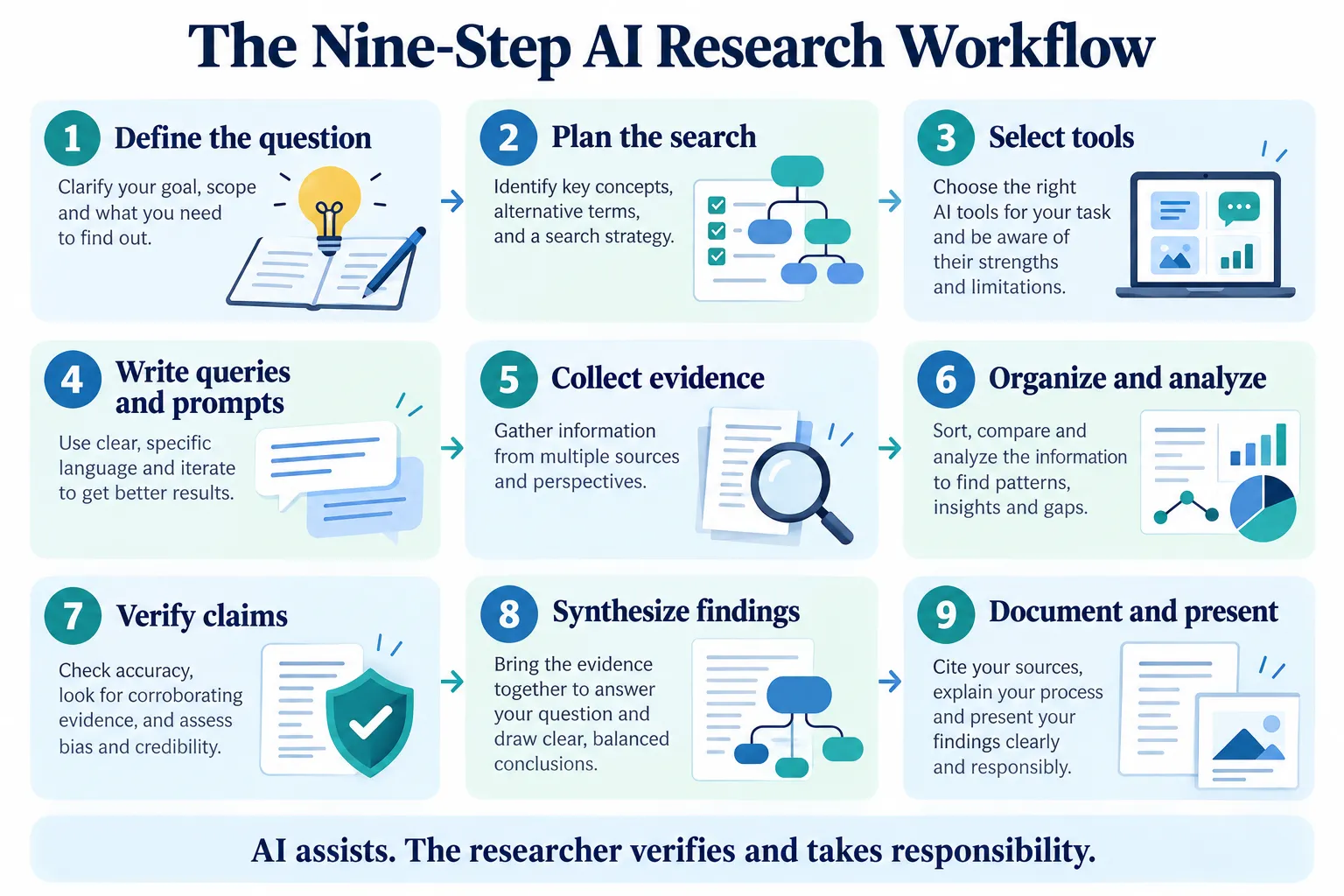
A sound methodology turns AI from a mere tool for answering questions into a structured research assistant.
This nine-step procedure can be applied to academic investigations, business research, journalism, market analysis, and all other forms of professional information gathering.
Step 1: Define the research question
All investigations must start with a definite question.
An issue as wide-ranging as artificial intelligence in education could result in thousands of documents that have nothing to do with one another.
A more useful question is:
What are universities doing to use generative AI in order to assist with student research, and what evidence is there regarding its impact on information evaluation?
Specify the population, the geographical area involved, the time period, the outcomes to be considered, and the kind of evidence required.
Step 2: Develop a search strategy
Find the key concepts, synonyms, alternative terms, and the proper source categories.
In the example mentioned above, appropriate terms could be generative AI, higher education, information literacy, research skills, and the assessment of sources.
When dealing with academic papers, institutional reports, surveys, and official policies, do not base your information on just one search term or on a single information source.
Step 3: Select appropriate research tools
Match tools to tasks.
Find institutional documents using conventional search engines, look up scholarly evidence in academic databases, and use AI document tools to compare the material that has been collected.
Keep a record of the sources that each tool can access; it should not be assumed that a system which searches a particular database searches the whole internet.
Step 4: Construct effective queries and prompts
Give clear instructions that specify the evidence wanted, the scope, and the required output.
For example:
Find peer-reviewed studies that were published between 2023 and 2026 and look at how university students use generative AI in their research. Separate out the empirical findings from those that are based on opinion, give the original publication references, and point out the important gaps in the evidence.
Before using automated searches, you should look over the proposed queries.
Step 5: Discover and collect evidence
Gather the relevant documents and make a record of their titles, authors, dates, URLs, and source types.
If at all possible, prefer publications that are original.
A research log avoids the need for duplicate collections and makes it easier to verify things later.
Step 6: Organize and analyze information
AI can help with grouping studies, extracting the methodological details, and comparing the findings.
Make use of a consistent evidence table.
| Source | Research method | Main finding | Limitation |
|---|---|---|---|
| Study A | Survey | Finding from the original source | Self-reported data |
| Study B | Controlled experiment | Finding from the original source | Limited study population |
| Report C | Institutional analysis | Finding from the original report | Organization-specific context |
The table shows the extraction format and is not a representation of the completed studies.
Compare the extracted information with the original documents, with a particular focus on the numerical results and the qualifications.
Step 7: Verify sources and claims
Verification is essential because AI systems can produce plausible but unsupported explanations.
For each significant claim, check that:
- The cited source exists and is accessible.
- The source supports the specific statement.
- The publication date is appropriate.
- Important methodological limitations are acknowledged.
- Multiple apparent sources are not simply repeating the same original claim.
For a deeper discussion, see the AOFIRS verification guide.
Step 8: Synthesize findings
Mix the evidence together without hiding any uncertainty or disagreements.
Tell the difference between the findings of individual studies, the implications of a number of studies taken together, and what is still unknown.
A good synthesis should explain the differences in the methods used, the features of the samples, the dates on which the publications appeared, and the circumstances of the research.
Step 9: Document and present the research
Draw up a report which specifies the research question, the methods, the sources, the findings, the limitations, and the conclusions.
Keep a record of the search queries, the databases consulted, the AI assistance obtained, and the key verification decisions.
The documentation enables a different researcher to see how the conclusions were arrived at, even though the dynamic search results cannot be reproduced exactly.
Advanced search techniques for AI-assisted research
Search operators that are advanced allow researchers to retrieve more specific information.
| Search technique | Example query | Purpose |
|---|---|---|
| Domain restriction | site:who.int artificial intelligence guidance | Find information within a particular website |
| Document type | filetype:pdf AI research methodology | Search for PDF documents |
| Exact phrase | “generative AI” “information literacy” | Look for specified phrases |
| Title targeting | intitle:”artificial intelligence” research | Find pages with relevant title terms |
| Exclusion | AI research -marketing | Reduce selected unrelated results |
Search operators vary by platform, and their behavior can change. Google’s operator guidance documents site: and filetype: and explains important indexing and retrieval limits.
How to write more reliable research prompts
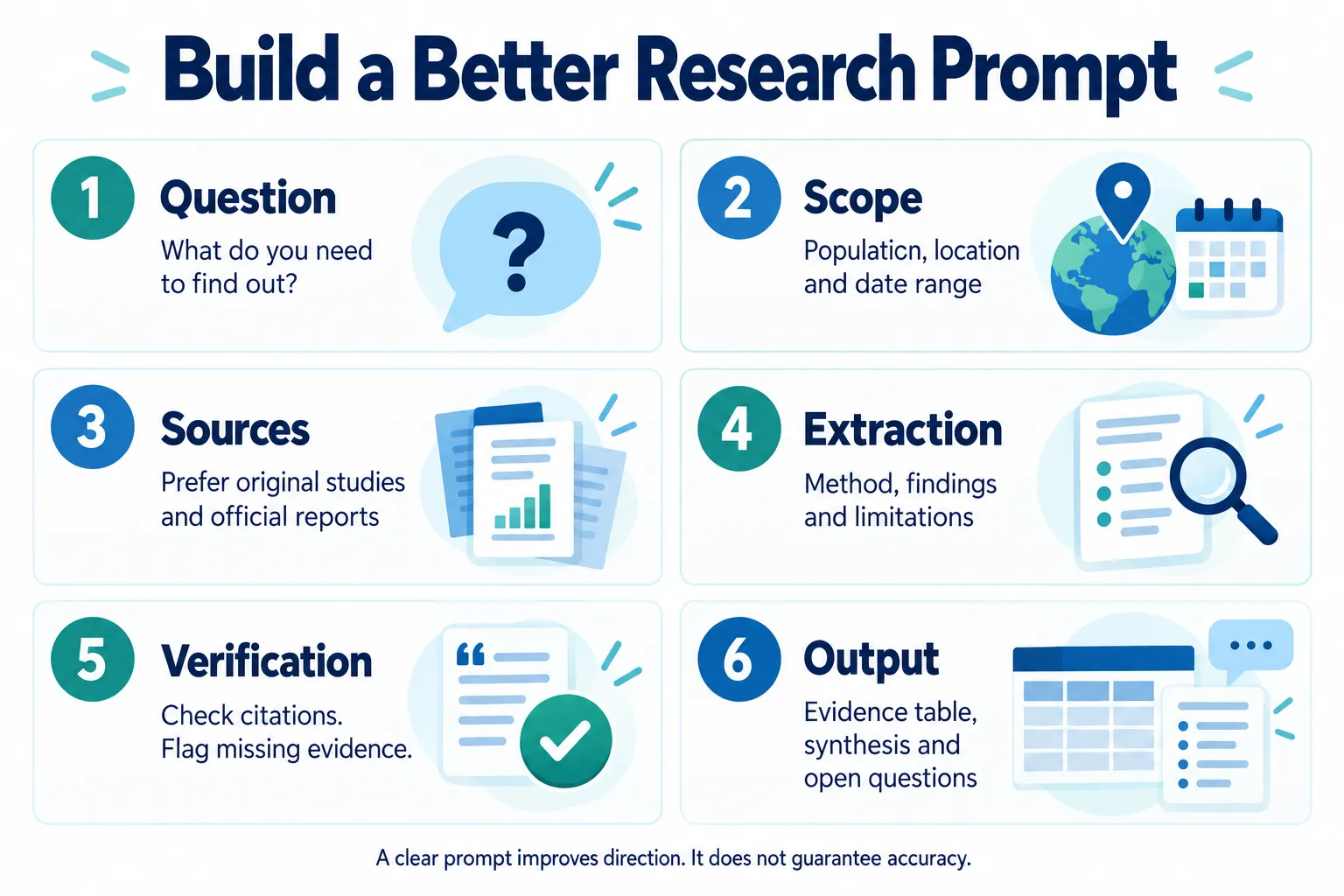
A good prompt should state the research task, specify the evidence needed, indicate the required format for the output, and include any limitations.
Reusable AI research prompt
The research question is [QUESTION] and the scope and time period cover [SCOPE / DATE RANGE]. When selecting sources, preference should be given to original studies, official publications, and appropriate primary sources. For each of these sources, the author, date, methodology, findings, and limitations should be identified. The evidence that has been verified should be distinguished from any interpretation that may have been offered. Direct references must be given. It is essential not to make up any missing information or citations. A table of the evidence should be provided, together with a brief synthesis and a list of the unresolved questions.
A well-crafted prompt enhances the clarity of the task; it won’t cause the system to gain access to sources that it cannot retrieve or ensure factual accuracy.
Worked example: Evaluating AI’s impact on online research
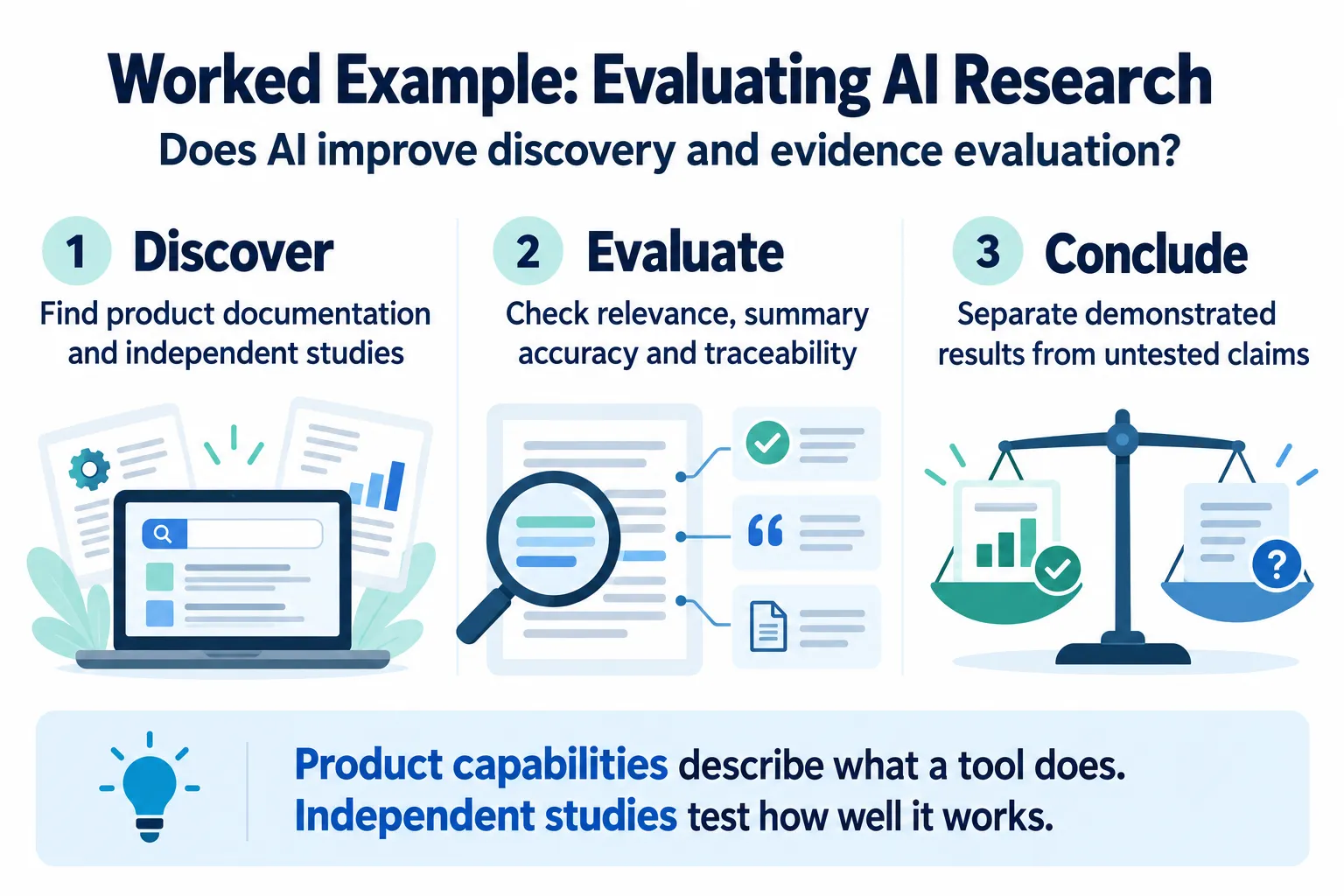
Consider a research analyst investigating:
What is the impact of generative AI on the processes of information discovery and evidence evaluation?
To begin with, the analyst breaks the question down into three themes which can be measured: information discovery, source evaluation, and research synthesis.
The strategy for the search involves the official descriptions of AI search features, academic research into information retrieval, and studies concerning the accuracy of AI-generated responses.
Collecting evidence
An initial evidence set might include:
- Google’s documentation describing AI Overviews, AI Mode, and the continuing role of conventional search.
- OpenAI’s documentation explaining source-linked, multi-stage deep research.
- Semantic Scholar’s documentation describing scholarly discovery and machine-generated paper summaries.
- Consensus documentation explaining how academic retrieval and AI synthesis work together.
These documents establish what the respective products are designed to do. They do not, by themselves, establish how much these tools improve research performance.
That would require independent evaluation studies with defined outcomes, appropriate comparisons, and suitable samples.
Comparing findings
The analyst could create a comparison framework with three questions:
- Does the tool retrieve relevant, independently verifiable sources?
- Does its summary accurately represent the source documents?
- Can another researcher trace the conclusions to their supporting evidence?
For empirical evaluation, the analyst would collect independent studies that test these questions, examine their methods, and compare results across tasks and research settings.
Preparing the conclusion
A defensible preliminary conclusion is:
Generative AI expands the ways researchers can discover and organize information, particularly through conversational retrieval and document synthesis. However, product capabilities alone do not demonstrate improvements in research accuracy. Reliability must be evaluated through the quality of retrieved evidence, fidelity of interpretation, and independent verification.
This conclusion deliberately avoids unsupported claims about time savings, accuracy percentages, or superiority over human researchers.
Common mistakes in AI-powered online research
Treating AI-generated citations as proof
A citation is a route to evidence, not evidence that a statement is correct. Open the source and confirm that it supports the claim.
Confusing source quantity with source independence
Ten websites reporting the same finding may all rely on one original study. Trace important claims to their earliest credible source.
Using summaries without examining methodology
An abstract or AI summary may omit selection criteria, sample limitations, or qualifications that change how results should be interpreted.
Overlooking updates to research software
AI research interfaces change regularly. Elicit’s current documentation states that older Find Papers, Extract Data and Chat with Papers sessions created before September 30, 2026, are view-only. Check current documentation before planning a workflow.
Uploading sensitive information without reviewing permissions
Before using confidential datasets, interview transcripts, or unpublished research, examine the service’s relevant privacy, retention, access, and organizational policies.
Essential skills for professional online researchers
The ability to use AI is becoming part of a broader range of research skills.
Researchers must understand information retrieval, advanced search queries, source evaluation, evidence management, research ethics, and the limitations of automated analysis.
A strong professional skill set involves having both technical competence and sound judgment.
Researchers can apply these capabilities consistently across different projects if they receive training in structured research methodology, responsible AI use, data analysis, and legal considerations.
The Association of Internet Research Specialists advocates for the education of internet research from a multidisciplinary point of view, incorporating advanced search techniques and more recent technologies.
Frequently asked questions
What is AI-powered online research?
AI-powered online research uses artificial intelligence to assist with finding, organizing, evaluating, and interpreting digital information. It commonly combines conventional search engines, academic databases, language models, and document-analysis systems. Researchers remain responsible for selecting suitable evidence, checking sources, and drawing defensible conclusions.
How can beginners use AI for online research?
Beginners should start with a narrow research question, ask an AI assistant to suggest search terms and source categories, then locate original documents. They can use AI to organize notes or compare passages, but should verify important claims directly. A simple research log makes the process easier to review.
Which AI tools are useful for professional researchers in 2026?
The best choice depends on the task. ChatGPT and similar assistants can help structure complex investigations. Semantic Scholar and Consensus support scholarly discovery. NotebookLM assists with selected document collections, while Elicit supports academic research workflows. Researchers often benefit from combining complementary tools rather than relying on one system.
Can AI replace traditional internet search?
No. AI-generated answers can accelerate interpretation, but traditional search engines and specialized databases remain important for discovering original documents, checking publication details, and testing alternative search strategies. Research quality depends on source access, coverage, methodology, and verification rather than the sophistication of the interface alone.
How can researchers verify AI-generated information?
Researchers should open each important cited source, confirm the relevant claim, examine the author’s methodology, and compare findings with independent evidence. Publication dates, missing context, conflicts of interest, and inaccessible references also need attention. Unsupported claims should be qualified or excluded.
What is the difference between AI search and deep research?
AI search generally helps answer or explore a question through retrieved information and generated explanations. Deep research involves a more extensive, multi-step process of planning, collecting, comparing, and synthesizing sources. The distinction varies between providers, and neither approach eliminates the need for human oversight.
How does AI improve research efficiency?
AI can reduce manual effort in organizing documents, extracting comparable information, preparing search strategies, and drafting preliminary summaries. Whether these benefits produce meaningful time savings depends on the task, tool quality, and amount of verification required. Efficiency should be evaluated alongside accuracy and completeness.
What skills are needed to become an effective AI-powered researcher?
Important skills include research-question formulation, Boolean and semantic searching, database selection, prompt writing, information evaluation, citation management, data interpretation, and ethical decision-making. Researchers must also recognize uncertainty and distinguish reliable evidence from persuasive but unsupported automated explanations.
Conclusion: Master the method, not just the technology
Mastering AI online research in 2026 requires more than learning to use an advanced chatbot. It requires understanding how information is discovered, how digital sources differ in reliability, how AI systems interpret material, and how researchers can test conclusions against original evidence. The strongest research process combines effective search strategies, appropriate AI tools, reliable source selection, critical analysis, and documented human verification. AI can support discovery and synthesis. The researcher remains accountable for the quality of the final work.