Interviews and focus groups are established methods of data collection in qualitative research. Both explore experiences, meanings, and decisions, but they produce different evidence. An interview develops an individual account; a focus group examines what people say in response to one another.
Choose the method around your research question, participants, ethical responsibilities, and analytical approach. Neither a detailed transcript nor a large discussion automatically produces a strong study.
What counts as qualitative data collection?
Qualitative research investigates how people understand and experience their worlds. Data may include interview recordings, group discussions, observations, documents, diaries, and open-ended survey responses. Observations can reveal practices that participants overlook in conversation; diaries can capture experiences over time. Surveys generally offer fewer opportunities for immediate follow-up.
Methods can be combined when each has a clear purpose. For example, interviews might identify barriers to booking an appointment, while observations show how people navigate the booking system. Explain how the different materials contribute to the research question.
Interviews: structure without leading the participant
Structured interviews use predetermined questions in a consistent order. They can include open-ended questions; structure alone does not make an interview quantitative. Semi-structured interviews use a topic guide with room to explore unexpected answers. Unstructured interviews give participants more control over the conversation while still requiring a research purpose, preparation, and ethical safeguards.
A useful opening invites an account of an actual experience: “What happened when you tried to book?” A question such as “Why was the system frustrating?” assumes an experience the participant may not have had. Follow with neutral prompts: “What happened next?” or “Can you describe an example?”
Listen without rushing to complete answers. Allow pauses, clarify unfamiliar terms, and avoid signaling approval of particular views. The GOV.UK guide to in-depth interviews provides practical advice on preparation, discussion guides, and interviewing.
Focus groups: interaction is the evidence
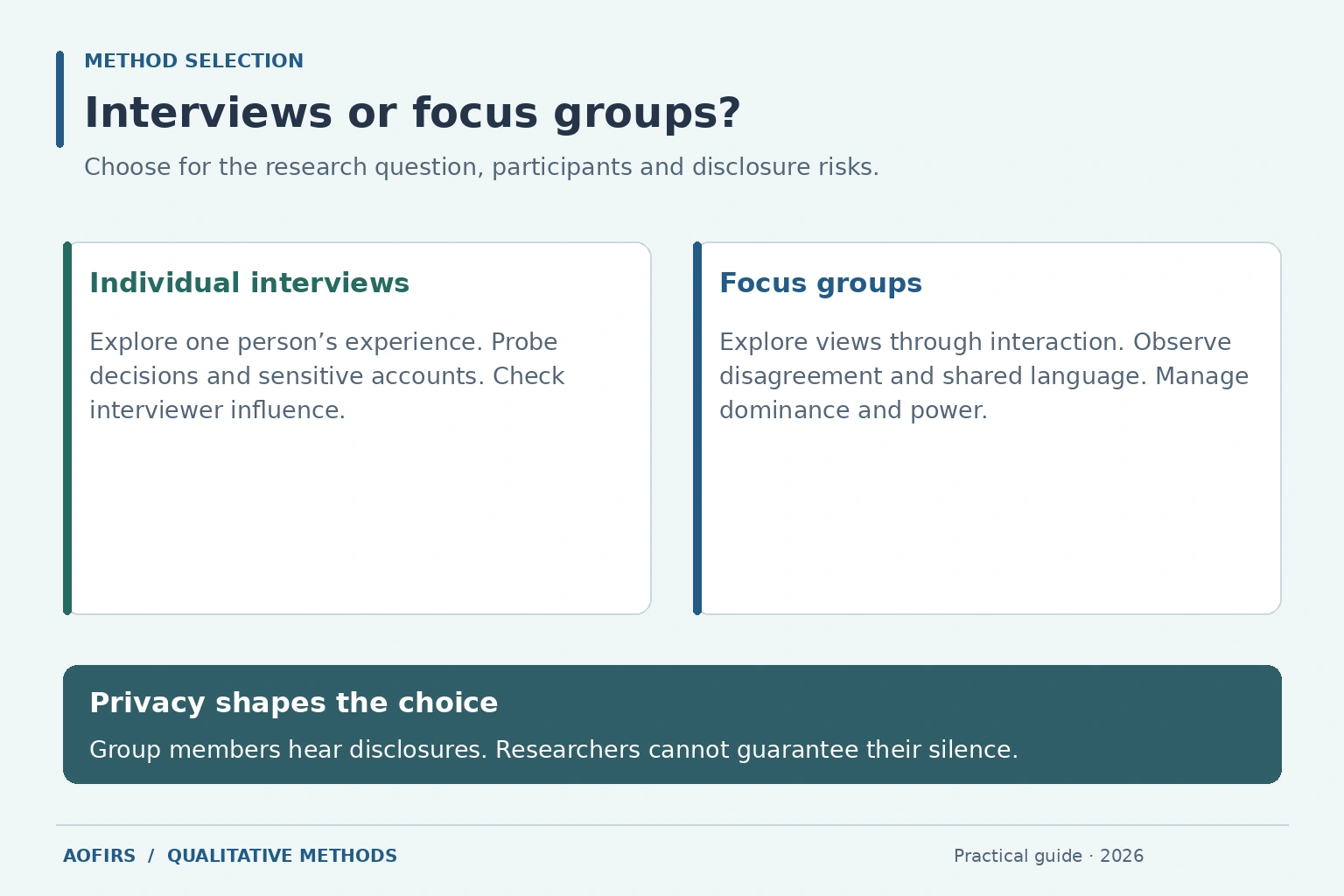
A focus group is a facilitated discussion in which participants respond to each other. Comments may prompt memories, expose differences, or reveal how a shared view develops. The objective is not to force consensus or collect a sequence of isolated answers.
Composition matters. Similar experiences may help participants speak openly, while differences can reveal contrasting assumptions. Existing relationships can support discussion but also inhibit disclosure. Combining employees with their manager, for example, may make criticism difficult. Consider separate groups where power differences could silence participants.
Use a manageable group size for the topic, participants, and setting. A skilled moderator invites quieter voices without pressuring anyone, manages dominant speakers, and explores disagreement respectfully. A note-taker can track speakers and interaction. The GOV.UK focus group guidance explains these design and facilitation considerations.
Interviews vs. focus groups: choosing a method
| Decision | Interviews | Focus groups |
|---|---|---|
| Research purpose | Explore a person’s experience in depth | Explore interaction and shared or contested meanings |
| Privacy | Greater control over who hears an account | Other participants hear what is disclosed |
| Follow-up | Tailored probes and individual pacing | Probes must balance individuals and group discussion |
| Recruitment | Arrange individual appointments | Recruit a suitable mix available together |
| Facilitation | Build rapport and avoid leading | Also manage turn-taking and power differences |
| Resources | Repeated sessions and individual processing | Coordination and complex multi-speaker processing |
| Main limitation | Accounts may differ from observed behavior | Conformity or dominance may shape disclosure |
Focus groups are not automatically faster or cheaper. Recruitment, moderation, and analysis can be demanding. Choose both methods only when their different contributions justify the work.
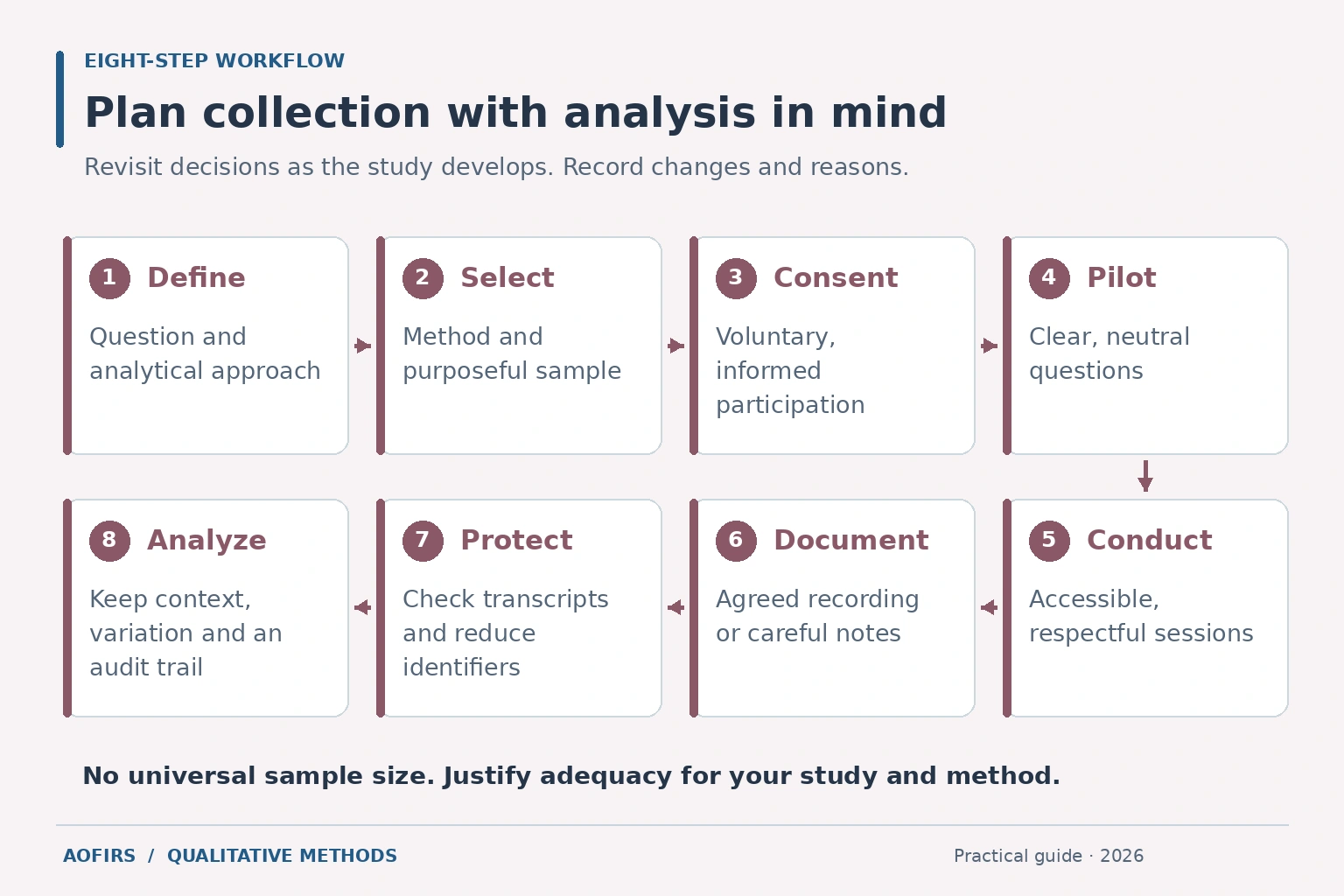
An eight-step qualitative data collection workflow
1. Define the question and analytical approach
Specify what you need to understand and why participants can illuminate it. Studying first-time patients’ booking experiences differs from studying how people construct identities in conversation. The question and approach determine what to ask, observe, record and transcribe.
2. Select participants deliberately
Set eligibility criteria and recruit people with relevant experiences. Consider whose perspectives are missing and how recruitment channels exclude them. Information power relates sample adequacy to the study aim, sample specificity, theory, dialogue quality and analysis strategy. There is no universal interview count. Explain your rationale; do not treat saturation as mandatory for every approach.
3. Establish consent and safeguards
Obtain required ethics approval before recruitment. Explain participation, recording, quotation, reuse and withdrawal limits in accessible language. Make clear that declining should not adversely affect employment, services or care. Avoid recruitment pressure, and distinguish permission to participate from permission to record or reuse material.
4. Develop and pilot the guide
Start with accessible questions, then move toward detailed experiences and reflection. Pilot the wording and timing, and record substantial changes and their reasons. An appointment-booking guide might ask:
- Tell me about the last time you booked an appointment.
- What happened first?
- How did you decide what to do next?
- What helped or made the process difficult, if anything?
- What else should we understand?
5. Conduct an accessible, respectful session
Arrange suitable language support, breaks, accessibility adjustments, and a private setting. Introduce the researcher and explain the session. Use plain language, open questions and neutral follow-up. Participants can skip questions or stop. For groups, agree on respectful turn-taking and requests for confidentiality.
6. Document with permission
Record only when appropriate and consented to. Choose audio or video according to the question and privacy implications; test equipment and plan for failure. Add field notes on context, interaction and interruptions, separating observations from interpretations. If recording is declined, agree on note-taking and its limits. Notes should not be presented as verbatim quotations.
7. Check and protect the material
Compare transcripts with recordings, checking speaker attribution, technical terms, and proposed quotations. Mark unclear passages rather than guessing. Decide whether pauses, overlap, and translation details matter analytically. Remove unnecessary identifiers, consider indirect identification, separate identity keys, restrict access, and specify retention and deletion arrangements.
8. Review and analyze iteratively
Begin reviewing material during collection so gaps and useful follow-up become visible. Document guide changes and analytical decisions. Framework analysis, grounded theory, discourse analysis, and reflexive thematic analysis have different commitments; select a coherent approach. With focus groups, preserve exchanges and context instead of treating every quotation as an independent interview response.
Remote interviews and responsible AI assistance
Telephone and video interviews can improve access but may exclude people without reliable connections or private space. Offer appropriate alternatives. Asynchronous email interviews allow reflection but need clear response windows and follow-up arrangements. Online groups require plans for turn-taking, disconnections, private messages, and who can access recordings.
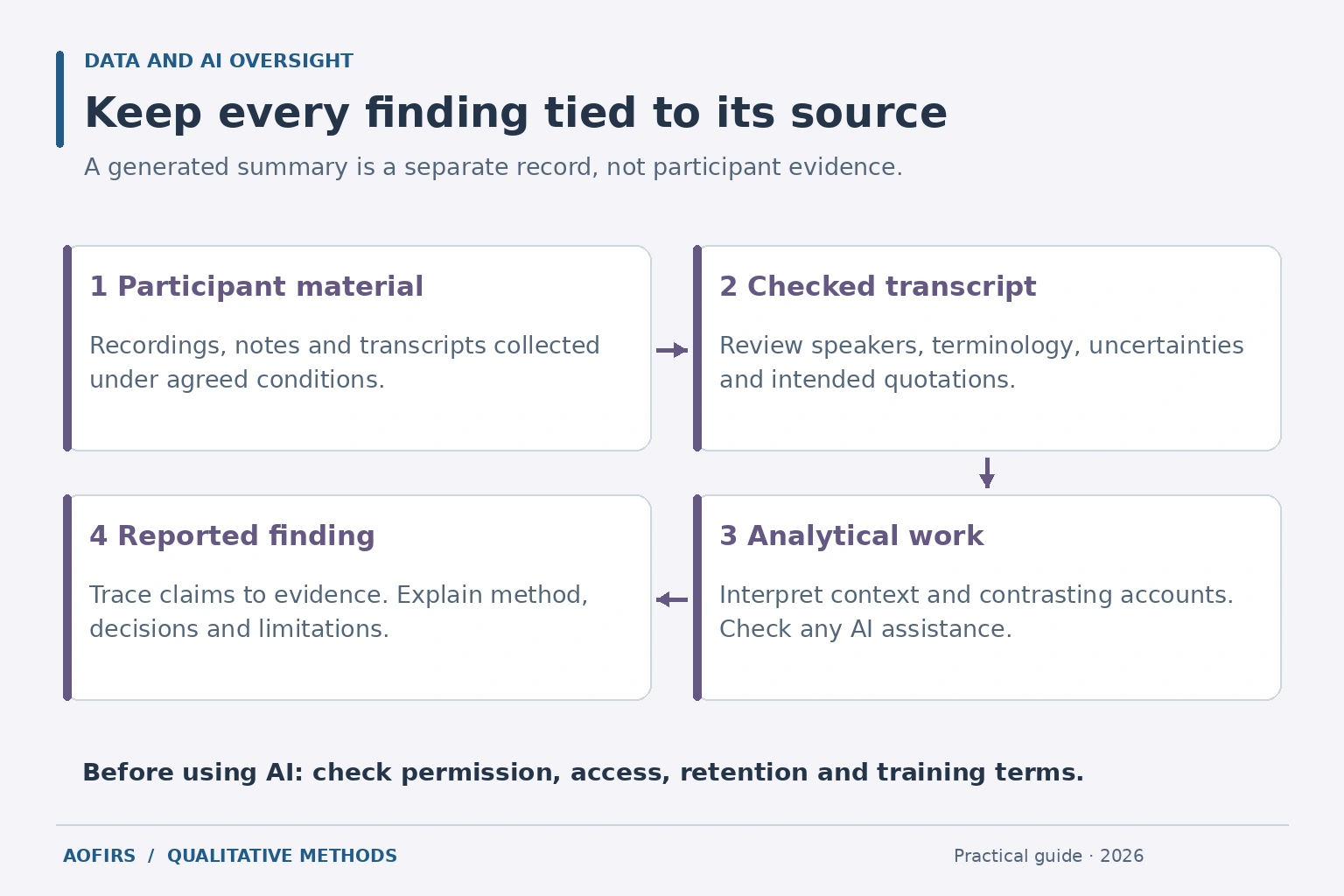
AI tools can assist transcription or organization, but their output requires human checking. Review consent, institutional requirements, and provider terms before uploading participant material. Check retention, access, training use and deletion options. An ended meeting does not mean its recording has been deleted.
Keep machine-generated summaries separate from participant evidence. Record the tool, version, task, checks, and decisions. Verify quotations against source material; AOFIRS’ guide to checking AI-generated answers and citations supports this verification habit.
Maintain a traceable route from the recording or notes to the transcript, interpretation, and reported finding. The AOFIRS report on verification debt in online research explains why unchecked outputs create later verification work. The AI deep research integrity guide offers further context on checking provenance. Neither substitutes for a justified qualitative methodology.
Ethics, reflexivity and transparent reporting
Protecting confidentiality means controlling disclosure; it is different from promising that nobody can identify participants. In focus groups, researchers can request confidentiality but cannot guarantee other members’ behavior. Explain this limitation before participation. The Association of Internet Researchers’ ethics guidance supports ongoing, context-sensitive ethical judgment.
Consider how your role, assumptions and relationships shape questions and interpretation. Keep a decision record, examine contrasting accounts and explain limitations. Member checking or agreement between coders may suit some designs, but neither is a universal quality requirement.
Use COREQ, a 32-item checklist for interview and focus-group reporting, or the broader Standards for Reporting Qualitative Research as appropriate. Reporting checklists improve transparency; completing one does not establish methodological quality.
Frequently asked questions
What is the main difference between interviews and focus groups?
Interviews develop individual accounts. Focus groups also examine how participants respond to, challenge, and build on each other’s accounts.
Are structured interviews always quantitative?
No. Predetermined questions can invite open-ended qualitative responses. The questions, data, and analytical approach matter.
How many interviews or focus groups are enough?
Justify adequacy against your aim, participants, information needs, and analytical approach. No fixed number suits every study.
Must every session be recorded?
No. Recording needs consent and a clear purpose. Where notes are appropriate, explain their limitations and avoid claiming verbatim accuracy.
Can focus-group confidentiality be guaranteed?
No. Researchers can secure their own records and establish ground rules but cannot fully control participants’ later disclosures.
Can AI replace qualitative interpretation?
AI assistance needs a justified role, appropriate permissions, and human scrutiny. Synthetic participants are not evidence of real people’s experiences.
Can a small purposive sample represent a population statistically?
It does not by itself support population estimates. Explain the context, depth, and limits of the claims you make.
What should a methods section report?
Explain recruitment, researcher roles, consent, setting, guide development, recording, processing, analysis, and limitations, using a suitable reporting guideline.