A practical, evidence-based method can verify whether an AI answer is correct, whether its citations are genuine, and whether those sources support the claims made alongside them.
The evidence synthesis was carried out using two research reports from the AOFIRS as reference material, and was further enhanced by incorporating current research and standards up to and including October 6, 2026.
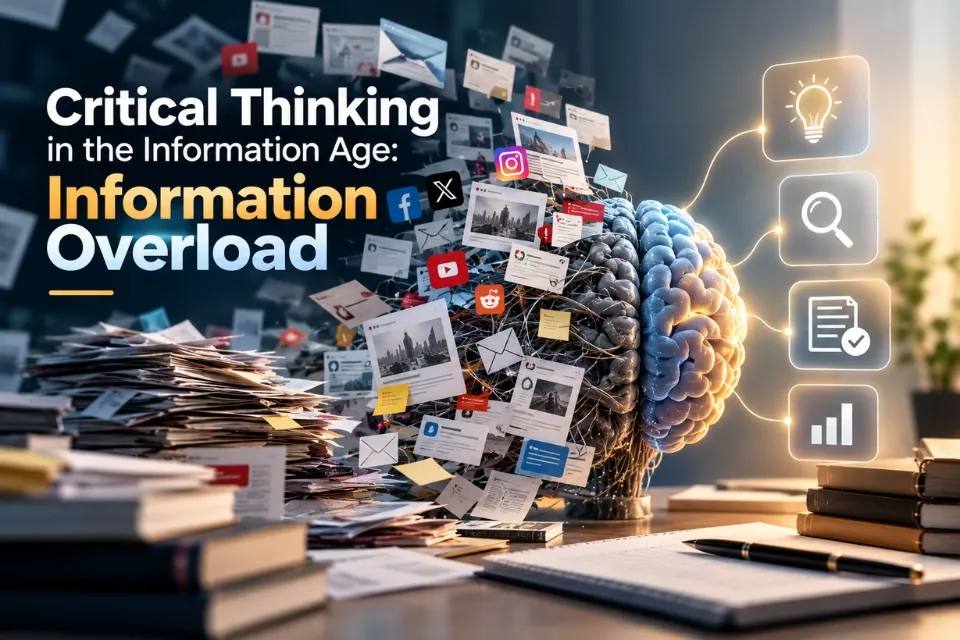
The issue isn’t that AI is always incorrect. Answers that are wrong can appear to be complete.
Modern AI systems are able to search, summarise, carry out calculations, compare different sources, and generate well-written prose within a matter of seconds. While this fluency is useful, it also masks a fundamental issue: there is a difference between presentation quality and factual accuracy. An answer that appears confident might in fact be correct, only partly correct, out of date, misattributed, or completely made up, and the external style could be almost the same in all such cases.
The AOFIRS research reports given for this article arrive at the same practical conclusion from different angles. The one on the trust aspect explains why people are susceptible to fluent, confident, and human-like responses from AI. The other, concerning verification debt, describes what occurs in practice when such responses go through research workflows without being verified. Taken together, they imply a straightforward rule: AI output should be treated as claims that need to be tested, not as a source to be believed (Manzoor, 2026a, 2026b).
Even when an AI response includes citations, the distinction is important. A citation might be present even if it does not support the claim. A URL might work in opening but could lead to the wrong article. An actual article can be cited for a statement which it never makes. Moreover, a source can contain a statement accurately and yet still form a weak basis for the conclusion since the source in question may be out of date, conflicting, derivative, or contradicted by stronger evidence. Verification must therefore extend beyond simply checking whether a link is clickable.
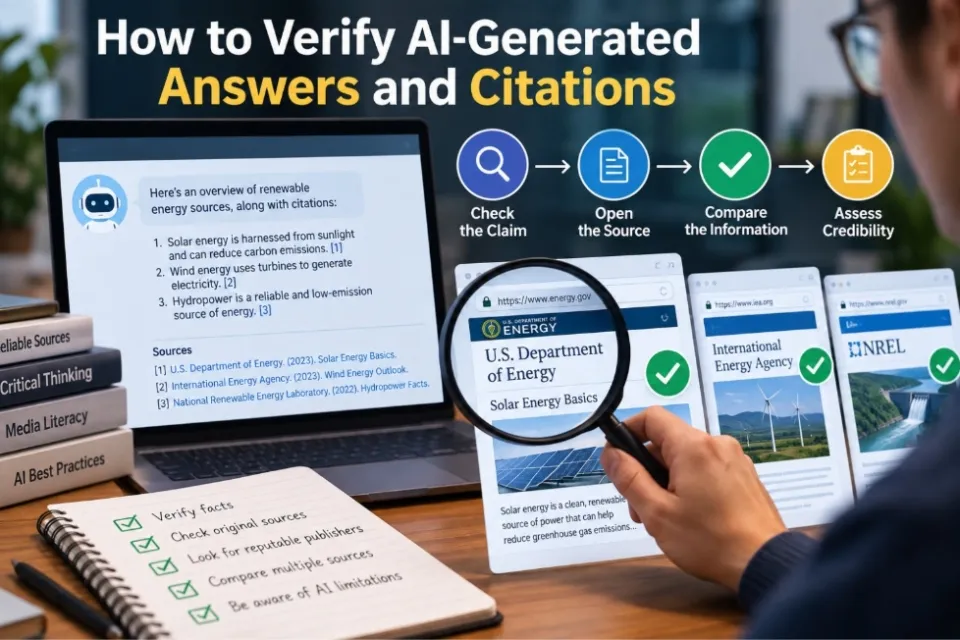
The basic principle is that a citation can only be regarded as evidence when you have verified four points: that it actually exists, that it is the source which was claimed, that it genuinely supports the statement in question, and that it is strong given the significance of the statement.
Why are AI answers easy to overtrust?
People do not evaluate information solely on the basis of its content; they also react to factors such as fluency, confidence, structure, the apparent amount of effort put in, and the social tone. The AOFIRS trust report classifies these aspects into a number of layers. Fluency in language can serve as an indication that something is true; confidence may be taken to mean that knowledge is present; preference-trained models might learn to agree with users; and interfaces which show a multi-step process can make the system seem more thorough than it actually is (Manzoor, 2026a).
That is the reason why the fact that “it sounds right” is an inadequate criterion. Long-standing research into the illusory truth effect has demonstrated that the ease with which information is processed can lead to an increased sense of truth. The danger is greater in the context of AI-assisted work since the model is designed to generate coherent language even if its factual basis is weak. NIST refers to this as confabulation: generative systems are able to present false or incorrect content with confidence, including made-up logic and citations (Autio et al., 2024).
No explanations by themselves can resolve the issue. While chain-of-thought or reasoning-type text may help identify obvious contradictions, it shouldn’t be regarded as a reliable record of how the model arrived at its answer. Experiments have demonstrated that models are capable of generating plausible explanations that omit important features of the prompt or justify their answer afterwards (Turpin et al., 2023). The more cautious approach is to view the explanation as another claim that will have to be tested.
What is involved in checking an answer that has been generated by an AI?
Verification is most effective when the answer is divided into separate layers. Rather than putting forward one general question — ‘Is this correct?’ — it is better to ask a number of more specific questions. Each of these questions addresses a different kind of failure.
| Verification layer | Question to ask | Typical failure caught |
|---|---|---|
| 1. Claim accuracy | Is the factual statement itself correct? | Dates, names, amounts, definitions, events, technical facts |
| 2. Citation existence | Does the cited article, report, case, DOI, or URL actually exist? | Fabricated references, broken links, invented journals |
| 3. Citation identity | Is this the exact source described by the AI? | Wrong title, wrong author, wrong publisher, syndicated copy |
| 4. Citation entailment | Does the source support the specific claim attached to it? | Real source used for an unsupported claim |
| 5. Source quality | Is the source authoritative enough for the claim? | Weak blogs, conflicts of interest, derivative reporting |
| 6. Currency and scope | Is the information current and applicable to the situation? | Changed laws, model updates, old statistics, different jurisdictions |
| 7. Independence | Is the claim corroborated independently? | Circular citation chains and multiple sites repeating one origin |
The fact that this method is layered is based on research into generative search. Liu, Zhang, and Liang (2023) discovered that only about half of the sentences produced by the systems they examined were completely supported by citations, although citation support was better but still not complete. Later, the Tow Centre identified serious problems with source identification in eight AI search tools, including confidently wrong answers and fabricated links (Jaźwińska & Chandrasekar, 2025). Thus, a citation gives rise to a question requiring verification; it does not settle the question.
A practical workflow for verifying AI answers and citations
Step 1: Break the answer into checkable claims
Do not treat a paragraph as a whole when checking it. Instead, you should note those statements which might be true or false—such as dates, figures, causal assertions, quotations, legal rules, references to specific studies, product specifications, historical claims, current events, and conclusions based on external evidence. Doing so turns what would otherwise be an impressive answer into a feasible queue for verification.
A good shortcut is to focus on the claims that are ‘load-bearing’. If any one of them were false, would the recommendation or conclusion be different? In that case, deal with those first and put descriptive filler off until later.
Step 2: Set the verification level before you start checking
It isn’t necessary to subject every AI response to the same degree of review. Both of the reports in question call for proportionate verification. In the case of brainstorming or during the initial orientation phase, a spot-check might suffice. However, when it comes to internal reports, all important sources should be examined. In situations involving public, academic, client, legal, medical, financial, or investigative work, verification should be considerably more rigorous and might need to include an independent second reviewer (Manzoor, 2026a, 2026b).
| Use Case | Minimum Check | Recommended Posture |
|---|---|---|
| Orientation/brainstorming | Spot-check key claims | Treat AI output as leads, not settled facts |
| Internal work | Check all key citations and numbers | Confirm the sources behind decisions |
| Published / client-facing | Verify every citation and quotation | Keep a verification record |
| High stakes | Independent second review | No unverified AI-generated citation should survive |
Step 3: Verify that each citation exists
Begin with the most inexpensive mechanical checks by opening each URL. In the case of scholarly references, resolve the DOI and then compare the title, the list of authors, the journal or conference, and the publication year with a reliable metadata registry such as Cross ref. Crossref does allow searches to be made by DOI, title, and author, and the process of DOI resolution serves as a quick initial check to verify that the identifier is active and directs to the correct record (Crossref, n.d.-a, n.d.-b).
When checking legal cases, make sure to verify them in an official or reliable legal database; with regard to standards, policies, and government guidance, go with the organization that issued them. If a source cannot be located using its title, author, DOI, a distinctive phrase, or publisher, regard it as unverified rather than as ‘probably real’.
Step 4: Open the source and test claim-to-source support
Step that people most frequently omit is to locate the document that is cited. Simply finding the document isn’t sufficient; you have to search within the source for the precise statistic, quotation, finding, or concept in question. After that, you must read a sufficient amount of the surrounding text in order to understand the conditions, the population, the date range, and the limitations.
Ask: Does this source actually say what the AI says it says? A citation may be topically related while failing to support the specific claim. NIST research on machine-generated reports treats this mapping between claims and source documents as central to verifiability, not a cosmetic feature (Mayfield et al., 2024).
Step 5: Check quotations, numbers, and dates.
Numbers should be subjected to more careful analysis since a minor transcription error can alter the meaning of an answer. Check the numerator and the denominator, distinguish between percentage and percentage points, verify the sample size, confirm the currency, ensure the correct measurement unit is used, check the date range, and determine whether the statistic refers to a subgroup or to the entire population. With regard to quotations, compare the exact wording and make certain that the quote has not been deprived of a qualification which changes its meaning. Verses its meaning.
The verification-debt report suggests that this should be included as a standard pre-publication check, together with validating URLs and matching DOI metadata to the work cited (Manzoor, 2026b).
Step 6: Evaluate the source laterally, not only from inside the page
Even if a website appears professional, it may still be unreliable. Rather than spending several minutes looking at its About page, you should open new tabs and find out who runs it, what independent sources have to say about it, whether its claims have been questioned, and whether it is part of a network of sites that repeat the same content. This method is known as “lateral reading” and is one that Civic Online Reasoning (Digital Inquiry Group, n.d.) teaches.
The following three questions are particularly useful: Who is the source of the information? What is the evidence? And what do other independent sources say? This is all the more important in the case of AI search since a page that is retrieved might be little known, based on other material, designed to be visible to machines, or deliberately inserted in order to affect the model’s output.
Step 7: Triangulate important or contested claims
When making a significant claim, a single source is usually insufficient. You should try to find at least one independent source that reaches the same factual conclusion through a different method of reporting or research. What is important is independence rather than the number of sources. Even if five websites reproduce the same press release, they still count as just one source for evidentiary purposes.
Whenever possible, combine a primary source with an independent secondary source. For instance, you could link an agency’s dataset to a reliable analysis, or a peer-reviewed study to a systematic review or a replication study. When the sources differ, do not impose a clear conclusion. Instead, report the disagreement and explain which evidence is more convincing and why.
Step 8: Challenge the framing, not just the facts
Even if the question is flawed, AI systems can respond to it in a fluent manner. Before you accept the answer, check the premise to see if the question assumes that something took place when it might not have. Does it assume a causal link where the evidence only shows a correlation? Might the answer be employing a different definition from the one you had in mind?
The trust report suggests that it is advisable to form an independent judgement before looking at the AI’s answer in cases where the consequences are significant, since commit-before-reveal procedures can help reduce overreliance (Buçinca et al., 2021; Manzoor, 2026a). It is likewise useful to request counter-evidence or alternative explanations, although this should be regarded as a discovery tactic and not as a replacement for external verification.
Step 9: Verify freshness for current or changing facts
Facts that are time-sensitive should be given a date stamp. Since prices, the people in office, the capabilities of software, laws, the status of court cases, medical advice, company policies, the availability of products, and the performance of a model can all change rapidly, it is necessary to check both the publication date and the “as of” date of the relevant facts. What is the correct answer for the year 2024 might be an incorrect answer for 2026.
If a claim is current, it is best to refer to official up-to-date sources and more recent primary documents. It should be remembered that merely retrieving information does not ensure that the attribution is accurate; even search systems capable of accessing current material can misidentify or miscite what they have retrieved (Jaźwińska & Chandrasekar, 2025).
Step 10: Record what was checked and what remains uncertain
Verification is greatly increased in reliability if it is visible. Whenever an important claim is made, you should note the source that was checked, what was confirmed, who carried out the check, and any remaining uncertainty. This stops ‘verification debt’ from being passed on to the next person, who might otherwise think that the report has already been audited (Manzoor, 2026b).
A simple citation-audit template
A small audit table can be used to avoid the majority of citation errors when writing articles, research reports, client deliverables and academic work; you can store it in a spreadsheet or in a research log.
| Claim | Citation | Exists? | Supports Claim? | Source Quality | Status/Notes |
|---|---|---|---|---|---|
| [Claim] | [Source] | Yes / No | Full / Partial / No | Primary / Strong / Weak | [Notes] |
| [Claim] | [Source] | Yes / No | Full / Partial / No | Primary / Strong / Weak | [Notes] |
| [Claim] | [Source] | Yes / No | Full / Partial / No | Primary / Strong / Weak | [Notes] |
| [Claim] | [Source] | Yes / No | Full / Partial / No | Primary / Strong / Weak | [Notes] |
What not to use as proof
While several signals may be of use as clues, none of them should be taken as proof of correctness by itself.
- Models are just as confident whether they are correct or not, and verbal confidence should not be regarded as a reliable measure of accuracy.
- An extensive answer has more room to include unsubstantiated claims.
- Reasoning that is visible can be incomplete, given after the fact, or inconsistent with the actual process used to produce the answer (Turpin et al., 2023).
- The number of citations may increase both the workload and the probability that at least one of them is incorrect; having more citations does not mean that they have higher evidentiary quality (Manzoor, 2026b).
- The fact that a link works shows only that the page exists, not that it is the correct page or that it supports the statement.
- When an artificial intelligence checks its own work: while asking a model to ‘double-check’ can help reveal problems, self-correction in the absence of an external source or oracle is unreliable. It should be used as a prompt for additional verification, not as a final validation.
- I agree with you: research into sycophancy indicates that models can tend to align with a user’s stated beliefs. Agreement should be taken as only weak evidence, in particular when the answer matches what you had already expected.
How to verify different kinds of citations
Academic articles
Look up the DOI, title, authors, venue, year, and publication status. Make sure to tell the difference between a preprint and a peer-reviewed version. When the AI references a particular result, you should open the paper and find that result in the abstract, the results section, the tables, or the supplementary material. Do not assume that the abstract supports a more specific claim than the full study actually does. Crossref metadata can be helpful for verifying the identity of the paper, whereas the publisher or the repository is the better source for accessing the actual content (Crossref, n.d.-a).
News articles
Check the original publisher, date, byline, headline, and URL. Be on the lookout for syndicated or copied versions. According to the Tow Centre’s 2025 audit, AI search tools were able to name the wrong publisher or URL even though traditional search methods could easily identify the correct information (Jaźwińska & Chandrasekar, 2025).
Legal material
It is essential to check the actual case when using an AI-generated citation, making sure that the case exists, that the court and the year are accurate, and that the proposition cited is included in the opinion. Research involving AI legal research tools has found that specialization reduces but does not eliminate hallucinations (Magesh et al., 2025).
Government, policy, and standards sources
Go with the issuing agency or standards body and make sure that you have the correct version number, revision date, jurisdiction, and that the guidance is up to date. When it comes to questions regarding AI risk and governance, NIST’s Generative AI Profile is a useful primary, standards-based source since it defines confabulation and also recommends specific risk-management practices (Autio et al., 2024).
A 10-minute verification routine for everyday research
When the stakes are moderate, and you do not have time for a full audit, use this compact routine:
- Highlight the three or five claims that are most important.
- Look at each of the citations that are attached to those claims.
- Check the title, author, date, and URL or DOI.
- For each claim, identify the specific passage, table, or data point that supports it.
- Verify at least one of the key claims by referring to a separate, independent source.
- Try to find the best possible counter-evidence or limitation.
- Instead of brushing over anything that is not resolved, treat it as uncertain.
This short routine will not eliminate every error, but it directly attacks the failure modes most likely to mislead a busy researcher: fabricated sources, weak attribution, unsupported claims, anchoring, and invisible uncertainty.
Verification should be part of a workflow and not just a last-minute check in on-the-line situations involving
Legal, medical, financial, compliance, investigative, or safety-sensitive work, a higher standard is required. When making decisions in such cases, the individual responsible should not use the AI’s list of citations as a replacement for examining the original evidence. It is necessary to carry out checks based on primary sources, obtain an independent review wherever possible, and keep a record of what has been verified. Furthermore, sensitive material might need to be kept off third-party AI systems depending on the confidentiality and security requirements (Manzoor, 2026b). and security requirements (Manzoor, 2026b).
It is here too that the cost of ‘verification debt’ is greatest. A minor error left unchecked can develop into a filing, a diagnosis, a recommendation to a client, or a public claim. Generally, it is cheaper to detect the error early than to correct it after the fact or after publication.
The right mental model: AI is a research assistant, not an evidentiary authority
AI is valuable since it can reduce the time needed for searching and synthesising information. This does not mean that its output is automatically valid. The best approach is to separate the generation of content from the process of verification: let the system assist you in identifying possible options, organising the material, and bringing forward potential sources, and then check on your own the facts and evidence that are important.
The key habit is straightforward in nature—go from asking “Does this answer appear credible?” to asking “What do I need to verify before I can responsibly rely on it?” By making that change, AI becomes a tool that can be used as part of a careful research process rather than a source of persuasive content.
References
Autio, C., Schwartz, R., Dunietz, J., Jain, S., Stanley, M., Tabassi, E., Hall, P., and Roberts, K. (2024), Artificial intelligence risk management framework: Generative artificial intelligence profile (NIST AI 600-1), National Institute of Standards and Technology, https://doi.org/10.6028/NIST.AI.600-1
Buçinca, Z., Malaya, M. B., and Gajos, K. Z. (2021) ‘To trust or to think: Cognitive forcing functions can reduce overreliance on AI in AI-assisted decision-making’, Proceedings of the ACM on Human-Computer Interaction, 5(CSCW1). https://arxiv.org/abs/2102.09692
Crossref (n.d.-a)Metadata retrieval. Retrieved on October 6, 2026, from https://www.crossref.org/services/metadata-retrieval/
Crossref (n.d.-b) states how to verify your registration. It was retrieved on October 6, 2026, from https://www.crossref.org/documentation/register-maintain-records/verify-your-registration/.
Civic Online Reasoning, by the Digital Inquiry Group, was retrieved on October 6, 2026, from https://cor.inquirygroup.org/.
Jaźwińska, K., and Chandrasekar, A. (2025, March 6). AI search has a citation problem. Tow Centre for Digital Journalism, Columbia Journalism Review. https://www.cjr.org/tow_center/we-compared-eight-ai-search-engines-theyre-all-bad-at-citing-news.php
Lee, H.-P., Sarkar, A., Tankelevitch, L., Drosos, I., Rintel, S., Banks, R., and Wilson, N. (2025) “The impact of generative AI on critical thinking: Self-reported reductions in cognitive effort and confidence effects from a survey of knowledge workers”, in Proceedings of the 2025 CHI Conference on Human Factors in Computing Systems (Article 1121, pages 1–22). Association for Computing Machinery. https://doi.org/10.1145/3706598.3713778
Liu N. F., Zhang T., and Liang P. (2023) ‘Evaluating verifiability in generative search engines’, in Findings of the Association for Computational Linguistics: EMNLP 2023, pages 7001–7025. https://arxiv.org/abs/2304.09848
Magesh V., Surani F., Dahl M., Suzgun M., Manning C. D. and Ho D. E. (2025) ‘Hallucination-free? Assessing the reliability of leading AI legal research tools’, Journal of Empirical Legal Studies, 22(2), pp. 216–242. https://doi.org/10.1111/jels.12413
Manzoor, N. (2026a): The psychology of agentic AI trust – the perceived correctness of fluent answers and the meaning of ‘correct’ in AI outputs. Association of Internet Research Specialists.
Manzoor, N. (2026b), ‘Verification debt in online research: What accumulates when AI agents search and no one checks’, Association of Internet Research Specialists.
Mayfield, E. Yang, D. Lawrie, S. MacAvaney, P. McNamee, D. Oard, L. Soldaini, I. Soboroff, O. Weller, E. Kayi, K. Sanders, M. Mason, and N. Hibbler (2024), ‘On the evaluation of machine-generated reports’, in Proceedings of the 47th International ACM SIGIR Conference on Research and Development in Information Retrieval. https://doi.org/10.1145/3626772.3657846
Rao D., Wong E., and Callison-Burch C. (2026) Detecting and correcting reference hallucinations in commercial LLMs and deep research agents (arXiv:2604.03173) [Preprint]. arXiv. https://doi.org/10.48550/arXiv.2604.03173
Romeo G. and Conti D. (2026) ‘Exploring automation bias in human–AI collaboration: A review and implications for explainable AI’, AI & Society, 41, pp. 259–278. https://doi.org/10.1007/s00146-025-02422-7
Turpin M., Michael J., Perez E., and Bowman S. R. (2023) ‘Language models don’t always say what they think: Unfaithful explanations in chain-of-thought prompting’, Advances in Neural Information Processing Systems, 36. https://arxiv.org/abs/2305.04388
W. H. Walters and E. I. Wilder (2023) ‘Fabrication and errors in the bibliographic citations generated by ChatGPT’, Scientific Reports, 13, article number 14045. https://doi.org/10.1038/s41598-023-41032-5
Note: The article combines the two AOFIRS reports provided and includes additional information from NIST, Crossref, the Digital Inquiry Group, peer-reviewed research, and published audits. Since the performance of models and products changes rapidly, treat the tool-specific error rates as evidence that is valid only for a certain period of time rather than as permanent rankings.