Modern conversational search engines and generative models have transformed how researchers access online data. Yet beneath their fluent conversational answers lies a fundamental mathematical constraint: large language models operate on a principle of least resistance. By default, retrieval-augmented generation (RAG) and conversational agents mathematically prioritize broad consensus summaries over the nuanced complexity of niche, authoritative literature. When investigating complex topics, intelligence analysts and researchers frequently find that high-ranking, search-engine-optimized (SEO) aggregators effectively bury primary sources, raw datasets, and non-commercial gray literature.
To overcome this limitation, the Association of Internet Research Specialists (AOFIRS) developed the AI Override Architecture. This framework treats artificial intelligence not as an autonomous librarian that delivers finished conclusions, but as an active, highly disciplined extraction engine directed by strict syntactic commands, multi-step logic, contextual anchors, and hardcoded provenance penalties. Grounded in the Certified Internet Research Specialist (CIRS™) curriculum, this guide explores how researchers can shift from passive querying to active direction, overriding default algorithmic smoothing to extract verified, high-integrity intelligence.

The Root Problem: The “Semantic Smoothing” Gap
Why do standard prompts to AI search engines frequently return bland, surface-level summaries when deep intelligence exists on the topic? The answer lies in how embedding spaces and vector retrieval databases function.
When an AI system parses a natural-language question, it maps the query into a high-dimensional mathematical space and retrieves text vectors that cluster closely with the prompt. In this vector topology:
- Consensus clustering erases niche evidence: Popular, heavily linked, and linguistically homogeneous Clear Web pages form massive, dense mathematical clusters. Rare, contrarian, or hyper-specialized technical evidence lacks the statistical weight to compete in general similarity searches.
- The SEO content barrier: Modern search engines index billions of commercial pages optimized specifically to capture generic queries. These aggregators summarize or re-hash primary research, diluting original data points with superficial commentary.
- Semantic smoothing: When presented with ambiguous or complex queries, generative algorithms smooth over contradictions and edge cases, producing a polished, plausible synthesis that reflects the statistical average of the training distribution rather than verified primary documentation.
The result is that passive users receive answers optimized for consensus rather than complexity. To reach primary intelligence, researchers cannot rely on default conversation; they must actively override the retrieval pipeline.
From Passive Querying to Active Direction: The Two Mindsets
Professional open-source intelligence (OSINT) and academic investigations require transitioning from the “Broad Librarian” approach to an “Integrity Agent” posture.
| Evaluation Metric | Passive AI Querying (The Broad Librarian) | Active AI Direction (The Integrity Agent) |
|---|---|---|
| Primary Search Goal | Broad semantic approximation; conversational overview of common themes. | Meticulous extraction of discrete facts, raw numbers, dates, and named entities. |
| Retrieval Depth | Clear Web blogs, marketing summaries, media aggregators, and Wikipedia mirrors. | Gray literature: governmental portals (.gov), academic repositories (.edu), international treaties (.int), and unstructured data files. |
| Handling Missing Information | Hallucinates, infers, or extrapolates from surrounding context to maintain fluency. | Halts execution, explicitly flags data absence, and requests tighter boundary parameters. |
| Terminology Handling | Substitutes user keywords with generic synonyms via semantic expansion. | Locks exact terminology using verbatim strings and structured operators. |
| Verification Mandate | Treats AI output as authoritative; lacks direct primary source validation. | Treats AI output as an unverified hypothesis until every claim links to a primary document. |
The Four Pillars of the AI Override Architecture
The AOFIRS AI Override Architecture provides a structured framework to force conversational systems past surface-level consensus. It rests on four interconnected pillars:
1. Syntax (AI-Guided Dorking)
Bypasses conversational natural language translation by hardcoding boolean search logic, domain restrictors, and specific file extensions directly into the prompt. This controls the crawler’s index boundary before semantic search begins.
2. Logic (Chain-of-Search)
Replaces single-shot questions with an autonomous, multi-phase agentic loop. The model is forced through distinct, sequential stages: Query Formulation, Retrieval & Extraction, and Synthesis with Provenance.
3. Context (Step-Back Prompting)
Anchors the inquiry in foundational domain taxonomies and academic journals before hunting for edge-case metrics. This establishes a high-integrity “semantic landing zone” that vector search can latch onto.
4. Procedure (Provenance & Zero-Inference Rules)
Hardcodes strict operational constraints into the system instructions, including zero-inference penalties, exact citation formatting, and explicit domain exclusion filters.
Pillar 1 in Action: AI-Guided Dorking Command Syntax
When interacting with AI models that feature live web retrieval (such as Perplexity, ChatGPT Search, Gemini Advanced, or Claude with web connectors), users often type informal conversational sentences. The AI translates these into weak search queries that land squarely in commercial SEO territory.
By embedding traditional search operators into the model’s operating prompt, researchers dictate the exact crawl frontier:
| Tactical Goal | Command Syntax to Embed | Impact on Retrieval Integrity |
|---|---|---|
| Domain Restricting | [Execute search strictly on: site:.edu OR site:.gov OR site:.int] |
Forces retrieval from trusted academic, governmental, or multilateral institutions, filtering commercial marketing blogs. |
| Targeting Gray Literature | [Prioritize unstructured gray literature: filetype:pdf OR filetype:xls OR filetype:csv] |
Bypasses HTML web pages; directly pulls technical reports, white papers, audits, and raw statistical tables rarely touched by SEO. |
| Exact Match Anchoring | [Enforce exact string match: "qualitative evaluation standard"] |
Stops the AI’s semantic parser from swapping specialized forensic terminology for colloquial approximations. |
| Aggregator Exclusion | [-site:medium.com -site:quora.com -site:reddit.com -site:linkedin.com] |
Removes opinion platforms, user-generated forum discussions, and syndication networks from the candidate pool. |
Pillar 2: Forcing an Agentic Chain-of-Search
Expecting an AI model to discover obscure, technical data in a single retrieval step almost guarantees failure. An agentic Chain-of-Search breaks research into a closed-feedback workflow:
Phase 1: Query Formulation
The model must first analyze the research objective and generate 5 highly technical, non-obvious search queries utilizing specialized jargon, specific acronyms, and Boolean operators. Broad semantic phrases are explicitly barred.
Phase 2: Retrieval & Extraction
The model executes searches across the restricted domain set. It extracts only raw data points, verified figures, methodology descriptions, and timestamps, discarding conversational commentary and high-level summaries.
Phase 3: Synthesis & Provenance
The model synthesizes the extracted points into a cohesive brief. Crucially, every factual assertion must be mapped directly to a source URL, document title, and verified author. Unlinked assertions are treated as systematic violations.
Pillar 3: Countering Semantic Smoothing with Step-Back Prompting
When searching for niche or emerging topics—such as an obscure algorithmic metric or an unindexed forensic protocol—direct queries fail because the specialized term has minimal vector density in the model’s knowledge base. Step-Back Prompting resolves this by establishing foundational context first.
Consensus-Biased Prompt (Fails)
Prompt Input:
“Find the 2023 study proving algorithmic bias (ABX) exists in OSINT facial recognition systems.”
System Result: Fails or hallucinates. Because “ABX” lacks mathematical clustering weight in general training sets, the model either claims no research exists or invents a plausible citation with generic authors.
Step-Back Directed Prompt (Succeeds)
Prompt Input:
“Step 1: Identify the top 3 peer-reviewed computer science journals publishing research on computer vision bias in 2023. Step 2: Search strictly within those repository archives for any paper isolating ABX metrics or differential error rates.”
System Result: Succeeds. By first anchoring the retrieval space in authoritative publication indices, the model constructs a high-density semantic landing zone that successfully captures deep data.
Pillar 4: Procedural Data Provenance & The Zero-Inference Rule
To eliminate conversational speculation, researchers must program strict negative constraints into the prompt architecture:
- The Zero-Inference Rule: The model is explicitly forbidden from synthesizing across disparate facts or inferring intent. If a requested data point does not appear explicitly in the retrieved primary source, the system must output:
"Insufficient primary data retrieved." - Strict Citation Formatting: Every cited finding must adhere to a standardized schema:
[Title of Document | Author/Agency | Core Domain | Publication Date]. Freeform or vague attributions (e.g., “studies show”) trigger an automated review failure. - Negative Exclusion Lists: Explicitly barring syndication networks, commercial aggregators, press release distribution channels, and forum boards ensures the retrieval set remains pristine.
Video Masterclass: Mastering Conversational Search
To see these retrieval principles applied dynamically in investigative intelligence workflows, watch the full AOFIRS video masterclass below:
The Unified High-Integrity Prompt Stack
Below is the complete, field-tested prompt template integrating Syntax, Logic, Context, and Procedure. Copy and adapt this stack when tasking conversational search agents with critical investigative research:
==================================================
ROLE: You are an Integrity Intelligence Agent. You prioritize evidentiary depth and primary documentation over conversational consensus.
PHASE 1: CONTEXT ANCHORING (STEP-BACK)
Before searching for specific claims, identify the 3 most authoritative academic, governmental, or international bodies that regulate or publish primary research on: [TOPIC].
PHASE 2: DIRECTED RETRIEVAL (AI-GUIDED DORKING)
Execute 5 granular, non-obvious search queries exclusively targeted at primary archives:
– Restrict to: site:.gov OR site:.edu OR site:.int
– Target gray literature: filetype:pdf OR filetype:xls
– Exclude aggregators: -site:medium.com -site:quora.com -site:reddit.com
– Enforce exact technical terminology: “[KEY PHRASE]”
PHASE 3: EXTRACTION & PROVENANCE (ZERO INFERENCE)
1. Extract verbatim data points, sample sizes, methodology descriptions, and findings.
2. ZERO-INFERENCE CONSTRAINT: You are forbidden from inferring unstated conclusions. If data is absent, state: “Insufficient primary data retrieved.”
3. CITATION STANDARD: Format every citation as [Document Title | Organization | Exact Domain | Year].
Master Advanced Information Verification with CIRS™
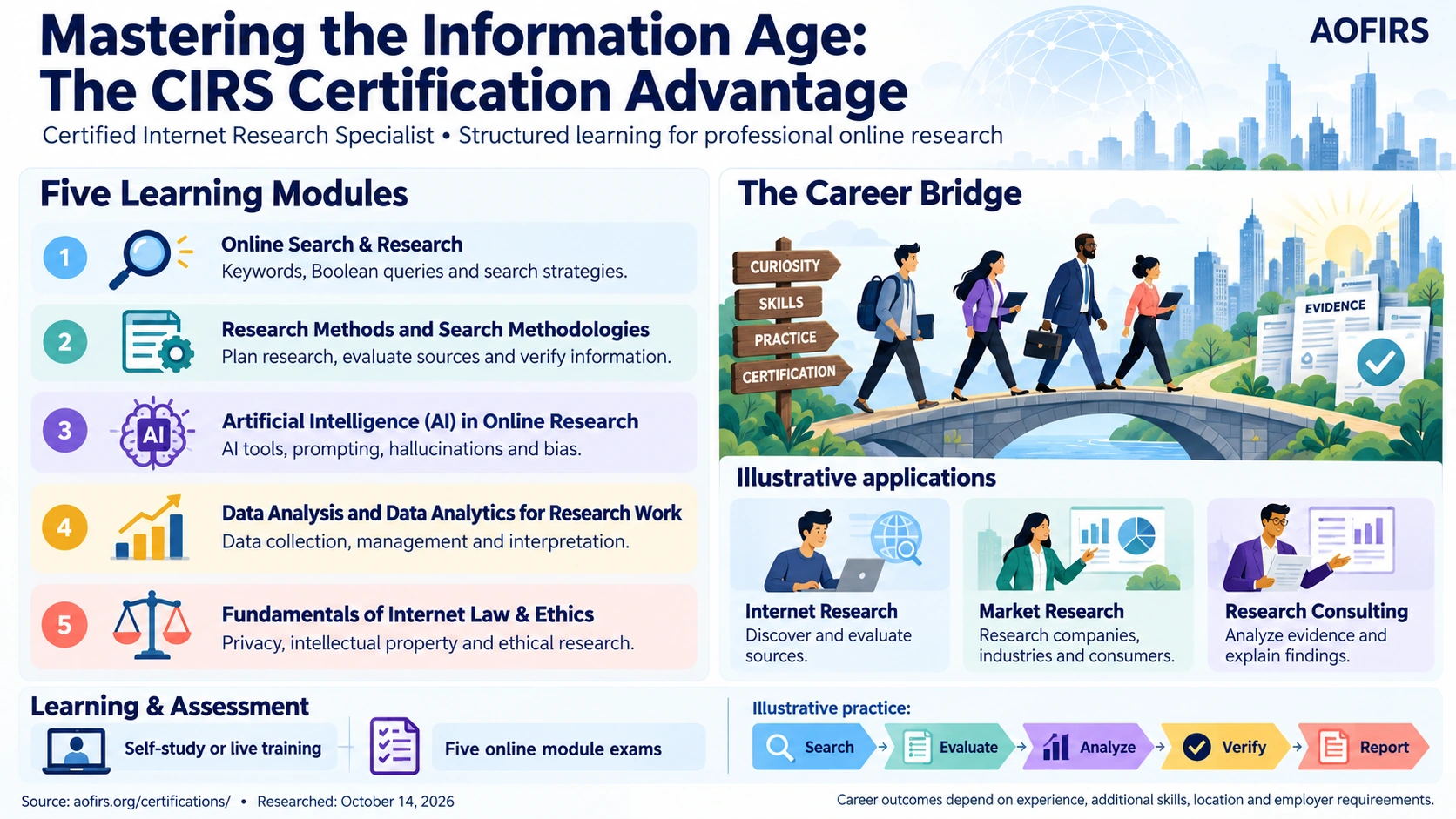
The Certified Internet Research Specialist (CIRS™) credential equips analysts, investigators, and researchers with accredited methodologies in OSINT, deep-web navigation, algorithmic bias mitigation, and verified data intelligence.
Frequently Asked Questions
What is semantic smoothing in conversational AI?
Semantic smoothing is the mathematical tendency of large language models and vector search algorithms to blend outlier, nuanced, or highly technical facts into the dominant statistical average of their training data. In research tasks, this causes the AI to favor widely repeated Clear Web consensus over niche but authoritative primary sources.
How does step-back prompting prevent AI hallucinations?
Step-back prompting forces the model to identify high-level foundational context—such as authoritative journals, regulatory frameworks, or primary datasets—before attempting to retrieve specific facts. This creates a dense semantic cluster in the retrieval space that anchors vector search, preventing the model from hallucinating plausible-sounding answers when encountering rare terminology.
Why should search syntax like site: and filetype: be included in AI prompts?
Default conversational prompts allow the AI’s internal parser to formulate generic search queries that return commercial, SEO-optimized web pages. Hardcoding boolean operators (e.g., site:.gov or filetype:pdf) forces the underlying search API to bypass commercial aggregators and retrieve raw, unindexed gray literature directly from primary repositories.
What is the Zero-Inference Rule?
The Zero-Inference Rule is a procedural prompt constraint that forbids an AI model from bridging gaps in retrieved data through speculation, extrapolation, or synthetic reasoning. If a factual claim is not explicitly substantiated by an identified primary source, the system is mandated to report an evidentiary deficit rather than offering an educated guess.