Quick Answer: Books, Online Sources, or AI?
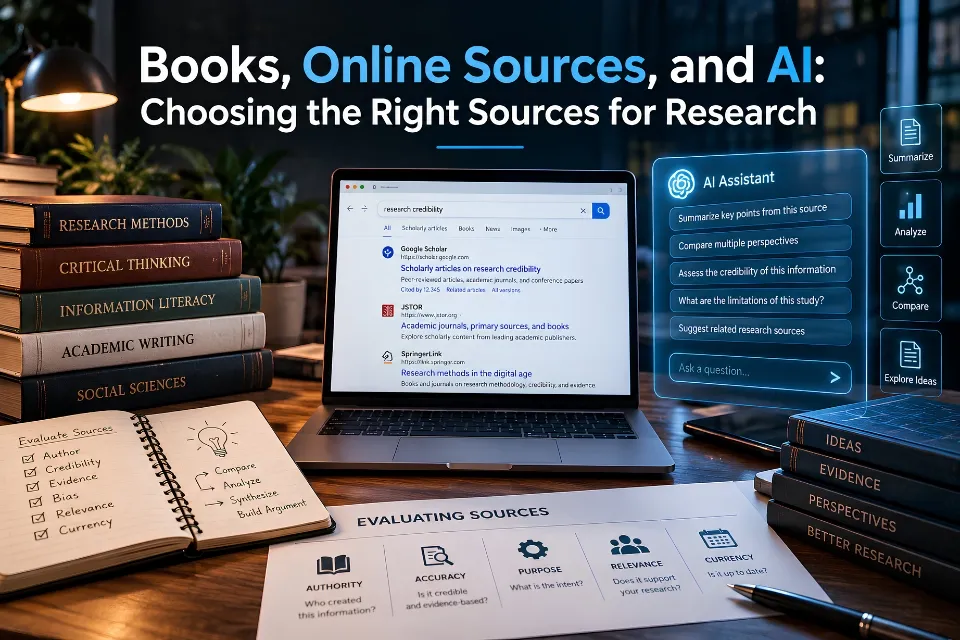
Books, online sources, and artificial intelligence serve different purposes in modern research. Books offer detailed explanations and established knowledge, online sources provide access to recent findings and original evidence, and AI tools assist with discovery, organization, and analysis. The most reliable research approach combines these resources according to information depth, currency, credibility, accessibility, and citation quality, while verifying important claims against original sources.
A researcher studying a historical event may need a scholarly book and archival documents. Someone investigating changes in public policy may require current government records and academic studies. An AI assistant can help both researchers explore a topic, but its generated answers are not a replacement for verifiable evidence.
The real challenge in 2026 is no longer simply finding information. It is knowing which information deserves attention, which sources are appropriate for a particular question, and how to establish whether the evidence supports a conclusion.
This guide examines the strengths and limitations of books, online publications, academic databases, and AI-powered tools. It also provides practical methods for selecting sources, evaluating their reliability, and documenting research findings.
What Are the Main Types of Research Sources?
Research sources are materials that provide information, evidence, or interpretations relevant to a research question. They can include original documents, academic books, journal articles, government records, datasets, and digital publications.
Artificial intelligence occupies a different position. Although an AI system may retrieve and cite research materials, its generated response is generally a synthesis or interpretation rather than an original source of evidence.
Understanding these distinctions is essential before comparing research methods.
Books and Traditional Research Materials
Books remain important for developing foundational knowledge and understanding complex subjects. They often offer detailed explanations that connect ideas, historical developments, theories, and competing interpretations.
Academic monographs focus on specialized research topics, while textbooks organize established knowledge for educational purposes. Reference books provide definitions, background information, and summaries.
The value of a book depends on its author, evidence, editorial standards, and relevance. A publication from a recognized academic press may undergo expert review, but this does not mean every statement is beyond challenge.
Traditional research also includes physical archives, historical manuscripts, institutional records, and printed documents. Some of these materials are primary sources, meaning they provide direct evidence of an event, observation, or research finding.
Books are particularly valuable when a researcher needs to understand how knowledge developed over time rather than examine only the latest findings.
Online Sources and Digital Research Materials
Internet research extends beyond entering keywords into a general search engine. It involves identifying, retrieving, evaluating, comparing, and documenting digital information from multiple sources.
Researchers can use scholarly journals, online databases, government portals, digital libraries, institutional repositories, historical archives, research datasets, and official records.
The AOFIRS article What Is Internet Research? A Professional Guide for 2026 explains how structured online investigation combines research planning, source discovery, evidence assessment, and documentation. This distinction matters because locating information through a search engine is only one part of the research process.
For example, a general search engine may help identify relevant organizations, but a specialized database may be necessary to locate original scientific studies or technical publications.
Online sources are particularly useful when the research question requires recent information, multiple perspectives, original datasets, or materials unavailable in a local library.
However, internet accessibility does not establish accuracy. Researchers may encounter reliable academic publications alongside misleading articles, outdated pages, and unsubstantiated claims.
Artificial Intelligence and AI-Assisted Research
AI-powered research tools can assist with discovering publications, developing research questions, summarizing documents, comparing evidence, and organizing information.
General-purpose assistants such as ChatGPT, Claude, Gemini, and Perplexity can support exploratory research. Specialized tools, including Elicit, Consensus, Semantic Scholar, and ResearchRabbit, offer capabilities focused on scholarly literature and related research tasks.
These systems do not all work in the same way. Some search the web, others examine selected documents, and certain platforms focus on citation networks or academic databases.
Researchers can benefit from AI assistance, but generated information must still be checked. AI may omit relevant evidence, misinterpret a publication, introduce unsupported details, or produce references that do not substantiate its claims.
AI is most useful when it accelerates research activities without replacing the researcher’s responsibility for evaluating evidence.
Books vs. Online Sources vs. AI: Key Differences
The strengths and weaknesses of research materials become clearer when they are compared against specific requirements.
| Research factor | Books | Online sources | AI research tools |
|---|---|---|---|
| Depth | Often provide sustained explanations and theoretical context | Range from brief reports to comprehensive research studies | Can summarize and compare information but may omit context |
| Currency | Depends on publication date and edition | Can provide newly published findings and updated records | Depends on knowledge availability, source retrieval, and tool capabilities |
| Credibility | Depends on author expertise, publisher, and supporting evidence | Depends on source authority, methodology, and transparency | Requires independent verification of generated claims |
| Accessibility | May require library access or purchase | Includes free, open-access, and subscription resources | Often accessible through conversational interfaces, with feature and subscription limits |
| Citation quality | Usually provides identifiable bibliographic information | Varies from formal scholarly records to poorly documented webpages | Generated references may be incorrect, incomplete, or unsupported |
These differences do not establish an overall winner. Each format becomes more or less useful depending on the research question.
A detailed academic book may be the strongest starting point for understanding a historical theory, while a current scientific paper may provide better evidence for a recently tested hypothesis.
Similarly, an AI-generated answer may be useful for identifying relevant search terms, but it should not be treated as stronger evidence merely because it combines information from several publications.
1. Research Depth: Which Sources Provide a More Complete Understanding?
Research depth refers to how thoroughly a source examines a subject, including its background, assumptions, methods, supporting evidence, competing explanations, and limitations.
A long publication is not necessarily a deep one. A brief original research paper may contain more relevant evidence for a narrowly defined question than an extensive book about the broader subject.
Books Provide Context and Theoretical Depth
Academic books often develop arguments across several chapters. They can connect events and ideas, explain changes over time, and explore theories from multiple perspectives.
For example, a researcher investigating the Industrial Revolution might consult academic histories covering economic change, labor conditions, technological innovation, and political institutions.
A well-researched book can help explain the relationships between these developments rather than presenting isolated facts.
Books are also useful for identifying influential theories and earlier scholarship that shaped current research.
Their limitation is that the discussion may reflect the knowledge available when the author completed the manuscript. Later discoveries or revised interpretations may require consulting more recent publications.
Online Sources Offer Specialized and Original Evidence
Online academic publications can provide exceptional depth, especially when the researcher needs detailed methodological information.
Original studies may include research designs, statistical analyses, experimental results, supplementary documents, and datasets. Digital archives can provide access to historical manuscripts, photographs, institutional correspondence, and other primary materials.
The AOFIRS resource 100 Academic Search Engines, AI-Powered Research Tools & Scholarly Databases surveys discovery platforms serving different academic purposes, including literature searching, citation analysis, data discovery, and scholarly research mapping. Selecting the appropriate database can uncover evidence that broad web searches may miss.
Online research also allows researchers to move between general explanations and specialized publications.
The challenge is that relevant evidence may be distributed across multiple databases, publishers, and repositories. Researchers must evaluate how these materials relate to one another rather than assuming the most prominent search result provides a complete answer.
AI Helps Organize Research but May Reduce Nuance
AI assistants can help organize complex information by identifying recurring themes, comparing supplied documents, and proposing ways to structure findings.
Suppose a researcher is examining barriers to renewable energy adoption. An AI assistant might organize relevant publications into categories such as financing, infrastructure, regulation, and public attitudes.
This can make a large collection of material easier to review.
However, a summary may overlook contradictory findings, methodological weaknesses, or important qualifications. The researcher’s understanding should come from examining the underlying publications.
For detailed academic work, AI-generated synthesis should be considered an aid to interpretation rather than a substitute for reading the original evidence.
2. Information Currency: Which Sources Are Most Up to Date?
Information currency concerns whether a source reflects the period and developments relevant to the research question.
Recent information is especially important when studying changing technologies, regulations, scientific findings, markets, or public policies. Older publications may remain highly relevant when researching historical events, foundational theories, or the development of ideas.
Books Can Have Publication Delays
Traditional publishing involves manuscript development, editing, review, production, and distribution.
A recently published book may therefore rely on evidence collected several years earlier.
This is particularly important in rapidly changing fields such as artificial intelligence, cybersecurity, medicine, and digital communications.
Researchers should check publication dates, editions, references, and whether newer findings have challenged the author’s conclusions.
A book published in 2026 is not automatically more appropriate than one published in 2020. The correct choice depends on whether the research concerns recent developments or established knowledge.
Online Sources Can Provide Timely Evidence
Government agencies, research institutions, academic publishers, and regulatory organizations can publish new information online.
For example, a researcher analyzing current employment conditions should seek recent labor statistics from the appropriate statistical authority rather than depend exclusively on figures reproduced in an older textbook.
Nevertheless, a website’s displayed update date can be misleading if researchers do not understand what was changed.
A page might have been revised recently even though its principal evidence is several years old. A news article may report findings from an earlier study without identifying when the data was collected.
Researchers should distinguish the date of an event, the date evidence was collected, the date a publication appeared, and the date it was updated.
AI Answers May Combine Information From Different Periods
AI systems may draw on previously acquired knowledge, current web retrieval, uploaded documents, or a combination of these sources.
An answer can therefore combine recent and outdated information without clearly distinguishing their origins.
Even AI tools with web access may retrieve an outdated webpage or overlook a newer correction.
Researchers should independently confirm dates using original publications and official records before presenting a claim as current.
The best source for time-sensitive research is one that provides dated, relevant, and verifiable evidence, not simply the newest-looking content.
3. Source Credibility: How Can Researchers Identify Trustworthy Information?
Source credibility depends on whether the information deserves confidence based on the creator’s expertise, the strength of the evidence, the research methods, and the transparency of the publication.
No source should be considered reliable solely because it appears in a book, academic database, or AI-generated response.
Evaluating the Credibility of Books
Academic books may undergo expert review and editorial evaluation, but standards differ across publishers and publication categories.
Researchers should examine the author’s qualifications, institutional or professional background, evidence, references, and reception within the relevant field.
A textbook may accurately explain established concepts without providing the strongest evidence for a newly emerging question.
Similarly, a respected historian may offer an influential interpretation that other scholars dispute.
The appropriate response is not to reject such sources automatically but to examine their arguments and supporting evidence.
Evaluating Online Information
Online sources require careful assessment because the internet contains materials produced under widely different editorial and research standards.
A government statistical report, a peer-reviewed research article, a company press release, and a personal blog may all be accessible through the same search engine.
Each serves a different purpose.
Official reports can be primary evidence of what an institution has published. Research papers can provide original findings. Company statements can establish what an organization claims, but independent evidence may be needed to assess those claims.
Researchers should examine authorship, methodology, publication context, possible conflicts of interest, and supporting documents.
Evaluating AI-Generated Information
AI-generated answers can sound confident even when their evidence is incomplete or inaccurate.
The AOFIRS learning publication The AI Trust Illusion: Why It Sounds Right Even When It’s Wrong examines why convincing AI explanations may encourage misplaced confidence. This is particularly relevant to research because a fluent answer can make unsupported claims appear authoritative.
An AI response containing several references is not necessarily more reliable than one containing fewer. Each reference must be checked to determine whether it exists and supports the relevant claim.
Researchers should also distinguish information retrieved from identified documents from explanations generated without traceable supporting evidence.
A Practical Source Credibility Checklist
Before relying on an important source, evaluate the following:
- Authorship: Who produced the information, and what relevant expertise do they have?
- Evidence: What documents, observations, or data support the conclusion?
- Methodology: Can the research methods or reasoning be examined?
- Currency: Is the information appropriate for the period being investigated?
- Independence: Do other credible sources provide independent confirmation?
- Transparency: Are limitations, funding, and potential conflicts disclosed?
- Integrity: Has the publication been corrected, challenged, or retracted?
Credibility should be assessed in relation to the specific research question. A source can be trustworthy for one type of information and unsuitable for another.
4. Accessibility: Which Research Sources Are Easier to Obtain?
Accessibility determines whether researchers can locate, obtain, read, search, and use information.
It includes practical issues such as cost, location, subscription requirements, language, technology, and restrictions on digital content.
Books May Require Physical or Institutional Access
Printed books may require purchase, library membership, or an interlibrary loan.
Some specialized publications are expensive or available only through selected academic institutions.
Digital books can reduce geographic limitations and allow full-text searching, but licensing restrictions may still prevent unrestricted access.
University libraries remain valuable because they provide access to scholarly books, databases, archival collections, and research assistance.
Online Sources Expand Research Opportunities
Online publications can help researchers access materials beyond their local libraries.
Open-access journals, government records, institutional repositories, and public datasets provide important opportunities for independent investigation.
However, researchers should distinguish search visibility from actual accessibility. A search result may display a publication’s title and abstract while the complete document remains behind a subscription.
Other research materials may not appear in ordinary search results at all.
The AOFIRS research report The Hidden Web in the Age of AI Search investigates the limitations of conventional indexing and AI-powered information retrieval. It highlights why researchers may need to search specialized databases and other legitimate information systems directly rather than depend entirely on general-purpose search engines.
This distinction is especially important when an unsuccessful web search is incorrectly interpreted as proof that information does not exist.
AI Makes Research Interfaces Easier to Use
AI systems allow researchers to explore topics through natural-language questions.
Instead of immediately learning complex search syntax, a researcher can ask an assistant to explain terminology, suggest related concepts, or organize supplied material.
This can help beginners develop an initial understanding of unfamiliar subjects.
However, convenience does not guarantee completeness. AI services may have restrictions involving source access, subscription features, document processing, and regional availability.
Researchers must also consider whether confidential records, personal data, or unpublished documents can be uploaded to an external AI service.
The most accessible tool is not always the most appropriate tool for handling sensitive or specialized information.
5. Citation Quality: Which Sources Are Easier to Verify?
Citation quality concerns whether a reference accurately identifies a source and allows readers to examine the evidence supporting a claim.
Strong research requires traceability. Readers should be able to determine where important information originated and whether the original material supports the author’s interpretation.
Books Usually Provide Established Bibliographic Details
Books commonly include identifiable information such as author names, titles, publishers, publication years, and editions.
For direct quotations or claims tied to particular passages, page numbers help readers locate the supporting evidence.
Researchers should pay attention to editions because chapter structures, pagination, and even conclusions can change.
A citation to a book is useful only when the book actually supports the statement.
Online Publications Can Offer Persistent Identifiers
Academic journals and digital repositories frequently provide metadata that helps researchers identify publications.
Digital Object Identifiers (DOIs) can provide persistent identifiers for registered research outputs, while repository records may offer stable links and version information.
Citation databases also help researchers identify related publications and trace how findings have been used by subsequent authors.
However, identifiers are not measures of scientific quality. A DOI can establish the identity of a registered work without establishing that its methods or conclusions are correct.
AI-Generated References Require Independent Checking
AI systems can produce references that resemble formally structured academic citations but contain incorrect information.
A reference may include a real author and journal but an inaccurate title. Another may identify an existing publication that does not support the statement attributed to it.
The AOFIRS article How to Do Internet Research in 2026 describes the importance of structured searching, source assessment, corroboration, and documentation. These practices are especially relevant when AI-generated material contains references that appear credible but have not been independently examined.
Researchers should conduct three separate citation checks.
Existence: Does the cited document actually exist?
Accuracy: Are its title, authors, publication date, identifiers, and other details correct?
Evidence: Does the original document support the exact claim?
Passing the first two checks does not guarantee that the citation provides appropriate evidence.
| Citation problem | Recommended verification method |
|---|---|
| Publication cannot be located | Search the title, author, and publisher records |
| Incorrect DOI | Check official DOI registration metadata |
| Wrong publication year | Compare the reference with the original publication |
| Unsupported claim | Read the relevant passage, methods, or results |
| Outdated research | Check for later studies, corrections, or retractions |
| Misleading quotation | Examine the original wording and surrounding context |
For academic publications, researchers should also consult the relevant citation style, such as APA, MLA, or Chicago, to ensure references are formatted consistently.
How Academic Databases Improve Research Quality
Academic databases help researchers discover specialized publications and organize literature searches.
Unlike general web search engines, many scholarly systems provide discipline-specific indexing, bibliographic metadata, subject classifications, and citation-searching functions.
The AOFIRS comparison 9 Best Academic Search Engines for Research in 2026 examines different academic discovery platforms and their applications. It provides useful context for selecting research services according to subject coverage, search capabilities, and access requirements.
Choosing the Right Academic Search Platform
Different platforms serve different purposes.
| Platform | Main research use | Important limitation |
|---|---|---|
| Google Scholar | Broad discovery of academic publications | Indexing does not guarantee peer review |
| PubMed | Biomedical and life sciences literature | Not all indexed records provide full-text access |
| JSTOR | Scholarly journals, books, and archival collections | Collection coverage and access vary |
| Scopus | Academic indexing and citation analysis | Comprehensive access usually requires a subscription |
| Web of Science | Scholarly discovery and citation analysis | Coverage is selective |
| Semantic Scholar | Research discovery and related-paper exploration | Automated recommendations require review |
| CORE | Discovery of open-access research | Available versions and metadata may differ |
| Crossref | Publication metadata and DOI identification | Bibliographic metadata does not establish research reliability |
A researcher exploring a medical question may begin with PubMed, while someone studying historical interpretations may benefit from JSTOR and specialized library catalogs.
For interdisciplinary topics, searching several databases can improve coverage.
Why Multiple Databases Matter
No academic search engine contains every relevant publication.
Databases differ in disciplinary coverage, supported document types, indexing decisions, language coverage, and access arrangements.
A researcher conducting a literature review should therefore consider more than one appropriate source.
Citation searching can also expand the literature collection.
Backward citation searching examines the references used by a known publication. Forward citation searching identifies later works that cite that publication.
These techniques can help researchers find influential studies, subsequent developments, and differing interpretations that a basic keyword search might overlook.
How AI Is Changing Research in 2026
Artificial intelligence is becoming an important part of information discovery and research organization.
Its principal advantage is not that it automatically produces correct conclusions. It can help researchers work through large collections of material, explore unfamiliar concepts, and identify possible relationships between documents.
AI Tools for Different Research Activities
General-purpose AI assistants can support question development, explanation, summarization, and preliminary analysis.
Research-focused systems can provide more specialized functions, such as finding scholarly papers, extracting study characteristics, or visualizing citation relationships.
| Research task | Examples of tools | Appropriate use |
|---|---|---|
| Topic exploration | ChatGPT, Claude, Gemini | Develop questions, clarify concepts, identify terminology |
| Scholarly discovery | Semantic Scholar, Consensus | Locate research publications and related evidence |
| Literature analysis | Elicit, NotebookLM | Organize and compare selected research documents |
| Citation mapping | ResearchRabbit, Connected Papers | Discover relationships among academic publications |
| Web research | Perplexity and web-enabled AI assistants | Identify potentially relevant online sources |
Capabilities and access conditions vary among tools and may change over time.
Why AI Summaries Are Not Original Evidence
An AI assistant may produce a convincing explanation of a scientific issue without conducting an original scientific investigation.
Even where the system retrieves external information, the generated summary can contain mistakes.
For instance, an AI response might state that a research finding applies to the entire population when the original study examined a narrow participant group.
It might also omit an important limitation or confuse correlation with causation.
The researcher must therefore examine the original publication and determine whether the AI interpretation accurately reflects the evidence.
AI Can Assist With Research Without Replacing Researchers
Responsible AI use involves assigning tasks according to the tool’s capabilities.
AI can help organize literature, propose search terms, explain technical concepts, and compare supplied documents.
Human researchers remain responsible for deciding whether evidence is appropriate, whether conclusions are justified, and whether important uncertainty has been acknowledged.
This distinction is particularly important for professional, academic, legal, medical, and policy-related research, where an unsupported interpretation may have significant consequences.
How to Combine Books, Online Sources, and AI in a Reliable Research Workflow
The most effective research strategy combines different information sources through a planned and documented process.
A structured workflow helps researchers avoid collecting large quantities of information without establishing whether it answers the research question.
The AOFIRS guide What Is OSINT? Methods, Tools and Ethics for 2026 provides an investigative example of combining source discovery, corroboration, documentation, and analysis. Although open-source intelligence serves particular investigative purposes, these methodological principles are also relevant to academic and professional research.
Step 1: Define the Research Question
Begin by establishing what the investigation needs to determine.
A broad question such as “Does remote work improve productivity?” can be refined to specify a population, timeframe, and measurable outcome.
For example:
“How does remote work affect employee productivity in knowledge-based occupations?”
A clear question makes it easier to identify suitable evidence and avoid unrelated information.
Step 2: Identify the Required Source Types
Determine what kinds of information would answer the question.
Books may explain theories of workplace productivity. Academic studies may provide original findings. Government publications may offer relevant labor statistics.
AI can assist with identifying concepts or possible search terms, but it should not independently determine which evidence is authoritative.
Step 3: Develop a Search Strategy
Identify important keywords, synonyms, and related concepts.
For a research question about remote work, a database search supporting Boolean operators might use:
("remote work" OR telework) AND (productivity OR performance)Researchers can refine the search using publication dates, document types, subject categories, and other available filters.
The syntax and supported operators should be checked against the documentation for each database.
Step 4: Search Books and Scholarly Publications
Consult appropriate library catalogs, academic databases, and institutional repositories.
Begin with relevant background publications before moving toward original research.
Where possible, record the search terms and filters used to locate the publications.
This makes the investigation more transparent and helps other researchers understand how evidence was collected.
Step 5: Use AI for Preliminary Organization
AI can help classify selected publications by research topic, methodology, population, or reported findings.
For example, a researcher might ask an assistant to organize supplied studies into themes such as employee autonomy, collaboration, technology access, and productivity measurement.
The resulting categories can guide further reading, but they should be checked against the original studies.
Step 6: Evaluate the Evidence
Read the relevant original documents rather than relying exclusively on abstracts or summaries.
Examine study design, sample characteristics, data quality, limitations, and the relationship between findings and conclusions.
If studies disagree, investigate whether they examined different populations, employed different methods, or measured different outcomes.
Step 7: Verify Important Claims
Compare significant claims with original publications and, where appropriate, independent supporting evidence.
Check quotations, statistics, dates, bibliographic details, and reported findings.
If a source cannot be verified or does not substantiate the claim, the researcher should revise or exclude the statement.
Step 8: Organize Research Records
Maintain a record of relevant publications, bibliographic details, research notes, and supporting evidence.
Citation management tools can help organize sources, but imported metadata should still be reviewed.
Researchers should also distinguish direct quotations from paraphrases and their own interpretations.
Step 9: Synthesize the Findings
Combine the evidence into a coherent explanation that addresses the original research question.
Identify areas of agreement, disagreement, and uncertainty.
Do not treat the number of sources repeating a statement as a substitute for evaluating their quality and independence.
Step 10: Document Limitations
Explain relevant limitations in the evidence and research process.
These might include unavailable publications, limited database coverage, incomplete datasets, language restrictions, or conflicting findings.
Acknowledging such limitations strengthens transparency and helps readers understand what the conclusions can and cannot establish.
Real-World Examples of Choosing Research Sources
Different research problems benefit from different combinations of books, digital sources, and AI tools.
Example 1: Historical Research
Research question: How did industrialization affect living conditions in nineteenth-century Britain?
Academic history books can provide background on industrial development, economic conditions, and changing social structures.
Digitized census records, historical newspapers, government reports, and archival documents may provide direct evidence about living conditions during the period.
AI could help researchers organize transcribed documents by subject or identify recurring themes.
However, historical interpretation requires attention to the origin, purpose, and limitations of the original records.
For example, an official document may reflect the administrative priorities of the institution that produced it rather than a complete account of the population being studied.
Recommended approach: Combine historical scholarship with primary archival documents and critically assess the context in which each source was created.
Example 2: Medical and Scientific Research
Research question: What evidence supports the effectiveness of a particular medical intervention?
Medical textbooks can explain biological mechanisms and established clinical concepts.
Original clinical trials, systematic reviews, and current professional guidelines provide more direct evidence about effectiveness and safety.
Researchers can locate relevant studies through biomedical databases and inspect the published methods, findings, and limitations.
AI may assist with organizing study characteristics or summarizing supplied research papers, but generated explanations must be checked against the original publications.
Recommended approach: Prioritize appropriate clinical evidence and current guidelines, using textbooks for foundational understanding and AI for limited supporting tasks.
Example 3: Business and Market Research
Research question: Which factors influence electric vehicle adoption in a particular country?
Academic books can explain economic behavior, innovation diffusion, and consumer decision-making.
Government registration data, charging infrastructure reports, regulatory documents, and company disclosures can provide evidence relevant to current market conditions.
AI can help organize potential factors such as vehicle prices, charging availability, consumer attitudes, and policy incentives.
However, the researcher’s final analysis should rely on verifiable datasets and clearly documented assumptions.
Recommended approach: Use scholarly theory for context, current official records for factual evidence, and AI-assisted analysis for organization and preliminary exploration.
When Should Researchers Use Books Instead of Online Sources?
Books may be preferable when the research requires sustained explanation, historical context, established theories, or a comprehensive introduction to a complex discipline.
They can also be useful when an influential author’s original argument is itself the subject of investigation.
For example, a student researching the development of economic theory may need to examine historical books directly rather than rely on contemporary summaries.
The important consideration is whether the book provides the most suitable evidence for the question.
Books should not automatically be preferred when recent findings, current legislation, or newly released statistics are essential.
When Are Online Sources the Better Choice?
Online sources may be preferable when researchers need current information, specialized academic publications, official documents, digital archives, or original datasets.
They are particularly valuable for comparing evidence across institutions and tracking developments over time.
However, researchers should choose the appropriate source rather than rely on general web search alone.
A government database may be more appropriate than a commercial blog for official statistics. An original scientific publication may be more appropriate than a news summary for evaluating research findings.
The quality of the source and its relevance to the question remain more important than the method used to retrieve it.
Why Source Verification Matters More in the Age of AI
AI-assisted search makes it possible to produce detailed explanations from large collections of information in a short period.
This convenience can create the impression that an answer has already been thoroughly researched.
In reality, a generated explanation may draw on incomplete material, repeat inaccuracies, or present uncertain findings without sufficient qualifications.
Researchers must distinguish between information that has been located, information that has been summarized, and evidence that has actually been verified.
Repeated Claims Are Not Independent Confirmation
Suppose a researcher finds the same statistic in several websites and an AI-generated answer.
The repetition may appear to strengthen the claim, but all the sources could have copied the figure from a single publication.
If that original publication contains an error, repeated references do not correct it.
The researcher should trace the statistic back to its primary source, examine the methodology, and determine whether the result has been represented accurately.
A Search Match Does Not Establish Original Authorship
Finding identical text in several search results does not automatically identify who created it first.
Material may be republished, syndicated, archived, translated, or copied. Search engines also do not necessarily discover or index pages in publication order.
Establishing provenance may require examining original documents, publication records, archived versions, and identifiable authorship.
This is particularly relevant when checking AI-generated references that repeat information without identifying the original evidence.
Researchers Remain Responsible for Their Conclusions
AI systems can support information retrieval and analysis, but they do not remove the researcher’s obligation to evaluate evidence.
Professional research requires judgment about source relevance, methodological quality, uncertainty, and the strength of a conclusion.
A credible final report should clearly distinguish established findings, reasonable interpretations, and unanswered questions.
Research Ethics and Academic Integrity
Selecting appropriate sources is only one part of responsible research. Researchers must also follow relevant ethical, legal, and institutional requirements.
Proper Attribution and Plagiarism Prevention
Researchers should clearly distinguish their original analysis from ideas, quotations, data, and interpretations obtained from other sources.
Paraphrasing requires genuine understanding and independent expression. Replacing a few words from an existing publication does not necessarily produce original writing.
Source acknowledgment allows readers to locate supporting material and assess how conclusions were developed.
Responsible Use of AI
Research institutions, publishers, and academic journals may have different requirements concerning AI assistance.
Researchers should follow applicable disclosure policies and should not use AI-generated content to conceal plagiarism, fabricate evidence, or misrepresent research methods.
When disclosure is required, the description of AI involvement should accurately reflect the work performed.
Privacy, Copyright, and Data Protection
Research involving personal records, confidential materials, or restricted databases requires additional care.
Public availability does not automatically make all forms of collection, redistribution, or analysis permissible.
Researchers should consider applicable privacy laws, copyright restrictions, platform conditions, institutional policies, and ethical research standards.
These requirements may differ across jurisdictions and types of information.
Essential Research Skills for 2026 and Beyond
The growing availability of information makes effective research skills more valuable, not less.
Researchers need to understand how information is created, discovered, evaluated, connected, and interpreted.
Important professional competencies include developing precise research questions, constructing advanced searches, selecting suitable databases, distinguishing primary from secondary evidence, evaluating information credibility, and verifying citations.
AI literacy adds another requirement: understanding when automated tools can assist and when their outputs require additional scrutiny.
The future of research is not defined by abandoning traditional methods. It depends on integrating established research principles with appropriate digital technologies.
Frequently Asked Questions
1. Are books more reliable than online sources?
Not necessarily. Reliability depends on the author’s expertise, the quality of supporting evidence, the publication process, and the relevance of the source to the research question.
2. What is the main difference between books and internet research?
Books often provide sustained explanations and established context, while internet research offers access to many types of digital evidence, including recent studies and original records. Both can support reliable research when their contents are evaluated appropriately.
3. Can AI replace academic books and research databases?
AI can assist with discovery, organization, and explanation, but it does not replace authoritative publications or original evidence. Researchers should verify generated claims and citations before relying on them.
4. Which research source provides the most current information?
Official online records, recently published studies, and regularly updated datasets are often suitable for time-sensitive questions. The researcher must still verify when the information was collected and whether it remains valid.
5. Are online academic journals credible?
Many academic journals publish peer-reviewed research, but editorial and methodological standards vary. Researchers should examine the journal, article type, research design, evidence, and any subsequent corrections.
6. How can researchers verify AI-generated citations?
Researchers should confirm that the referenced publication exists, check its bibliographic details, and read the relevant original material. A correctly formatted citation does not prove that the cited document supports the claim.
7. Why is combining books, online sources, and AI useful?
Combining these resources allows researchers to benefit from established context, specialized evidence, and efficient information organization. The approach is most effective when original sources remain the foundation of the conclusions.
8. What research skills are most important in 2026?
Important skills include advanced searching, source evaluation, research planning, evidence verification, citation management, AI literacy, and ethical information use. These skills help researchers produce findings that are transparent, traceable, and defensible.
Conclusion: The Best Research Approach Combines Sources and Verification
Books, online sources, and AI tools offer complementary benefits. Books help researchers develop detailed understanding, digital publications provide access to specialized and current evidence, and AI systems can improve the efficiency of research discovery and organization.
None of these resources should be trusted solely because of its format or apparent authority. A respected book may contain outdated information, an online article may misrepresent original research, and an AI-generated answer may provide convincing explanations without sufficient evidence.
Reliable research depends on selecting appropriate materials, examining original sources, evaluating credibility, verifying references, and acknowledging uncertainty. These responsibilities remain essential regardless of which technologies researchers use.
The most important research skill in 2026 is not simply finding answers. It is knowing how to establish whether those answers are supported by reliable evidence.