
Good writing requires more than vocabulary and creative ideas. Academic papers, nonfiction books, investigative articles, and professional reports depend on research that makes their claims accurate, useful, and traceable.
Writing workshops help aspiring writers develop research skills through instruction, practical exercises, source evaluation, and feedback. Participants practice forming questions, finding information, assessing its quality, comparing evidence, taking notes, and integrating findings into original writing.
How Writing Workshops Teach Research Methods
A writing workshop provides an opportunity for people to work through their individual research skills and get feedback on their choices. The ACRL information literacy framework presents research as an iterative inquiry process. It emphasizes contextual authority, strategic searching, and ethical information use. See ACRL literacy framework.
Rather than research being a one-off preliminary exercise, the research is embedded throughout the process of topic development, outlining, drafting, revising and fact-checking.
1. Turning Broad Ideas Into Researchable Questions
Many novice writers begin with topics that are far too wide.
For example, “technology and education” is too broad for a focused article. It needs a specific population, activity, or problem.
A workshop instructor might help the writer narrow the subject to:
How do university students assess AI-generated material when they’re doing their research assignments?
The more specific question is one which identifies a particular audience, a particular activity, and a particular research problem.
It also points to which sources might be of use (e.g., information literacy research, university guidance, and student interviews).
2. Learning to Select Appropriate Sources
Writers encounter different forms of evidence, each with strengths and limits. A workshop can teach participants to distinguish original records, scholarly interpretations, commentary, and unsupported claims.
A workshop can teach you to tell the difference between firsthand records, academic interpretations, professional commentary, and unsubstantiated claims that you’ll find on the internet.
A source which is useful for understanding public opinion may be of no use at all for the establishment of scientific fact.
Through guided comparison, participants learn to select information in accordance with the purpose of their writing.
3. Practicing Information Verification
Source evaluation is much easier to grasp when learners get to do it in practice.
An instructor can present several sources discussing the same event and ask participants to identify:
- Who produced each source?
- What original evidence does it provide?
- Which ones are factual statements and which are interpretations?
- Are all the key details independently verified elsewhere?
- What remains uncertain?
Purdue OWL recommends evaluating sources as part of the research process, including checking whether claims have identifiable evidence and whether information is appropriate for the topic. See source evaluation guidance.
4. Receiving Feedback on Research-Based Writing
Feedback enables the writer to spot problems they might otherwise miss.
For instance, a draft might contain a perfectly reliable statistic but use it to support a conclusion which the statistic in fact doesn’t establish.
A workshop facilitator or a peer reviewer could in fact question the link between the evidence and the argument.
This encourages the writer to go back and reconsider their reasoning rather than just work on the sentence construction.
Essential Research Methods Every Writer Should Learn
Research methods are systematic ways of finding, collecting, analyzing, and interpreting information.
The right method will depend on the purpose of the piece, the subject matter, and the evidence you need.
| Research method | Explanation | Writing application |
|---|---|---|
| Primary research | Collecting or examining firsthand evidence | Interviews, observations, original records |
| Secondary research | Studying existing analyses or publications | Literature reviews and background research |
| Qualitative research | Exploring experiences, meanings, and perspectives | Interviews and thematic analysis |
| Quantitative research | Examining numerical information | Survey results and statistical reports |
| Library research | Using catalogs, journals, and reference collections | Academic and nonfiction writing |
| Online research | Finding information through digital resources | News research, professional reports |
| Archival research | Examining preserved historical records | History and historical fiction |
| AI-assisted research | Using AI to support research activities | Planning, organizing, and reviewing evidence |
These approaches overlap and describe different aspects of research. An archive document can be a primary source, and an online journal article may analyze secondary evidence. AI assistance is a supporting workflow, not a substitute for a sound research design.
A source’s role as primary or secondary depends on its relationship to the topic and research question. The format alone does not determine its value. See primary source guidance.
How to Conduct Effective Online Research in 2026
Online research starts with picking the right search systems and then developing a considered search strategy.
Typing a wide question into a search engine will give you a starting point, but very rarely will it provide you with all the evidence you need for a real article.
Start With Specific Search Terms
Instead of searching for “student writing problems,” a researcher could search for terms such as:
university students information literacy source evaluationA more targeted search will help you find the academic discussions and instructional materials.
Try related terms because disciplines may describe the same issue differently.
Use Search Operators Carefully
Search operators can be used to narrow the results.
| Search example | Intended use |
|---|---|
| “information literacy” | Look for an exact phrase |
| site:edu “research writing” | Explore matching pages on educational domains |
| filetype:pdf “writing research methods” | Search for matching PDF documents |
| “research methods” “creative writing” | Combine two research concepts |
Search engines may well interpret the operators in different ways and no query is going to give you complete results.
Search Beyond General Search Engines
Useful sources are Google Scholar, university library catalogs, research databases, government publications and digital archives.
For academic writing, the bibliography and citation records can be a useful tool for the researcher to find out about further publications.
For historical work library and archive collections can contain material that you simply won’t find through a normal web search.
General search results do not cover every useful resource. Combine them with library catalogs, scholarly databases, and archives appropriate to the question. See research source guide.
How Writers Can Evaluate Sources and Verify Information
Finding out something is only the first step. The writer has to then assess whether the source is suitable and whether the assertions made in it are in any way supported.
Evaluate Authority in Context
Consider the author’s expertise and their relationship to the subject.
A firsthand witness can be of considerable value in terms of evidence regarding an event they’ve been directly involved in. A scientist may be in a better position to interpret a particular study.
Neither form of authority should be regarded as unlimited.
Examine the Original Evidence
Key questions are whether the source identifies its data, its methodology, its documents and its references.
When a news story reports on the results of a study, it’s worth looking at the original study if you can.
Check that the article accurately reflects the research population, the methods and the conclusions.
Check Dates and Context
Current information matters in rapidly changing fields such as technology and public policy. Match the publication date to the question rather than assuming that the newest page is always the strongest source.
Historical research invariably involves the use of older original documents.
A source should be judged on its relevance to the research question rather than simply dismissed on the grounds that it’s old.
Practice Lateral Reading
Lateral reading is just leaving the page to check out the publisher, the claims and the reputation of the page via independent sources.
Rather than just looking at the organization’s About page, a researcher might look for external reporting, the original documents or independent assessments.
This helps to establish the context which may not be present in the source at all.
Corroborate Important Claims
Independent corroboration can strengthen confidence in a claim, but only when sources provide evidence relevant to it. Agreement alone does not establish accuracy.
However five sites repeating the same unsubstantiated claim don’t constitute five independent confirmations.
Writers should look at where the original information came from.
Source Verification Checklist
Before you use a source ask whether the author and publisher are identifiable, whether the claims are backed up by evidence, whether the date and context are appropriate and whether the information can be independently corroborated.
Also bear in mind what the source cannot establish. A reputable publication may well have a very limited dataset, a very narrow perspective or simply not have resolved the uncertainties.
Organizing Research Notes, Sources, and Evidence
Reliable information is difficult to use when notes are disorganized. Record bibliographic details, evidence, quotations, and your own interpretations separately.
Writers should record their source details as they go during the research phase rather than trying to piece references together after the draft is complete.
A good research log will contain the source title, the author, the date of publication, the URL or where the document can be found, the key findings and then your own notes on the credibility of the source and any limitations you may have identified.
Create an Evidence Matrix
An evidence matrix links the research questions to the evidence.
| Research question | Evidence needed | Source type | Verification action |
|---|---|---|---|
| What happened? | Dates, events, records | Original documents | Confirm dates and chronology |
| Why did it happen? | Explanations and context | Scholarly analysis | Compare interpretations |
| Who was affected? | Experiences and population data | Interviews and statistics | Assess sample and scope |
| What remains uncertain? | Missing or conflicting evidence | Multiple source types | Document unresolved questions |
Citation-management software such as Zotero can help collect and organize references and documents. It does not replace checking the accuracy of the record. See Zotero basics.
Writers should still check imported citations. Wrong metadata can make it all the way through into the final reference list.
Integrate Evidence Without Plagiarism
Research-supported writing requires more than just dropping in a few quotes.
Writers should provide the relevant evidence, explain what it establishes and then link it to the wider argument.
Paraphrasing is about expressing the meaning of the original in genuinely original language and structure, with appropriate attribution. Simply changing a few words is not enough.
Direct quotations must be accurate, purposeful and correctly attributed.
Purdue OWL explains how quotation, paraphrase, and summary differ and why each requires appropriate attribution. See Purdue citation guidance.
Using AI Research Tools Responsibly in Writing
AI can assist with research planning, alternative search terms, organizing supplied notes, summarizing supplied documents, and identifying claims that may need support. The writer must review the output against original evidence.
Tools such as ChatGPT, Claude, Gemini, and NotebookLM can support parts of this work. Choose tools according to the task, permitted data, and access to source material.
Their features, access to source material and availability all differ. Writers should check the current documentation before picking a tool for a particular research task.
OpenAI notes that ChatGPT can produce incorrect facts, fabricated quotations, and nonexistent citations. Important claims should be checked against reliable sources. See ChatGPT accuracy guidance.
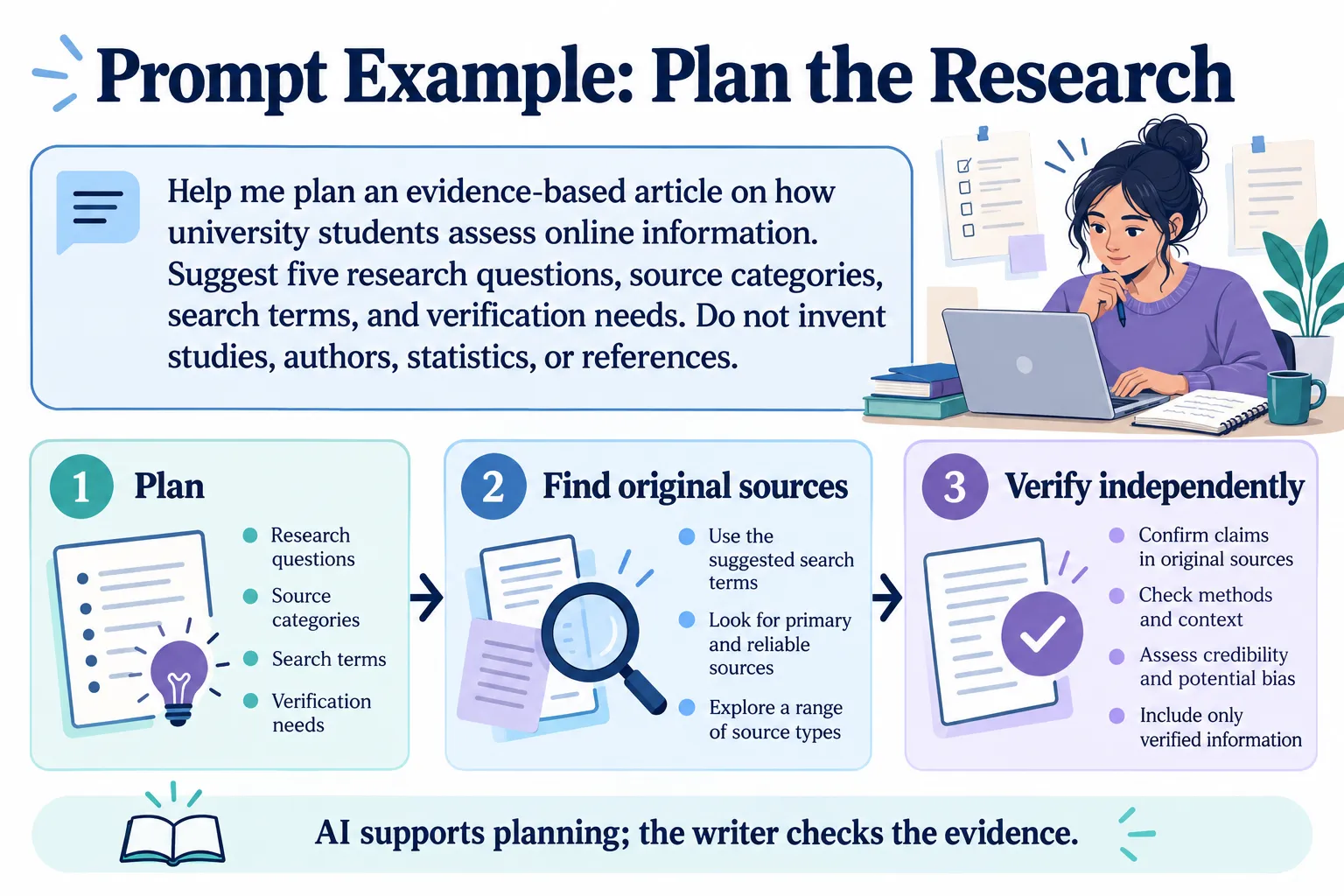
Example: Using ChatGPT to Plan Research
A writer might use the following prompt:
Help me plan an evidence-based article on how university students assess online information. Suggest five research questions, source categories, search terms, and verification needs. Do not invent studies, authors, statistics, or references.
This prompt is asking for help with research planning rather than for some unsupported factual conclusion.
A follow-up prompt could request a critical review:
Review my draft for factual claims that need citations, overly broad statements, and conclusions that exceed the supplied evidence. Do not generate references. For each issue, identify the evidence I need to verify.
The writer then has to do the check using the original sources.
Protect Research Integrity
Do not upload confidential research or identifiable participant data unless the required consent, institutional approval, and tool permissions are in place. Verify quotations, statistics, and cited publications against originals, and follow applicable AI-use and disclosure policies.
Generated content can also be biased and can just as easily miss key perspectives.
An effective workshop would be one that teaches people to treat AI output as material to assess rather than as a replacement for their own research.
ACRL’s framework revisions approved on September 2, 2026 address critical engagement with emerging technologies, including AI and digital literacy. These principles support evaluating tools and outputs rather than assuming they are authoritative. See ACRL literacy framework.
Five Practical Research Exercises for Aspiring Writers
The following activities can be used in a writing workshop or can be completed individually.
Exercise 1: Turn a Broad Topic Into a Research Question
Objective: To produce a focused and researchable question.
Materials: notebook or word processor and access to the introductory sources.
Start with climate change. Narrow it down to urban tree cover. Then pick a population, a place and a research issue.
An example question is:
How do the city’s tree planting policies deal with the issue of unequal exposure to urban heat in that particular US city?
Expected output: One focused research question and three supporting questions.
Evaluation: The question should be specific, answerable on the basis of the evidence available and something that can be sensibly addressed within the confines of the assignment.
Exercise 2: Compare Three Sources
Objective: To learn how to assess different types of evidence.
Materials: One news article, one relevant academic study and one government publication on the same subject.
Read the three sources and record their authors, publication dates, purposes, evidence and limitations. Identify which of the claims are independently supported and which are based on the same underlying information.
Expected output: A one-page source comparison.
Evaluation: the writer should set out the strengths and weaknesses of each source, without necessarily implying that one form of publication is better than another.
Exercise 3: Build an Evidence Matrix
Objective: To organize the research findings for the purpose of accurate writing.
Materials: Three to five verified sources and a spreadsheet or table.
Select three factual claims which are relevant to your research question. For each of those claims you need to record the source, the evidence, the date of publication and any uncertainty.
Expected output: A completed evidence matrix linking the claims to the sources.
Evaluation: Every assertion should be properly supported and any gaps in the argument should be apparent.
Exercise 4: Verify an AI-Generated Claim
Objective: Practice independent fact-checking.
Materials: An AI-generated factual statement, web access and relevant primary sources.
Ask an AI assistant for a factual claim on a research topic. Find the original source of the cited evidence or independently source a reliable one.
Determine whether the statement is confirmed, contradicted, partly supported or unverifiable.
Expected output: A brief fact-checking report containing the claim, the evidence and the conclusion.
Evaluation: The conclusion has to be one that follows from independently verifiable evidence rather than the AI assistant’s confidence.
Exercise 5: Write a Research-Supported Paragraph
Objective: To incorporate credible evidence into the original text.
Materials: A research question, an approved source and a citation guide.
Draft a paragraph containing a clear topic sentence, an accurately attributed piece of evidence and original analysis explaining its relevance.
Review the paragraph to make sure the evidence actually supports the claim.
Expected output: One polished paragraph with appropriate citation.
Evaluation: The work should set out the writer’s own interpretation of the material and not simply restate or rephrase the findings of the source.
A Seven-Step Research Workflow for Writers
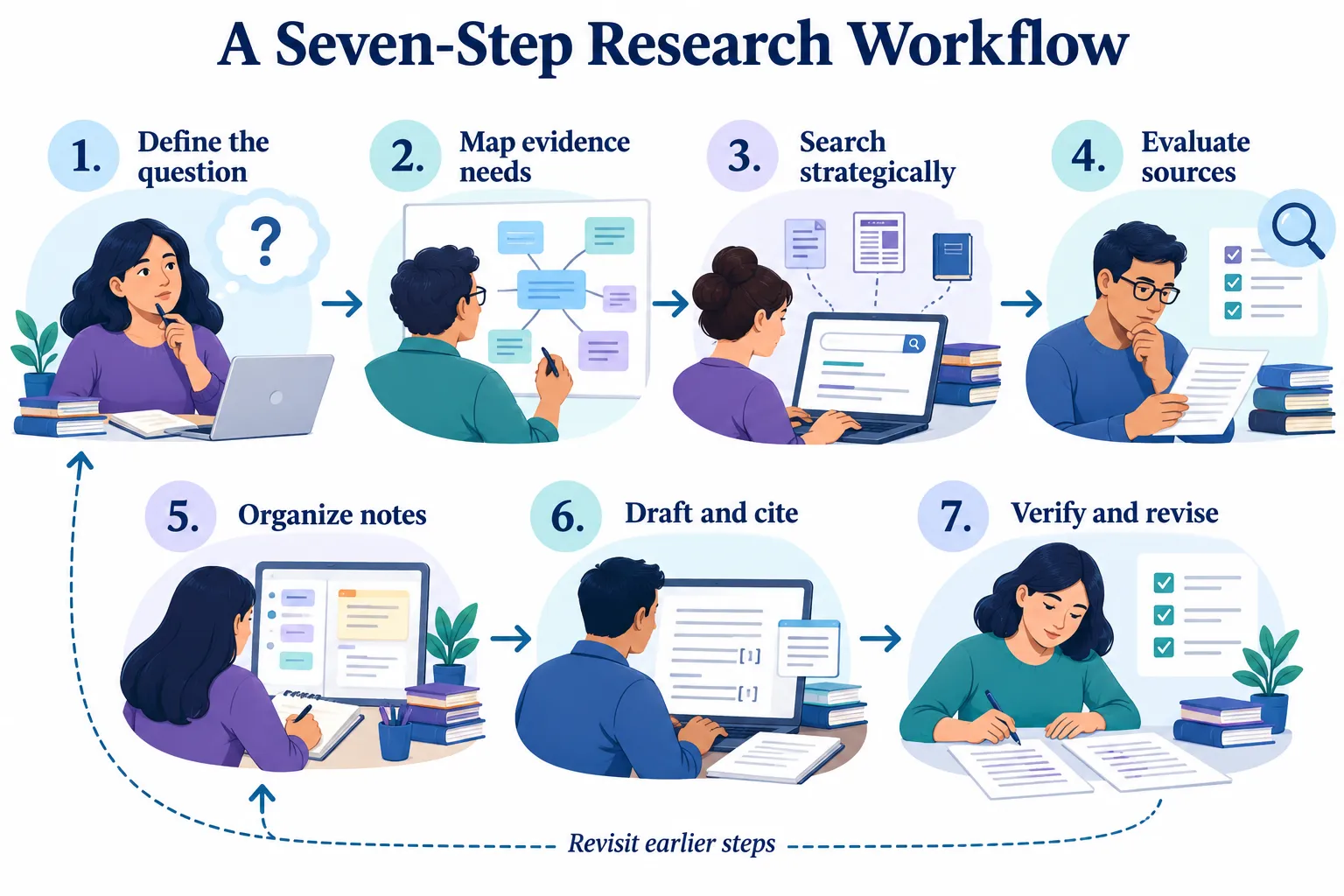
A consistent workflow helps writers turn an initial idea into a supported draft. New sources may reveal gaps, require a narrower question, or prompt additional research.
Writers should regard the process as iterative rather than a rigid sequence that cannot be revisited.
- Define the question: Set the topic, scope, audience, and purpose.
- Map evidence needs: Identify the kinds of evidence each question requires.
- Search strategically: Use relevant keywords, databases, libraries, and archives.
- Evaluate sources: Check authorship, methods, dates, context, and corroboration.
- Organize notes: Record source details, exact quotations, findings, and limitations.
- Draft and cite: Connect evidence to your reasoning and attribute borrowed material.
- Verify and revise: Check factual claims, citations, and the limits of your conclusions.
Worked Example: Researching the Environmental Impact of Fast Fashion
Consider a hypothetical writing workshop in which a student is assigned an evidence-based article about fast fashion.
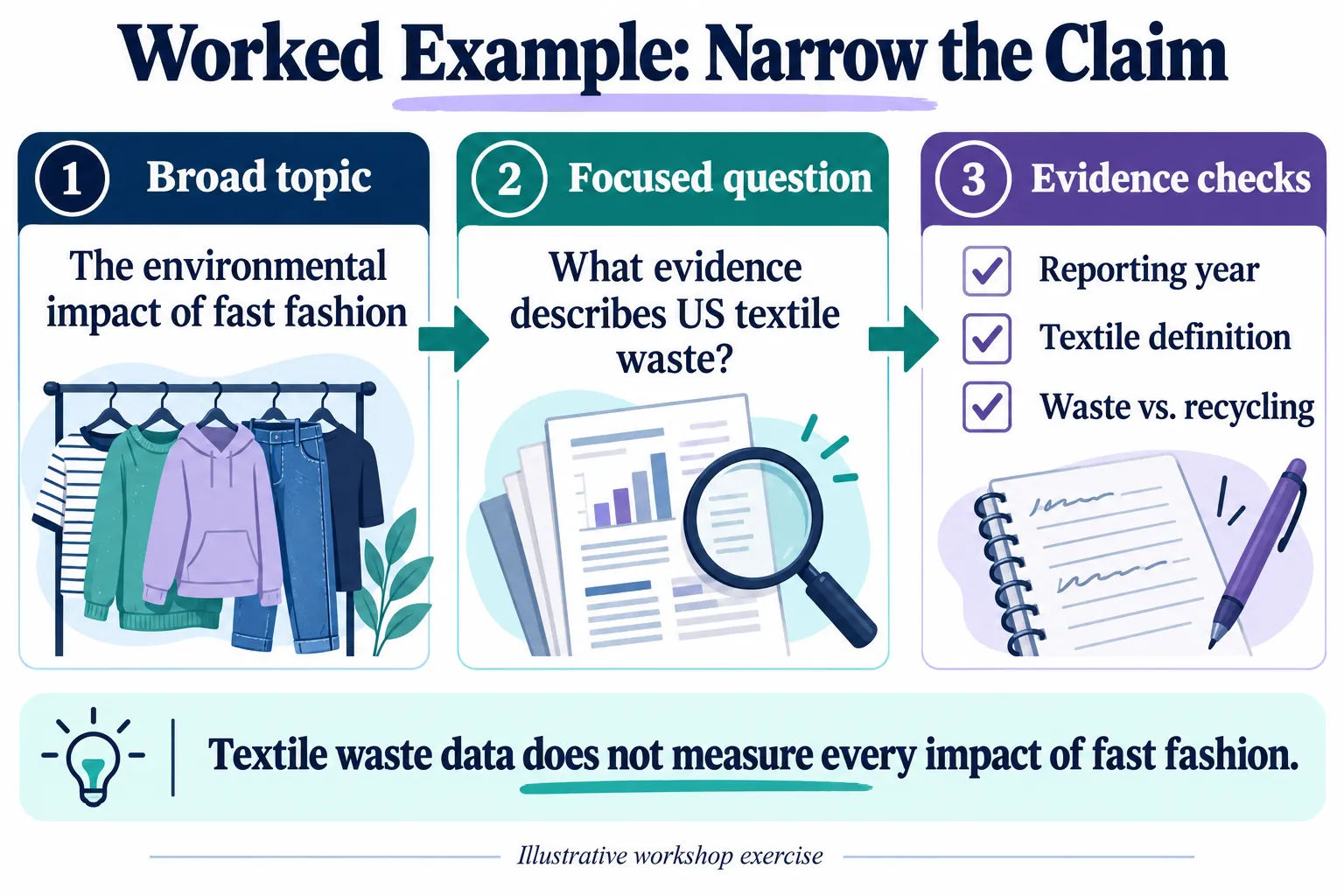
The initial subject is too broad:
The environmental impact of fast fashion.
A more manageable question would be:
What evidence is available about textile waste associated with clothing consumption in the United States?
Define the Scope
The student decides to examine textile waste rather than attempting to cover every environmental consequence of the fashion industry.
This creates a clearer research boundary and helps identify suitable sources.
Find Relevant Evidence
The student begins with official environmental statistics and relevant academic research.
A starting point is the US Environmental Protection Agency’s textile material-specific data for municipal solid waste. The page’s summary table covers 1960–2018, so the figures must not be presented as measurements of 2026 waste. See EPA textile data.
The researcher must check the reporting year, definition of textiles, and scope of the data before drawing conclusions.
Develop Search Queries
Useful search strategies might include:
site:epa.gov textile waste municipal solid wastetextile waste United States academic researchclothing reuse recycling environmental assessmentThese searches target different evidence needs rather than repeatedly requesting a general explanation of fast fashion.
Evaluate the Sources
The student examines whether each source concerns clothing specifically or a broader category of textiles.
The student also checks whether figures describe waste generated, materials recycled, or another measurement.
These distinctions matter because superficially similar numbers may refer to different quantities.
Build an Outline
A suitable article outline might include an explanation of the textile waste problem, the available US evidence, measurement limitations, approaches to reuse and recycling, and unresolved research questions.
Each major section should connect to identifiable sources.
Draft an Evidence-Supported Paragraph
A model paragraph could read:
Textile waste is one measurable dimension of the environmental issues associated with clothing consumption. EPA estimates describe textiles within municipal solid waste and can support an analysis of disposal and recycling. However, the categories extend beyond clothing, and the reporting year and definitions must accompany any numbers. These data alone do not measure every environmental impact of fast fashion.
This paragraph avoids unsupported numerical claims and identifies the limits of the evidence.
Complete the Fact-Check
Before submitting the article, the student reviews the EPA source, confirms the terminology, verifies any added figures, and checks that each claim has an appropriate citation.
The exercise demonstrates that rigorous research depends not only on finding information but also on understanding what that information actually proves.
Common Research Mistakes Aspiring Writers Should Avoid
| Common mistake | Better approach |
|---|---|
| Starting with an overly broad topic | Develop a focused research question |
| Using only the first search result | Compare relevant sources |
| Depending on a single publication | Seek independent corroboration |
| Treating opinion as established fact | Identify the evidence behind claims |
| Ignoring publication dates | Match source dates to the research question |
| Repeating unchecked statistics | Verify original data and definitions |
| Copying source language too closely | Paraphrase genuinely and cite appropriately |
| Losing track of references | Maintain a source log from the beginning |
| Trusting AI-generated summaries | Inspect original documents |
| Searching only for supporting evidence | Investigate contradictory explanations |
Good research practices reduce errors and improve the clarity of the final work. They also help writers recognize when the available evidence is insufficient.
Frequently Asked Questions
Why are research skills important for aspiring writers?
Research skills help writers find reliable information, develop informed arguments, and avoid factual errors. They also make it easier to distinguish credible evidence from unsupported claims.
How do writing workshops teach research methods?
Writing workshops can combine instruction, guided exercises, source comparisons, peer feedback, and research-based writing assignments. These activities allow participants to practice research decisions and improve their work through revision.
What is the difference between primary and secondary research?
Primary research involves collecting or examining firsthand evidence, such as interviews or original records. Secondary research analyzes or interprets information that already exists.
How can beginners find reliable sources for writing?
Beginners can start with university libraries, academic databases, government publications, and credible institutional resources. They should also check authorship, evidence, publication dates, and independent corroboration.
Which online research tools are useful for writers in 2026?
Google Scholar, library databases, digital archives, citation managers such as Zotero, and AI-assisted research tools can support different stages of writing. The right choice depends on the research question and the evidence required.
Can ChatGPT help writers conduct research?
Yes. ChatGPT can assist with planning, generating search terms, organizing supplied information, and reviewing drafts. Writers must independently verify factual claims, references, and quotations.
How can writers avoid plagiarism when using research?
Writers should accurately attribute ideas, quote directly when necessary, and paraphrase using their own language and sentence structure. Citation requirements should follow the relevant publication or academic style.
What is the best way to organize research notes and citations?
Use a source log, organized research notes, and an evidence matrix to connect claims with supporting material. Citation-management software can help, but imported bibliographic records should still be checked.
Conclusion
Writing workshops can provide aspiring writers with a practical foundation in research methods by combining structured instruction with exercises, feedback, and opportunities to revise their work. Learning to formulate useful questions, identify appropriate sources, evaluate evidence, and integrate findings into original writing can strengthen work across academic, creative, journalistic, and professional contexts.
In 2026, digital databases, online archives, and AI-assisted tools offer additional ways to discover and organize information. Their value depends on how responsibly they are used. The strongest writers remain active investigators who question sources, document their methods, and take responsibility for the accuracy of their work.