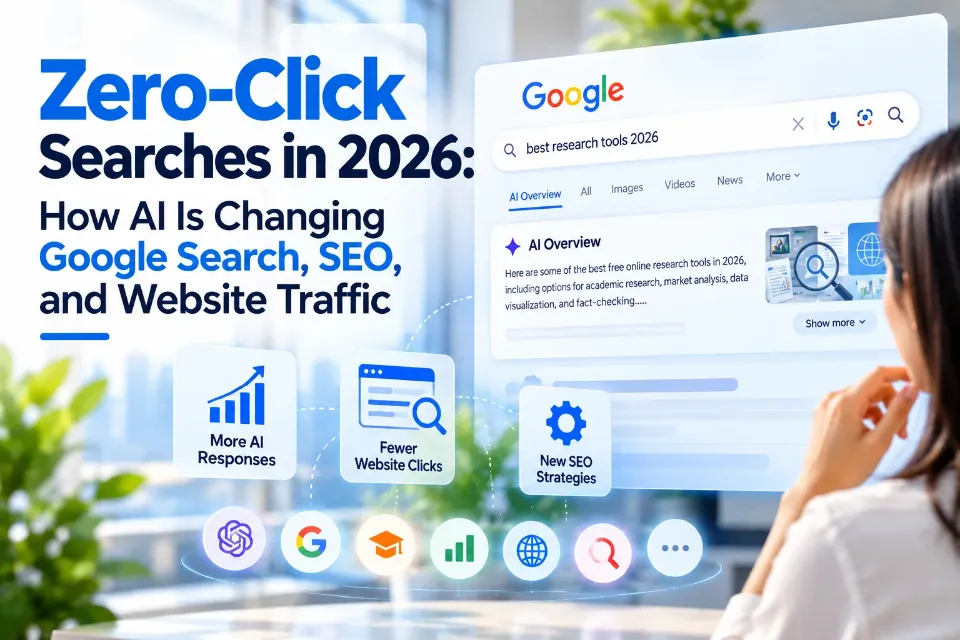
When customers need information, they do not always type keywords into a search engine. Many now speak directly to their smartphones, smart speakers, and AI assistants, asking questions in the same way they would speak to another person.
Instead of typing “best digital marketing agency nearby,” someone might ask, “Which digital marketing agencies near me specialize in helping small businesses?”
This change matters because spoken questions often communicate more about what a person wants, the problem they are trying to solve, and the type of answer they expect.
Optimizing your marketing strategy for voice search queries means making your business information and website content easier to discover and understand when people use spoken, natural-language searches.
As voice-enabled technology evolves alongside artificial intelligence, businesses have good reasons to review how their content answers customer questions.
The goal is not to replace traditional SEO. It is to make existing marketing strategies more responsive to the different ways people search for information in 2026.
What Are Voice Search Queries?
Voice search queries are spoken requests that people submit through voice-enabled search applications, digital assistants, and other connected devices.
They can be simple requests, such as asking for opening hours, or more detailed questions involving comparisons, recommendations, and explanations.
Voice search involves several technologies working together.
Automatic speech recognition processes spoken words. Natural language processing helps interpret the meaning of the request. Search or information retrieval systems then identify relevant information, while some AI-powered interfaces generate conversational responses.
The exact process varies by platform.
For example, users may interact with Google Search through supported voice features, communicate with Siri on Apple devices, or make requests through Alexa-enabled products.
These interfaces do not necessarily use identical information sources, ranking systems, or response formats.
That distinction is important for marketers. There is no single optimization technique that guarantees a business will appear in every voice assistant’s response.
Why Voice Search Matters for Digital Marketing in 2026
Voice search deserves attention because it reflects a broader movement toward conversational interaction with digital information.
People increasingly expect technology to interpret questions expressed in ordinary language.
For businesses, this affects how content is planned, organized, and presented.
1. Customers Search Using Natural Language
Traditional keyword research often focuses on short phrases.
A user might type:
“affordable website design”
When using voice search, the same person could ask:
“How much does it cost to build a professional website for a small business?”
The spoken question reveals a more specific information need. The user wants to understand pricing rather than simply find a service provider.
A marketing strategy built around customer questions can address these differences.
Businesses can create explanations that answer common concerns, clarify available services, and help potential customers make informed decisions.
However, marketers should not assume all voice searches are longer than typed searches. Search behavior depends on the device, user, and task.
The practical advantage comes from understanding search intent, not simply targeting longer phrases.
2. Voice Search Can Support Local Business Discovery
Voice-enabled search can be useful when someone needs information about nearby businesses.
A customer might ask:
“Where can I find an emergency plumber near me?”
Another could ask:
“Which coffee shops are open before seven in the morning?”
These questions depend on accurate business information, including location, services, and operating hours.
For businesses serving local customers, maintaining complete and consistent information is a practical optimization step.
A well-maintained Google Business Profile, accurate contact details, relevant service pages, and clearly described service areas can support local discovery.
Businesses should also review changes to their opening hours and contact information across the platforms they use.
These efforts improve the reliability of business information generally. They do not guarantee a particular position in a spoken recommendation.
See Google’s local ranking guidance for maintaining complete business information.
3. Conversational Queries Can Reveal Stronger Customer Intent
Some voice searches communicate a clear intention to take action.
Consider these requests:
- “How do I book a consultation with a tax advisor?”
- “Where can I buy replacement filters for my air conditioner?”
- “What should I ask before hiring a cybersecurity consultant?”
Each question represents a different stage in a customer journey.
The first concerns booking, the second suggests a purchase need, and the third involves evaluating a service.
When businesses understand these differences, they can develop content suited to the user’s objective.
A service page might explain appointment options, while an educational guide could discuss important evaluation criteria.
The result is a more useful content experience for visitors who arrive through either spoken or typed searches.
4. Voice Search Encourages Clearer, More Accessible Content
People using voice interfaces may expect straightforward explanations without needing to navigate lengthy pages.
This creates a useful editorial principle: answer the main question clearly before expanding into supporting details.
For example, an article about customer relationship management software should explain what CRM software does before introducing complex features or comparing products.
Readable sentences, descriptive headings, and understandable terminology benefit a wider audience.
These improvements can also help users who rely on assistive technologies or have limited familiarity with technical subjects.
Voice search optimization is therefore an opportunity to improve content accessibility and usability, not simply a tactic for attracting additional traffic.
How AI Is Changing Voice Search and Search Behavior
Artificial intelligence is influencing how voice-enabled systems interpret requests and deliver information.
Earlier voice assistants often focused on short commands and predefined tasks. More recent systems can support richer questions and, in some cases, follow-up conversations.
In June 2025, Google introduced Search Live with voice input in AI Mode as an experimental experience in the United States. It allowed participants to have back-and-forth spoken conversations, receive audio responses, and explore relevant web links.
Google’s Search Live announcement documents this initial rollout.
This illustrates how voice interaction can become part of a broader research process rather than a single isolated search.
A user might initially ask how to reduce electricity costs, then request an explanation of energy-efficient appliances, followed by a comparison of available options.
The user’s information needs develop during the conversation.
For content marketers, this creates an opportunity to provide accurate, interconnected explanations that address several stages of a research journey.
However, AI-generated responses can contain errors, and their choice of supporting information may differ from conventional search results.
Businesses should therefore focus on reliable source material rather than trying to exploit assumptions about how AI assistants select answers.
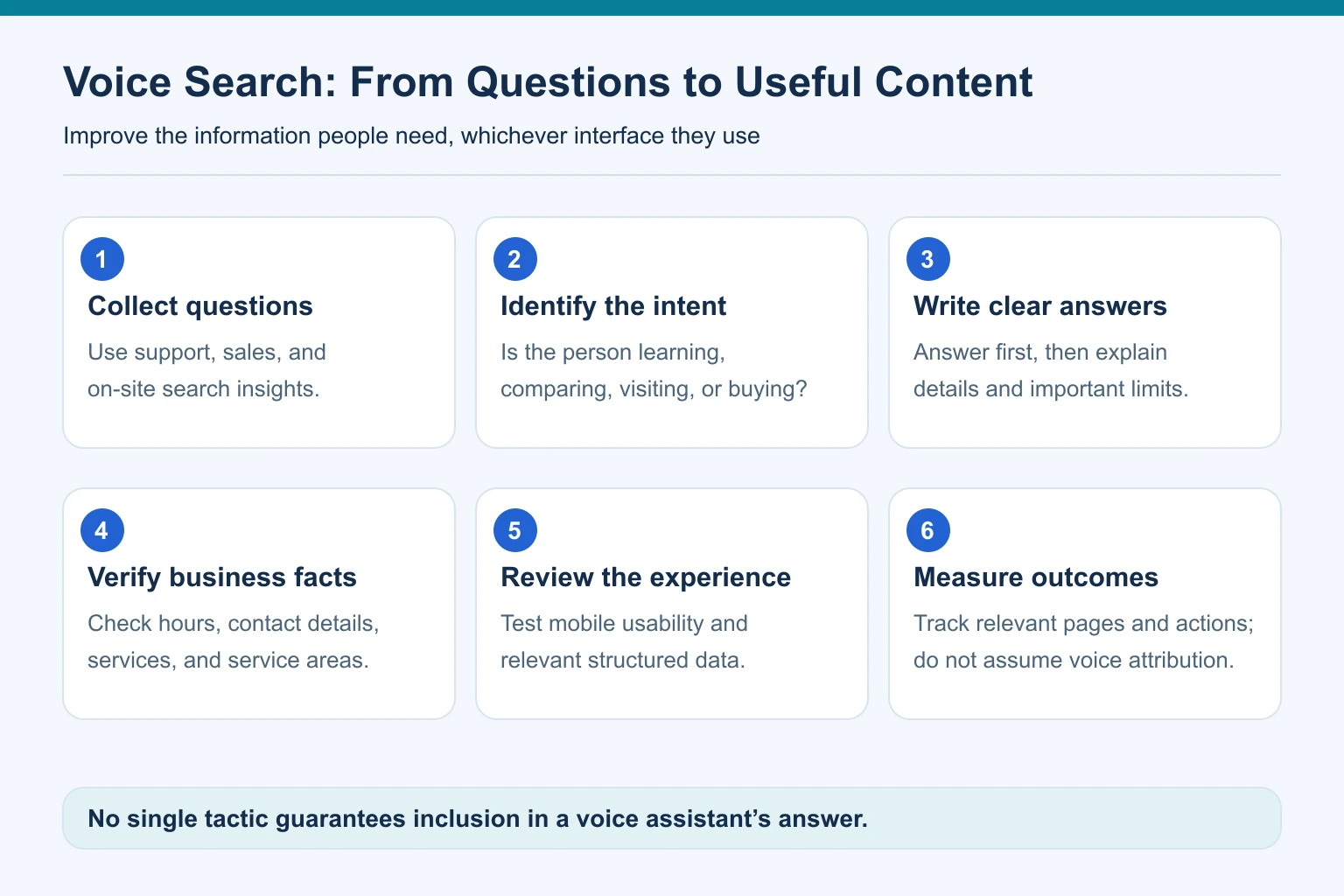
How to Optimize Your Marketing Strategy for Voice Search Queries
Voice search optimization works best when incorporated into a wider SEO and content marketing program.
The following steps offer practical ways to adapt existing strategies.
1. Research Conversational Keywords and Customer Questions
Begin by identifying the language customers use when discussing your products or services.
Standard keyword research tools can help uncover relevant topics, but other sources are equally valuable.
Customer service conversations, sales inquiries, website search records, and commonly asked questions can reveal the information customers genuinely need.
For example, a business offering website security services might find that potential customers frequently ask:
“How do I know whether my business website has been hacked?”
This question could support an educational article explaining warning signs, verification methods, and appropriate next steps.
Avoid inserting multiple keyword variations into the same paragraph simply to match possible spoken phrases.
Instead, prioritize questions that deserve useful, distinct answers.
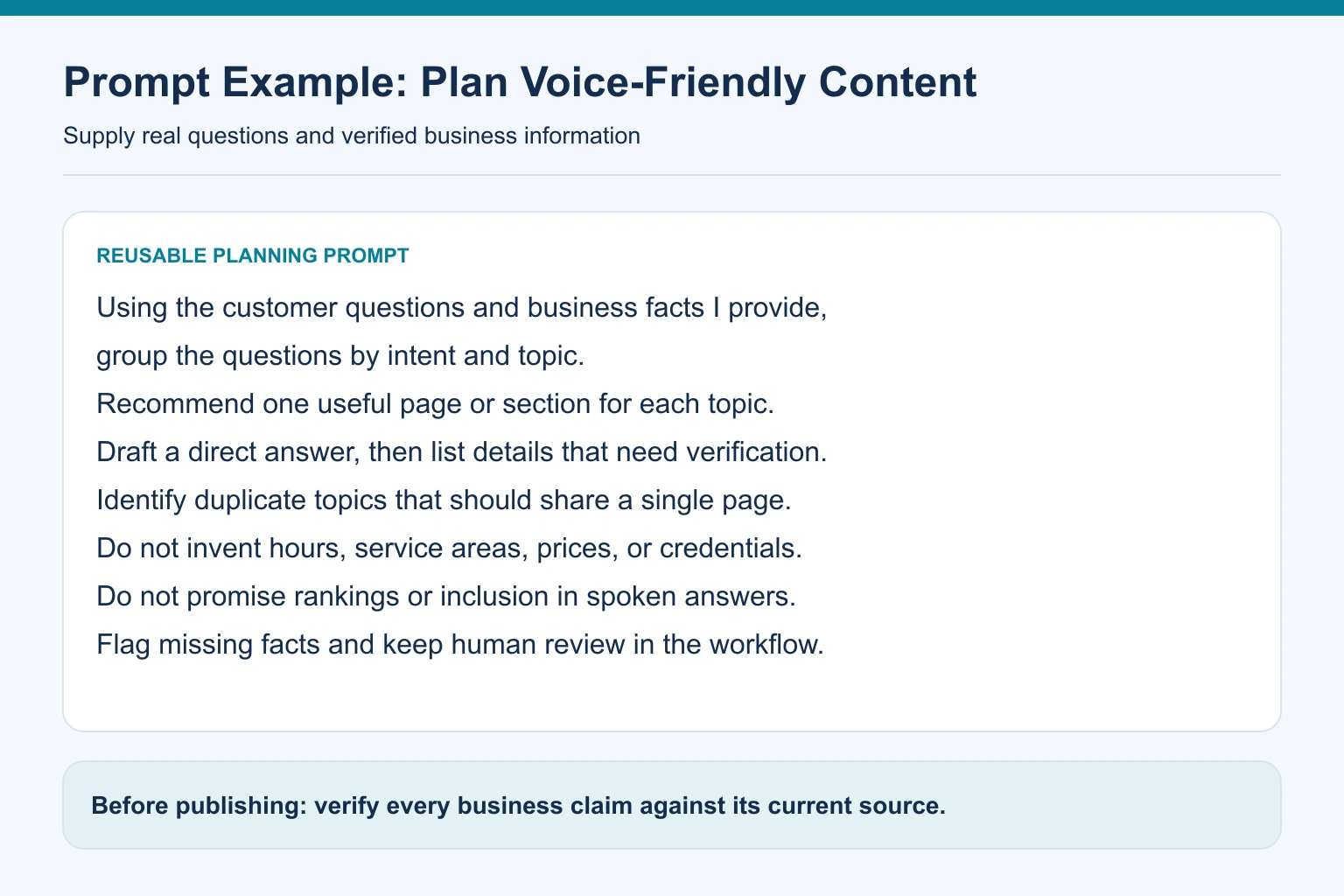
AI Prompt: Turn Customer Questions Into a Content Plan
Use this prompt with a list of actual customer questions and verified business facts. Treat the output as a draft plan for human review, not as evidence of search demand.
Using the customer questions and business facts I provide, group the questions by intent and topic. Recommend one useful page or section for each topic. Draft a direct answer, then list details that need verification. Identify duplicate topics that should share a single page. Do not invent hours, service areas, prices, or credentials. Do not promise rankings or inclusion in spoken answers. Flag missing facts for review.
2. Match Content With Search Intent
Understanding what users want is more valuable than matching their exact wording.
A question beginning with “what” may request a definition. A question beginning with “how” may require instructions. A question about comparing options may need a balanced evaluation.
For example:
“What is email marketing automation?” requires an explanation.
“How do I set up an automated welcome email?” calls for a practical tutorial.
“Which email automation features are useful for small businesses?” needs decision-making guidance.
These questions belong to the same general topic, but they serve different purposes.
Marketers should build content around those purposes rather than create near-identical pages for every keyword variation.
3. Write Direct, Helpful Answers
Clear answers improve the usefulness of informational content.
When writing about a specific question, introduce the answer near the beginning of the relevant section.
Then explain the important details, exceptions, and practical considerations.
For example, a page answering “What is local SEO?” should first define local search optimization.
It can then explain business profiles, location-focused webpages, accurate contact details, and other relevant practices.
The objective is to help readers understand the subject without unnecessarily complicated language.
Direct answers are useful, but they should never omit critical qualifications merely to make the content shorter.
4. Strengthen Local SEO and Business Information
Businesses targeting local customers should review whether search engines and potential customers can understand where they operate.
Important information includes the business name, address where applicable, telephone number, operating hours, and services offered.
Service-area businesses should clearly explain which locations they serve.
A local company can also create useful location-specific content when there is enough distinct information to justify it.
For instance, a home maintenance company may provide separate pages explaining services and availability in different cities.
Those pages should contain genuine location-specific details rather than repeating the same content with different city names.
Accurate information helps customers evaluate whether a business meets their needs.
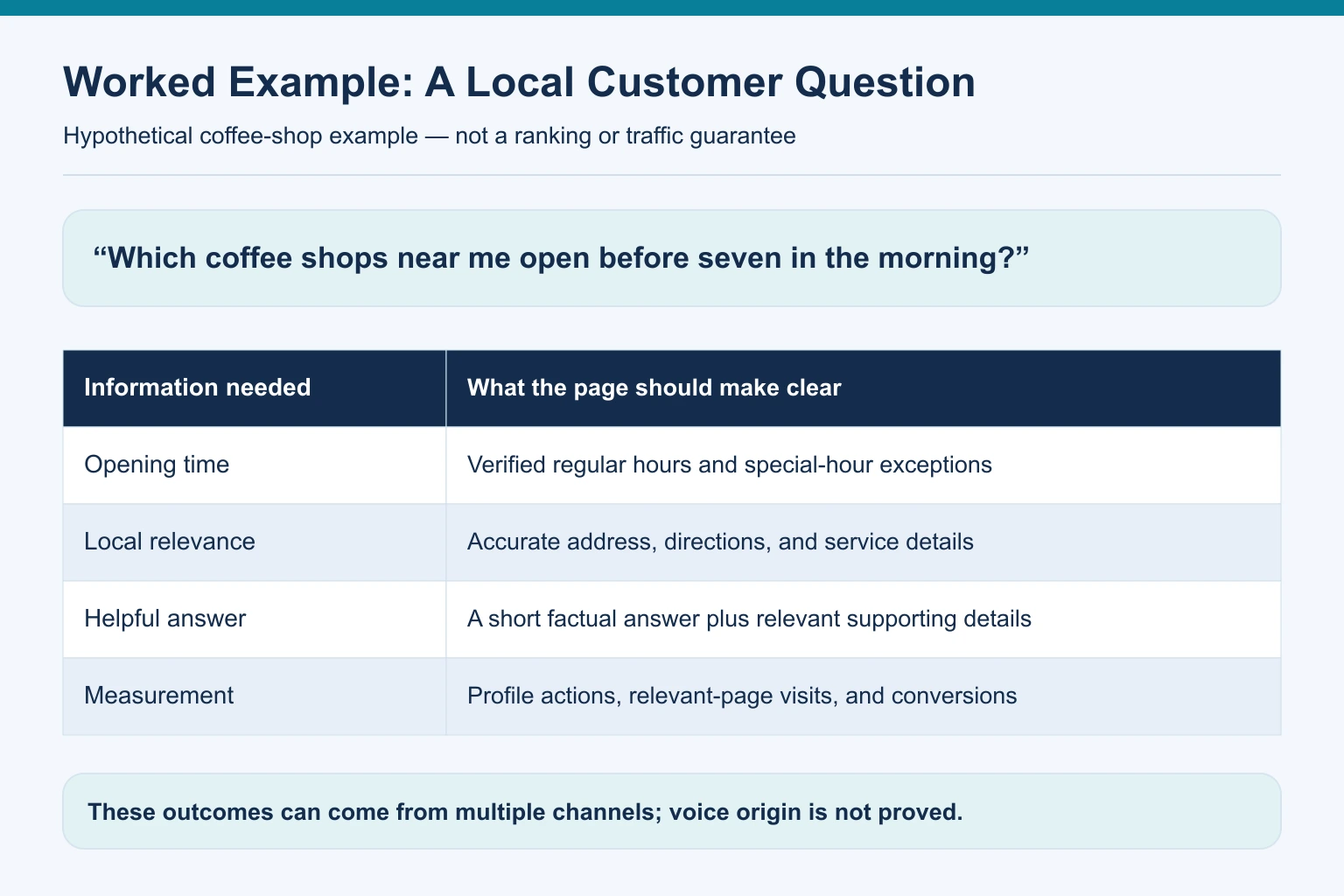
Example: A Coffee Shop’s Opening-Hours Question
Suppose a customer asks, “Which coffee shops near me open before seven in the morning?” A useful business page should make the shop’s actual opening time, address, and any special-hour exceptions easy to find. Keep the business profile consistent with the current page.
Do not claim an early opening time merely to match the question. If regular hours or holiday schedules are unknown, verify them before publishing. A concise answer can help customers, but it does not guarantee that any assistant will select the business.
5. Make Your Website Mobile-Friendly
Mobile usability is an important part of modern search marketing.
A website should be easy to navigate on smaller screens, with readable text, accessible controls, and clearly presented information.
Pages that load slowly or display unstable layouts can frustrate visitors.
Businesses should review images, scripts, navigation elements, and page templates to identify unnecessary performance problems.
Important information should also be available as readable page text rather than only appearing inside decorative images.
These practices support accessibility and search engine processing across many types of search, including voice-related experiences.
6. Use Structured Data Where Appropriate
Structured data provides machine-readable information about certain aspects of website content.
For example, businesses may use appropriate Organization or LocalBusiness markup, while publishers can use Article or BlogPosting structured data for qualifying content.
The information in structured data should accurately reflect what appears on the page.
Adding schema markup does not automatically produce higher rankings, featured snippets, or voice search responses.
It is a supporting technical practice, not a substitute for quality content.
Businesses should follow Google’s current structured data documentation and avoid adding unsupported markup solely because it is promoted as a voice search shortcut.
See Google’s structured data policies.
7. Build Trust Through Accurate Information
The credibility of online content becomes particularly important when search experiences provide concise answers.
A brief response may not include every qualification found in a longer article.
This means publishers should avoid misleading statistics, unsupported recommendations, and exaggerated claims.
When discussing scientific findings, technical developments, or market trends, identify the original sources whenever possible.
Explain the context behind statistics and distinguish verified facts from predictions.
For rapidly changing technologies, include accurate publication or update dates when relevant.
A trustworthy article should help readers evaluate information rather than merely persuade them to accept a conclusion.
How Voice Search Fits Into SEO, AEO, and GEO
Voice search optimization is closely related to several commonly used marketing concepts.
Search Engine Optimization (SEO) focuses on improving the discoverability and relevance of website content in search engines.
Answer Engine Optimization (AEO) generally describes techniques for presenting information clearly to systems that provide direct answers.
Generative Engine Optimization (GEO) is an emerging marketing term associated with improving how content is represented in AI-generated search experiences.
Although these approaches emphasize different forms of discovery, they share important foundations.
Relevant content, reliable information, accessible pages, meaningful links, and clear organization can support multiple search experiences.
Google’s guidance for AI Overviews and AI Mode emphasizes that established SEO best practices remain relevant. It does not prescribe special markup or a separate technical system for inclusion in these features.
Therefore, businesses should avoid treating voice search, SEO, AEO, and GEO as entirely independent strategies.
A coordinated approach can reduce unnecessary work while improving content consistency.
See Google’s AI search guidance.
Why Research Skills Matter in Voice Search Marketing
Effective voice search optimization depends on understanding real customer questions and interpreting available evidence.
Marketers need to distinguish actual user behavior from assumptions based on industry trends.
For example, a keyword research tool may show interest in a conversational query, but it does not necessarily reveal whether users submitted that query by speaking or typing.
Similarly, an AI assistant may provide a business recommendation without revealing every factor that contributed to the response.
Professionals evaluating these systems need strong research skills, including source verification, search methodology, and critical analysis.
The Association of Internet Research Specialists (AOFIRS) offers the CIRS certification program, which covers online search and research strategies, research methodologies, AI-assisted research, data analysis, and internet law and ethics.
These skills are relevant to professionals who need to evaluate information quality and understand how digital research practices are evolving.
Reliable research helps businesses make marketing decisions based on evidence rather than unsupported predictions about new search technologies.
Common Voice Search Marketing Mistakes to Avoid
Voice search optimization advice sometimes relies on oversimplified assumptions.
One common mistake is believing that every voice query must be answered on a separate webpage.
This can lead to repetitive content that provides little additional value.
Another is assuming that a featured snippet automatically becomes the spoken answer across every voice assistant.
Different systems may process questions and select information in different ways.
Businesses should also be cautious about widely repeated voice search statistics that lack identifiable sources or clear methodologies.
A further mistake is focusing exclusively on voice search at the expense of traditional website users.
People continue to use typed queries, conventional search results, maps, and direct website navigation.
An effective marketing strategy should support these interactions together.
Finally, publishing large quantities of AI-generated content without sufficient review can introduce factual errors, duplicated explanations, and weak analysis.
Content quality should be evaluated through usefulness, accuracy, originality, and relevance.
How to Measure the Success of Voice Search Optimization
Measuring voice search effectiveness is more complicated than measuring ordinary website traffic.
Google Search Console provides data about search impressions, clicks, queries, and pages. However, its standard search performance reporting does not universally identify which individual queries were spoken.
This means marketers should not claim to measure all voice search traffic directly from standard Search Console reports.
Instead, businesses can evaluate broader indicators that relate to their objectives.
For example, they can monitor the performance of pages that answer important customer questions, review relevant search queries, and assess whether informational content contributes to inquiries or other meaningful actions.
Local businesses can also examine changes in business profile interactions, while recognizing that these activities are not necessarily caused by voice searches.
For more useful results, establish a baseline before making content changes and evaluate performance over a suitable period.
Analytics should support reasonable conclusions, not create certainty where the underlying data is incomplete.
Review the documented Search Console dimensions before interpreting results.
The Future of Voice Search Marketing
Voice search is becoming one part of a more diverse information retrieval environment.
People can move between typing, speaking, reading, listening, and interacting with AI-generated answers.
These behaviors create new opportunities for businesses to make information easier to access.
However, technological developments do not eliminate the importance of search fundamentals.
A website still needs clear content, accurate information, accessible navigation, and a reliable technical foundation.
Businesses that understand their customers’ questions and provide genuinely useful answers will be better prepared to adapt as search interfaces change.
The long-term priority should be improving information quality and user experience rather than relying on temporary optimization tricks.
Frequently Asked Questions
Is voice search optimization different from SEO?
It emphasizes spoken questions and conversational intent, but it relies on the same foundations: useful content, accessible pages, reliable information, and accurate business details.
Does schema guarantee a voice-search answer?
No. Use structured data only when it fits the visible content and applicable guidance. Eligibility is not a promise of visibility or ranking.
Can Search Console identify all spoken queries?
No. Standard reports do not provide a universal spoken-query label. Monitor useful business outcomes and avoid attributing every change to voice search.
Conclusion
Optimizing your marketing strategy for voice search queries is worthwhile because customers increasingly interact with search technology using natural language and conversational interfaces. The most practical improvements involve researching customer questions, addressing search intent, writing clear explanations, strengthening local business information, and ensuring websites remain accessible and technically sound.
Voice search should not be treated as a replacement for conventional SEO or as a guaranteed source of additional traffic. Instead, it is another reason to build content around how people actually seek information. By combining reliable research, useful content, and established SEO practices, businesses can develop marketing strategies that remain relevant across traditional search engines, voice assistants, and evolving AI-powered search experiences.