YouTube uses several discovery systems rather than one formula. Search evaluates a query; Home and Suggested Videos personalize viewing choices; Shorts matches short-form videos to viewers. Relevance, audience response, and satisfaction matter, but no fixed combination of views, subscribers, or upload frequency guarantees reach.
In 2026, YouTube announced conversational video discovery, standardized view counting, and a recommendation update emphasizing original Shorts. These developments affect different parts of the platform. A measurement change should not be confused with a ranking change.
Creators have to work out what their audience wants and what they respond to in their videos. The researchers look at the effect of personalization in terms of what people see and why the most popular videos aren’t necessarily the most credible.
Why there is no single ranking formula
Imagine the situation where two people are on YouTube at the same time. YouTube describes its discovery goals as helping viewers find videos they want to watch and maximizing long-term satisfaction. See the YouTube performance FAQ.
Documented recommendation inputs include watch and search history, subscriptions, likes, dislikes, feedback such as “Not interested,” and satisfaction surveys. The importance of signals differs across surfaces. See the YouTube recommendation guide.
How Does YouTube’s Recommendation System Work in 2026?
YouTube recommendations are all about two things really: personalization for the individual viewer and how well the video performs. It’s all about who might like the video and how people respond when they see it.
1. Viewer personalization
YouTube uses your viewing habits to work out what you’re interested in.
This can include:
- Videos watched, skipped, or dismissed.
- Search history and any topics that have been looked at previously.
- Channels subscribed to.
- Likes, dislikes, “Not interested” feedback, and satisfaction surveys.
- Preferred video formats and languages.
- Similar viewing patterns among audiences with related interests.
For instance, if you’re regularly watching AI tutorials on YouTube, it may well suggest you some new videos on AI research tools even if you haven’t subscribed to any of those channels.
Personalization evolves over time. Your recommendations will change as you watch new content and as you stop watching things that you previously enjoyed.
2. Video performance and audience satisfaction
When YouTube makes a suggestion, it looks at how viewers are responding in a variety of ways.
Choosing to watch: does the viewer pick the video or simply ignore it?
Watch duration: How long does the viewer watch?
Relative viewing duration: what proportion of the video does the viewer watch?
Positive engagement: does the viewer like it, share it, or otherwise respond in a positive way?
Explicit feedback: does the viewer say the video is boring or give some form of satisfaction feedback?
YouTube’s Shorts guidance identifies whether viewers choose to watch, average view duration, average percentage viewed, likes, and post-watch survey results as useful performance signals.
See Shorts discovery guidance.
These are different types of evidence. Higher CTRs would suggest that the titles and thumbnails are effectively grabbing that initial interest, while watch time and satisfaction metrics tell you whether the content in fact delivers on what the viewer was looking for.
3. Topic demand, competition, and seasonality
A drop or a spike in views doesn’t necessarily mean the algorithm has changed.
YouTube looks at topic interest, competition, and seasonality as external factors that can all have an impact on the reach of a video.
For instance, a tax filing tutorial might see a spike in interest at certain times of year. An educational video on a new piece of technology is likely to get a lot of attention initially before search interest subsequently drops.
Similarly, a video can get positive engagement and yet be up against other videos that the viewer finds more appealing.
Content performance should be judged in terms of audience demand, against the competition, and in terms of traffic. A fall in viewership doesn’t necessarily mean it’s been penalized by the algorithm. See YouTube discovery guidance.
YouTube Search vs. Home vs. Suggested Videos
YouTube doesn’t use the same algorithm to rank every video. Search answers for a particular question or topic. Recommendations are trying to work out what you might like to watch next.
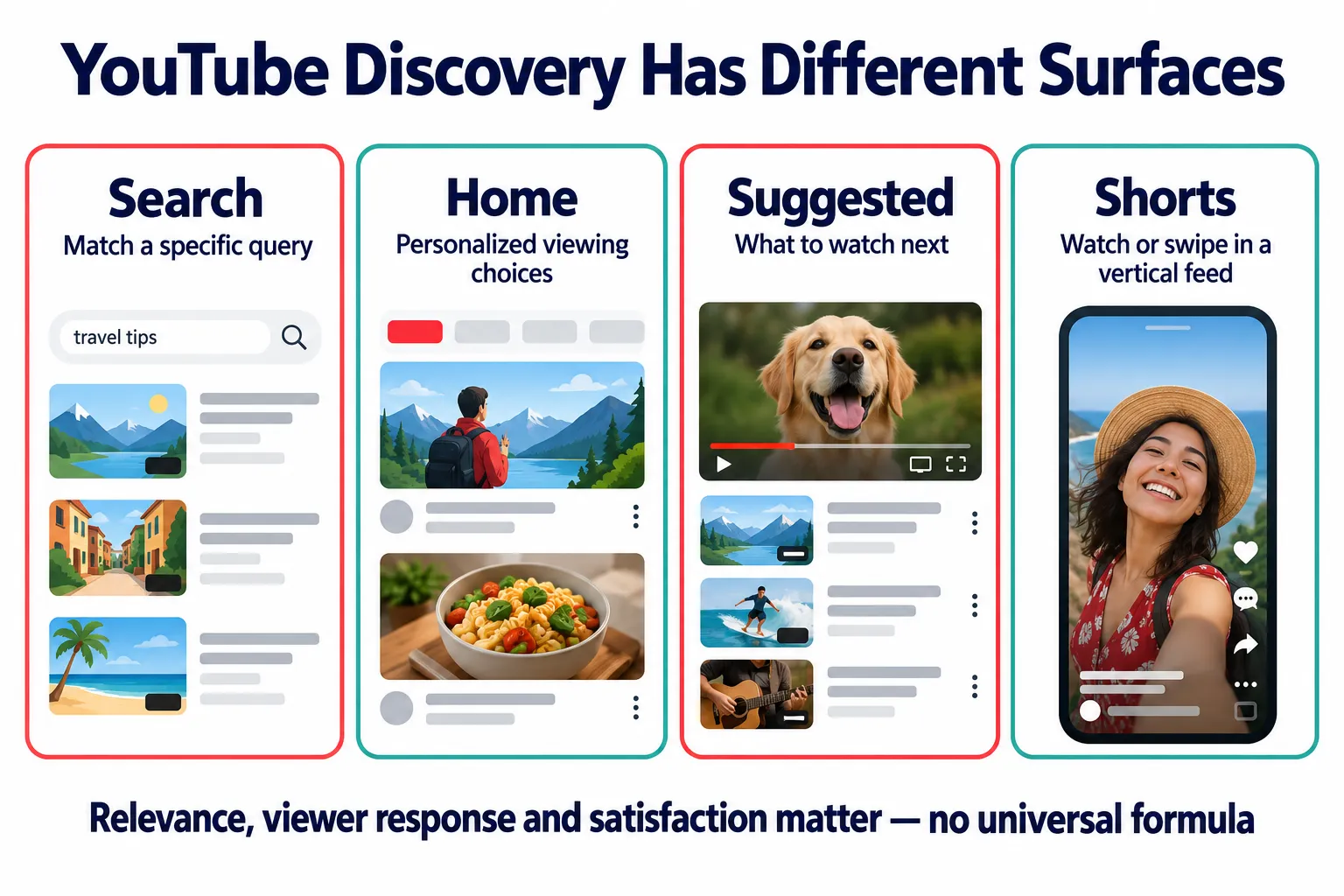
| Discovery surface | Main purpose | Important considerations |
|---|---|---|
| YouTube Search | Help users find videos matching their queries | Relevance, engagement, quality, and search intent |
| Home feed | Recommend videos suited to individual viewers | Viewing history, interests, and video performance |
| Suggested Videos and Up Next | Recommend content related to a viewing session | Current video context, viewing patterns, and personalization |
| Shorts feed | Deliver personalized short-form content | Viewer choice, retention, satisfaction, and originality |
| Subscriptions | Help users access content from followed channels | Channel subscriptions, upload recency, and interface behavior |
How YouTube Search ranks videos
YouTube’s official search guidance identifies three key elements: relevance, engagement, and quality.
Relevance is all about how well the video and its content matches what the user was looking for.
Engagement is all about how the audience engages with the results, i.e., how long they watch after they’ve done the search.
Quality involves signals of expertise, authoritativeness, and trustworthiness. The importance of relevance, engagement, and quality varies with the search. See YouTube search guidance.
For example, if someone searches “how to verify AI-generated citations,” YouTube will assess whether the candidate videos actually answer that question, what previous searchers did, and all the relevant quality signals.
Just dropping a keyword in your description won’t get your video to rank.
How Home and Suggested Videos differ
Home recommendations are all trying to answer a question you haven’t actually typed in: what do I want to watch at the moment?
Suggested videos and ‘Up Next’ are all based on what you’re currently watching. It’s your current video, your interests, and your viewing history that all feed into what gets suggested to you next.
A film on online misinformation might well lead to recommendations around fact-checking, media literacy, or investigative journalism.
But not every recommended video is of equal value in terms of accuracy or usefulness for learning.
How the YouTube Shorts Algorithm Works in 2026
YouTube Shorts uses personalization to find the right short videos for the right people. The Shorts feed takes into account past viewing behavior, subject matter preferences, whether users choose to watch or just swipe away, and how people respond after they’ve watched.
Shorts play in a continuous feed so whether you keep watching or just swipe away is a signal to YouTube of what you like.
YouTube’s Shorts guidance lists choice to view, average view duration, average percentage viewed, likes, and satisfaction surveys. These metrics need context; none is a guaranteed distribution threshold.
YouTube states that Shorts performance does not negatively affect long-form recommendations. See Shorts discovery guidance.
Original content receives greater emphasis
On October 1, 2026, TeamYouTube announced a recommendation update to prioritize original Shorts and reduce distribution of videos re-uploaded from other creators without meaningful additions.
Channels primarily aggregating copied videos may receive less Shorts-feed distribution. Original commentary, storytelling, or substantial creative edits can add value; minor technical changes alone do not establish originality.
This is a recommendation update, distinct from monetization policy. It does not establish that all remixes, reactions, or AI-assisted Shorts are restricted.
For researchers, it illustrates why platform distribution cannot be reduced to engagement metrics alone. See the original Shorts update.
Evaluate the specific content and policy context rather than assuming every reused clip or AI tool has the same effect.
For those looking at platform visibility the change is also a case in point as to how recommendation systems can incorporate content quality objectives other than just engagement.
What Changed in YouTube’s Algorithm and Discovery Systems in 2026?
Three developments in particular had a significant impact on YouTube’s discovery, measurement and content distribution in 2026.
Ask YouTube conversational discovery
At its May 19, 2026, announcement, YouTube described Ask YouTube as conversational discovery across long-form videos and Shorts, with follow-up questions and structured responses. Initial access was for US Premium members aged 18 and older through its experimental-features page; access can change as rollout progresses.See the Ask YouTube announcement.
Standardized view counting
Beginning August 24, 2026, YouTube standardized public views from playback’s first frame across formats. The earlier definition was renamed “engaged views,” not removed. YouTube said this measurement change did not change recommendations. See the view counting announcement.
Greater emphasis on original Shorts
The October 1 announcement concerned reduced Shorts distribution for channels primarily re-uploading others’ work without significant additions. See the original Shorts update.
These changes are not all the result of the same ranking formula. The conversational search changes are about how people find videos. The standardized counting is about how views are counted. The Shorts update is about how recommendations work for Shorts.
How AI Is Changing YouTube Search and Video Discovery
AI has been part of large scale recommendation technology for years. By 2026, its presence was more apparent in the form of conversational discovery and AI-assisted video creation.
Does YouTube penalize AI-generated content?
YouTube does not publicly describe a blanket recommendation penalty solely for using generative AI. Evaluate the content, applicable policies, and viewer response rather than treating every AI-assisted video identically.
Follow YouTube’s applicable content policies and disclosure requirements for relevant altered or synthetic media. Disclosure and originality are separate issues from a universal ranking penalty. See AI disclosure guidance.
A video that uses AI for editing or illustrations is very different from a channel that is essentially just re-posting copied content with minimal alteration.
What really matters is that the content is original, useful, accurate, and compliant with YouTube’s policies.
YouTube Algorithm Myths: What the Evidence Actually Shows
If the creators don’t understand how YouTube’s recommendation system works, they may end up making changes they don’t need to and could easily misread the normal fluctuations.
| Common belief | Evidence-based explanation | Practical lesson |
|---|---|---|
| One poorly performing video damages the channel | YouTube uses fresh performance data for individual videos; one unsuccessful experiment does not necessarily harm future uploads. | Evaluate individual videos and longer-term audience patterns. |
| Publishing daily guarantees growth | YouTube does not prescribe a universal minimum posting frequency. | Maintain a realistic schedule that supports quality. |
| More subscribers always mean more recommendations | Subscriptions inform personalization, but viewer interests and performance also matter. | Understand active audiences, not just subscriber totals. |
| Shorts automatically reduce long-form reach | YouTube says Shorts performance does not negatively affect long-form recommendations. | Use formats according to audience needs. |
| External traffic always damages performance | YouTube reports external traffic separately; an automatic penalty based solely on traffic origin is not established. | Examine the quality and context of external visits. |
| High CTR guarantees success | CTR is only one indicator. Watch behavior and satisfaction also matter. | Match titles and thumbnails to the actual content. |
| AI-generated videos are automatically suppressed | A universal AI-content ranking penalty is not publicly established. | Follow applicable policies and prioritize meaningful originality. |
A very common mistake is to confuse correlation with causation. If your views drop after you post a Short that doesn’t in any way mean the Short caused the drop.
In the same vein, just because a video does well at a particular time of day doesn’t mean that the upload time was the reason it was a success.
YouTube says publication time is not known to affect long-term performance. Timing can still matter for early viewing and scheduled formats such as live streams and Premieres. See the YouTube performance FAQ.
How to Optimize YouTube Videos for Search and Recommendations
Good YouTube SEO starts by focusing on what viewers want to know. Your title, description, thumbnail, and video structure should make the topic clear and help people decide if the video is right for them.
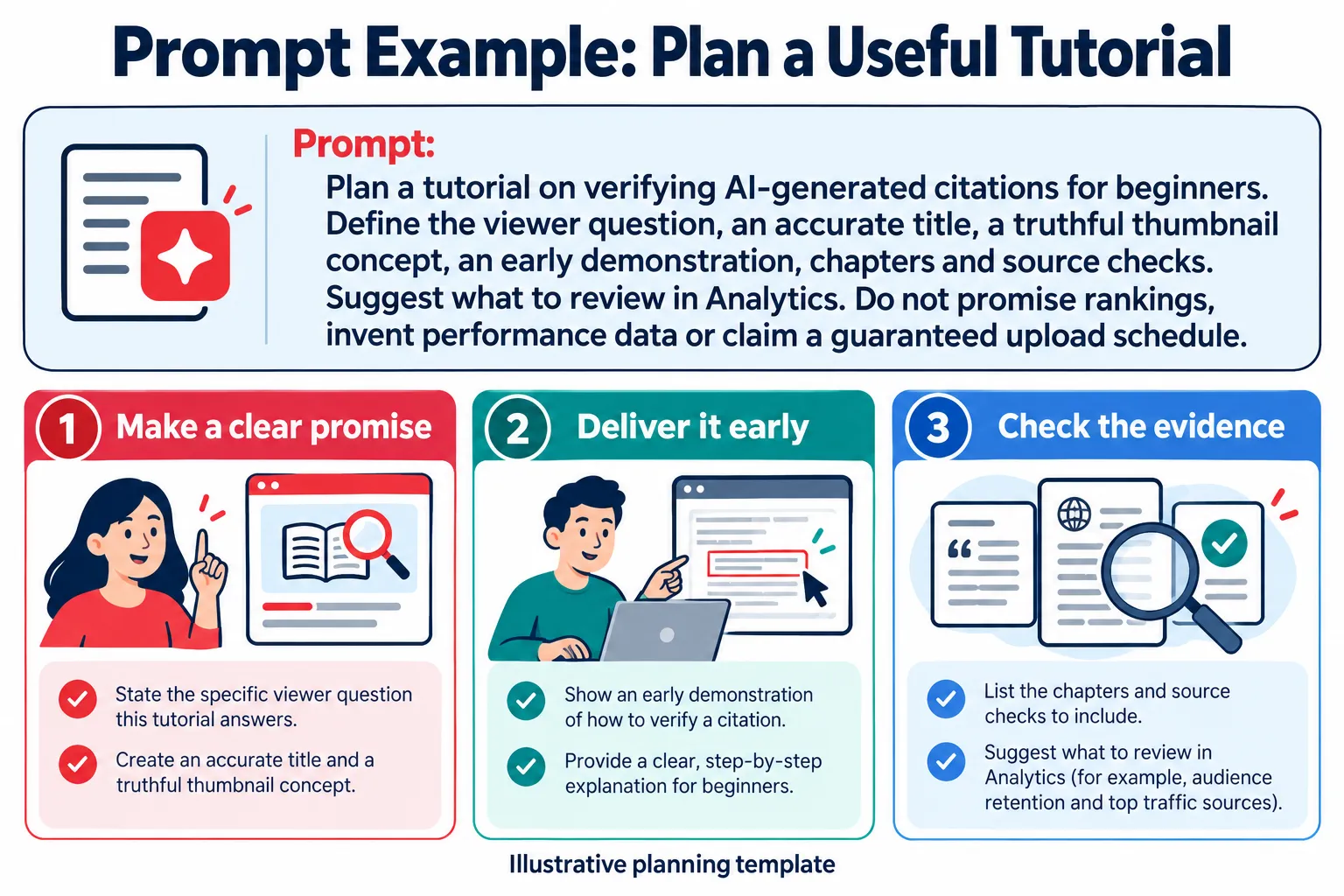
Planning prompt: Plan a tutorial on verifying AI-generated citations for beginners. Define the viewer question, an accurate title, a truthful thumbnail concept, an early demonstration, chapters, and source checks. Suggest what to review in Analytics. Do not promise rankings, invent performance data, or claim a guaranteed upload schedule.
1. Research the audience’s questions
Start by identifying what viewers are trying to learn, solve, compare, or understand.
Look for recurring questions in YouTube Search, relevant community discussions, and the audience information available in YouTube Studio.
For an educational channel, it is easier to make a useful video about a specific topic like “How to Check Whether an AI Citation Is Real” than a broad topic like “Everything About AI.”
2. Write accurate, descriptive titles
A good title tells viewers what the video is about and what they will get from it.
For example:
Clear: How to Verify AI-Generated Citations: 5 Practical Checks
Misleading: This Secret AI Trick Changes Everything!
The first title tells viewers what they will learn. The second title makes a promise but does not explain what the video covers.
The goal is not just to get clicks but to attract viewers who will actually find the video helpful.
3. Match thumbnails with the video
Your thumbnail should quickly and clearly show what the video is about.
If you are making a comparison video, show both things being compared. For a tutorial, use a clear image of the task.
Do not suggest your video has a demonstration or result if it does not actually include it.
4. Deliver the promised information early
A clear introduction helps viewers know they picked the right video.
For a tutorial, explain the problem, show what you will achieve, and start the demonstration quickly.
Use chapters to help people navigate longer videos. Add accurate captions and clear visuals so everyone can follow along.
5. Create useful content series
Related videos let interested viewers dive deeper into a topic.
For example, a digital literacy channel might publish a series covering source credibility, fabricated citations, reverse image searching, and misinformation verification.
Playlists and end screens make it easier for viewers to find related videos.
6. Publish sustainably and review results
A realistic schedule gives you time to improve your research, script, editing, and presentation.
YouTube recommends focusing on steady quality instead of uploading too often. See the YouTube performance FAQ.
Check your performance trends, try out improvements, and remember that what your audience likes can change.
How to Measure YouTube Performance Using Analytics
YouTube Analytics shows you how people find your videos, if your content keeps their attention, and which topics get real engagement.
But do not treat any single metric as a direct sign of how the algorithm works.
Understanding YouTube’s 2026 view-counting change
On August 19, 2026, YouTube announced that beginning August 24, a view would be counted when playback starts from the first frame across its video formats.
The earlier definition became known as an engaged view: a deliberate click or tap to watch, or viewing beyond the initial seconds.
YouTube says most existing analytics calculations remain anchored to engaged views, with no change to recommendations or Partner Program qualification rules from this counting update. See the view counting announcement.
This difference is important when you compare past results. A higher public view count does not always mean more people actually watched your video in a meaningful way.
Important YouTube Analytics metrics
| Metric | What it tells you | Important limitation |
|---|---|---|
| Impressions | How often a thumbnail is shown in eligible YouTube locations | Does not represent every possible exposure |
| Impressions CTR | How often impressions lead to viewing | Varies by traffic source and audience |
| Views | Playback starts counted under the current definition | Does not measure meaningful engagement by itself |
| Engaged views | Viewing that meets the engagement definition | Different from the broader public view count |
| Watch time | Total time viewers spend watching | Can increase with a larger audience or longer videos |
| Average view duration | Average viewing time for qualifying views | Needs context about video length |
| Average percentage viewed | Proportion of a video watched on average | Not a universal quality score |
| Audience retention | Where viewers continue watching or leave | Drop-offs can have multiple explanations |
| Traffic sources | Where viewers discovered the video | Different sources produce different viewing patterns |
| Returning viewers | Estimated viewers who have watched before | Does not measure all forms of loyalty |
| Shorts stayed-to-watch rate | How often viewers continue beyond initial seconds | Does not establish satisfaction on its own |
YouTube’s Analytics documentation explains these reach and engagement measures, including the distinction between impressions, views, and viewers who stay to watch Shorts. See the YouTube Analytics guide.
How to interpret the metrics together
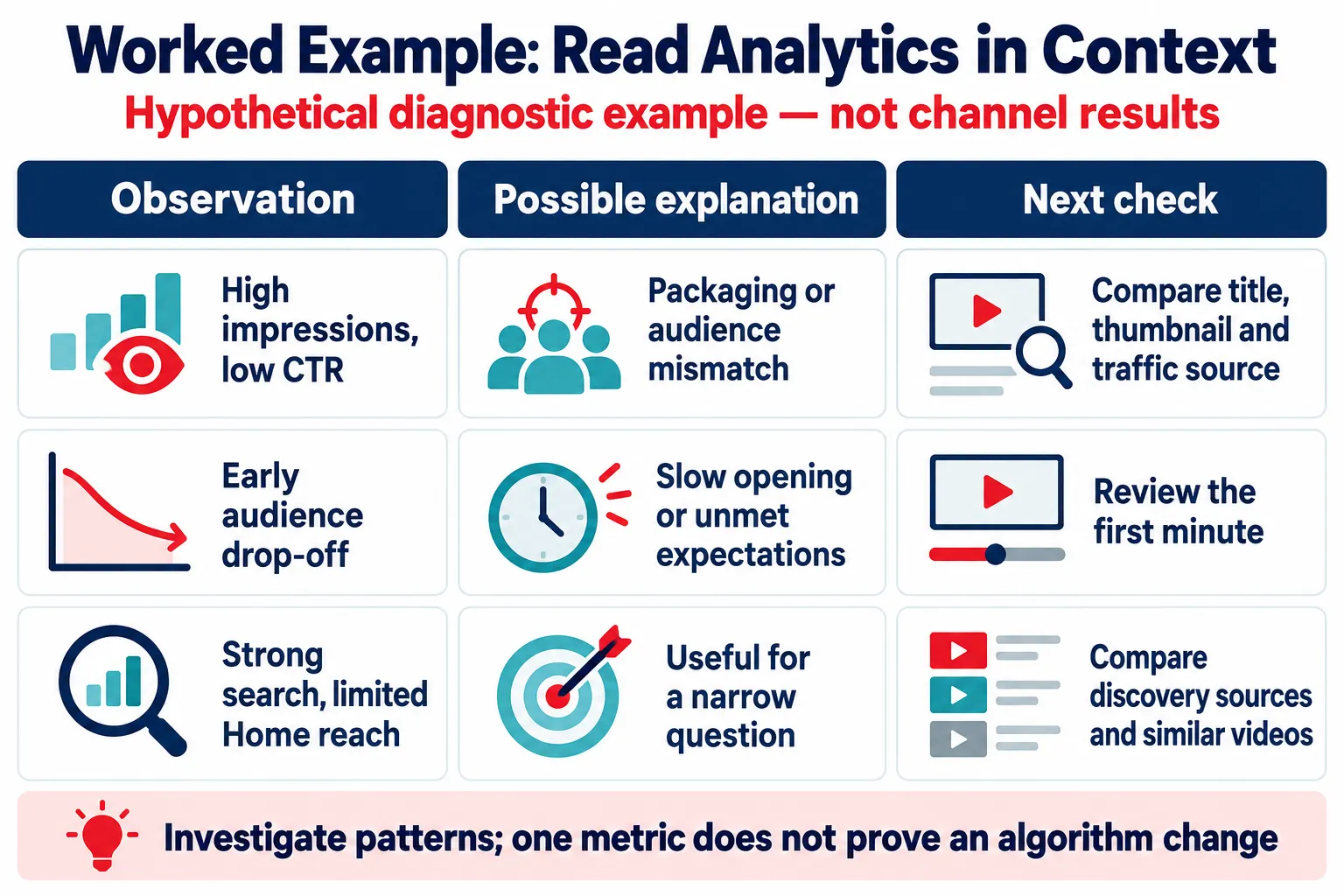
If your video gets a lot of impressions but not many views, the title, thumbnail, or topic might not appeal to the people seeing it.
If lots of viewers start watching but leave quickly, check if your introduction matches what the title promised.
If you get a lot of search traffic but not many Home recommendations, your video might answer a specific question but not attract wider interest.
These are things to check, not final answers. To really understand, compare similar videos, traffic sources, viewer groups, and time periods.
Practical Example: Publishing an Educational Video About AI Verification
Consider an educational YouTube channel preparing a video titled How to Verify AI-Generated Answers and Citations.
The video is for students, researchers, educators, and professionals who use AI tools to find information.
Step 1: Identify the research need
The creator examines common questions about fabricated references, unsupported AI claims, and inaccurate source attribution.
The video aims to answer a practical question: How can you check if an AI-generated citation is real and supports the claim?
Step 2: Structure the video around the task
The script introduces a suspicious citation, demonstrates how to locate the original publication, and explains how to check whether the source supports the statement.
Instead of spending time on the general AI background, the video goes straight to solving the viewer’s main problem.
Step 3: Build a truthful title and thumbnail
The title clearly states the task. The thumbnail shows a citation being checked against the original source.
Neither the title nor the thumbnail promises a magic way to catch every AI mistake.
Step 4: Publish with useful supporting information
The description tells viewers what the tutorial covers, gives useful references, and lists chapters for each main step.
Captions are checked for accuracy, especially for technical terms and source names.
Step 5: Observe discovery and engagement
The video could show up in search results for AI citation questions, or be recommended to people interested in research, information literacy, or using AI in their work.
How many people see the video depends on how relevant it is, how viewers respond, what other videos are out there, and other factors.
Step 6: Improve based on evidence
If Analytics shows viewers leave before the demonstration, try making the introduction shorter in your next videos.
If viewers keep coming back to the citation-checking part, consider making a more detailed follow-up tutorial.
This is just an example, not a real YouTube experiment. It shows how planning, clear presentation, and checking your audience data can work together.
Frequently Asked Questions About the YouTube Algorithm
How does the YouTube algorithm work in 2026?
YouTube uses personalized systems to recommend and rank videos based on viewer interests, viewing history, video performance, and satisfaction signals. Search, Home, Suggested Videos, and Shorts use different discovery processes.
What is the most important factor in YouTube recommendations?
There is no single publicly confirmed factor that determines every recommendation. YouTube emphasizes helping individual viewers discover content they want to watch and find satisfying.
Does YouTube favor Shorts over long-form videos?
YouTube does not describe Shorts as universally favored over long-form videos. Different formats serve different viewing needs, and YouTube says Shorts performance does not negatively affect long-form recommendations.
Can one poorly performing video hurt an entire channel?
One unsuccessful video does not necessarily damage future recommendations because YouTube evaluates fresh performance information for individual uploads. Repeatedly publishing content that audiences do not enjoy can, however, affect longer-term channel performance.
Does uploading videos every day improve rankings?
Daily publishing does not guarantee stronger rankings or recommendations. YouTube advises creators to prioritize sustainable quality and audience satisfaction rather than excessive upload frequency.
Do inactive subscribers affect YouTube recommendations?
Subscriptions are one input into personalization, but subscriber count alone does not determine distribution. Videos can reach interested viewers who have never subscribed to a channel.
How does AI influence YouTube Search?
Machine learning supports personalization and content discovery, while conversational experiences such as Ask YouTube allow eligible users to search with more detailed questions. The precise internal ranking formulas are not publicly disclosed.
Does YouTube penalize AI-generated videos?
A universal penalty for using generative AI has not been publicly established. Creators must still comply with relevant disclosure, originality, copyright, and platform policies.
How can creators improve YouTube discoverability?
Create videos that answer identifiable audience needs, use accurate titles and descriptions, make useful thumbnails, and deliver engaging content. Review YouTube Analytics to identify improvements rather than relying on supposed algorithm shortcuts.
Conclusion
The YouTube algorithm in 2026 is best understood as a collection of discovery and recommendation systems designed to connect viewers with relevant, satisfying content. Viewer personalization, engagement, search relevance, and audience feedback remain central to this process. Developments such as Ask YouTube, standardized view counting, and greater emphasis on original Shorts demonstrate how the platform continues to evolve, while also highlighting the importance of distinguishing genuine recommendation changes from updates to analytics or user interfaces.
For creators and digital marketers, sustainable visibility requires understanding audience needs, producing original and useful content, and interpreting performance data carefully. For researchers, YouTube’s algorithm presents a broader information-literacy challenge: what receives attention is not necessarily what deserves trust. Effective digital research therefore combines an understanding of algorithmic discovery with independent verification, credible evidence, and informed human judgment.