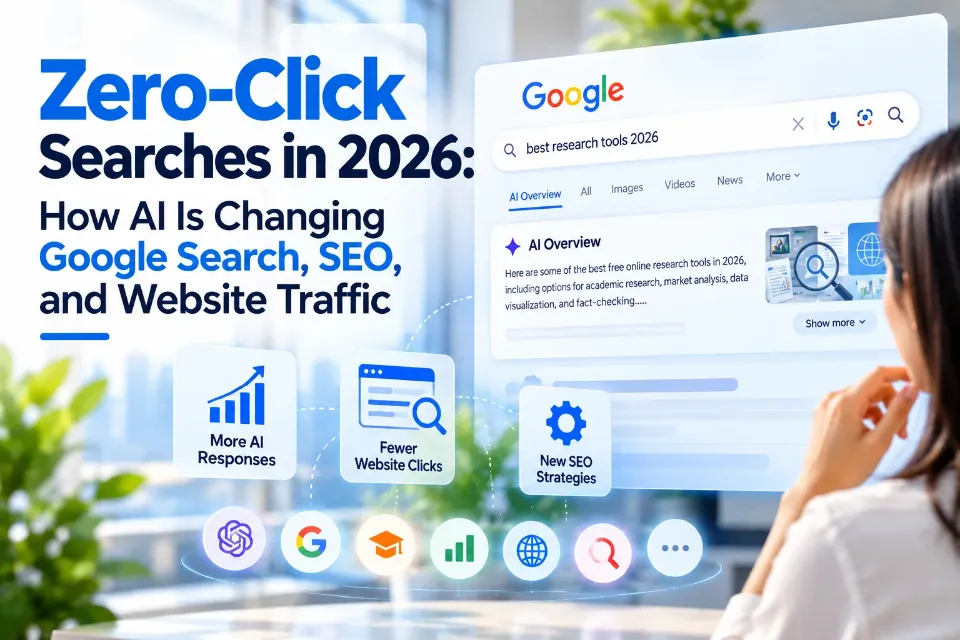
Zero-click searches are changing how people discover information online. Instead of opening a website, users can receive answers directly from Google Search, featured snippets, knowledge panels, maps, and AI-generated summaries.
SparkToro’s June 2026 study, using Similarweb data, estimated that 68.01% of US Google browser searches ended without a click during January–April 2026. This sample excludes searches in Google’s mobile app. See the SparkToro 2026 study.
For researchers, this raises questions about source credibility and information verification. For website owners, it creates challenges involving organic traffic, content visibility, and measuring search performance.
However, zero-click searching does not mean that websites or traditional search engine optimization (SEO) have become irrelevant. It means that search success increasingly depends on both visibility within search experiences and meaningful engagement when users do visit a website.
This guide examines the latest zero-click search statistics, the effects of AI-powered search, and practical strategies for adapting in 2026.
What Are Zero-Click Searches?
A zero-click search is a search interaction with no tracked result click before the user stops or continues searching. Exact definitions vary by study and measurement system.
The user may obtain the information directly from the search results page or simply decide not to visit another website.
For example, someone searching for “What is the population of Canada?” may receive a direct answer without opening a government statistics website.
Other common examples include:
- Featured snippets: Short extracts displayed prominently in Google results.
- Knowledge panels: Structured information about people, organizations, and places.
- Local search results: Business addresses, phone numbers, maps, and operating hours.
- Direct-answer tools: Weather forecasts, calculations, currency conversions, and time zones.
- AI Overviews: AI-generated explanations that combine information from multiple sources.
- People Also Ask: Expandable answers to related questions.
Not every zero-click search means the user successfully found an answer. Some searches end because the results are irrelevant, the user changes their query, or they abandon the task.
How a Zero-Click Search Works
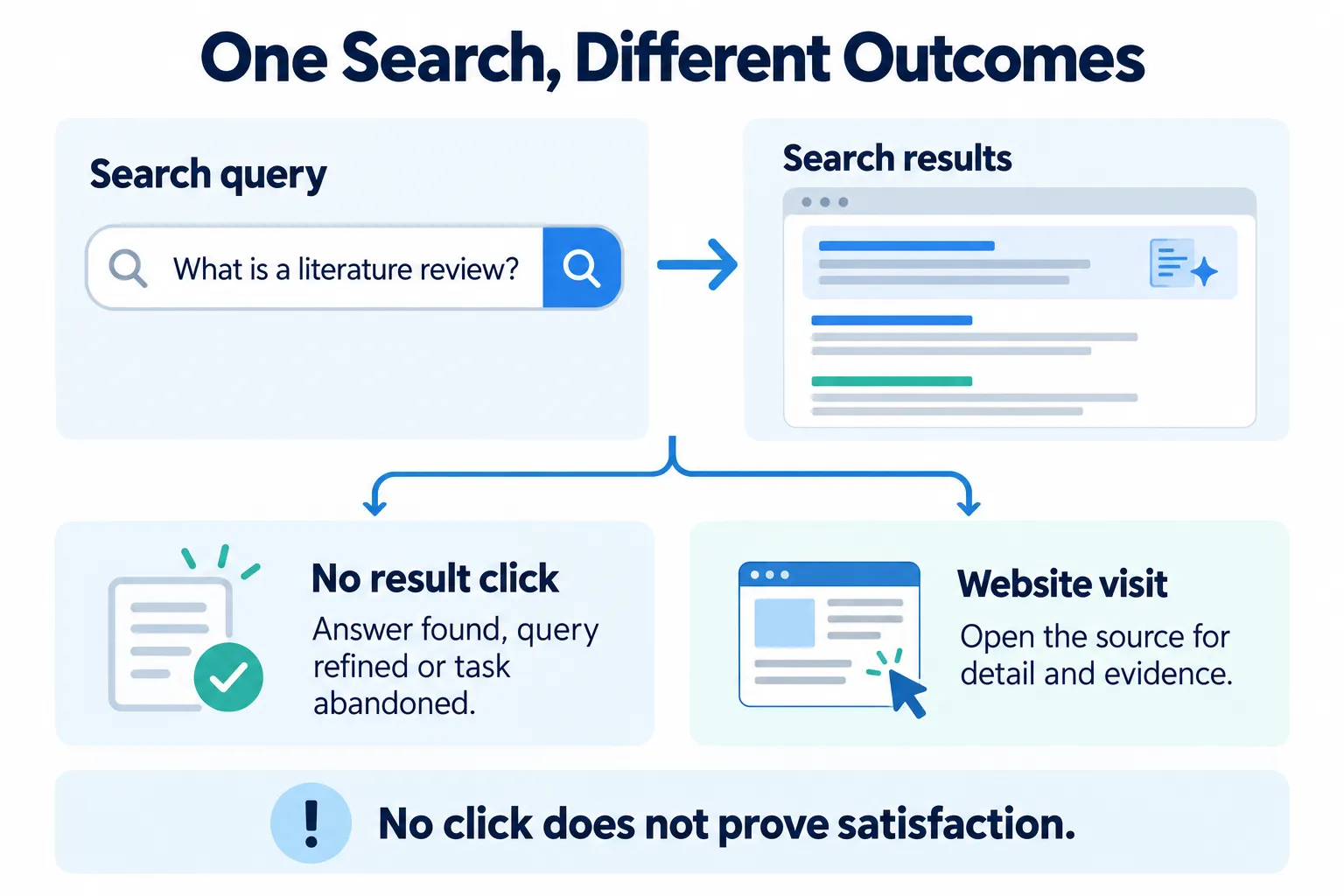
Zero-Click Search Statistics in 2026: What the Research Shows
Zero-click searching existed long before the introduction of generative AI. Search engines have provided direct answers to questions about weather, calculations, definitions, and geographic information for years.
What has changed is the range of questions search interfaces can address without requiring a separate website visit.
68.01%: the estimated no-click share in SparkToro’s January–April 2026 US browser sample. See the SparkToro 2026 study.
Historical zero-click research
| Research period | Reported zero-click share | Important context |
|---|---|---|
| 2019 | About 50% | Jumpshot browser panel; period-specific estimates |
| 2020 | 64.82% | Similarweb-based global study |
| 2024 | 58.5% in the US | SparkToro analysis using Datos |
| Jan.–Apr. 2026 | 68.01% in the US | SparkToro analysis using Similarweb |
Historical sources: SparkToro 2019 study, SparkToro 2020 study, SparkToro 2024 study, SparkToro 2026 study. These are separate studies, not a standardized time series.
These figures should not be interpreted as a perfectly consistent time series.
The studies used different panels, geography, device coverage and classification methods. The 2026 article restates 2024 as 60.45%; the earlier Datos-based publication reported 58.5% for the US. These estimates are not directly interchangeable.
Therefore, the figures provide evidence of substantial zero-click activity, but the exact increase cannot be determined simply by subtracting one historical estimate from another.
What the 2026 study tells us
The 2026 analysis highlights several important developments.
The report describes substantial no-click activity and continued searching within Google. It does not isolate the causal contribution of each search feature.
Open-web clicks and searches with at least one click are different measures: one search may produce multiple clicks, and some destinations belong to Google. Do not treat these metrics as interchangeable.
The findings are based on an observed sample of browser activity, not a complete record of every Google search. They also cannot establish that AI features alone caused the changes.
Why Are Zero-Click Searches Increasing?
Several technological and behavioral changes contribute to zero-click search activity.
1. Search engines answer more questions directly
Google can display dates, definitions, calculations, geographic facts, and other information without requiring users to open another page.
For simple questions, these direct answers can make search more convenient.
2. Search results include more interactive features
Maps, business profiles, featured snippets, product information, and expandable question panels allow users to gather information within the results interface.
For example, someone researching a nearby library may find its address and opening hours directly in a local result.
3. AI-generated summaries address complex questions
AI Overviews can combine information from multiple sources into an explanation.
Rather than opening several pages to understand a subject, users may read the summary and decide whether further research is needed.
4. Conversational search encourages follow-up questions
AI-powered search tools allow users to refine questions or ask for explanations using natural language.
This can create additional interactions within the same search environment, rather than visits to multiple websites.
5. Search behavior varies by intent
A user checking tomorrow’s weather has different needs from someone conducting academic research or purchasing specialized software.
Simple informational searches may end quickly. Complex, commercial, or investigative tasks often require additional evidence, comparisons, or direct interaction with an organization.
The growth of zero-click behavior should therefore be analyzed by search intent rather than treated as a uniform trend affecting every query.
How Google AI Overviews and AI Mode Are Changing Search Behavior
Google’s AI-powered search features extend the direct-answer approach to more complex questions.
Google AI Overviews
AI Overviews provide generated summaries within Google Search and can include links to supporting websites.
They are intended to help users understand a topic quickly and identify information worth exploring further.
A person asking about the differences between qualitative and quantitative research may receive a structured explanation covering both approaches, without immediately opening a research guide.
Google AI Mode
AI Mode provides a more conversational search experience. Users can ask complex questions, examine comparisons, and submit follow-up queries.
Google states that its AI systems may perform multiple related searches when assembling answers, a process it describes as query fan-out. This means a single user question can involve information retrieval across several related topics. See Google AI guidance.
What independent research says about AI summaries and clicks
Pew Research Center published a study in July 2025 examining Google search behavior among 900 US adults whose browsing activity was analyzed for March 2025.
Its findings included:
Pew observed traditional-result clicks in 15% of visits without an AI summary and 8% with one. See the Pew click study.
The study also found that users clicked a source link inside an AI summary in only 1% of visits involving those summaries.
These results demonstrate an association between AI summaries and lower click activity. They do not prove that the summary caused every difference. Query types, user intentions, and result presentation can also affect behavior.
Additional evidence from Ahrefs
In February 2026, Ahrefs published an update to its analysis of AI Overviews and organic click-through rates.
Using a 300,000-keyword comparison and aggregated desktop Search Console data, Ahrefs found AI Overview presence correlated with about 58% lower average CTR for the top-ranking page. Its analysis compared December 2023 with December 2025 and used an estimated counterfactual. See the Ahrefs CTR study.
This is not a claim that every website loses 58% of its traffic. It is a finding from a particular research design and keyword sample.
Taken together, these studies indicate that AI-generated search experiences can influence how often users visit external websites, particularly for informational queries.
Zero-Click Search vs. Traditional Search vs. AI-Powered Search
| Feature | Traditional web search | Zero-click search | AI-powered search |
|---|---|---|---|
| Primary experience | List of website results | Direct answer or interactive result | Generated explanation or conversation |
| Typical user action | Open relevant pages | Read results without a click | Read, refine, or follow supporting sources |
| Information source | Websites selected by search ranking | Search features and source content | Retrieved information and model-generated synthesis |
| Source verification | Visit original websites | May require opening cited or underlying sources | Requires checking citations and source claims |
| Publisher opportunity | Rankings and referral traffic | SERP visibility and possible visits | Supporting links, citations, discovery, and referrals |
| Main limitation | Users must evaluate multiple results | Answer may lack context | Generated answers can contain inaccuracies |
These experiences overlap. A traditional Google results page can contain an AI Overview, organic links, and direct-answer features simultaneously.
Similarly, AI search tools such as ChatGPT Search, Perplexity, and Microsoft Copilot may provide links that encourage further exploration.
The important distinction is not whether a system uses AI, but how it presents information, attributes sources, and enables users to verify the result.
How Zero-Click Searches Affect Website Traffic and SEO
Zero-click searches create a difference between being visible in search results and receiving website visits.
A page may appear prominently in results, yet receive fewer clicks when users find enough information in a displayed answer.
Organic traffic and click-through rates
Organic click-through rate measures the proportion of search impressions that lead to clicks.
For example, 200 clicks from 10,000 impressions gives a 2% CTR. This is a hypothetical calculation, not a measured result for this website.
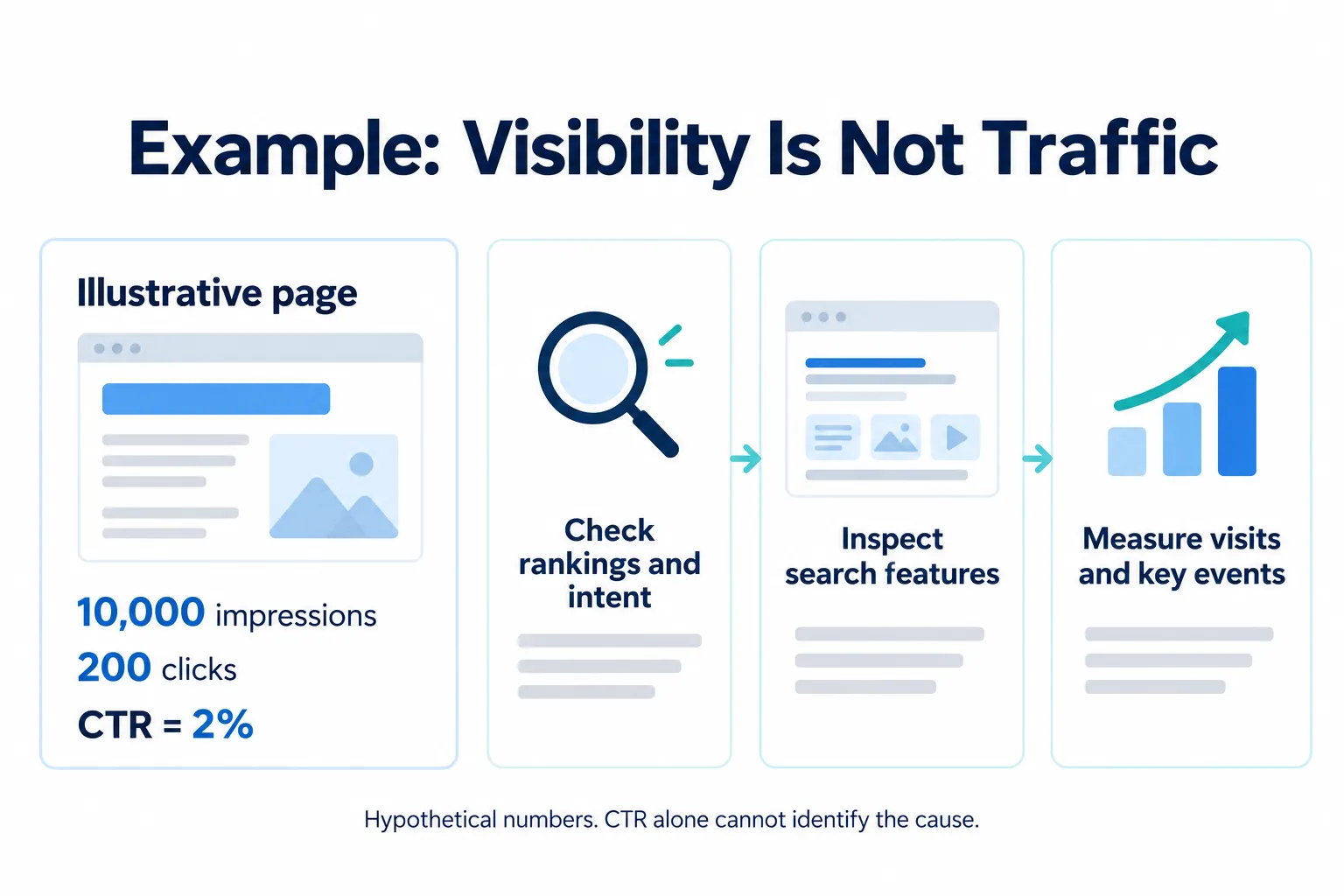
An increase in impressions accompanied by a decrease in clicks may indicate changing search behavior, but it could also reflect ranking changes, broader keyword exposure, competition, or other factors.
Search performance should therefore be analyzed using multiple measurements.
Brand awareness without a website visit
Search features can display an organization’s name, location, information, or content before a visitor reaches the website.
This may contribute to brand recognition, but visibility alone does not demonstrate that users remember the brand or take meaningful action.
Effects vary by website type
Educational websites may experience fewer visits for introductory definitions.
News publishers may face challenges when summaries substitute for opening reported articles.
Local businesses can benefit from map-based calls, directions, and other interactions, even when website clicks are limited.
E-commerce websites may continue receiving valuable traffic from users who need product specifications, pricing, availability, or purchasing options.
These patterns depend on search intent, audience behavior, and the specific search features involved.
A changing model for content performance
Traditional SEO often emphasized rankings, organic sessions, and traffic growth.
Useful measurement in 2026 can include:
- Visibility within relevant search features.
- The quality of visitors reaching the website.
- Conversions and meaningful user actions.
- Brand discovery and subsequent branded searches.
- Performance of original research and specialized resources.
- The contribution of search traffic to organizational goals.
Website traffic remains important, but not every increase in search visibility will result in a proportional increase in visits.
What Zero-Click Searches Mean for Internet Researchers
Zero-click search is not only a marketing issue. It also changes how researchers discover, evaluate, and document evidence.
A search engine may provide a convincing summary of a scientific study, legal decision, or historical event. However, the summary may omit qualifications that are necessary for interpreting the original information correctly.
The difference between finding an answer and verifying evidence
Consider a researcher investigating whether artificial intelligence improves student learning outcomes.
An AI-generated search response might summarize several studies and conclude that AI-supported learning improves academic performance.
Before accepting that conclusion, the researcher should examine:
- Whether the cited studies actually exist.
- Whether the sources support the stated conclusions.
- Whether the research measured learning outcomes or merely student satisfaction.
- Whether the studies involved comparable participants and conditions.
- Whether important limitations or conflicting findings were omitted.
The summary may provide a useful starting point. It should not be treated as the final evidence.
Information provenance and citation accuracy
Information provenance concerns the origin of information and the steps through which it was collected, interpreted, or transformed.
When a researcher uses an AI-generated answer, several questions become important:
- Which original sources support the claim?
- Does the linked source contain the relevant evidence?
- Is the information current?
- Was it taken from primary research or another summary?
- Could the AI system have combined incompatible findings?
- Can another researcher reproduce the search and evaluation process?
A citation attached to an AI-generated paragraph does not automatically validate every statement within that paragraph.
A Practical Source-Verification Workflow
- Identify the factual claim.
- Open the original source.
- Review methods, dates, context and limitations.
- Cross-check material claims independently.
- Record the sources, access date and verification notes.
Researchers should also maintain search records when conducting systematic reviews, investigative research, or other projects requiring reproducibility.
Search results can change according to time, location, language, and search settings. Recording the query, date, platform, and relevant source information helps preserve an audit trail.
How to Optimize Content for Zero-Click Searches in 2026
Zero-click SEO focuses on making information useful and discoverable within modern search experiences while giving people a reason to explore the original website.
The most effective approach begins with the same foundations as conventional SEO: relevant content, technical accessibility, original information, and a clear understanding of user needs.
1. Understand search intent
Different queries require different kinds of answers.
A query such as “What is quantitative research?” needs a clear definition.
A query such as “How do I select a sampling method for a qualitative interview study?” requires deeper methodological guidance.
Rather than optimizing every page for short answers, match the depth and presentation of the content to the underlying research task.
2. Provide clear answers near relevant headings
Use descriptive headings followed by direct explanations.
For example:
What is a zero-click search?
A zero-click search is a search interaction that ends without the user opening a result. The answer may be displayed directly, or the user may abandon or reformulate the search.
Once the basic answer is established, provide further context, evidence, and examples.
This approach improves readability without reducing the article to disconnected snippets.
3. Publish original information
Content based on firsthand research, original datasets, expert interviews, practical testing, or documented methodologies can provide value beyond a brief search summary.
For educational publishers, valuable material may include:
- Original research examples.
- Methodology comparisons.
- Downloadable research templates.
- Explained datasets.
- Source evaluation exercises.
- Detailed practical tutorials.
Originality does not require every article to contain a new scientific discovery. It requires adding meaningful information or insight instead of repeating existing summaries.
4. Improve technical accessibility
Important information should be accessible to search crawlers and readers.
Google recommends making relevant content available as text, maintaining internal links, allowing appropriate crawling, and using structured data that matches visible page content.
Google also states that no special AI-specific schema or additional technical requirements are necessary for eligibility in AI Overviews and AI Mode. See Google AI guidance.
Technical best practices include:
- Allowing Googlebot to access intended public pages.
- Using descriptive page titles and headings.
- Maintaining indexable canonical URLs.
- Avoiding accidental noindex directives.
- Keeping significant content available in HTML.
- Providing descriptive image alt text.
- Using accurate Article or BlogPosting structured data where appropriate.
- Maintaining functional, mobile-friendly page layouts.
These practices support discovery and understanding. They do not guarantee indexing, rankings, or AI citations.
5. Connect short answers to deeper resources
A concise definition can satisfy an immediate question, while a detailed guide can help readers complete a more complex task.
For example, a research methods article could provide a short explanation of sampling bias followed by a worked example showing how bias can affect study findings.
This gives readers a clear reason to continue beyond the initial answer.
6. Demonstrate author and source credibility
Identify authors and their relevant qualifications where appropriate.
Support research findings with original sources and explain uncertainty rather than presenting every conclusion as established fact.
For academic and educational content, transparency about evidence is particularly important.
SEO, AEO, and GEO: What Is the Difference?
Three related approaches are often discussed in connection with modern search visibility.
| Approach | Main focus | Practical objective |
|---|---|---|
| Search Engine Optimization (SEO) | Search discovery, relevance, technical accessibility, and ranking | Help users find useful website content |
| Answer Engine Optimization (AEO) | Clear, relevant answers to user questions | Make information understandable and suitable for direct-answer experiences |
| Generative Engine Optimization (GEO) | Content discovery and presentation in generative AI search systems | Improve the clarity, credibility, and retrievability of source information |
These are overlapping approaches, not separate replacements for one another.
A well-researched article with accessible text, clear definitions, original analysis, and verifiable references can serve all three objectives.
However, AEO and GEO are industry terms, not independently guaranteed ranking mechanisms. The behavior of AI systems can vary by platform, query, and retrieval method.
Google’s official guidance emphasizes established SEO foundations rather than a special optimization method exclusively for generative search. See Google AI guidance.
The practical goal is therefore to publish content that is useful, accessible, and trustworthy across different discovery systems.
How to Measure Search Performance Beyond Organic Clicks
Website owners need to measure more than rankings when evaluating the impact of zero-click searches.
Search visibility, referral traffic, user engagement, and business outcomes describe different aspects of performance.
Google Search Console
Google Search Console provides information about search appearances, impressions, clicks, and other performance indicators.
A major development occurred on June 3, 2026, when Google announced dedicated generative AI performance reporting for Search Console. See the June reporting announcement.
Google’s help documentation states that generative AI performance insights rolled out worldwide by August 31, 2026. The Search report covers impressions in AI Overviews and AI Mode; Discover has a separate report. A report may be absent when a site lacks enough impressions. See AI reporting guidance.
This represents an important improvement over relying entirely on combined organic search figures.
However, a reported appearance is not evidence that the user read, trusted, or remembered the content.
Google Analytics 4
GA4 can help assess what happens after visitors arrive at a website.
Useful measurements include:
- Engaged sessions.
- Relevant landing page visits.
- Newsletter subscriptions.
- Document downloads.
- Contact requests.
- Purchases or registrations.
- Other defined key events.
GA4 cannot measure every user interaction that occurs entirely within an external search interface.
AI citation and brand visibility monitoring
Specialized monitoring tools can help organizations observe whether their content or brand appears in AI-generated responses.
Such measurements should be interpreted cautiously because AI answers may vary between queries, users, sessions, or platforms.
A citation count is not necessarily equivalent to search impressions, and an AI mention does not prove that it generated a conversion.
A practical measurement framework
| Metric | What it helps evaluate | Main limitation |
|---|---|---|
| Search impressions | Visibility in reported search results | Does not prove attention |
| Organic clicks | Visits originating from search | Misses zero-click interactions |
| Organic CTR | Click activity relative to impressions | Influenced by query intent and SERP features |
| AI feature impressions | Reported visibility within applicable Google AI experiences | Not a measure of user comprehension |
| Engagement rate | Visitor interaction after arrival | Excludes users who never visit |
| Conversions | Completion of meaningful actions | Requires reliable tracking and attribution |
| Brand mentions | Presence within monitored answers | Coverage depends on the monitoring method |
Using these measures together offers a more useful assessment than treating organic traffic as the only indicator of search performance.
A Practical Zero-Click Search Strategy for Website Owners
A structured workflow can help publishers identify where search behavior is changing and decide which content deserves attention.
A Prompt for Investigating Search Performance
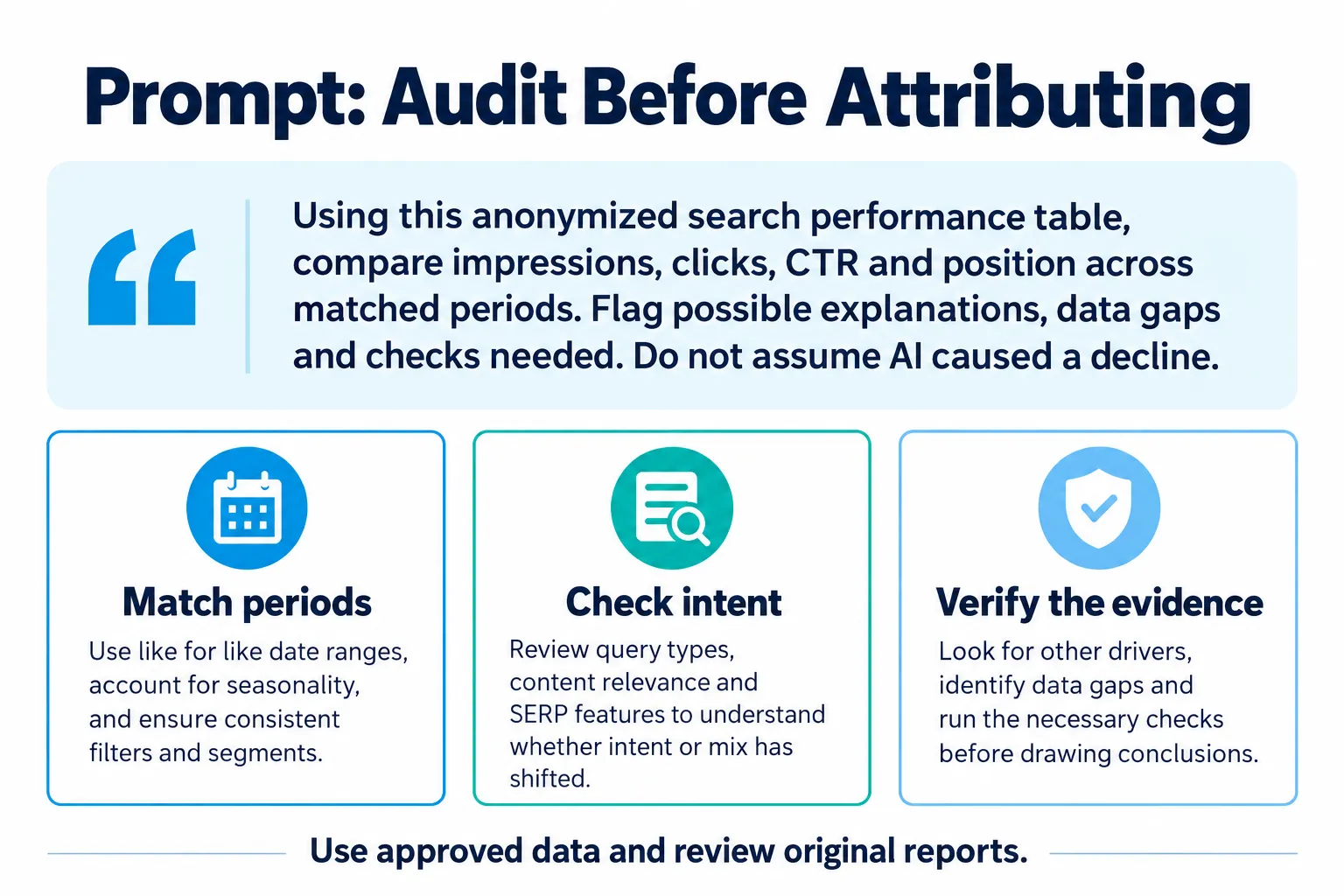
Using this anonymized search performance table, compare impressions, clicks, CTR and position across matched periods. Flag possible explanations, data gaps and checks needed. Do not assume AI caused a decline.
Use only data approved for the chosen service. Remove confidential identifiers, verify the calculations, and investigate tracking, rankings, intent, demand and seasonality before drawing conclusions.
Step 1: Identify high-impression, low-CTR queries
Review Google Search Console data to find pages receiving substantial visibility but relatively few visits.
Compare similar time periods and account for seasonal patterns.
Step 2: Classify search intent
Determine whether the queries are informational, navigational, commercial, or transactional.
Look for direct-answer features, AI Overviews, maps, and other SERP elements that may affect clicks.
Step 3: Investigate changes in search performance
Compare rankings, impressions, clicks, and CTR.
Do not automatically attribute declining traffic to AI. Algorithm changes, increased competition, technical issues, and changes in search demand may also contribute.
Step 4: Strengthen original content
Update outdated material, improve explanations, add original examples, and verify references.
Focus especially on information that helps readers make decisions or perform tasks.
Step 5: Improve technical SEO
Review crawling, indexing, canonical tags, internal links, mobile usability, and structured data accuracy.
Step 6: Examine AI search visibility
Use Google’s available generative AI reporting and appropriate third-party monitoring to assess where content appears.
Treat these as complementary sources rather than interchangeable measurements.
Step 7: Evaluate meaningful outcomes
Measure what visitors accomplish after reaching the website.
For a research association, meaningful outcomes might include reading a detailed guide, downloading educational material, enrolling in professional development, or finding additional research resources.
Step 8: Repeat and document the process
Keep a record of content changes and their dates.
Compare performance over suitable periods and revise strategies based on evidence rather than assumptions.
Common Myths About Zero-Click Searches
Myth 1: Zero-click searches mean SEO is dead
SEO continues to support discoverability, technical accessibility, and organic search visibility.
Its performance should be evaluated through more than website clicks alone.
Myth 2: Artificial intelligence causes every zero-click search
Direct answers, calculators, knowledge panels, and other SERP features existed before generative AI became widely available.
AI is one contributor, not the sole explanation.
Myth 3: Every zero-click search represents a successful search
Some users obtain answers, while others abandon searches or refine their queries.
Clickstream data alone does not establish satisfaction or answer accuracy.
Myth 4: Being cited by AI guarantees traffic
A citation may increase the possibility of discovery, but users can still obtain enough information without opening the source.
Myth 5: Structured data guarantees AI Overview inclusion
Google does not identify special schema markup as a requirement for AI Overviews or AI Mode.
Myth 6: All websites face the same consequences
Search intent, content type, audience, and business model influence how zero-click behavior affects a website.
Myth 7: More impressions always mean better results
Impressions represent exposure within a reporting system, not necessarily engagement or business value.
The Future of Zero-Click Search Beyond 2026
The next stage of search development will likely involve closer integration between conversational answers, multimodal search, and task-oriented AI systems.
Several developments deserve attention.
Conversational research may make it easier to refine complicated questions without repeatedly switching between websites.
Multimodal search can combine text, images, and other input types, allowing users to investigate information in different ways. In September 2026, Google announced additional multimodal performance reporting in Search Console. See the multimodal reporting announcement.
AI-assisted task completion may allow systems to move beyond providing information toward helping users perform actions. The extent of this change will depend on product capabilities, user trust, and appropriate safeguards.
Publisher attribution and visibility will remain important concerns as generated answers increasingly incorporate information from external sources.
For researchers, a central challenge will be determining whether an answer is supported by sufficiently reliable evidence.
For publishers, the challenge will be maintaining useful, original content that people and automated retrieval systems can discover.
No available evidence establishes that traditional web search or external website visits will disappear. The more defensible conclusion is that search experiences are becoming more varied.
Frequently Asked Questions About Zero-Click Searches
What is a zero-click search?
A zero-click search occurs when a person searches but does not click a result before ending or continuing their search. This can happen when an answer appears directly in the search results.
What percentage of Google searches are zero-click in 2026?
SparkToro’s June 2026 research estimated that 68.01% of US Google searches ended without a click during January–April 2026. The estimate is based on Similarweb browser clickstream data and does not cover every Google search environment.
Why are zero-click searches increasing?
Contributing factors include direct answers, featured snippets, knowledge panels, maps, AI-generated summaries, and changing user behavior. Their relative importance varies across queries.
Do Google AI Overviews reduce organic clicks?
Independent research has found an association between AI Overviews and lower click activity. Pew Research Center and Ahrefs have reported relevant findings, although their measurement methods differ.
Are zero-click searches bad for websites?
They can reduce referral opportunities for some queries, particularly simple informational searches. However, search visibility may still contribute to awareness, local interactions, and later website visits.
Is SEO still important in 2026?
Yes. SEO remains important for crawlability, indexing eligibility, relevance, content quality, and organic discovery, including eligibility for supporting links in Google’s AI search features.
What is the difference between SEO, AEO, and GEO?
SEO focuses on search discoverability. AEO emphasizes clear answers to user questions. GEO concerns how content is discovered and represented in generative AI experiences. They share many underlying content and technical practices.
How can businesses optimize for zero-click searches?
Businesses should understand search intent, provide clear answers, publish original information, improve technical SEO, maintain accurate business details, and measure engagement and conversions alongside search visibility.
Can Google Search Console measure AI search visibility?
Yes. Google documents dedicated generative AI impression reporting for applicable Search features, with a separate Discover report. It measures reported visibility, not every user interaction or the influence of a particular AI answer.
Why should researchers verify AI-generated answers?
AI-generated answers can omit context, misunderstand evidence, or present unsupported information. Researchers should inspect original sources, assess methodological limitations, and document their verification process.
Conclusion: Adapting to Search Where Clicks Are No Longer Guaranteed
Zero-click searches are a significant feature of the modern information environment. The 2026 evidence shows that many Google searches end without a click, while independent studies indicate that AI-generated summaries are associated with reduced visits to conventional search results. These developments create both opportunities and challenges.
Users may find information more quickly, but the convenience of summarized answers can reduce engagement with original sources. Publishers may gain visibility without receiving corresponding website traffic. Researchers must distinguish efficient information discovery from reliable source verification. Successful adaptation requires three complementary priorities: publish trustworthy original information, make that information accessible across search experiences, and measure outcomes that matter beyond click volume. For internet research professionals, the most important principle remains unchanged: a useful search result is a starting point, while credible research depends on examining and verifying the underlying evidence.