
In today’s data-driven world, finding reliable and peer-reviewed information can be challenging. General web searches mix scholarly sources with unverified content. Academic search engines focus on scholarly literature and connect students, researchers and professionals with journals, papers, theses and datasets. Researchers in 2026 move between scholarly search engines, citation indexes, academic databases, open-access repositories, literature-mapping tools and AI research systems. Each solves a different part of the research problem.
This directory covers 100 tools for scholarly discovery, from subject databases to AI research assistants. The entries describe what each tool is useful for, what access may require, and where coverage or verification can fall short. For a more focused starting point, see Shortlist of academic tools, Free academic search engines, Specialized student search tools, Nine academic search engines.
How This List Was Checked
The directory draws on platform documentation, publisher information, and public databases. It does not report comparative performance testing.
- Checked: The official page was readable and the relevant details were confirmed during the documented review.
- Reached: The official site responded, but its details could not be reconfirmed from the accessible page.
- Not re-checked: The official page could not be verified during the documented review.
Access labels describe the general model, such as free search, a paid plan, or access through a library. Free search can still lead to material behind a paywall. Check the provider for current terms. Coverage figures reported by platforms use different counting methods.
A Quick Glance
| # | Platform | Type | Access | AI features | Status, 9 Nov 2026 |
|---|---|---|---|---|---|
| 1 | Gemini Deep Research | Generative research agent | Free + paid | Yes | Checked |
| 2 | ChatGPT Deep Research | Generative research agent | Free + paid | Yes | Checked |
| 3 | Perplexity Deep Research | Generative research agent | Free + paid | Yes | Checked |
| 4 | Semantic Scholar | Scholarly AI search | Free | Yes | Checked |
| 5 | Gemini Notebook (formerly NotebookLM) | Source-grounded AI notebook | Free + paid | Yes | Checked |
| 6 | Elicit | AI research assistant | Free + paid | Yes | Checked |
| 7 | Consensus | AI academic search | Free + paid | Yes | Checked |
| 8 | SciSpace | AI research workspace | Free + paid | Yes | Checked |
| 9 | ResearchRabbit | Citation-based discovery | Free + paid | Yes | Checked |
| 10 | Scite | Citation context | Subscription (free trial) | Yes | Checked |
| 11 | Claude Research | Generative research agent | Subscription (paid plans) | Yes | Checked |
| 12 | Google Scholar Labs | AI scholarly search | Free (sign-in) | Yes | Checked |
| 13 | Litmaps | Citation mapping | Free + paid | Yes | Checked |
| 14 | Connected Papers | Similar-paper graphs | Free + paid | Algorithmic | Reached |
| 15 | Rayyan | Review screening | Free + paid | Yes | Checked |
| 16 | Microsoft Researcher | Generative research agent | Microsoft 365 Copilot licence | Yes | Checked |
| 17 | Covidence | Systematic-review management | Subscription or institutional (free trial) | Not stated | Checked |
| 18 | Google Scholar | Scholarly search | Free | Limited | Checked |
| 19 | Scopus | Citation database | Institutional (free Scopus Preview) | Yes, Scopus AI | Checked |
| 20 | Web of Science | Citation database | Institutional | Not re-checked | Reached |
| 21 | WorldCat | Library catalogue | Free to search | No | Checked |
| 22 | CORE | Open-access aggregator | Free | Limited | Checked |
| 23 | OpenAlex | Open scholarly catalogue | Free | Algorithmic | Checked |
| 24 | BASE | Repository search | Not stated | Not stated | Reached |
| 25 | DOAJ | Open-access journal index | Free | No | Checked |
| 26 | Crossref | DOI metadata search | Free | No | Checked |
| 27 | Dimensions | Research intelligence | Free + paid | Yes | Checked |
| 28 | The Lens | Scholarly and patent search | Free + institutional | Limited | Checked |
| 29 | OpenAIRE Explore | Open-science graph | Free | Semantic | Checked |
| 30 | Science.gov | U.S. federal science search | Free to search | Not stated | Checked |
| 31 | DataCite Commons | PID and dataset discovery | Free | No | Checked |
| 32 | arXiv | Preprint server | Free | No | Checked |
| 33 | PubMed Central | Biomedical full-text archive | Free | No | Checked |
| 34 | SSRN | Working papers and preprints | Not stated | Not stated | Checked |
| 35 | Zenodo | Open repository | Free | No | Checked |
| 36 | Europe PMC | Life-sciences literature | Free | Semantic features | Not re-checked |
| 37 | bioRxiv | Preprint server | Free | No | Checked |
| 38 | medRxiv | Preprint server | Free | No | Checked |
| 39 | SciELO | Open-access journal network | Free | No | Reached |
| 40 | OSF Preprints | Preprint network | Not stated | Not stated | Reached |
| 41 | HAL | Open archive | Not stated | Not stated | Reached |
| 42 | ChemRxiv | Preprint server | Free | Not stated | Checked |
| 43 | Redalyc | Open-access journal network | Not stated | Not stated | Not re-checked |
| 44 | LA Referencia | Repository network | Free | No | Reached |
| 45 | PubMed | Biomedical index | Free | Limited | Checked |
| 46 | Cochrane Library | Evidence database | Varies by country and institution | Limited | Checked |
| 47 | Embase | Biomedical database | Subscription or short passes | Yes, Embase AI | Checked |
| 48 | ClinicalTrials.gov | Trial registry | Free | No | Reached |
| 49 | APA PsycInfo | Psychology database | Subscription or institutional | Not stated | Checked |
| 50 | CINAHL | Nursing and allied-health index | Institutional | Not stated | Checked |
| 51 | WHO ICTRP | Trial meta-registry | Free | No | Checked |
| 52 | Trip Database | Clinical evidence search | Free + paid | Not confirmed | Checked |
| 53 | Global Health (CABI) | Public-health database | Institutional | Not stated | Not re-checked |
| 54 | Epistemonikos | Evidence-synthesis database | Free (CC BY content) | Not stated | Checked |
| 55 | Global Index Medicus | Regional health literature | Not stated | Not stated | Checked |
| 56 | PEDro | Physiotherapy evidence | Free | Not stated | Checked |
| 57 | IEEE Xplore | Engineering digital library | Subscription, institutional or pay-per-document | Limited | Checked |
| 58 | ACM Digital Library | Computing library | Free to read (Premium features paid) | Yes (Premium) | Checked |
| 59 | dblp | CS bibliography | Free | No | Reached |
| 60 | CAS SciFinder | Chemistry research platform | Institutional | Yes | Checked |
| 61 | MathSciNet | Mathematics database | Institutional | Not stated | Reached |
| 62 | Inspec | Engineering and physics index | Subscription or via platforms | Not stated | Checked |
| 63 | NASA ADS | Astronomy literature | Not stated | Not stated | Not re-checked |
| 64 | zbMATH Open | Mathematics database | Free | Not stated | Checked |
| 65 | AGRIS | Agricultural bibliography | Free | Not stated | Checked |
| 66 | INSPIRE-HEP | High-energy physics | Not stated | Not stated | Reached |
| 67 | AGRICOLA | Agricultural catalogue and index | Not stated | Not stated | Checked |
| 68 | GeoRef | Geoscience database | Institutional (licensed) | Not stated | Checked |
| 69 | Westlaw | Legal research | Subscription | Yes (AI tiers) | Checked |
| 70 | LexisNexis | Legal and news research | Subscription | Not stated | Checked |
| 71 | ERIC | Education research | Free | Not stated | Checked |
| 72 | HeinOnline | Legal research | Institutional | Not stated | Checked |
| 73 | NBER Working Papers | Economics working papers | Partly free (see entry) | Not stated | Checked |
| 74 | IDEAS/RePEc | Economics index | Free | Not stated | Checked |
| 75 | EconLit | Economics bibliography | Institutional | Not stated | Checked |
| 76 | ICPSR | Social-science data archive | Not stated | Not stated | Checked |
| 77 | EconBiz | Economics and business search | Not stated | Not stated | Reached |
| 78 | EconPapers | Economics index | Not stated | Not stated | Checked |
| 79 | Sociological Abstracts | Sociology index | Institutional | Not stated | Checked |
| 80 | PAIS Index | Public-policy index | Institutional | Not stated | Not re-checked |
| 81 | JSTOR | Journal and book archive | Institutional, JPASS or free open content | Not stated | Checked |
| 82 | ScienceDirect | Elsevier publisher platform | Open access + paid | Not stated | Checked |
| 83 | SpringerLink | Springer Nature platform | Subscription (some open access) | Not stated | Checked |
| 84 | Google Books | Book search | Free to search | Not stated | Checked |
| 85 | Wiley Online Library | Wiley publisher platform | Subscription (some open access) | Not stated | Not re-checked |
| 86 | Taylor & Francis Online | Publisher platform | Not stated | Not stated | Checked |
| 87 | Sage Journals | Publisher platform | Subscription or purchase | Not stated | Checked |
| 88 | Oxford Academic | OUP publisher platform | Subscription (some open access) | Yes, AI Discovery Assistant | Checked |
| 89 | Cambridge Core | CUP publisher platform | Subscription (some open access) | Not stated | Checked |
| 90 | Project MUSE | Humanities platform | Institutional (some open access) | Not stated | Checked |
| 91 | HathiTrust | Digital library | Free (full view limited by copyright) | Not stated | Checked |
| 92 | Open Library | Book catalogue and lending | Free | Not stated | Checked |
| 93 | ProQuest Dissertations & Theses Global | Dissertation database | Institutional | Not re-checked | Checked |
| 94 | Google Dataset Search | Dataset search | Free | Search ranking | Checked |
| 95 | Data.gov | U.S. government data | Free | Not stated | Checked |
| 96 | OATD | Open dissertation index | Free | No | Checked |
| 97 | Harvard Dataverse | Data repository | Free to browse (login to deposit) | Not stated | Checked |
| 98 | EBSCO Open Dissertations | Open dissertation index | Free | No | Checked |
| 99 | Dryad | Data repository | Free to use (deposit charges) | Not stated | Checked |
| 100 | Shodhganga | Indian thesis repository | Not stated | Not stated | Reached |
AI-Powered Academic Search Engines & Research Assistants (2026)
AI tools now sit alongside traditional databases in many research workflows. These systems use natural language processing and machine learning to interpret queries, summarise findings and connect ideas across disciplines. They can go beyond keyword matching, but their answers still have to be checked against the sources they cite.
1. Google Gemini (Deep Research)
Best for: Multi-step research, web investigation, source synthesis, and research within Google’s AI ecosystem.
Gemini Deep Research is an agentic feature that plans, searches and browses the web, and, if you opt in, your Gmail, Drive and Chat, to produce multi-page reports (Google). Its integration with Google’s broader ecosystem makes it useful for researchers already working with Google tools and information sources.
Its weakness is that academic database coverage and search reproducibility are not equivalent to those offered by specialist scholarly databases.
2. ChatGPT Deep Research
Best for: Multi-source research, exploratory investigations, complex research questions, and structured research reports.
ChatGPT Deep Research can conduct multi-step searches, investigate websites and documents, work with uploaded files and connected information sources, and produce structured reports with citations. It is particularly useful when a research question requires information from several types of sources rather than one academic database.
Its weakness is that it is a general-purpose research system rather than a dedicated scholarly database. Important academic searches should still be repeated in specialist sources such as PubMed, Scopus, Web of Science, or IEEE Xplore.
3. Perplexity Research
Best for: Fast web research, cited answers, current information, exploratory academic research, and source discovery.
Perplexity combines live web search with generative AI to produce direct answers supported by source citations. Its Deep Research mode, launched in February 2025, runs many searches and writes a full report; it is free with a limited number of daily queries, and Pro subscribers get a higher volume (Perplexity, 2025).
Its weakness is that its source universe extends far beyond scholarly literature. Researchers must distinguish journal articles and primary research from news, websites, reports, and secondary sources.
4. Semantic Scholar
Best for: AI-assisted scholarly literature discovery, related-paper searching, influential-paper discovery, and citation exploration.
Semantic Scholar is a free, AI-powered academic search engine run by the Allen Institute for AI (Ai2), a non-profit research institute. Its About page says it indexes over 200 million academic papers (Semantic Scholar). It combines traditional academic retrieval with machine-learning-based recommendations, citation information, paper summaries and related-paper discovery, and offers open datasets and an API.
Its weakness is that full-text availability varies and its coverage is not identical across every academic discipline.
5. Gemini Notebook (formerly NotebookLM)
Best for: Researching and synthesizing a controlled collection of documents selected by the researcher.
Google renamed NotebookLM as Gemini Notebook on 16 July 2026. It remains a standalone research tool, and existing notebooks and links carry over through automatic redirects (Google Workspace Updates, 2026). It lets researchers build source-grounded notebooks around papers, reports, webpages, PDFs and other selected material, and its answers show references to those sources in the text. It is particularly useful after a literature collection has already been assembled.
Its weakness is that the quality and completeness of the research depend heavily on the sources added to the notebook.
6. Elicit
Best for: Literature reviews, systematic-review support, research-paper discovery, structured evidence extraction, and study comparison.
Elicit is a specialist AI research tool for evidence-based academic work. It offers a research agent, semantic paper search, generated research reports and systematic-review support. Elicit says it searches about 138 million scholarly papers and 545,000 clinical trials (Elicit, 2026).
Its weakness is that its strongest capabilities are concentrated around research literature and evidence synthesis rather than broader web or investigative research.
7. Consensus
Best for: Asking academic questions in natural language and identifying what published research says about a topic.
Consensus describes itself as an AI academic search engine for peer-reviewed literature. Its own site does not currently state a corpus size; Ohio University Libraries’ guide (updated 3 April 2026) describes it as searching over 200 million academic papers (Ohio University Libraries, 2026). It is particularly useful for questions such as whether research supports a particular relationship, intervention, or scientific claim.
Its weakness is that generated synthesis can simplify disagreements, methodological differences, or nuances between individual studies.
8. SciSpace
Best for: Searching research papers, reading PDFs, explaining academic language, comparing studies, and AI-assisted literature reviews.
SciSpace combines academic search with AI tools for understanding and interacting with research papers. Researchers can locate publications, chat with PDFs, ask questions about papers, and use AI-supported literature-review and writing functions. SciSpace says it gives access to over 280 million papers (SciSpace, 2026).
Its weakness is that AI explanations should not substitute for reading methodology, limitations, statistical results, and original conclusions in important papers.
9. ResearchRabbit
Best for: Visual literature exploration, citation chasing, related-paper discovery, author exploration, and maintaining research collections.
ResearchRabbit analyzes citation and authorship relationships to help researchers move outward from known papers. Its citation maps make it particularly useful when entering a research field and identifying related papers, authors, and clusters. Litmaps acquired ResearchRabbit in May 2025 (IT Brief New Zealand, 2025); the tool still runs under its own name and says it covers over 320 million academic papers (ResearchRabbit, 2026).
Its weakness is that citation-network discovery works best once the researcher already has relevant seed papers.
10. Scite.ai
Best for: Citation verification and understanding whether subsequent research supports, contrasts with, or mentions a publication.
Scite is best known for Smart Citations, which provide context around how publications are cited by later research. This helps researchers go beyond simple citation counts and investigate how a paper’s findings have been treated in the literature. Scite is now part of Research Solutions and is a paid service with a free trial (Scite, 2026).
Its weakness is that citation classifications should still be checked against the actual citing paper when the interpretation matters.
11. Claude Research
Best for: Long-form research synthesis, source-cited web investigation, connected information sources, and detailed analytical reports.
Claude Research runs a series of connected web searches and can also draw on connected tools such as Google Workspace; Anthropic offers it on its paid Pro, Max, Ultra, Team and Enterprise plans (Anthropic, 2026). Its long-context capabilities also make it useful for working through substantial collections of research documents.
Its weakness is that it is a general research agent rather than a comprehensive academic citation database.
12. Google Scholar Labs
Best for: AI-assisted scholarly discovery within the Google Scholar ecosystem.
Scholar Labs uses AI to interpret detailed research questions, identify important concepts and relationships, search scholarly material, and explain why particular papers may be relevant. Google launched it on 18 November 2025 as an experimental feature for a limited number of signed-in users.
Its weakness is that it requires a Google sign-in and is newer than standard Google Scholar. Since a June 2026 update it has been open to all signed-in users and accepts questions in all languages, with the updated version released first in English (Google Scholar Blog, 2026).
13. Litmaps
Best for: Citation mapping, literature discovery, research-field visualization, and monitoring newly published papers.
Litmaps builds visual maps from citation relationships and helps researchers expand literature collections from important seed papers. It is especially useful for tracking how research fields develop over time, and it sends alerts for new papers on a topic. The same company now owns ResearchRabbit (entry 9).
Its weakness is that citation mapping complements rather than replaces systematic keyword and database searching.
14. Connected Papers
Best for: Finding conceptually related research from a known paper and visually exploring research clusters.
Connected Papers generates graphical networks of related publications based on bibliographic relationships. It is particularly useful for identifying foundational papers and adjacent lines of research when entering an unfamiliar field.
Its weakness is that it is designed primarily for discovery around a seed paper rather than comprehensive literature searching.
15. Rayyan
Best for: Systematic-review screening, title and abstract review, collaboration, and AI-assisted study prioritization.
Rayyan helps research teams organize and screen large sets of references produced during systematic and scoping reviews. AI-assisted features can help prioritize likely-relevant studies.
Its weakness is that Rayyan is primarily a review-management and screening environment, not a substitute for the databases used to find the studies.
16. Microsoft Researcher
Best for: Research combining information from the web with Microsoft 365 organizational sources.
Researcher is a Microsoft 365 Copilot agent for deep, multi-step research with source citations. It is part of the default experience for users with a Microsoft 365 Copilot licence. It draws on work data through Microsoft Graph and connectors, and on web data through Bing when an administrator allows web search (Microsoft, 2026).
Its weakness is that its main advantages depend on a Microsoft 365 Copilot licence and on organizational data.
17. Covidence
Best for: Managing systematic reviews, screening studies, extracting data, and organizing evidence-synthesis workflows.
Covidence provides structured workflows for screening, resolving reviewer disagreements, extracting study information, and managing systematic reviews.
Its weakness is that it becomes most useful after the literature search has already been completed in external scholarly databases.
General Academic Search Engines
These platforms are common starting points for broad academic research and scholarly exploration.
18. Google Scholar
Best for: Broad multidisciplinary academic discovery and finding scholarly papers across many disciplines.
Google Scholar is a widely used general academic search engine. It covers articles, theses, books, abstracts and court opinions from publishers, professional societies, online archives, universities and other sites (Google Scholar). Its “Cited by” and related-article features also support citation chasing.
Its weakness is selectivity. Inclusion in Google Scholar does not guarantee that a source has been peer reviewed or that the research is methodologically reliable.
19. Scopus
Best for: Structured multidisciplinary literature searching, citation analysis, bibliometrics, and research assessment.
Elsevier’s Scopus is a curated abstract and citation database. Elsevier lists over 100 million records, more than 404,000 books and over 2.6 million preprints, and offers Scopus AI for answers grounded in cited content (Elsevier, 2026). Researchers use it for literature reviews, author and institution analysis, citation tracking, journal evaluation, and bibliometric research.
Its weakness is that comprehensive access normally requires an institutional subscription (a free Scopus Preview offers limited searching) and it is primarily an indexing database rather than a universal source of full text.
20. Web of Science
Best for: Citation searching, authoritative scholarly indexing, bibliometric analysis, and research evaluation.
Web of Science is one of the most established citation-indexing systems in academic research. Its Core Collection is widely used for citation analysis, systematic searching, research assessment, and identifying relationships among publications.
Its weakness is that institutional access is generally required and coverage depends on the databases included in a subscription.
21. WorldCat
Best for: Finding books, theses, journals, archival resources, and library holdings worldwide.
WorldCat connects researchers with the collections of thousands of libraries internationally. It is particularly useful when scholarly material exists in books, dissertations, print collections, or library holdings rather than freely available journal databases.
Its weakness is that discovering a record does not necessarily provide immediate digital full-text access.
22. CORE
Best for: Discovering openly accessible scholarly literature and finding free versions of research papers.
CORE aggregates scholarly material from repositories and journals worldwide. It is particularly valuable when a researcher has identified a paper but needs to locate an openly available copy.
Its weakness is that repository metadata and full-text availability can vary between contributing sources.
23. OpenAlex
Best for: Open scholarly metadata, citation relationships, bibliometrics, research intelligence, and large-scale scholarly analysis.
OpenAlex is an open catalogue of global research that indexes about half a billion scholarly works, linked to their authors, institutions, sources and topics (OpenAlex, 2026). Its open dataset and API make it particularly useful for researchers, developers, librarians, and bibliometric analysts.
Its weakness is that it is primarily scholarly infrastructure and metadata rather than a conventional full-text academic library.
24. BASE
Best for: Searching institutional repositories and discovering open scholarly material from universities and research organizations.
BASE, operated by Bielefeld University Library, indexes records from academic repositories and other scholarly sources worldwide.
Its weakness is that the quality and completeness of metadata vary among contributing repositories.
25. DOAJ
Best for: Finding legitimate open-access scholarly journals and openly readable peer-reviewed articles.
The Directory of Open Access Journals focuses on quality-controlled open-access journals from many countries, languages, and academic disciplines.
Its weakness is that it focuses specifically on open-access journals and therefore does not represent the entire scholarly publishing landscape.
26. Crossref
Best for: DOI lookup, scholarly metadata verification, publication identification, and checking research records.
Crossref is essential scholarly infrastructure rather than a traditional academic search engine. Researchers can use its metadata to verify titles, authors, DOIs, publication dates, funding relationships, and other publication details.
Its weakness is that Crossref usually points researchers to publications rather than providing the full text itself.
27. Dimensions
Best for: Connecting publications with grants, patents, datasets, clinical trials, and research organizations.
Dimensions, from Digital Science, links grants, publications, datasets, clinical trials, patents and policy documents, giving a broader research-intelligence view than conventional article databases.
Its weakness is that advanced analytics and some research-intelligence features require paid access.
28. Lens
Best for: Searching scholarly literature together with patents and investigating connections between research and innovation.
The Lens combines scholarly publications, citation relationships, patents and intellectual-property information, and says it covers more than 200 million scholarly records and patents from over 100 countries. In June 2026 Cambia sold it to The Lens Limited, an Australian non-profit (The Lens, 2026).
Its weakness is that researchers focused only on conventional academic literature may find dedicated scholarly databases more straightforward.
29. OpenAIRE Explore
Best for: Open-science research discovery, European research outputs, datasets, software, grants, and linked research objects.
OpenAIRE Explore connects scholarly publications with datasets, software, organizations, and funding information.
Its weakness is that its strongest coverage and ecosystem relationships are particularly associated with European open-science infrastructure.
30. Science.gov
Best for: U.S. government-funded science, technical information, and federal research resources.
Science.gov searches scientific information produced or supported by U.S. government agencies.
Its weakness is that its scope is centered on U.S. federal scientific information rather than the entire international academic literature.
31. DataCite Commons
Best for: Research datasets, persistent identifiers, DOI relationships, researchers, organizations, and research-object discovery.
DataCite Commons connects research outputs through identifiers such as DOIs, ORCID records, and organizational identifiers.
Its weakness is that it functions primarily as discovery and metadata infrastructure rather than a conventional academic full-text search engine.
Open-Access Repositories & Preprint Platforms
32. arXiv
Best for: Current research in physics, mathematics, computer science, quantitative biology, statistics, and related disciplines.
arXiv is an open research-sharing platform holding over three million articles. In 2026 it became an independent non-profit after decades at Cornell University. Volunteer moderators check submissions for topical fit and scholarly value, but there is no peer review (arXiv, 2026). It is widely used in fast-moving fields such as artificial intelligence and computer science.
Its weakness is that arXiv papers should not automatically be treated as peer reviewed.
33. PubMed Central
Best for: Free full-text biomedical and life-sciences research.
PubMed Central is the U.S. National Library of Medicine’s free full-text archive of biomedical and life-sciences literature. It held 11,327,616 articles in fiscal year 2025 (National Library of Medicine).
Its weakness is that PMC contains only material deposited or made eligible for the archive, so it does not contain every publication indexed by PubMed.
34. SSRN
Best for: Working papers and early research in economics, finance, law, business, political science, and social sciences.
SSRN enables researchers to discover working papers and early versions of scholarly research before or alongside formal journal publication. Its home page listed 1,548,167 preprints and papers on 9 November 2026 (SSRN, 2026).
Its weakness is that many papers are working papers or preprints and may not yet have completed peer review.
35. Zenodo
Best for: Research papers, datasets, software, presentations, reports, and other research outputs.
Zenodo is a free, multidisciplinary open repository operated by CERN and funded by OpenAIRE and the European Union. Researchers can deposit many forms of scholarly output, and records are citable through DataCite DOIs (Zenodo).
Its weakness is that repository inclusion does not itself establish peer-review status or research quality.
36. Europe PMC
Best for: Open life-sciences literature, biomedical publications, preprints, grants, and related research objects.
Europe PMC provides literature search alongside links among publications, data, reviews, and other scientific resources.
37. bioRxiv
Best for: Early life-sciences research and biological-science preprints.
bioRxiv allows researchers to discover new biological research before formal journal publication.
Its weakness is that preprints have not completed journal peer review.
38. medRxiv
Best for: Early health, clinical, and medical research.
medRxiv, operated by the non-profit openRxiv, distributes health-science preprints rapidly and is free to read. It is particularly useful for monitoring emerging clinical and medical research (medRxiv).
Its weakness is that its papers are preliminary and should not be treated as established clinical evidence before peer review and verification.
39. SciELO
Best for: Open-access scholarly research from Latin America and other participating research communities.
SciELO provides strong multidisciplinary coverage across medicine, science, social sciences, and humanities and improves visibility for research that may be underrepresented in large commercial databases.
40. OSF Preprints
Best for: Discovering discipline-specific preprints connected with the Open Science Framework.
OSF supports a network of preprint communities and provides research infrastructure for open-science workflows.
Its weakness is that peer-review status varies because preprints are generally shared before conventional journal review.
41. HAL
Best for: Multidisciplinary open research, particularly scholarship from France and European institutions.
HAL is a major open archive used by universities and research organizations for papers, theses, conference material, and other research outputs.
42. ChemRxiv
Best for: Chemistry and related chemical-science preprints.
ChemRxiv supports rapid dissemination of chemistry research before journal publication.
Its weakness is that deposited work has generally not yet completed formal peer review.
43. Redalyc
Best for: Open scholarly literature from Latin America, Spain, Portugal, and related academic communities.
Redalyc increases access to scholarly publishing that may receive less visibility in major commercial indexes.
44. LA Referencia
Best for: Open-access research outputs from Latin American and Spanish national repository networks.
LA Referencia aggregates journal articles, theses, reports, and other scholarly material from participating repositories.
Medical, Biomedical & Health Research Databases
45. PubMed
Best for: Biomedical, medical, clinical, and life-sciences literature searching.
PubMed is a free resource from the U.S. National Library of Medicine. It contains more than 40 million citations and abstracts of biomedical literature (National Library of Medicine) and supports detailed searching with Medical Subject Headings and advanced query tools.
Its weakness is that PubMed primarily indexes records and abstracts. It is not itself a complete full-text library.
46. Cochrane Library
Best for: Systematic reviews, evidence-based medicine, controlled trials, and clinical decision research.
The Cochrane Library is a central source for evidence synthesis in healthcare. It contains the Cochrane Database of Systematic Reviews and CENTRAL, the Cochrane Central Register of Controlled Trials.
Its weakness is that complete access to some content varies by country or institutional subscription.
47. Embase
Best for: Biomedical research, pharmacology, drug safety, clinical literature, and comprehensive medical systematic reviews.
Embase is Elsevier’s biomedical and pharmacological database for systematic reviews, drug-safety monitoring and evidence-based research. Elsevier says it adds about 8,000 records a day and now includes Embase AI search (Elsevier).
Its weakness is that access requires an annual organizational subscription or a short paid individual pass (7 or 30 days).
48. ClinicalTrials.gov
Best for: Finding registered clinical studies, their status and, where submitted, their results.
ClinicalTrials.gov is a public registry of clinical studies. Study record managers submit registration information and, where required, results information, so a single record can hold both.
Its weakness is that registry records are submitted by sponsors and are not peer-reviewed publications; check the linked publications as well.
49. APA PsycInfo
Best for: Psychology, behavioural science, mental-health research, and related social sciences.
APA PsycInfo is the American Psychological Association’s abstracting and indexing database for the behavioural and social sciences. It contains 6,058,231 records (American Psychological Association, 2026).
Its weakness is that comprehensive access normally requires an institutional subscription.
50. CINAHL
Best for: Nursing, allied health, occupational therapy, rehabilitation, and related healthcare research.
CINAHL is one of the principal specialist databases for nursing and allied-health literature.
Its weakness is that access is typically provided through institutional subscriptions.
51. WHO ICTRP
Best for: Searching clinical-trial registration information from participating registries worldwide.
The WHO International Clinical Trials Registry Platform provides a single search point for trial records from national and regional registries. It is not itself a registry: trials are registered with primary registries, and the portal, at trialsearch.who.int, also offers an API (World Health Organization).
52. Trip Database
Best for: Evidence-based clinical practice, systematic reviews, guidelines, and healthcare evidence.
Trip Database helps clinicians and researchers rapidly locate evidence relevant to clinical questions.
Its weakness is that some advanced functionality requires paid access.
53. Global Health
Best for: International public health, epidemiology, tropical health, disease prevention, and global-health research.
CABI’s Global Health database focuses on public-health literature and provides valuable international coverage.
Its weakness is that full database access generally depends on subscription availability.
54. Epistemonikos
Best for: Systematic reviews, evidence synthesis, and health-decision research.
Epistemonikos organizes health evidence around systematic reviews and related studies and is useful for evidence-based healthcare research.
55. Global Index Medicus
Best for: Health literature from regions that may be underrepresented in mainstream international biomedical indexes.
The WHO-supported Global Index Medicus brings together regional indexes, including AIM (Africa), IMEMR (Eastern Mediterranean), IMSEAR (South-East Asia), LILACS (Latin America and the Caribbean) and WPRIM (Western Pacific).
56. PEDro
Best for: Physiotherapy trials, systematic reviews, and evidence-based rehabilitation practice.
The Physiotherapy Evidence Database is a free database of physiotherapy trials, reviews and guidelines. It held 70,940 records after its 12 October 2026 update (PEDro, 2026).
Engineering, Computing, Mathematics & Scientific Research
57. IEEE Xplore
Best for: Electrical engineering, electronics, computer science, telecommunications, robotics, artificial intelligence, power systems, and technical standards.
IEEE Xplore holds more than 6 million documents from IEEE and partners, including journal articles, conference papers, standards, books and courses (IEEE).
Its weakness is that much of the full-text collection requires subscription or institutional access.
58. ACM Digital Library
Best for: Computer science, software engineering, information systems, human-computer interaction, and computing research.
The ACM Digital Library provides journals, conference proceedings, and extensive bibliographic information covering computer science and related technology fields.
ACM completed its move to full open access at the end of 2025, so ACM-published articles are free to read. From January 2026 the library has Basic and Premium tiers: Premium features such as the ACM Guide to Computing Literature, AI-assisted search and bulk downloads need an ACM Open or Premium subscription (ACM, 2026).
59. dblp
Best for: Free bibliographic searching of computer-science publications and conference literature.
dblp provides millions of structured computer-science publication records and is particularly useful for author, conference, and publication discovery.
Its weakness is that it is primarily bibliographic and generally links researchers to external full-text sources.
60. CAS SciFinder
Best for: Chemistry literature, chemical substances, reactions, and scientific information.
CAS SciFinder is a curated chemistry research platform covering substances, literature, patents, reactions and suppliers, with AI-assisted search and retrosynthesis predictions.
Its weakness is that access normally requires an institutional or organizational subscription.
61. MathSciNet
Best for: Mathematics publications, reviews, authors, and mathematical research discovery.
MathSciNet, produced by the American Mathematical Society, is one of the principal specialist databases for mathematical literature.
Its weakness is that full access normally requires an institutional subscription.
62. Inspec
Best for: Physics, electrical engineering, electronics, computing, and technical scientific literature.
Inspec provides specialized indexing and controlled vocabulary for technical research.
Its weakness is that it is primarily available through paid institutional services.
63. NASA Astrophysics Data System
Best for: Astronomy, astrophysics, planetary science, and related physics literature.
NASA ADS is a widely used research-discovery system for astronomy and astrophysics and supports citation and bibliographic exploration.
64. zbMATH Open
Best for: Open mathematics literature discovery, mathematical authors, reviews, and related research metadata.
zbMATH Open is an abstracting and reviewing service for mathematics, edited by FIZ Karlsruhe and the European Mathematical Society. It holds about 5 million entries and has been open access since 2021 (zbMATH Open).
65. AGRIS
Best for: Agriculture, food systems, forestry, agricultural science, and related international research.
AGRIS, run by the Food and Agriculture Organization since 1974, is a free multilingual database of agricultural research with 16,631,750 bibliographic records (FAO, 2026).
66. INSPIRE-HEP
Best for: High-energy physics literature, researchers, conferences, and citation information.
INSPIRE-HEP is a major specialist information platform for the high-energy physics community.
67. AGRICOLA
Best for: U.S. and international agricultural literature.
AGRICOLA is the U.S. National Agricultural Library’s catalogue of books and other materials, plus an index to journal citations. It is now searched through NAL’s SEARCH service together with PubAg and NAL Digital Collections: choose the AGRICOLA dataset in the drop-down menu (National Agricultural Library).
68. GeoRef
Best for: Geology, geosciences, earth science, and geological literature.
GeoRef, produced by the American Geosciences Institute since 1966, holds more than 4.7 million geoscience references (American Geosciences Institute).
Its weakness is that access commonly depends on institutional subscriptions.
Social Sciences, Economics, Business & Legal Research
69. Westlaw
Best for: Case law, statutes, regulations, legal commentary, and professional legal research.
Westlaw is a widely used professional legal research system for searching legal authorities and secondary sources. Thomson Reuters sells it in tiers, including versions with AI-assisted research.
Its weakness is that access is expensive and primarily subscription based.
70. LexisNexis
Best for: Legal research, news archives, business information, public records, and professional research.
LexisNexis combines legal databases with extensive news, corporate, regulatory, and public-information collections.
Its weakness is that database access and available collections depend heavily on the subscription package.
71. ERIC
Best for: Education research, teaching, educational policy, curriculum, and academic literature in education.
The Education Resources Information Center is a free specialist research database sponsored by the Institute of Education Sciences (IES) of the U.S. Department of Education.
Its weakness is that full text is not available for every indexed record.
72. HeinOnline
Best for: Law reviews, legal history, legal journals, treaties, government material, and historical legal research.
HeinOnline, from William S. Hein & Co., offers searchable journals, government documents and case law and is particularly valuable for academic legal scholarship and historical legal collections.
Its weakness is that access is through annual institutional subscriptions.
73. NBER Working Papers
Best for: Current economics research and influential working papers.
The National Bureau of Economic Research working-paper series is widely followed by economists and policymakers for new economic research.
Its weakness is that working papers may later change before final journal publication. Papers more than 18 months old are open access; newer papers are free to eligible groups, and other visitors can download three a year (NBER, 2026).
74. IDEAS/RePEc
Best for: Economics working papers, articles, authors, institutions, and citation discovery.
IDEAS is a free index of economics literature built on the volunteer RePEc initiative. It lists more than 5.5 million research items, over 4.9 million of them downloadable in full text (IDEAS, 2026).
75. EconLit
Best for: Structured scholarly searching in economics.
EconLit is produced by the American Economic Association and holds more than 2 million records covering 140 years of economics literature (American Economic Association).
Its weakness is that access usually requires an institutional subscription.
76. ICPSR
Best for: Social-science datasets, quantitative research, archived studies, and secondary data analysis.
The Inter-university Consortium for Political and Social Research is an international consortium of more than 800 academic and research organizations, providing access to over 400,000 research files (ICPSR).
77. EconBiz
Best for: Economics and business literature discovery.
EconBiz provides research search and discovery tools covering economics and business studies.
78. EconPapers
Best for: Discovering economics working papers and publications distributed through RePEc.
EconPapers, hosted by Örebro University School of Business, is another interface to RePEc, with about 5.6 million searchable items (EconPapers, 2026).
79. Sociological Abstracts
Best for: Sociology, social theory, social behaviour, and related social sciences.
Sociological Abstracts provides specialist bibliographic indexing for sociological literature.
Its weakness is that comprehensive access generally requires a library or institutional subscription.
80. PAIS Index
Best for: Public policy, international relations, government, political science, and public-affairs research.
PAIS Index provides specialized indexing for policy-oriented research and public-affairs literature.
Its weakness is that access is generally subscription based.
Humanities, Books & Scholarly Publisher Platforms
81. JSTOR
Best for: Humanities, history, social sciences, archival journals, academic books, and primary-source research.
JSTOR, run by the non-profit ITHAKA, is a widely recognised platform for humanities and social sciences, serving more than 14,000 institutions and 1,850 publishers (JSTOR, 2026). Its deep journal archives make it particularly important for historical literature searching.
Its weakness is that access to much of its collection depends on institutional subscriptions, although significant open content is also available.
82. ScienceDirect
Best for: Scientific, technical, medical, and multidisciplinary journal and book content published by Elsevier.
ScienceDirect provides full-text access to a large collection of peer-reviewed journals and book chapters, more than 250,000 of them open access (ScienceDirect, 2026).
Its weakness is that it is primarily a publisher platform rather than a neutral index of the entire academic literature.
83. SpringerLink
Best for: Scientific journals, academic books, book chapters, and multidisciplinary research.
SpringerLink provides access to Springer Nature’s scholarly publishing collection, which it lists as more than 10.3 million items (SpringerLink, 2026).
Its weakness is that many full-text publications require institutional or individual access.
84. Google Books
Best for: Searching inside books, locating editions, tracing quotations, historical research, and identifying book references.
Google Books makes millions of books searchable and is particularly valuable when research extends beyond journal literature.
Its weakness is that full-view availability is restricted for many copyrighted works.
85. Wiley Online Library
Best for: Multidisciplinary journal articles, reference works, and academic books.
Wiley Online Library provides scholarly research across science, medicine, business, social science, and other disciplines.
Its weakness is that much full-text content requires subscription access.
86. Taylor & Francis Online
Best for: Social sciences, humanities, science, technology, medicine, and multidisciplinary journal research.
Taylor & Francis Online hosts a large academic journal collection covering numerous disciplines.
Its weakness is that it searches primarily content within its publishing ecosystem.
87. Sage Journals
Best for: Social sciences, research methods, education, business, healthcare, and applied academic disciplines.
Sage Journals is particularly strong in social science and methodological research, and now also hosts the Mary Ann Liebert journals.
Its weakness is that access to many articles requires institutional subscription or individual purchase.
88. Oxford Academic
Best for: Humanities, law, social sciences, medicine, and scholarship published by Oxford University Press.
Oxford Academic provides access to journals and books across many academic disciplines and offers an AI Discovery Assistant.
Its weakness is that it is primarily a publisher-specific platform.
89. Cambridge Core
Best for: Academic books and journals across humanities, social sciences, science, law, and related disciplines.
Cambridge Core provides the scholarly publishing collections of Cambridge University Press.
Its weakness is that much full-text material requires institutional or paid access.
90. Project MUSE
Best for: Humanities, cultural studies, literature, history, and social-science journals and books.
Project MUSE brings together scholarship from university presses, scholarly societies, and related academic publishers.
Its weakness is that comprehensive access generally depends on institutional subscriptions, although it also carries open-access and Subscribe to Open titles.
91. HathiTrust Digital Library
Best for: Digitized books, historical publications, library collections, and humanities research.
HathiTrust brings together more than 18 million digitized items from research libraries (HathiTrust, 2026) and is particularly valuable for historical and book-based scholarship.
Its weakness is that copyright restrictions limit full-text access to some material.
92. Open Library
Best for: Book discovery, bibliographic research, and accessing eligible digitized books.
Open Library, a non-profit catalogue backed by the Internet Archive, provides searchable records and lets users borrow more than 3 million books free through controlled digital lending (Open Library, 2026).
Its weakness is that it is not specifically curated as an academic scholarly database.
Theses, Dissertations & Research Data
93. ProQuest Dissertations & Theses Global
Best for: Comprehensive graduate research, doctoral dissertations, and master’s theses from institutions worldwide.
ProQuest Dissertations & Theses Global is a large specialist collection of graduate research, with more than 5 million citations and 3 million full texts (ProQuest).
Its weakness is that comprehensive access normally requires an institutional subscription.
ProQuest Dissertations and Theses
94. Google Dataset Search
Best for: Discovering datasets stored across research repositories, government portals, universities, and websites.
Google Dataset Search provides a dedicated search interface for locating structured datasets across many subject areas.
Its weakness is that it discovers datasets but does not independently assess their quality, methodology, or reliability.
95. Data.gov
Best for: U.S. government datasets, public-sector information, statistics, and open government research data.
Data.gov, run by the General Services Administration’s Technology Transformation Services, is the central discovery portal for U.S. federal datasets. It listed 532,480 datasets on 9 November 2026 (Data.gov, 2026), and a next-generation catalogue is available to try at catalog.data.gov.
Its weakness is that its main scope is U.S. government data rather than global research data.
96. OATD
Best for: Finding openly accessible theses and dissertations.
Open Access Theses and Dissertations indexes 7,230,116 theses and dissertations from more than 1,100 colleges, universities and research institutions (OATD, 2026). NDLTD’s “Global ETD Search” link now points to OATD; the separate NDLTD search listed as offline in the previous edition has been dropped.
Its weakness is that coverage depends on participating repositories and is less comprehensive than some commercial dissertation databases.
97. Harvard Dataverse
Best for: Research datasets, replication data, open-science data sharing, and dataset citation.
Harvard Dataverse provides a widely used platform for publishing, discovering, and citing research datasets.
Its weakness is that the quality and documentation of individual deposited datasets depend on the depositor.
98. EBSCO Open Dissertations
Best for: Free discovery of electronic theses and dissertations.
EBSCO Open Dissertations is a free portal with about 2 million records from 325 universities, also reachable at opendissertations.org (EBSCO, 2026).
Its weakness is that its collection is smaller than ProQuest Dissertations & Theses Global.
99. Dryad
Best for: Research datasets associated with scholarly publications and reproducible research.
Dryad is a non-profit membership organization that publishes and preserves research data for reuse. Data are free to download; depositors pay a data publishing charge (Dryad, 2026).
Its weakness is that it is a data repository rather than a broad academic literature search engine.
100. Shodhganga
Best for: Doctoral theses and dissertations produced by Indian universities.
Shodhganga is a major electronic thesis and dissertation repository and an important research source for scholarship produced across Indian higher-education institutions.
Its weakness is that its geographic and institutional focus is primarily India.
Related Tools Outside the Numbered List
Two current tools did not replace any numbered entry but are worth knowing.
Ai2 Asta
Asta is the Allen Institute for AI’s agentic system for scientific discovery. Its research-assistant agents help frame questions, trace ideas to evidence and show what is established versus unresolved (Ai2, 2026). It sits alongside Semantic Scholar (entry 4), which Ai2 also runs. Its access terms were not stated on the page checked.
Retraction Watch database (Crossref)
Crossref acquired the Retraction Watch database in 2023 and makes it publicly available, updated every working day, through its REST API and as a CSV file (Crossref). Use it to check whether a paper an AI tool cites has been retracted.
How Academic Research Search Changed in the AI Era
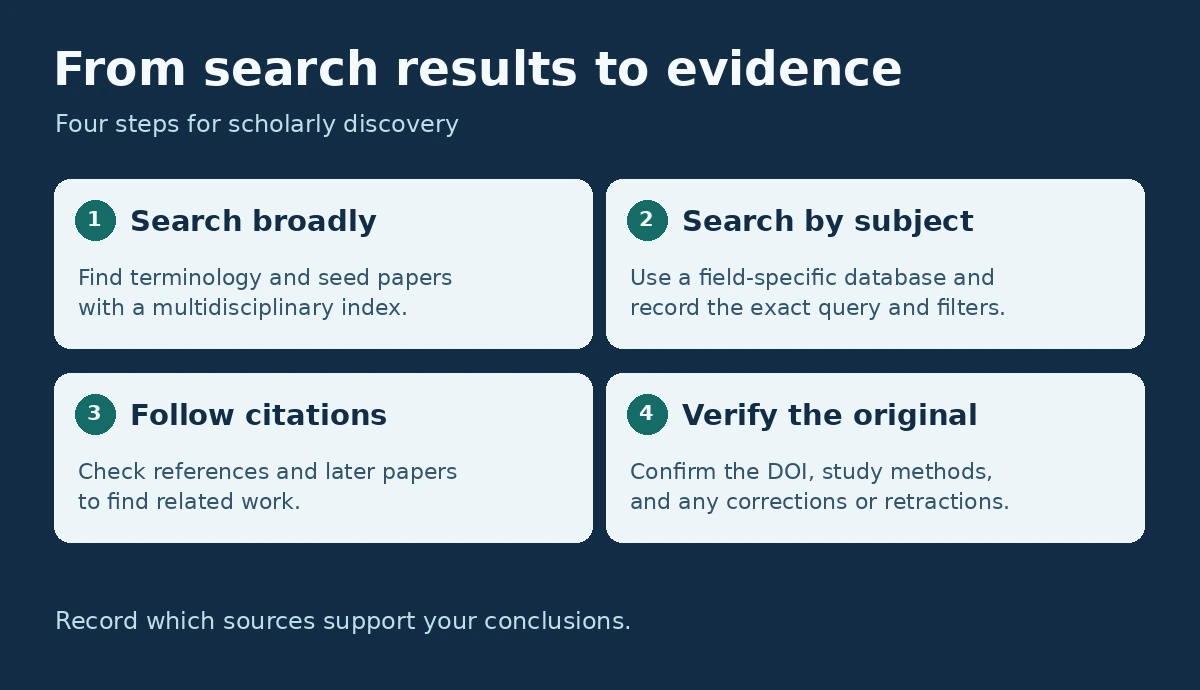
The evolution can be summarized as:
Keyword Search → Structured Database Search → Citation Discovery → Semantic Search → AI-Assisted Synthesis → Generative Research Agents
These approaches now coexist. Microsoft Academic, which some older lists still include, was discontinued with its APIs on 31 December 2021 (Microsoft Research, 2021). For open scholarly metadata today, see OpenAlex (entry 23).
Keyword Search
Traditional retrieval depends heavily on words entered by the researcher.
Example:
“artificial intelligence” AND education
It remains essential when precision and reproducibility matter.
Controlled Vocabulary
Specialist databases may assign standardized subject terms.
PubMed, for example, uses the National Library of Medicine’s Medical Subject Headings (MeSH), a thesaurus of controlled, hierarchically arranged terms used to index, catalogue and search biomedical and health information (National Library of Medicine).
Citation Discovery
Once a useful paper has been identified, researchers can investigate:
Backward citations: What did this paper cite?
Forward citations: Which later publications cited this paper?
Related-paper networks: Which publications share similar references or citation patterns?
This can uncover literature that keyword searching missed.
Semantic Search
Semantic systems attempt to retrieve papers by conceptual similarity rather than requiring identical terminology.
A natural-language question such as:
How does sleep restriction affect working memory in university students?
may therefore retrieve studies even if the exact wording does not appear in their titles.
Generative Research
Modern AI systems can now search, compare and synthesize evidence.
The efficiency gain can be substantial, but this changes the researcher’s role rather than eliminating it.
The researcher still has to determine:
- Whether the sources exist
- Whether the studies were represented accurately
- Whether the methodology supports the claim
- Whether conflicting evidence was ignored
- Whether a citation has been corrected or retracted
- Whether the synthesis exceeds what the evidence actually establishes
Conclusion
No single platform covers all scholarly literature. A practical approach is to start broad (Google Scholar, OpenAlex or Semantic Scholar), move to the subject databases for your field, use citation tools to fill gaps, and treat AI research assistants as a way to plan and speed up work rather than as the final source. Whatever you find, confirm the publication type, check for retractions and read the original paper before you rely on it. Access models and features change, so check each platform’s current terms; this list was last checked on 9 November 2026.
FAQs
1. What is an Academic Search Engine?
An academic search engine is a specialized search tool that helps users find scholarly content such as research papers, journal articles, theses, conference papers, books, and citations from academic sources.
2. What Is the Difference Between an Academic Search Engine, Research Database, and AI Research Tool?
An academic search engine discovers scholarly content across many sources, while a research database provides structured and often curated academic records. An AI research tool uses artificial intelligence to search, summarize, compare, analyze, or synthesize research information.
3. What is better than Google Scholar?
No single academic database is better for every topic. PubMed offers stronger biomedical searching, Scopus and Web of Science offer advanced citation analysis, CORE focuses on open-access discovery, and Semantic Scholar adds AI-assisted literature discovery.
4. What are the best free academic databases?
Strong free academic research platforms include PubMed, OpenAlex, Semantic Scholar, CORE, DOAJ, ERIC, arXiv, Europe PMC, SciELO and Google Scholar.
5. What is the best search engine for research papers?
Google Scholar is a strong general starting point. Researchers conducting formal reviews should also search relevant subject-specific databases because no single academic search engine covers all scholarly literature.
6. What is an AI academic search engine?
An AI academic search engine uses semantic search, machine learning or generative AI to locate and interpret scholarly literature. Examples include Elicit, Consensus, Semantic Scholar and Scite.
7. Can ChatGPT search academic papers?
ChatGPT can locate and analyze scholarly sources through its search and Deep Research capabilities when those sources are accessible. It should be used alongside specialist academic databases rather than as a replacement for them.
8. Is Semantic Scholar better than Google Scholar?
Semantic Scholar provides stronger AI-assisted discovery, recommendations and semantic features, while Google Scholar usually provides broader general scholarly discovery. Many researchers benefit from using both.
9. Where can I find peer-reviewed research?
Peer-reviewed research can be found through databases and platforms such as PubMed, Scopus, Web of Science, DOAJ, JSTOR, ScienceDirect and discipline-specific scholarly databases. Researchers should still confirm the publication type of individual documents.
10. How can I find research papers for free?
Use open-access resources such as CORE, DOAJ, PubMed Central, Europe PMC, arXiv, Zenodo, SciELO and institutional repositories. These can often provide legal open versions of scholarly works.
11. What is the difference between PubMed and PubMed Central?
PubMed primarily provides citations and abstracts for biomedical research. PubMed Central is a free archive containing the full text of eligible biomedical and life-sciences publications.
12. What is the best academic database for a literature review?
The best database depends on the subject. High-quality literature reviews normally search several relevant databases rather than relying on one platform. Medical reviews, for example, may use MEDLINE/PubMed, Embase, CENTRAL and specialist sources.
13. Can AI be trusted for academic research?
AI can accelerate literature discovery, summarization and evidence organization, but its citations and interpretations must be verified against original sources. AI systems can fabricate references or misrepresent study findings.
14. How do I verify an AI-generated academic citation?
Search the exact title in an academic database, confirm the DOI, authors, journal and publication date in Crossref, check the Retraction Watch database for a retraction, then open the original source and make sure it actually supports the claim attributed to it.
15. What are the best AI tools for literature reviews?
Elicit is strong for structured literature-review workflows, Consensus for research-question synthesis, Scite for citation context, ResearchRabbit and Litmaps for literature discovery, and Rayyan for systematic-review screening.
References
- ACM. (2026). Open access publication & ACM. Association for Computing Machinery. ACM open access
- Ai2. (2026). Asta. Allen Institute for AI. Ai2 Asta
- American Economic Association. EconLit. EconLit information
- American Geosciences Institute. GeoRef. GeoRef information
- American Psychological Association. (2026). APA PsycInfo. APA PsycInfo
- Anthropic. (2026). Using Research on Claude. Claude Help Center. Claude Research help
- arXiv. (2026). About arXiv. About arXiv
- Crossref. Retraction Watch. Retraction Watch data
- Data.gov. (2026). Data.gov home. U.S. General Services Administration. Data.gov catalog
- Dryad. (2026). Dryad home. Dryad repository
- EBSCO. (2026). EBSCO Open Dissertations. EBSCO Open Dissertations
- EconPapers. (2026). EconPapers home. Örebro University School of Business. EconPapers index
- Elicit. (2026). Elicit: AI for research & decision-making. Elicit platform
- Elsevier. (2026). Scopus. Scopus database
- Elsevier. Embase. Embase database
- Food and Agriculture Organization of the United Nations. (2026). AGRIS. AGRIS database
- Google. Gemini Deep Research. Gemini Deep Research
- Google Scholar. About Google Scholar. About Google Scholar
- Google Scholar Blog. (2026). Google Scholar Blog [Scholar Labs posts of November 18, 2025 and June 3, 2026]. Google Scholar Blog
- Google Workspace Updates. (2026, July 16). NotebookLM is now Gemini Notebook. Gemini Notebook announcement
- HathiTrust. (2026). HathiTrust Digital Library. HathiTrust Digital Library
- ICPSR. About ICPSR. Inter-university Consortium for Political and Social Research. About ICPSR
- IDEAS. (2026). IDEAS/RePEc. IDEAS RePEc
- IEEE. About IEEE Xplore. About IEEE Xplore
- IT Brief New Zealand. (2025, May 8). Litmaps acquires ResearchRabbit, raises $1 million for AI. ResearchRabbit acquisition report
- JSTOR. (2026). About JSTOR. ITHAKA. About JSTOR
- medRxiv. About medRxiv. openRxiv. About medRxiv
- Microsoft. (2026, November 4). Frequently asked questions about Researcher. Microsoft Learn. Microsoft Researcher FAQ
- Microsoft Research. (2021, May 4). Microsoft Academic [Editor’s note on discontinuation]. Microsoft Academic notice
- National Agricultural Library. AGRICOLA. U.S. Department of Agriculture. AGRICOLA catalog
- National Library of Medicine. About PubMed. About PubMed
- National Library of Medicine. PMC overview. PubMed Central overview
- National Library of Medicine. Medical Subject Headings. Medical Subject Headings
- National Bureau of Economic Research. (2026). Working papers. NBER working papers
- OATD. (2026). Open Access Theses and Dissertations. Open Access Theses Directory
- Ohio University Libraries. (2026, April 3). Consensus [Library guide]. Consensus library guide
- Open Library. (2026). Open Library. Internet Archive. Open Library
- OpenAlex. (2026). OpenAlex. OpenAlex index
- PEDro. (2026). Physiotherapy Evidence Database. PEDro database
- Perplexity. (2025, February 14). Introducing Perplexity Deep Research. Perplexity Deep Research
- ProQuest. ProQuest Dissertations & Theses Global. ProQuest dissertations
- ResearchRabbit. (2026). ResearchRabbit. Litmap Limited. ResearchRabbit platform
- ScienceDirect. (2026). ScienceDirect. Elsevier. ScienceDirect platform
- SciSpace. (2026). SciSpace. SciSpace platform
- Scite. (2026). Scite. Research Solutions. Scite platform
- Semantic Scholar. About Semantic Scholar. Allen Institute for AI. About Semantic Scholar
- SpringerLink. (2026). SpringerLink. Springer Nature. SpringerLink platform
- SSRN. (2026). SSRN. SSRN repository
- The Lens. (2026). About The Lens. The Lens Limited. About The Lens
- World Health Organization. International Clinical Trials Registry Platform (ICTRP). WHO trial registry platform
- zbMATH Open. About zbMATH Open. FIZ Karlsruhe. About zbMATH Open
- Zenodo. About Zenodo. CERN. About Zenodo