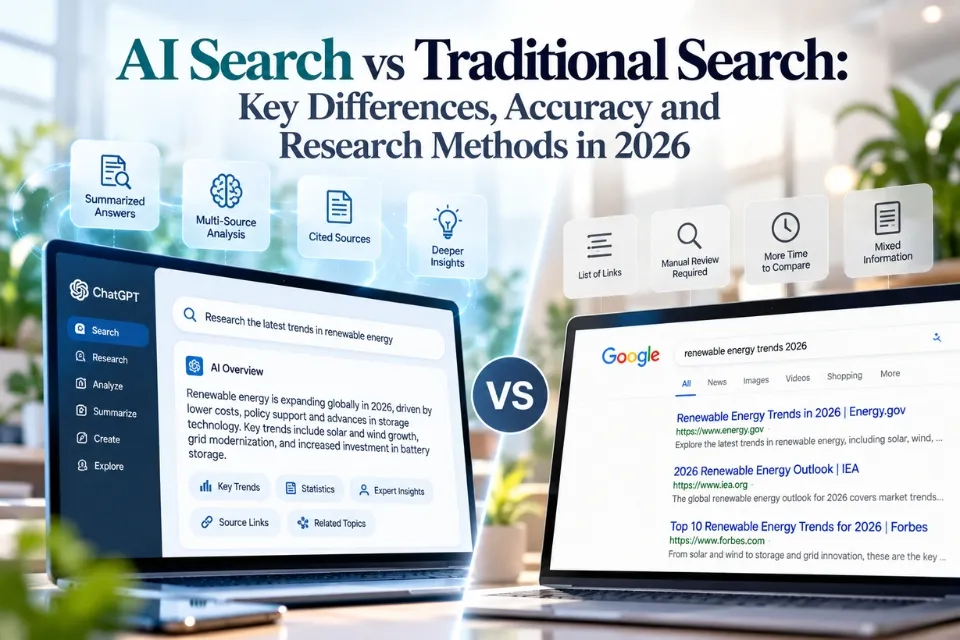
AI search and traditional search differ in how they find and present information. Traditional search retrieves and ranks sources, while generative search can turn retrieved material into conversational explanations. Many platforms now combine both approaches.
For researchers, speed is only one consideration. The more useful method helps locate credible evidence, verify claims and document findings clearly.
This guide compares how search methods work, where errors occur and how to choose a method by task. It includes worked examples and a hybrid workflow. For platform details, see the ChatGPT Search guide. For a head-to-head comparison, see ChatGPT vs Google Search. For advice on checking generated claims and sources, use the AI citation verification guide.
What Is Traditional Search and How Does It Work?
Traditional search refers to the process of discovering online information through search engines such as Google and Bing. Users submit keywords or queries, and the search engine returns a ranked list of relevant webpages, documents, images, videos, and other digital resources.
Modern search engines employ advanced information retrieval systems that extend beyond basic keyword matching, incorporating semantic analysis and contextual understanding.
Google’s documentation describes three main stages:
- Crawling: Automated systems discover and retrieve accessible web content.
- Indexing: Search engines analyze content and store information for retrieval.
- Serving results: Ranking systems select information relevant to a user’s query.
Ranking may consider meaning, relevance, quality, freshness, location and other signals. Search engines also use machine learning and semantic understanding to interpret queries.
Traditional search remains especially valuable in scenarios where researchers must locate original documents, conduct comparative analysis across independent sources, or examine the manner in which information is presented.
However, the trustworthiness of search results cannot be presumed. High placement in search results does not establish accuracy. How Google Search works explains that Google does not guarantee that it will crawl, index or serve any page.
What Is AI-Powered Search?
AI-powered search uses artificial intelligence to facilitate the discovery, interpretation, and organization of information.
In contrast to conventional results pages, an AI search interface may generate direct explanations, compare findings across multiple sources, and respond to follow-up inquiries.
Many AI search systems use large language models to generate responses in natural language.
How Generative AI Produces Search Answers
Language models generate responses using patterns learned during training and information supplied within the current interaction.
An AI chatbot may answer using existing model knowledge, retrieve external information or combine both approaches.
These distinctions have significant implications for research methodology and information reliability.
A response generated without current retrieval may reflect outdated information. Even when a model searches the web, it can misunderstand or incorrectly summarize what a source says.
Accordingly, AI-generated explanations should be regarded as preliminary starting points rather than as conclusions that have been independently verified.
The Role of Web Retrieval and RAG
Retrieval-augmented generation (RAG) connects language generation with retrieved information. Lewis and colleagues’ foundational RAG research describes this approach for knowledge-intensive tasks.
A typical process involves:
- Interpreting the user’s question.
- Retrieving potentially relevant information.
- Supplying selected evidence to the language model.
- Generating an answer grounded in that material.
- Providing source references where supported.
Retrieval-augmented generation can enhance access to relevant information; however, its effectiveness is contingent upon the quality of the retrieved sources and the accuracy with which the model incorporates and represents that information.
The presence of a citation does not, in itself, guarantee that the associated claim is substantiated by the referenced source.
AI Search vs Traditional Search: Key Differences
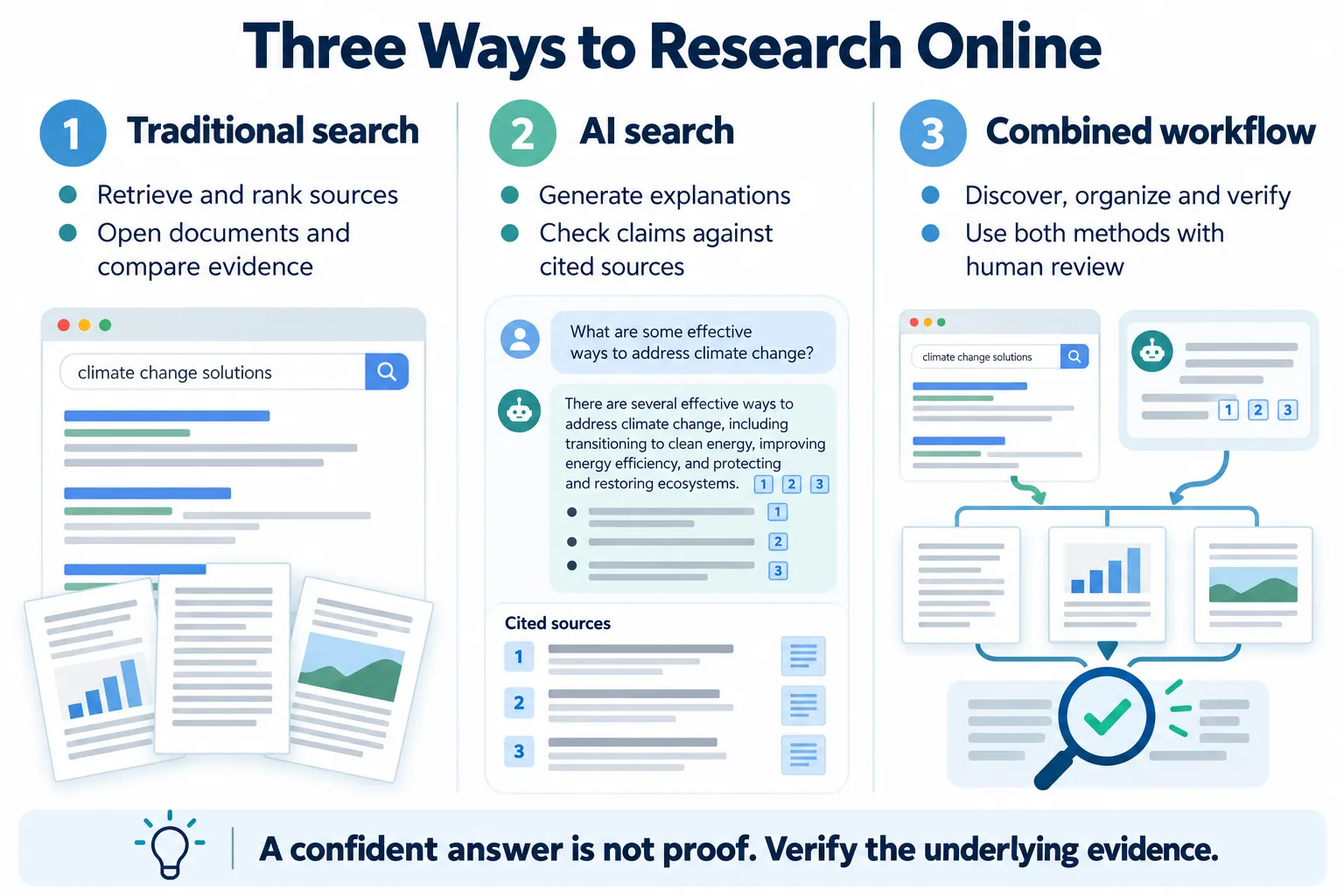
The following comparison distinguishes conventional search interfaces, generative answer systems and approaches combining both.
| Feature | Traditional Search | AI Search | Hybrid Search |
|---|---|---|---|
| Query input | Keywords and natural-language queries | Conversational prompts | Both |
| Main output | Ranked links and snippets | Generated explanations | Links and AI answers |
| Retrieval | Indexed web resources | Model knowledge and/or retrieved information | Search retrieval with AI synthesis |
| Context | Query and session signals | Multi-turn conversation | Search with conversational follow-up |
| Sources | Direct webpages | Citations when available | Links alongside generated answers |
| Accuracy | Depends on source quality and interpretation | Depends on model and evidence | Depends on retrieval and synthesis |
| Freshness | Depends on index updates | Depends on web access | Depends on current retrieval |
| Synthesis | Mostly performed by the user | AI-assisted | AI-assisted with source exploration |
| Research depth | Broad source discovery | Explanation and synthesis | Discovery plus synthesis |
| Reproducibility | Queries can be documented | Outputs may vary | Requires recording both |
| Bias | Ranking and coverage bias | Retrieval and generation bias | Both types |
| Privacy | Queries may be logged | Prompts and retrieved data may be processed | Depends on platform |
| Verification | Examine original results | Check generated claims | Check both answer and sources |
| Best use | Primary-source discovery | Scoping and explanation | Evidence-based research |
In practical terms, traditional search typically affords users greater direct control over the exploration of sources. AI search can streamline the process of interpreting information, whereas hybrid approaches integrate the strengths of both discovery and synthesis.
How Major Platforms Combine AI and Search
Major search providers combine retrieval and generated answers in different ways. Features and access can vary by plan, region, account or workspace. Check the provider’s current documentation before relying on a feature.
| Platform | What the provider documents | Source | Research note |
|---|---|---|---|
| Google AI Overviews and AI Mode | May run related searches across subtopics and surface supporting links. A supporting page must be indexed and eligible to show a snippet. | Google AI feature guidance | Check the linked pages and whether they support individual claims. |
| ChatGPT Search and Deep Research | Web search can return source links. Deep Research can investigate multiple sources and produce a report. Access varies by account and workspace. | ChatGPT web search documentation and ChatGPT deep research documentation | Review cited documents before using the report as evidence. See the ChatGPT Search guide. |
| Microsoft Copilot Search in Bing | Microsoft introduced Copilot Search in April 2025 as a combination of traditional and generative search with source links. | Microsoft Copilot Search announcement | Useful for scoping. Open the original references. |
| Perplexity Pro Search | Runs multiple searches, synthesises results and links to original sources. Follow-ups depend on plan allowances. | Perplexity Pro Search | Check whether source evidence supports the generated interpretation. |
| Claude web search and Research | Web search supplies citations when used. Research can run successive searches and is available on supported paid plans. | Claude web search and Claude Research | Check plan and organisation settings before relying on these features. |
Choose a platform based on the evidence you need, its access to original sources, and how easily you can verify its claims.
Is AI Search More Accurate Than Traditional Search?
Neither approach demonstrates consistent superiority in accuracy across all research tasks.
Traditional search helps users locate sources, but search rankings can surface incomplete, outdated or misleading information.
AI search is capable of generating well-structured explanations, but may introduce errors during the processes of interpretation or synthesis.
The distinction becomes clearer when separating five qualities:
- Fluency: Whether an answer sounds convincing.
- Accuracy: Whether its factual statements are correct.
- Grounding: Whether claims are supported by evidence.
- Verifiability: Whether readers can check the underlying information.
- Completeness: Whether important qualifications and alternative findings are included.
A response that is fluent in presentation may nonetheless fail to meet the criteria of accuracy, grounding, verifiability, or completeness.
AI Hallucinations and Citation Problems
AI hallucinations occur when systems generate unsupported or incorrect information, sometimes with considerable confidence.
The National Institute of Standards and Technology discusses confidently generated false content in its Generative AI Profile.
The Tow Center’s 2025 study summary describes tests of news retrieval and attribution across eight generative search tools.
The investigation raised concerns about how the tested systems retrieved and attributed news sources.
Its findings do not establish a permanent accuracy ranking for every AI tool or research task. They do demonstrate why citations need independent examination.
Why Original Sources Still Matter
Suppose an AI system claims that a scientific study demonstrates a particular outcome.
Before accepting the statement, a researcher should check whether:
- The cited study exists.
- The link leads to the correct publication.
- The study actually supports the claim.
- The findings are statistically and methodologically appropriate.
- Important limitations have been omitted.
- Other independent research supports or challenges the conclusion.
The original publication, rather than the AI-generated summary, must serve as the definitive source for determining what the evidence demonstrates.
When Should You Use AI Search or Traditional Search?
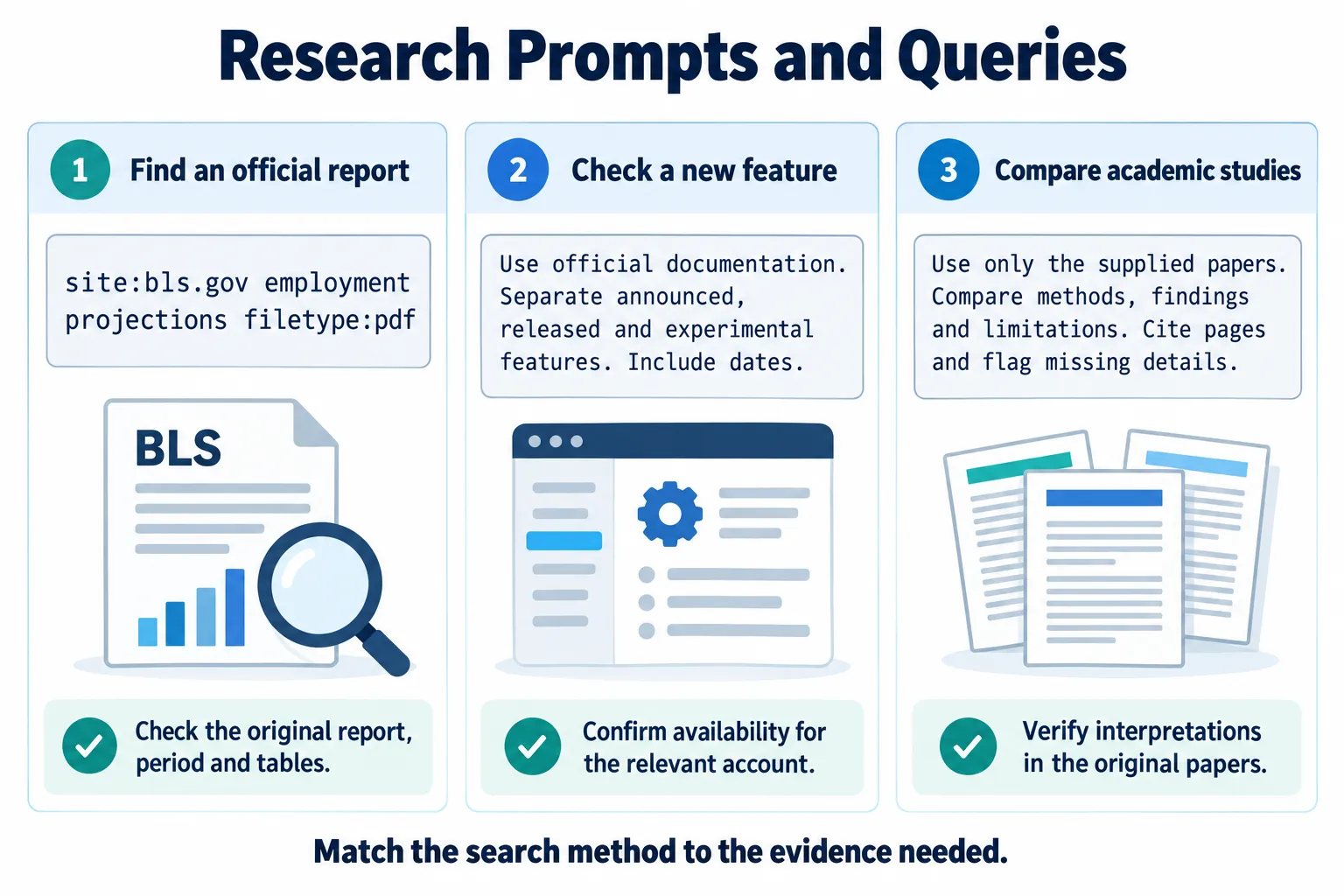
The right method depends on the evidence you need. Use this table to choose where to start.
| Research need | Start with | Then | Why |
|---|---|---|---|
| Find an official document or dataset | Traditional search with operators | Use AI to explain terminology in the original document. | You need the original, dated record. |
| Get oriented in an unfamiliar topic | AI search | Open cited sources and search key terms conventionally. | A generated overview can identify concepts quickly. |
| Confirm a product feature or policy | Official documentation via traditional search | Use AI to compare documented features and dates. | Availability may change by account, region or plan. |
| Compare academic findings | Scholarly databases | Use AI to tabulate papers you supply. | Study methods and conclusions need a human check. |
| Track breaking news | News search and wire services | Use AI to summarise verified reports. | Early reports and generated citations can contain errors. |
| Produce a reproducible search record | Traditional search with documented queries | Log the AI prompts, outputs and source links you used. | Generated answers can vary between runs. |
Example 1: Finding an Official Government Report
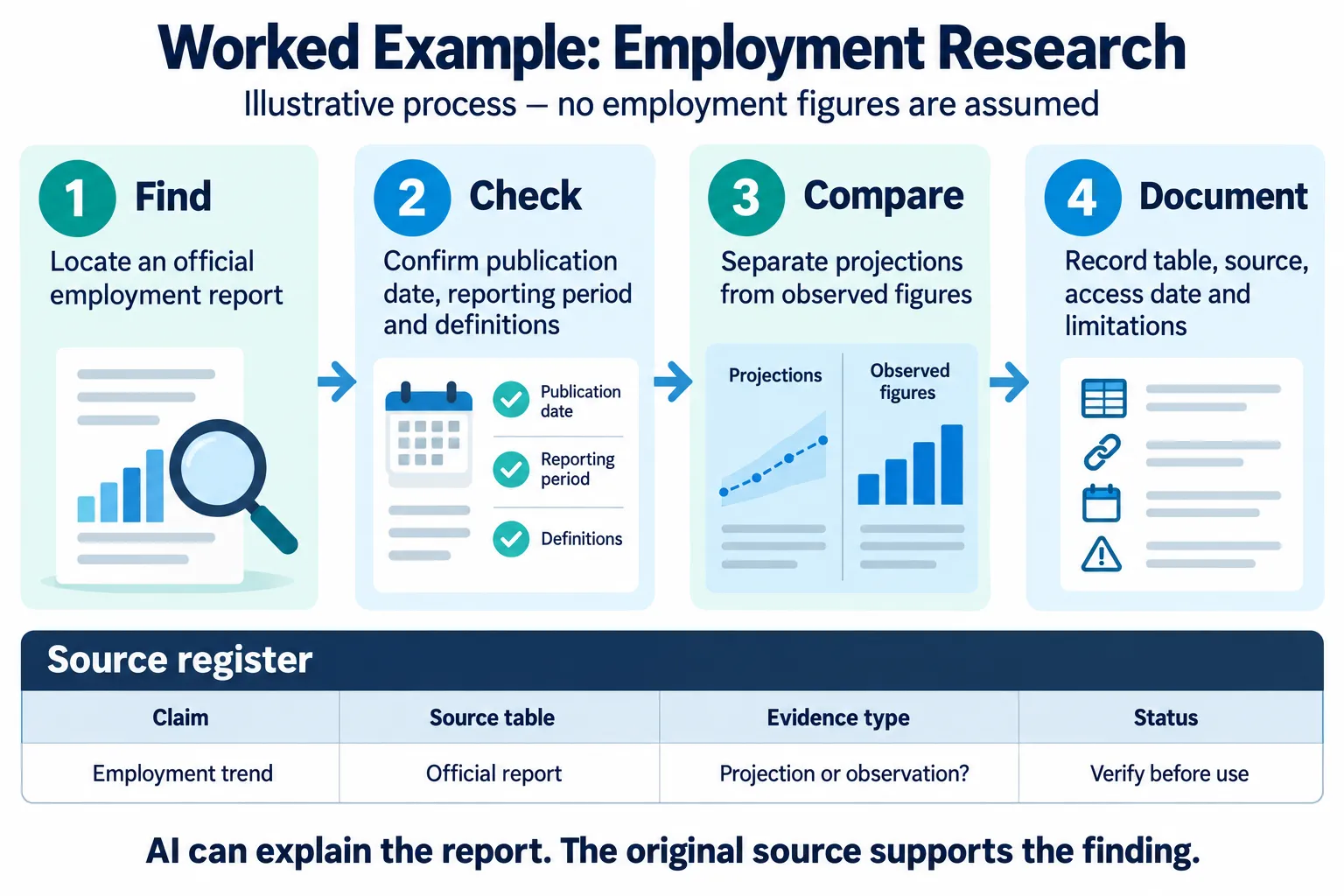
Objective: Locate the original publication containing national employment statistics.
Recommended approach: Begin with a conventional search focused on the relevant government department.
Example query:
site:bls.gov employment projections filetype:pdf
Open the official publication, check the reporting period and identify the relevant tables.
AI tools may subsequently assist in clarifying terminology or in organizing the verified statistical data.
Expected result: An original government report with a documented publication date and traceable statistics.
Limitation: An AI-generated summary may confuse projections with observed employment figures.
Example 2: Researching a New AI Technology
Objective: Determine whether a newly announced research capability is publicly available.
Recommended approach: Search official release notes and technical documentation first.
Suggested AI prompt:
“Compare the documented capabilities of this research tool using official sources. Separate announced features, released features and experimental capabilities. Identify the publication date of each source.”
Check the original announcements before accepting the comparison.
Expected result: A dated feature comparison supported by vendor documentation.
Limitation: Product availability may vary by location, subscription or account.
Example 3: Comparing Academic Findings
Objective: Explore academic research on AI-generated misinformation.
Recommended approach: Discover relevant studies through scholarly search systems, journals and academic databases.
Use AI to organize verified publications into a comparison covering research questions, sample sizes, methods and conclusions.
For example:
“Using only the attached research papers, compare the study designs, key findings and acknowledged limitations. Include page references and flag missing information.”
Expected result: A structured literature comparison linked to the original papers.
Limitation: AI may overlook methodological differences or describe correlation as causation.
How to Combine AI Search and Traditional Search for Reliable Research

A hybrid workflow uses search for discovery and AI for organisation. The researcher remains responsible for the evidence and conclusions. For more examples, see the hybrid research workflow guide.
Step 1: Define the Research Question
Identify what you need to establish, the relevant time period and the type of evidence required.
A clearly defined question reduces irrelevant results.
Step 2: Identify Authoritative Sources
Select suitable sources before searching.
These might include government records, peer-reviewed studies, standards organizations, institutional databases or original company documentation.
Step 3: Discover Information
Use conventional search to locate primary sources.
Use AI-assisted search to identify related concepts, alternative terminologies, and potentially relevant avenues for further research.
Step 4: Refine Queries
Apply advanced search techniques such as quotation marks, domain restrictions, document-type filters and date filters where supported.
Employ AI to suggest supplementary search terminology, ensuring that any proposed operators are compatible with the selected search engine.
Step 5: Examine Original Sources
Open the relevant documents.
Examine authorship, publication date, research methodology, contextual background, and the extent to which the material directly addresses the research question.
Step 6: Verify Important Claims
Compare findings with independent evidence.
Pay particular attention to numerical data, direct quotations, scientific conclusions, and evolving technical information.
Step 7: Document the Research
Document search queries, source URLs, dates of access, significant findings, and any unresolved uncertainties.
If AI systems contributed to the research process, their specific roles should be documented as appropriate.
Quick Source-Verification Checklist
- Is the original publication identifiable?
- Does the source support the specific claim?
- Is the information current enough for the question?
- Are the author and publisher credible?
- Have important limitations been considered?
- Has independent evidence been examined?
- Can another researcher trace the conclusion?
This process makes research easier to review and update. For further detail, see the AOFIRS verification guide and research methods guide.
The Future of Search: AI Agents, Multimodal Retrieval and Hybrid Systems
Search technology is evolving beyond the traditional dichotomy of search results and chatbot-generated answers.
Providers document conversational web search, generated summaries, multimodal inputs and multi-step research in supported products.
Emerging developments include research agents capable of autonomously navigating websites, retrieving documents, comparing sources, and organizing findings across interconnected applications.
While these systems may reduce repetitive research tasks, increased automation introduces additional considerations regarding source selection, privacy, access permissions, and the potential propagation of errors.
A research agent may execute multiple procedural steps prior to human review of its findings. An unsupported assumption introduced at an early stage can influence subsequent conclusions.
The most valuable professional competencies extend beyond the ability to prompt AI systems. They encompass the development of effective search strategies, the identification of unreliable evidence, a thorough understanding of research methodology, and the systematic documentation of conclusions.
Frequently Asked Questions
1. What is the main difference between AI search and traditional search?
Traditional search generally retrieves and ranks relevant sources for users to explore. AI-powered search can generate conversational answers by using model knowledge, retrieved evidence or both. Modern search platforms increasingly combine these methods. The essential distinction is how information is presented, synthesized and verified.
2. Is AI search more accurate than Google Search?
There is no universal winner. Accuracy depends on the question, source availability, retrieval method and system performance. AI-generated summaries can contain unsupported claims, while conventional results may surface unreliable websites. Researchers should evaluate the actual evidence rather than assuming one interface is inherently more accurate.
3. Does ChatGPT Search replace traditional search engines?
ChatGPT Search can answer many questions using web information and source links, but it does not eliminate the need for conventional search. Traditional engines remain useful for exploring multiple sources, locating original documents and conducting targeted searches. Both approaches can serve different stages of a research project.
4. Can AI search provide reliable academic references?
AI search can help discover academic publications and organize research findings. However, references may be incomplete, inaccurate or unrelated to the associated claims. Researchers should verify titles, authors, publication details and findings through journal websites, scholarly databases or original documents before citing them.
5. What are the main limitations of AI-powered search?
Limitations include hallucinations, incorrect citations, missing perspectives, outdated information, retrieval gaps and inconsistent outputs. AI systems may also misinterpret methodological details or express uncertain conclusions confidently. Their usefulness depends on source quality, system design and the user’s ability to evaluate evidence.
6. Can AI search access real-time information?
Some AI search systems retrieve current information from the web, while others generate responses without live retrieval. Freshness depends on the product, available tools and source accessibility. Even when web search is enabled, users should verify publication dates and confirm important information directly with authoritative sources.
7. Is Google Search still useful for professional researchers?
Yes. Google Search remains useful for identifying publications, accessing official resources, locating documents and comparing sources. Its advanced search features can support targeted discovery. Researchers may also use specialized academic databases or institutional collections when general web search does not provide sufficient coverage.
8. What is hybrid search?
In this article, hybrid search means combining conventional information retrieval with AI-generated explanations or conversational interaction. It can allow users to explore source links while benefiting from summaries and follow-up questions. In technical information retrieval, the term can also describe combining keyword and vector-based retrieval methods.
9. How can researchers verify AI-generated answers?
Researchers should open cited sources, confirm that they support individual claims, compare important findings with independent publications and check dates and limitations. They should also record unresolved uncertainties. Verification is particularly important for scientific, legal, financial and other high-stakes information.
10. Will AI search replace traditional search engines?
There is insufficient evidence to establish that traditional search engines will disappear. Major search providers are already combining AI-generated answers with familiar search capabilities. The more defensible conclusion is that search interfaces and research workflows will continue evolving while source discovery and verification remain necessary.
Conclusion: Why Search Skills Still Matter in the AI Era
The real question in 2026 is not whether AI search is better than traditional search. It is how researchers can use both approaches without sacrificing accuracy or accountability. Traditional search supports source discovery and direct evidence examination. AI-powered search assists with explanation, information organization and preliminary synthesis. Hybrid workflows connect these strengths. For professional researchers, the quality of a conclusion depends on the evidence behind it, not the sophistication of the system that produced the answer. As AI capabilities expand, structured searching, critical evaluation, research documentation and human judgment remain essential.
References
- Anthropic. Enable and use web search. Claude web search.
- Anthropic. Use Research on Claude. Claude Research.
- Google Search Central. How Google Search works.
- Google Search Central. Google AI feature guidance.
- Jaźwińska, K., & Chandrasekar, A. (2025, March 5). Tow Center study summary.
- Lewis, P., et al. (2020). Retrieval-augmented generation paper.
- Microsoft. (2025, April 4). Microsoft Copilot Search announcement.
- National Institute of Standards and Technology. (2024). NIST Generative AI Profile.
- OpenAI. ChatGPT web search documentation.
- OpenAI. ChatGPT deep research documentation.
- Perplexity. Perplexity Pro Search.