Modern research no longer means choosing between a search engine and an AI assistant. Each does a fundamentally different job: search engines retrieve existing documents, while generative AI writes new text based on patterns it has learned. Researchers who understand that difference can combine both into one disciplined workflow — using search for truth and proof, and AI for processing and explanation — to work faster without sacrificing accuracy.
Presentation: The Dual-Track Research Blueprint (7 Slides)
Related reading: The AI Search Revolution · Research Report: Information Retrieval in the Age of AI · A Guide to Data Analysis (video) · CIRS Program
Two Engines, Two Jobs
Diagnostic Comparison
| Attribute | Google Search | ChatGPT |
|---|---|---|
| Real-time freshness | Excellent — constantly crawling news, prices, sports | Semi-real-time; limited without search and dependent on what the AI retrieves |
| Sources used | Broad and transparent — 10+ links, snippets, images | Narrower — synthesizes from 3–5 top results or training data |
| Output style | List of links; you read and verify | Conversational paragraphs with some citations |
| Speed and convenience | Fast for scanning many options | Fast for one polished answer and contextual follow-ups |
Where Search Wins: The Evidence Layer
Search engines remain the researcher’s ground truth. They deliver currency and breadth, give direct links to primary sources, show publication dates, and expose the full diversity of viewpoints on the web rather than one blended answer.
Where AI Wins: The Cognitive Processing Layer
Key takeaway: ChatGPT shines as a powerful assistant on top of research, not as the primary oracle.
Watch: AI in Online Research
The Dual-Track Workflow in Four Steps
- Initiate (AI): start with ChatGPT for a quick overview, to map key questions and phrase better search queries.
- Verify (Search): switch to Google to find primary sources, check dates and explore distinct viewpoints.
- Synthesize (AI): feed the verified primary sources back to the AI to summarize and structure them.
- Cross-check (Human): verify every important claim; never treat an AI answer as final without checking its sources.
The Rule of Thumb: Search First, AI Second
| Use Google for Truth + Proof | Use AI for Processing |
|---|---|
| Facts, current information, primary-source verification | Explanations, ideation, summaries, contextual translation |
In 2025–2026 the two are complementary, not replacements for each other. Professional researchers keep the evidence trail in search and use AI to think faster with it.
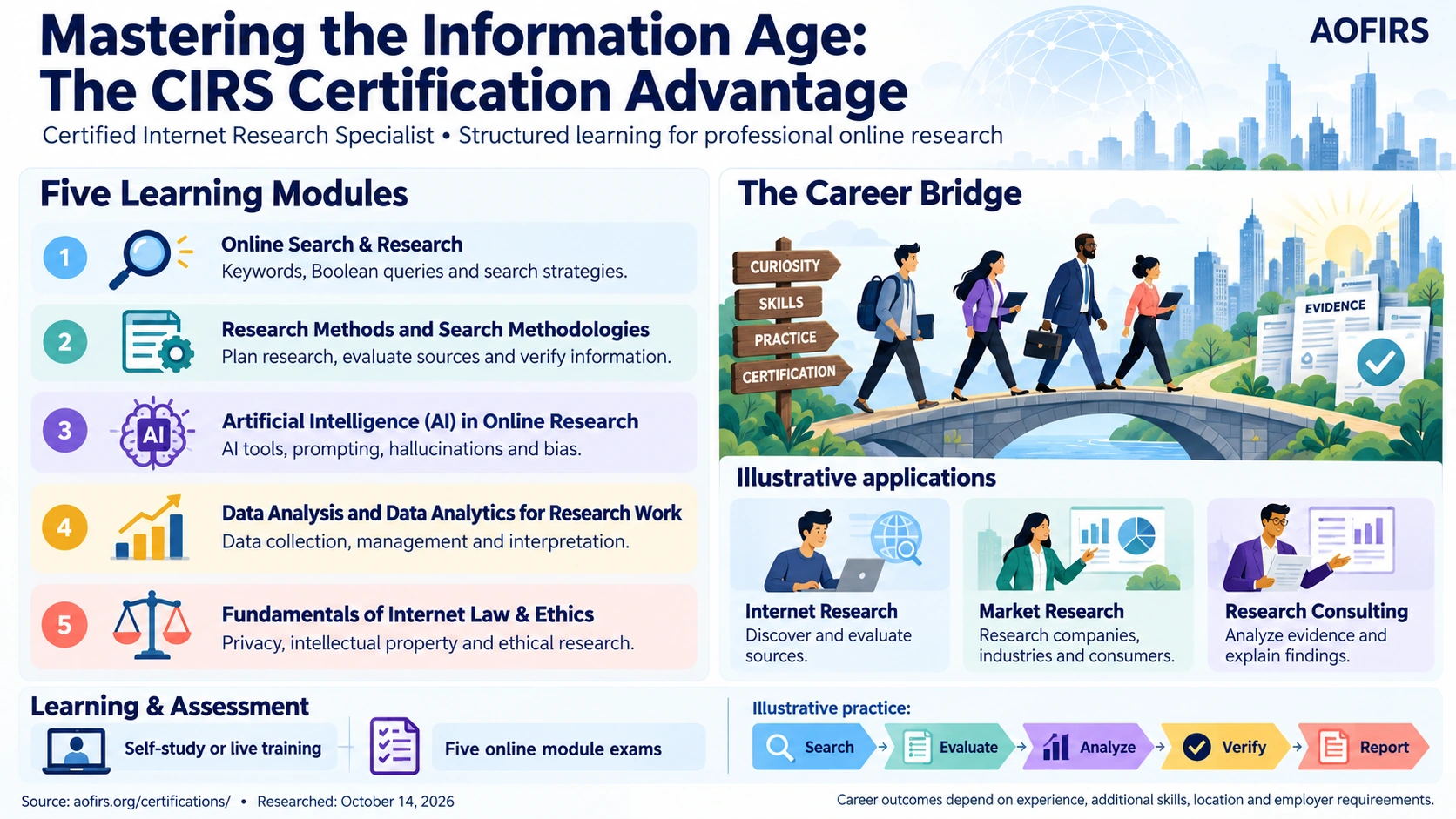
Build a Verified Research Workflow with CIRS™
Learn how professional investigators combine search engines, AI and human verification.
Essential Resources
- Research Redefined: The AI-Augmented Era
- Hacking AI for Deep Research
- The Lens and the Prism
- The Evolving Role of the Researcher
Frequently Asked Questions
What is the difference between information retrieval and information generation?
Search engines retrieve: they crawl, index and rank pages that already exist and show you the documents. Generative AI generates: it predicts likely words from training data (and, if enabled, a few retrieved pages) and writes a new answer.
Should I start research with Google or ChatGPT?
Use AI to get oriented — map the topic, key questions and better search terms — then switch to search to find and verify primary sources. For serious research the rule is: search for proof, AI for processing.
Why can’t an AI answer be treated as final?
AI synthesizes from only a handful of sources or from training data with a cutoff, and it can state errors fluently. Every important claim must be traced to a dated primary source.
What is the Dual-Track Research Blueprint?
A four-step workflow: initiate with AI, verify with search, synthesize the verified sources with AI, then cross-check the result as a human before relying on it.
Are search engines and AI tools replacing each other?
No. In 2025–2026 they are complementary: search delivers currency, breadth and direct links to primary sources; AI delivers explanation, summarization and iterative exploration.