The explosive proliferation of generative artificial intelligence has fundamentally disrupted the economics of information retrieval. Where researchers once spent hours engineering boolean queries and sifting through catalog indices, large language models now synthesize sprawling summaries in seconds. Yet this unprecedented speed introduces a dangerous paradox: synthetic plausibility often masquerades as factual authority. When probabilistic models hallucinate citations, compress nuanced arguments into shallow platitudes, or ingest biased training corpora, the vulnerability of uncritical research workflows becomes acutely apparent.
In response to this transformation, the Association of Internet Research Specialists (AOFIRS) established the Architect of Truth framework. Modern research competence is no longer defined by the ability to locate obscure links; it is defined by the capacity to orchestrate artificial intelligence systems while rigorously validating, synthesizing, and defending the integrity of empirical evidence. The augmented researcher transitions from a manual information collector into an epistemological guardian—directing automated agents, auditing data provenance, and translating complex inquiries into defensible strategic intelligence.
The Four Pillars of the Augmented Researcher
Navigating the contemporary intelligence landscape requires moving beyond conventional keyword search. The Architect of Truth curriculum establishes four operational pillars designed to anchor investigative accuracy in high-stakes environments:
1. Advanced Verification & Evidence Defense
Automated outputs must be treated as unverified hypotheses rather than established facts. Evidence defense requires active forensic examination: verifying cryptographic timestamps, auditing domain registries, cross-checking claims against unmanipulated primary source archives, and detecting synthetic media or astroturfed discourse. Augmented researchers implement a strict minimum two-source independent corroboration protocol before any observation is incorporated into analytical deliverables.
2. AI-Collaborative Workflow & Orchestration
Instead of relying on single-prompt interactions, practitioners construct multi-stage agentic workflows. This involves deploying specialized language models for initial exploratory scraping, employing retrieval-augmented generation (RAG) pipelines over verified document repositories, and using multi-model red-teaming to expose hidden assumptions. Human judgment governs every transition gate, ensuring automated efficiency never compromises investigative depth.
3. Strategic Synthesis & High-Impact Communication
Data accumulation without strategic framing is merely cognitive overload for executive decision-makers. The augmented researcher bridges quantitative metrics—such as statistical frequency, link topology, and financial flows—with qualitative human context, including regulatory pressures, corporate culture, and geopolitical nuance. Findings are structured into clear, decision-ready intelligence briefs with auditable provenance chains.
4. Ethics, Privacy & Specialized Access
Modern investigators navigate stringent data protection mandates, including GDPR, emerging algorithmic governance standards, and intellectual property constraints. Responsible practice requires privacy-by-design methodologies, systematic redaction of non-public personal information (PII), and conscious mitigation of systemic training bias. Furthermore, researchers cultivate specialized access protocols across paywalled academic repositories, corporate registries, and non-indexed databases without violating legal boundaries.
| Investigative Dimension | Traditional Research Approach | Augmented Researcher (Architect of Truth) | Core Operational Advantage |
|---|---|---|---|
| Information Retrieval | Manual boolean keywords, static index browsing | AI-orchestrated semantic search, RAG pipelines, entity clustering | 10x reduction in exploratory discovery time |
| Verification Protocol | Passive acceptance of reputable search snippets | Cryptographic provenance audit, primary archive cross-triangulation | Complete immunity to generative AI hallucinations |
| Data Processing | Manual spreadsheet compilation and note-taking | Automated tabular normalization, entity extraction, sentiment modeling | Scalable ingestion of massive multi-source datasets |
| Analytical Synthesis | Descriptive summarization of surface findings | Multi-model stress testing, causal diagnostic modeling, scenario forecasting | Actionable, defensible strategic intelligence |
| Governance & Ethics | Ad-hoc compliance checks at delivery | Built-in privacy by design, audit-ready provenance chains, bias auditing | Institutional risk reduction and regulatory compliance |
The Augmented Research Lifecycle: A 5-Phase Protocol
To implement this methodology systematically, AOFIRS defines a disciplined five-phase protocol that guides practitioners from raw inquiry to executive dissemination:
| Phase | Stage Objective | Key Tools & Methods | Mandatory Verification Gate |
|---|---|---|---|
| Phase 1: Framing | Problem decomposition and hypothesis formulation | Ontology mapping, query decomposition, parameter boundary definition | Peer review of investigative scope and bias pre-audit |
| Phase 2: Ingestion | Multi-channel automated data collection | Targeted web scrapers, API pipelines, academic repository indexes | Cryptographic hashing and raw capture timestamp logging |
| Phase 3: Triangulation | Forensic corroboration and anomaly audit | WHOIS historical audits, digital forensics, multi-source verification | Dual-source independent primary confirmation rule |
| Phase 4: Synthesis | Contextual intelligence generation | Multi-model red-teaming, cognitive bias checks, scenario modeling | Contradictory evidence stress test |
| Phase 5: Defense | Audit-ready intelligence briefing | Structured executive briefs, interactive evidence matrices, compliance logs | Chain-of-custody audit and institutional sign-off |
Defending Against Synthetic Distortion and AI Hallucinations
The greatest operational vulnerability in modern research is implicit trust in generative conversational interfaces. Large language models operate on probabilistic token prediction, not truth verification. When prompted for niche academic citations or specialized technical specifications, models frequently fabricate convincing references complete with plausible author names and journal titles.
The Architect of Truth mitigates this risk by enforcing a strict firewall between generative ideation and factual verification. Generative tools are utilized exclusively for brainstorming potential inquiry angles, generating synthetic test queries, and formatting structured data. Factual claims, chronological timelines, and statistical figures must originate from immutable primary archives, public filings, or peer-reviewed documentation.
Educational Video: AI in Independent Research
Watch this comprehensive educational lecture examining how artificial intelligence transforms independent research workflows, structured validation frameworks, and forensic analysis techniques:
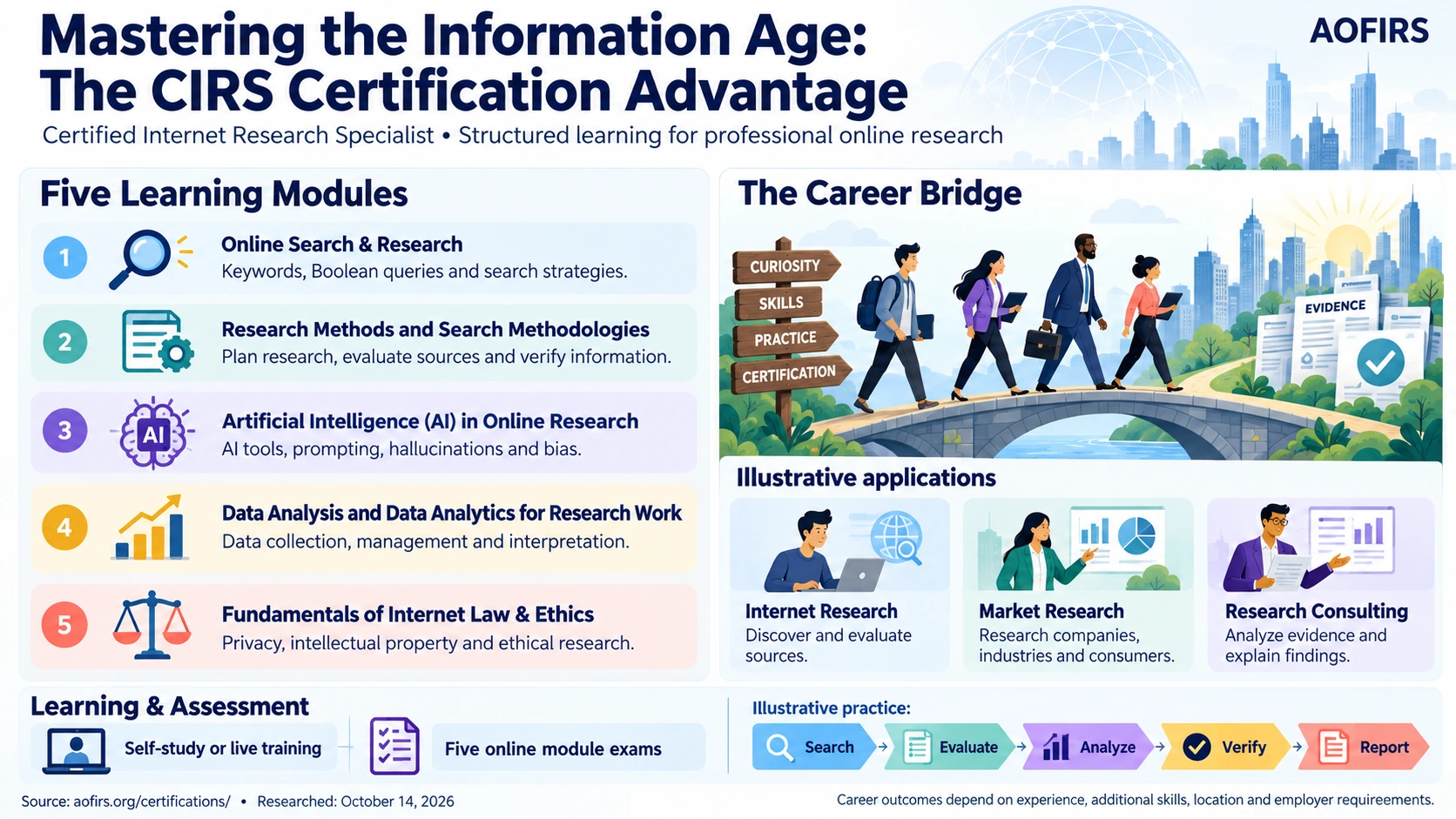
Become a Certified Internet Research Specialist (CIRS™)
Transform prompt orchestration, forensic source verification, and intelligence synthesis into a recognized professional qualification. The CIRS program equips analysts, investigators, and researchers with advanced investigative tradecraft designed for complex digital environments.
Related Resources & Recommended Reading
- The Researcher’s Journey: From Raw Data to Actionable Insight
- The Dual Engine Researcher: Google & ChatGPT Synergy
- Master Google Search: From Keywords to Precision Queries
- The Cognitive Foundation: Reorienting the Knowledge Economy in the Age of AI
- The Search Architect’s Toolkit: Advanced Methods & Precision Query Engineering
Frequently Asked Questions
What is an Augmented Researcher?
An Augmented Researcher is a professional who integrates artificial intelligence agents, automated scrapers, and natural language models into their research workflow while retaining strict cognitive control over source validation, investigative logic, and ethical governance.
How does the Architect of Truth model differ from traditional search training?
Traditional research training focuses primarily on keyword syntax and boolean operators. The Architect of Truth model emphasizes AI orchestration, prompt engineering, multi-model verification, RAG architectures, and forensic evidence defense against synthetic distortion.
Why is two-source triangulation essential when using AI research tools?
Generative AI tools frequently suffer from hallucinations, data drift, and training biases. Cross-referencing findings against at least two independent primary archives guarantees that decisions are based on verified facts rather than machine-generated plausibility.
Can generative AI replace human analytical judgment in research?
No. While AI excels at rapid pattern recognition, data summarization, and query generation, it lacks context awareness, moral responsibility, and real-time situational nuance. Human researchers must direct the inquiry, validate findings, and formulate strategic recommendations.
How does the CIRS certification prepare researchers for AI-driven environments?
The Certified Internet Research Specialist (CIRS) curriculum provides structured methodologies in prompt engineering, OSINT verification, open web extraction, data governance, and defensible reporting standards necessary for high-stakes professional analysis.
Published by the Association of Internet Research Specialists (AOFIRS).