Data without structured interpretation is merely digital noise, while interpretation without rigorous verification is little more than speculation. In contemporary investigations, market intelligence, and policy analysis, professionals are routinely inundated with fragmented datasets, unverified social records, registry dumps, and machine-generated summaries. The fundamental challenge of modern inquiry is not the acquisition of information, but the disciplined process of refining unvetted observations into decision-grade intelligence. The Researcher’s Journey outlines the structured methodology required to bridge this divide, guiding practitioners from chaotic raw inputs to defensible, actionable outcomes.
The Analytics Maturity Model in Modern Research
To produce conclusions that stakeholders can act on with confidence, researchers must move deliberately through progressive analytical tiers. Relying exclusively on surface-level summaries frequently leads to flawed strategic decisions. The Analytics Maturity Model establishes four distinct stages of investigative sophistication:
1. Descriptive Analytics: What Happened?
Descriptive analysis forms the baseline of all research investigations. At this stage, practitioners compile, organize, and normalize incoming observations into coherent timelines, entity registries, and transaction logs. Descriptive analytics answers foundational questions regarding occurrences, frequency, volume, and chronological sequencing, providing an unvarnished audit trail before deeper interpretations begin.
2. Diagnostic Analytics: Why Did It Happen?
Once baseline events are documented, diagnostic analysis interrogates underlying causes, structural correlations, and anomalies. Investigators deploy root-cause analysis, cross-source triangulation, and discrepancy audits to identify why specific patterns emerged, separating genuine causation from coincidental correlation or deliberate obfuscation.
3. Predictive Analytics: What Is Likely to Happen?
Leveraging verified historical baselines and diagnostic patterns, predictive analytics projects probable trajectories. Through statistical sampling, longitudinal trend modeling, and scenario forecasting, researchers evaluate likely future developments, emerging vulnerabilities, and behavioral shifts before they manifest into critical crises.
4. Prescriptive Analytics: What Should We Do?
The culmination of the analytical journey is prescriptive guidance. Rather than stopping at speculative forecasts, prescriptive analytics formulates tested courses of action. It models the anticipated impacts, trade-offs, and operational risks of specific interventions, delivering clear, evidence-based recommendations directly aligned with institutional objectives.
| Analytics Tier | Core Investigative Question | Key Methodologies & Tools | Primary Deliverable | Primary Risk of Failure |
|---|---|---|---|---|
| Descriptive | What took place and when? | Entity mapping, data cleaning, timeline extraction, automated scrapers | Chronological event logs, baseline datasets, entity registries | Incomplete records, duplicate entries, noise misidentified as signal |
| Diagnostic | Why did this anomaly or trend occur? | Root-cause analysis, hypothesis testing, relational databases, cross-table joins | Causal correlation reports, discrepancy briefs, anomaly audits | Confusing correlation with causation; confirmation bias in source selection |
| Predictive | What trajectory is most likely ahead? | Statistical modeling, trend projection, pattern extrapolation, probabilistic analysis | Forecast scenarios, risk indicators, probability matrices | Overfitting historical models to volatile, rapidly shifting real-world environments |
| Prescriptive | Which intervention produces the best outcome? | Scenario stress-testing, risk-benefit matrices, optimization algorithms, policy simulation | Actionable strategic directives, mitigation roadmaps, executive briefs | Failing to account for human variables, regulatory boundaries, or secondary friction |
The 5-Stage Data Refinement Pipeline
Transforming raw unstructured web data into executive insight requires strict adherence to a systematic pipeline. Every transition point serves as a quality checkpoint that shields the final synthesis from contamination:
| Pipeline Stage | Investigative Focus | Operational Procedures | Verification Gate |
|---|---|---|---|
| 1. Ingestion & Preprocessing | Raw Data Intake | Parsing messy HTML tables, normalizing date-time formats, stripping tracking tokens, and standardizing entity identifiers. | Schema validation and duplicate elimination audits. |
| 2. Verification & Triangulation | Source Integrity | Evaluating domain provenance, corroborating claims across independent archives, checking WHOIS and entity registry records. | Minimum two-source corroboration rule before facts enter analysis. |
| 3. Exploratory Analysis | Pattern Discovery | Clustering related entities, isolating statistical outliers, and performing sentiment and discourse frequency modeling. | Sensitivity analysis to detect sampling distortion. |
| 4. Strategic Synthesis | Insight Generation | Synthesizing quantitative metrics with qualitative human context, identifying strategic implications, and evaluating blind spots. | Red-teaming of competing hypotheses and contrary evidence. |
| 5. Ethical Reporting | Governance & Delivery | Ensuring compliance with GDPR, privacy standards, disclosure mandates, and producing clear chain-of-custody documentation. | Audit-ready provenance logs accompanying all final deliverables. |
Qualitative Context vs Quantitative Precision
A common vulnerability in digital intelligence is over-relying on either pure numerical metrics or purely anecdotal narratives. Quantitative metrics provide scale, statistical significance, and measurable benchmarks, but they cannot explain underlying intent, socio-cultural context, or nuance. Conversely, qualitative observations capture motive and sentiment, but remain prone to selection bias without numerical validation. Exemplary research actively fuses both domains: quantitative scrapers establish baseline scale, while qualitative forensic analysis decrypts meaning, motivation, and authenticity.
Data Governance, Privacy, and Ethical Integrity in 2026
Rigorous analysis is worthless if built on compromised data or unethical extraction. Modern researchers operate under strict data governance standards, navigating cross-border privacy regulations, institutional compliance frameworks, and digital rights mandates. Key operational pillars include:
- Chain-of-Custody Documentation: Logging exact capture dates, hash values, URLs, and retrieval environments for every external document.
- Privacy-by-Design Compliance: Redacting non-public personal information (PII) in compliance with GDPR and relevant regional privacy statutes.
- Algorithmic Bias Auditing: Scrutinizing automated scraping filters and AI model prompts to detect systemic omissions and skewed representations.
- Transparency in Methodology: Distinguishing observed empirical facts from inferred analytical assessments in all client-facing briefings.
Video: A Guide to Data Analysis
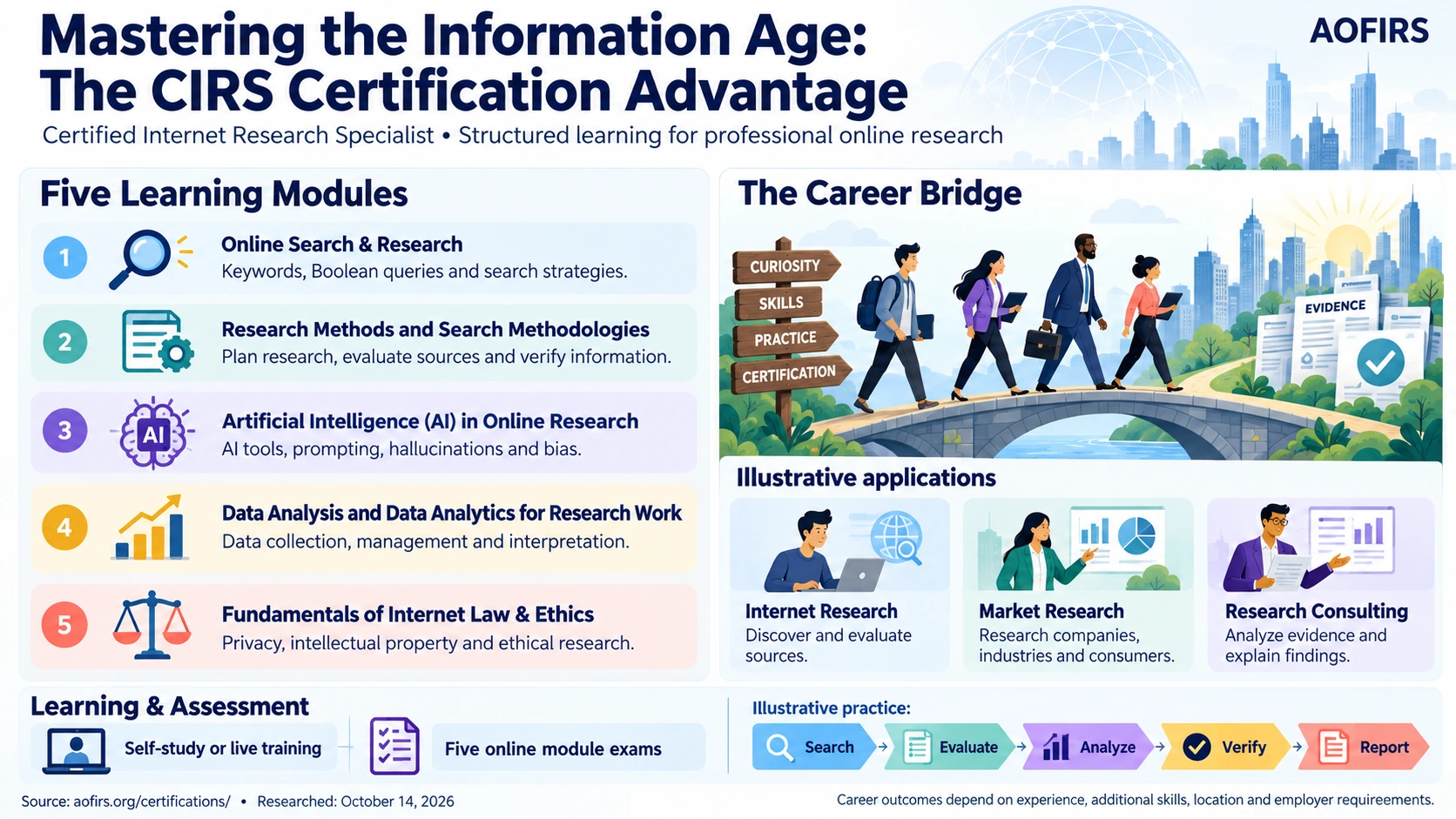
Become a Certified Internet Research Specialist (CIRS™)
Turn data synthesis and advanced analytics into a recognized professional credential. The CIRS program equips you with structured methodology, advanced query engineering, forensic verification, and executive reporting standards designed for high-stakes intelligence environments.
Related Resources
- A Researcher’s Guide to Data Analysis
- Strategic Plan for Data Analysis and Management (Research Report)
- The Architect of Truth: Training the Augmented Researcher
- The Dual Engine Researcher: Google & ChatGPT Synergy
- The Search Architect’s Toolkit: Advanced Methods & Precision Query Engineering
Frequently Asked Questions
What is the fundamental difference between raw data and actionable insight?
Raw data consists of unorganized, unprocessed observations, statistics, code snippets, or text fragments that lack context. Actionable insight is the refined output of verification, analysis, and synthesis that directly answers strategic questions and informs practical decision-making.
How does the Analytics Maturity Model improve research quality?
By forcing researchers to progress systematically through Descriptive (what occurred), Diagnostic (why it occurred), Predictive (what follows), and Prescriptive (what to do) stages, the model prevents hasty conclusions based on incomplete or superficial information.
How should contradictory findings between quantitative and qualitative sources be resolved?
Contradictions signal potential anomalies, measurement flaws, or evolving conditions. Researchers should conduct an audit of source provenance, evaluate collection methods for sampling bias, and triangulate against independent third-party primary records rather than forcing consensus.
What role does artificial intelligence play in the data refinement pipeline?
AI assists significantly in preprocessing, syntactic organization, large-scale entity clustering, and initial draft synthesis. However, human specialists must oversee verification gates, validate claims against primary source documentation, and formulate ethical conclusions.
Why is chain-of-custody documentation essential for digital investigations?
Webpages, social postings, and public databases are constantly modified or deleted. Maintaining rigorous documentation of source URLs, capture timestamps, cryptographic hashes, and collection methodology ensures that findings remain auditable, defensible, and legally sound.
Published by the Association of Internet Research Specialists (AOFIRS).