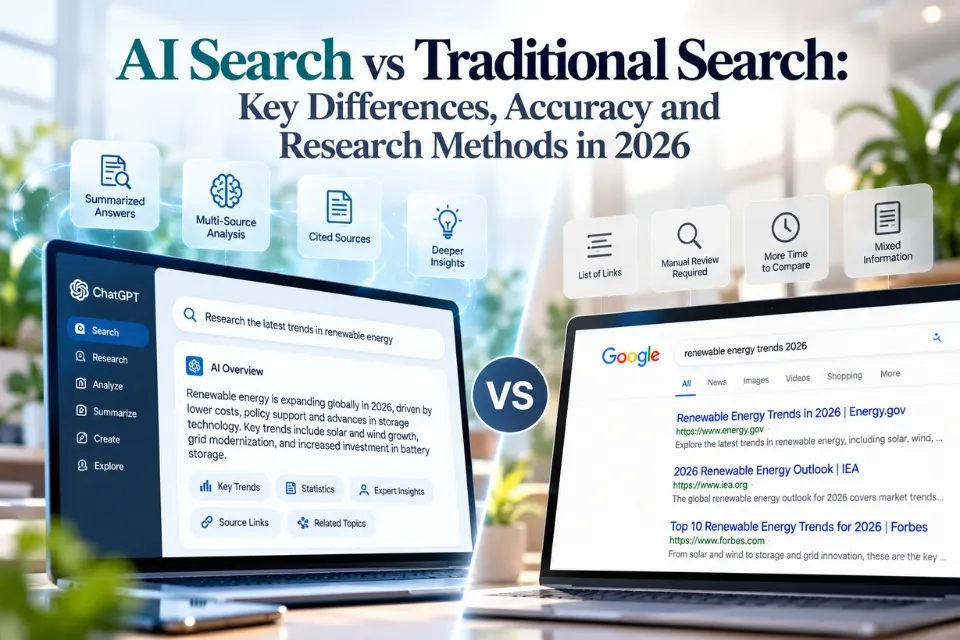
ChatGPT Search combines web information retrieval with conversational answers. It can help users explore a topic, organize findings and follow links to supporting sources. Citations offer a route to evidence; they do not establish that every statement is accurate.
For researchers, AI search can support topic exploration and better questions. Reliable work still requires original sources, independent checks and professional judgment. This guide compares ChatGPT Search with Google Search and Deep Research, then shows how to use them within a documented research process.
What Is ChatGPT Search?
ChatGPT Search is a feature accessible through the web that allows users to ask questions in natural language and receive answers which are based on information from online sources.
OpenAI’s search documentation describes web search within ChatGPT and notes that account and workspace settings can affect available features. This article’s product details were reviewed on October 22, 2026.
ChatGPT Search differs from a typical search results page in that it is able to provide a written explanation summarizing the information obtained from various websites.
For example, a researcher might ask:
What were the key developments in European AI regulation in 2026, which official documents cover these developments, and what remains uncertain?
ChatGPT Search can be used to find relevant material, to explain technical terms, and to organize the results. The researcher must still open the original regulatory documents, check the dates, and ensure that the explanation actually matches the current legal position.
The main thing to note is that ChatGPT Search aids in finding and comprehending information, rather than assuming responsibility for the researcher’s task of assessing the evidence.
How Does ChatGPT Search Work in 2026?
ChatGPT combines a conversational interface with web-search tools. When a question depends on current information, explicitly request a web search and supporting sources, as OpenAI’s prompting guidance recommends.
The precise method to be followed in retrieving information depends on the search tools available, the sources employed, and the product’s settings; it cannot be assumed that every question will result in the same sequence of searches.
1. Understanding the research question
People can express their information needs using ordinary language.
For example, instead of searching for renewable energy battery storage Europe 2026, a researcher could ask:
What are the factors that are affecting battery storage investment in Europe in 2026? You should look at government policies, the state of the market, and the appropriate primary sources.
The extra context enables the system to give a more targeted response.
2. Searching for relevant information
ChatGPT can automatically start web searches or make use of a search function that has been chosen by the user.
Web searches may make use of search companies and other sources of information; the results are affected by the availability of the information, the indexing, its relevance, and the restrictions concerning access to certain websites.
3. Synthesizing retrieved material
It is capable of arranging the information that is available and this is helpful to researchers when they need a general summary before looking at the primary material in detail.
Synthesis, on the other hand, can lead to errors since a response might leave out a qualification, bring together findings that are incompatible, or misinterpret a source.
4. Presenting citations and links
Review the citations and original material before accepting a finding. A real source can still be outdated, incomplete or incorrectly linked to the claim being made. Check the relevant passage and its context.
5. Refining questions through conversation
Researchers do not need to go over the whole topic when asking further questions.
They could ask for the point of view of a different country, restrict the date on which the publication takes place, or request documents which cast doubt on the original findings.
A Practical ChatGPT Search Research Workflow
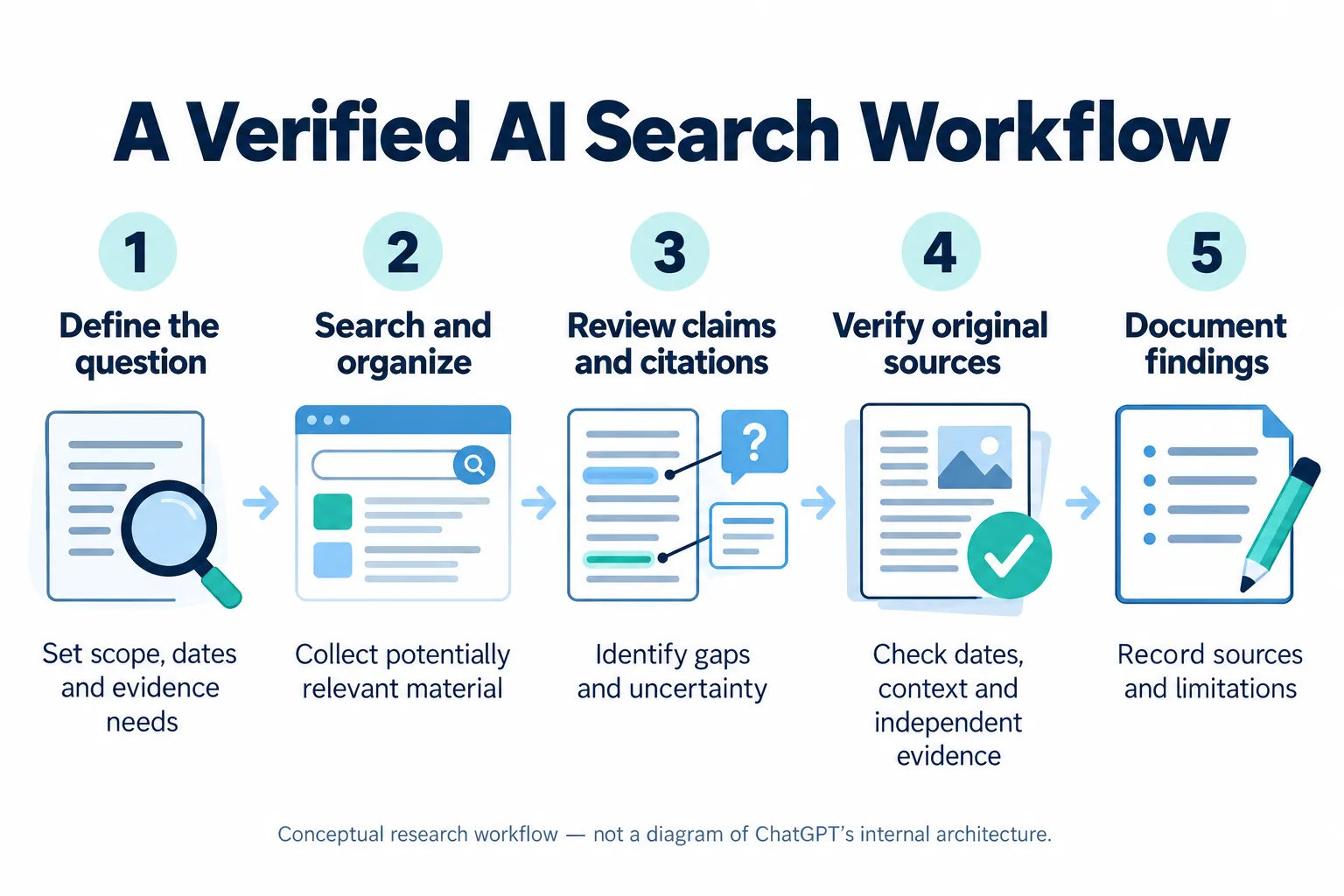
- Define research question: Topic, scope, dates, and evidence requirements.
- AI-assisted web search: Locate and organize potentially relevant sources.
- Review citations and synthesis: Identify important claims and evidence gaps.
- Human verification: Check primary records, dates, context, and independent evidence.
- Document verified findings: Record sources, limitations, and conclusions.
Key Features of ChatGPT Search for Online Researchers
Conversational information discovery
Researchers can put forward complicated questions in a natural way and improve their searches by giving further instructions.
This means there is less need to pose each question as a separate keyword query, even though advanced search operators are still useful in standard search engines and in specialist databases.
Search-supported summaries
ChatGPT is able to arrange information on topics that are unfamiliar into clear explanations.
For example, a market researcher who is looking into new consumer privacy requirements might ask for a summary arranged by jurisdiction, implementation date, and business implications.
Such summaries can be useful as a starting point, but they should not be taken as a replacement for looking at the official requirements.
Source discovery and citation links
Citations can enable researchers to find the documents referred to in an answer.
It is helpful to get into the habit of following each citation that is important, finding out who published the material, and checking whether it supports the claim.
Iterative investigation
Researchers can use conversational follow-ups to investigate any gaps in the first answer.
They could for example use questions like ‘What evidence goes against this conclusion?’ or ‘Which sources are independent of each other?’ to help direct their further investigation.
The final results will vary according to the sources that are retrieved and the quality of the system’s interpretation.
Structured presentation
ChatGPT Search is able to arrange its research in the form of comparison tables, short briefing documents, timelines, and lists of unanswered questions.
This means that it is easier to examine the information, though it should not be thought that the formatting constitutes verification.
ChatGPT Search vs Google Search: What Is the Difference?
Traditional web search and AI-powered search are increasingly overlapping technologies.
Google combines conventional listings with AI experiences, including AI Overviews and AI Mode, as described in its AI feature guidance. ChatGPT begins with a conversational interaction and can provide web-supported explanations.
| Feature | ChatGPT Search | Google Search |
|---|---|---|
| Primary interaction | Conversational questions | Search queries, links, and AI features |
| Results | Synthesized answers with possible citations | Web listings, structured results, and AI answers |
| Follow-up questions | Conversational refinement | Further searches and supported AI Mode interactions |
| Finding specific websites | Can identify relevant pages | Well suited to direct website discovery |
| Comparing sources | Can prepare a summary | Allows direct examination of search results and linked documents |
| Advanced search | Natural-language instructions | Dedicated search operators and filters |
| Information accuracy | Requires verification | Both linked sources and AI summaries require evaluation |
| Best research use | Initial synthesis and guided exploration | Targeted discovery and original-source navigation |
When should researchers use ChatGPT Search?
ChatGPT Search is particularly valuable for developing an initial understanding of complex subjects, formulating research questions, and identifying potential sources of evidence.
When is Google Search preferable?
Traditional search methods remain indispensable when locating specific documents, comparing competing websites, testing precise search queries, or independently reviewing search results.
In rigorous research contexts, both approaches can be integrated to support the same investigative project.
ChatGPT Search vs Deep Research
ChatGPT Search and Deep Research serve related yet distinct purposes within the research process.
Use search for a focused question or initial exploration. For a broader investigation, OpenAI’s research guidance describes Deep Research as a multi-source workflow producing a report for review. Availability and controls depend on the account and workspace.
| Research need | ChatGPT Search | Deep Research |
|---|---|---|
| Quick explanation | Suitable | Usually unnecessary |
| Current factual question | Useful with verification | Useful when broader investigation is needed |
| Multi-source literature review | Useful for initial scoping | Better suited to extensive synthesis |
| Detailed market report | Helps develop scope | Can assist with multi-step investigation |
| Source documentation | Citations may be provided | Structured reporting and source links |
| Human verification | Essential | Essential |
A straightforward inquiry regarding a recent technology announcement may be adequately addressed through web search alone.
A comprehensive investigation that compares regulations, technical standards, market developments, and expert perspectives is better suited to Deep Research or a structured research methodology employing multiple tools.
Deep Research does not resolve challenges related to inaccessible sources, erroneous interpretations, or incomplete evidentiary records.
Before starting a larger project, check the available source controls, review options and account limits. The AOFIRS deep research guide provides a broader methodological framework.
How to Use ChatGPT Search for Professional Research
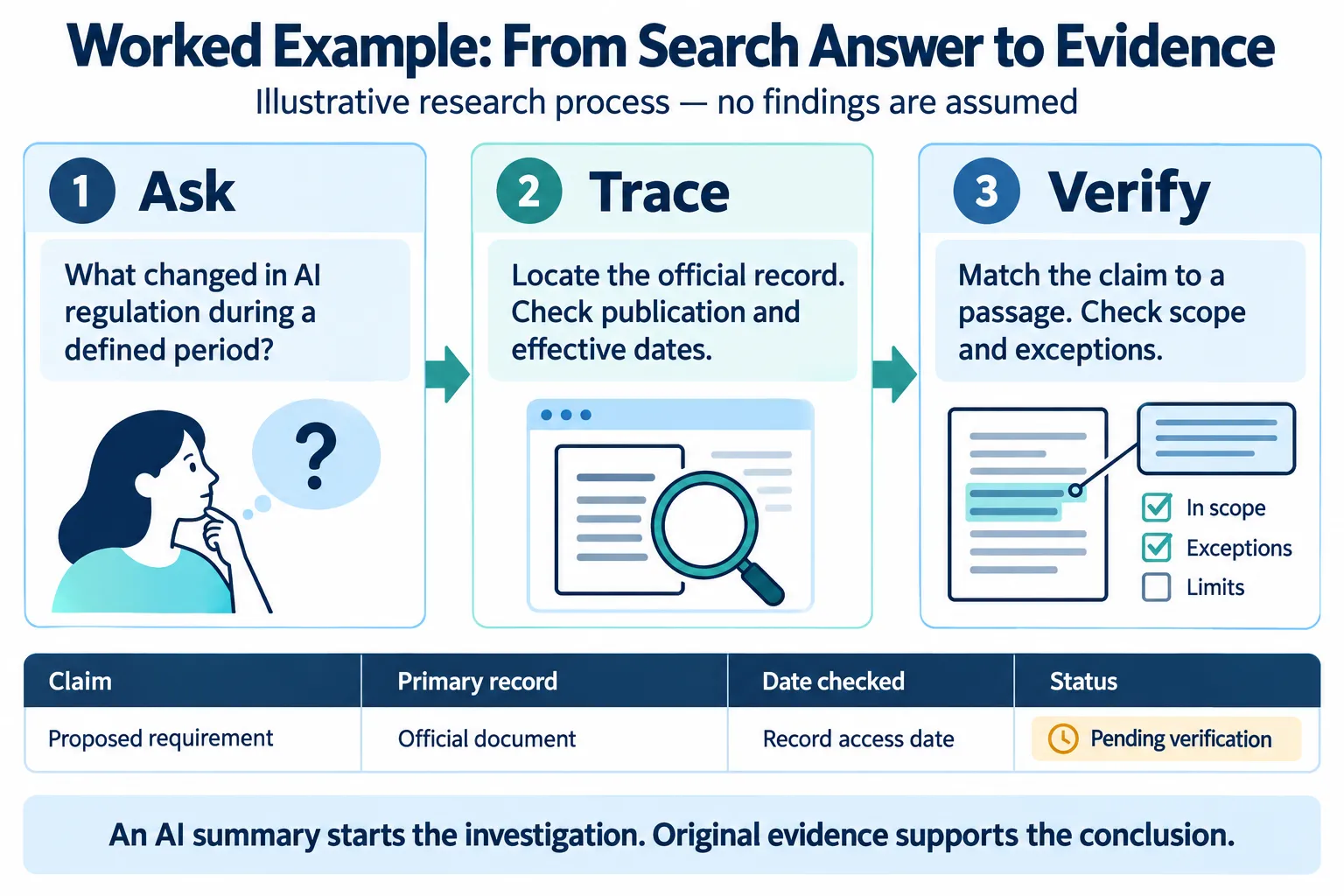
Reliable research commences with a clearly defined question and culminates in thoroughly documented evidence. ChatGPT Search can provide valuable assistance during the intermediate stages, but its use should be embedded within a structured research methodology.
Step 1: Define the research question
Identify the subject, purpose, geographical scope, and intended outcome.
For example:
“How have European data protection requirements influenced small business adoption of AI customer service tools during 2025–2026?”
A well-defined question helps prevent an investigation from becoming too broad.
Step 2: Set the research boundaries
Specify publication dates, preferred source types, languages, and exclusions.
Researchers should distinguish the date an article was published from the date an event actually occurred.
Step 3: Request relevant primary sources
Ask ChatGPT Search to prioritize government publications, original studies, technical documentation, and official records.
This does not guarantee that the system will retrieve all relevant documents.
Step 4: Examine the initial findings
Review the response for useful explanations, unsupported assertions, inconsistencies, and missing perspectives.
Step 5: Open the cited documents
Verify that sources exist, are accessible, and support the statements attributed to them.
Step 6: Look for independent confirmation
Use traditional search engines, official websites, specialist databases, or academic repositories to find additional evidence.
Step 7: Investigate contradictory findings
Determine whether disagreements arise from different methodologies, periods, definitions, or interpretations.
Step 8: Assess research limitations
Identify missing data, inaccessible sources, uncertain conclusions, and possible selection bias.
Step 9: Document verified results
Record the source title, publisher, URL, publication date, access date, relevant evidence, and remaining uncertainty.
The result should be a transparent research record, not simply a polished AI-generated response.
Six Practical ChatGPT Search Prompts for Researchers
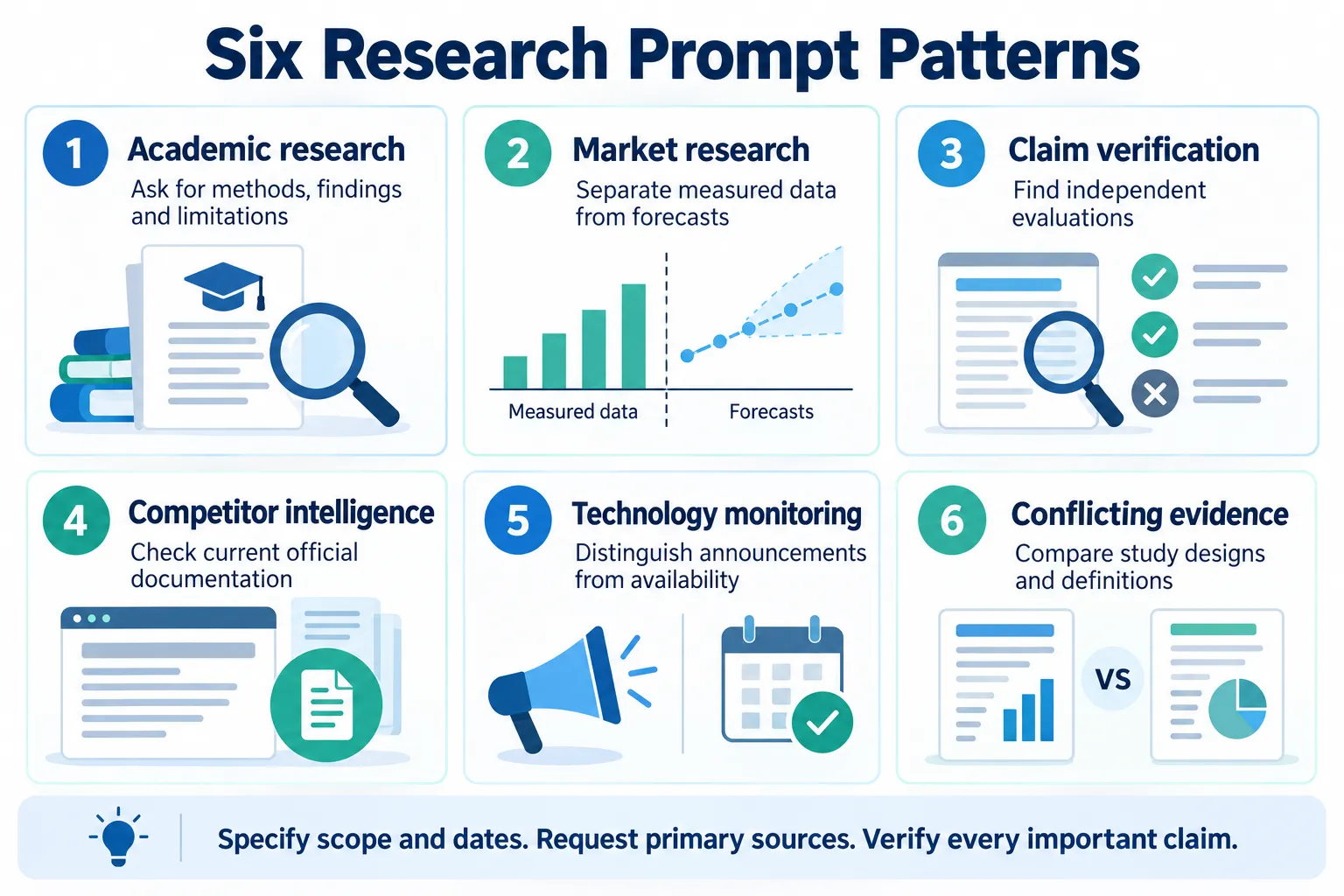
These examples illustrate how to frame research requests. Each requires independent source verification.
1. Academic research and literature discovery
Objective: Identify relevant studies and research gaps.
“Identify peer-reviewed research published between 2024 and 2026 examining the reliability of generative AI in academic information retrieval. Provide study titles, authors, publication dates, DOI links where available, methodologies, major findings, and limitations. Distinguish verified studies from references you cannot confirm.”
Verification: Check bibliographic records, original papers, and reported findings through the publisher or scholarly database.
2. Market research
Objective: Explore an emerging market using documented evidence.
“Analyze publicly available evidence about AI adoption among UK small businesses in 2026. Prioritize official statistics, recognized research institutions, and original industry surveys. Separate measured adoption rates from forecasts and explain important data limitations.”
Verification: Confirm survey dates, sample sizes, definitions, and statistical methods.
3. Verifying a factual claim
Objective: Establish whether a published statement is supported.
“Investigate the claim that AI-powered search engines consistently provide more accurate information than traditional search engines. Locate independent evaluations, identify the methods and performance measures used, and explain whether the available evidence supports this generalization.”
Verification: Read the evaluation methodologies rather than relying on headline accuracy figures.
4. Competitor intelligence
Objective: Compare documented product capabilities.
“Compare the publicly documented capabilities of three leading AI research platforms as of October 22, 2026. Use official product documentation, identify relevant subscription limitations, and separate confirmed functionality from vendor marketing claims.”
Verification: Compare product announcements with current documentation and independently observed capabilities where possible.
5. Monitoring technology developments
Objective: Compile an evidence-based update.
“Identify significant developments in AI-powered search announced between January 1 and October 22, 2026. Include dates, organizations, primary announcements, and practical implications for professional researchers. Exclude unconfirmed rumors and distinguish product releases from experimental features.”
Verification: Check original announcement dates, release notes, and whether features became generally available.
6. Investigating conflicting evidence
Objective: Understand why sources reach different conclusions.
“Find independent studies that reach different conclusions about AI-assisted research accuracy. Compare their research questions, datasets, assessment methods, limitations, and publication dates. Explain plausible reasons for disagreement without assuming either study is automatically correct.”
Verification: Review the study designs and determine whether the findings are genuinely comparable.
Limitations and Risks of ChatGPT Search
Explanations generated by artificial intelligence may appear authoritative even when the underlying evidence is insufficient. This underscores the critical importance of rigorous source evaluation.
Hallucinations and unsupported statements
Generative artificial intelligence systems may produce information that appears plausible but is incorrect, including fabricated details or erroneous interpretations.
The National Institute of Standards and Technology identifies confidently generated false content, or confabulation, as a generative AI risk in its Generative AI Profile.
Incorrect or misleading citations
A citation may direct the researcher to an authentic document that does not, in fact, support the statement to which it is attributed.
The Tow Center’s 2025 investigation tested news-source retrieval and citation across eight AI search tools. The findings highlight attribution problems in that study’s setting; they are not a benchmark of every current 2026 system or research task.
Incomplete web coverage
Search systems are inherently limited and cannot access all relevant documents.
Significant materials may be excluded due to access restrictions, subscription requirements, technical barriers, limitations in indexing, or specific retrieval parameters.
Outdated information
Even web-enabled systems may return outdated sources or fail to capture recent developments.
This limitation is particularly consequential in fields such as law, financial reporting, cybersecurity, medicine, and rapidly evolving technological domains.
Source and selection bias
A given answer may rely disproportionately on a limited set of publications or reiterate claims that originate from a single source.
Multiple websites reporting the same claim do not necessarily constitute independent corroboration.
Privacy and confidentiality
Researchers must refrain from submitting confidential records, personal data, unpublished research, or commercially sensitive documents unless they have thoroughly assessed the applicable permissions, privacy policies, and organizational requirements.
How to Verify Information Found Through ChatGPT Search
The most straightforward approach to verification is to assess the underlying evidence independently of the AI-generated explanation.
Research Verification Checklist
- Locate the original publication or primary record.
- Confirm the author, publisher, and publication date.
- Check whether the cited material directly supports the claim.
- Find independent corroboration for consequential findings.
- Examine methodology, definitions, and important qualifications.
- Check for corrections, revisions, or more recent evidence.
- Record source details and unresolved uncertainties.
For a detailed process, see the AOFIRS verification guide.
For consequential research, documentation should extend beyond a simple checklist. Maintain a comprehensive source register that records each claim, the supporting document, the location of evidence, verification status, and any pertinent caveats.
This practice establishes an auditable record that can be systematically reviewed or updated as new evidence emerges.
Will ChatGPT Search Replace Traditional Search Engines?
There is no substantive basis for presuming that ChatGPT Search will fully supplant traditional search methodologies.
Conversational systems may enhance the convenience of information discovery, yet direct website navigation, advanced querying, use of specialized databases, and independent examination of sources remain essential components of rigorous research.
Google’s AI search guidance also shows how conventional search providers incorporate generative AI alongside established search methods.
The more consequential development lies in the evolving manner in which researchers integrate multiple methods.
A professional researcher may employ ChatGPT Search to generate an initial overview, utilize Google Search to identify specific documents, access academic databases to retrieve original studies, and conduct a structured evidence review to arrive at a defensible conclusion.
The researcher retains ultimate responsibility for determining whether the available evidence adequately addresses the original research question.
Frequently Asked Questions About ChatGPT Search
1. What is ChatGPT Search in 2026?
ChatGPT Search is a web-enabled conversational search capability that helps users find information, receive synthesized explanations, and review relevant online sources.
2. Is ChatGPT Search free?
Check the search options and limits shown in your ChatGPT account. Access can vary with the product surface, account, region and workspace settings; availability of search does not imply unlimited use.
3. Can ChatGPT Search access real-time information?
It can retrieve recent web information, but it does not guarantee immediate access to every newly published event, document, or update.
4. Is ChatGPT Search more accurate than Google Search?
Neither system is universally more accurate. Reliability depends on the specific question, retrieved evidence, source quality, and how information is interpreted.
5. Can ChatGPT Search be used for academic research?
Yes. It can assist with topic exploration, literature discovery, and research planning. Academic claims and citations should be verified against original publications.
6. Does ChatGPT Search provide reliable citations?
It may provide useful citations, but those references can be incomplete or incorrectly associated with claims. Researchers should verify them individually.
7. What is the difference between ChatGPT Search and Deep Research?
Search is intended for relatively quick information retrieval and synthesis. Deep Research supports more extensive, multi-step investigations and structured reports.
8. Can ChatGPT Search access paywalled academic articles?
It cannot be assumed to access the full content of subscription-only publications. Researchers may need authorized institutional access or other legitimate sources.
9. How can researchers reduce AI hallucinations?
Use precise questions, request primary sources, check original documents, compare independent evidence, and investigate unsupported statements. These measures reduce risk but do not guarantee error-free output.
10. Will AI search replace professional research skills?
AI changes how research tasks can be performed, but information evaluation, methodology, evidence interpretation, and ethical judgment remain essential.
Conclusion: Combining AI Search With Human Research Skills
In 2026, ChatGPT Search provides a practical means for exploring subjects, retrieving web-based information, and organizing research findings through natural language interaction.
Its value is maximized when researchers employ it as part of an established investigative process, rather than regarding its outputs as verified conclusions.
Professional research continues to demand carefully formulated questions, the use of credible sources, independent corroboration, transparent documentation, and informed human judgment.
Artificial intelligence can assist in the identification and organization of evidence. However, the reliability of research ultimately depends on the rigor with which that evidence is evaluated.