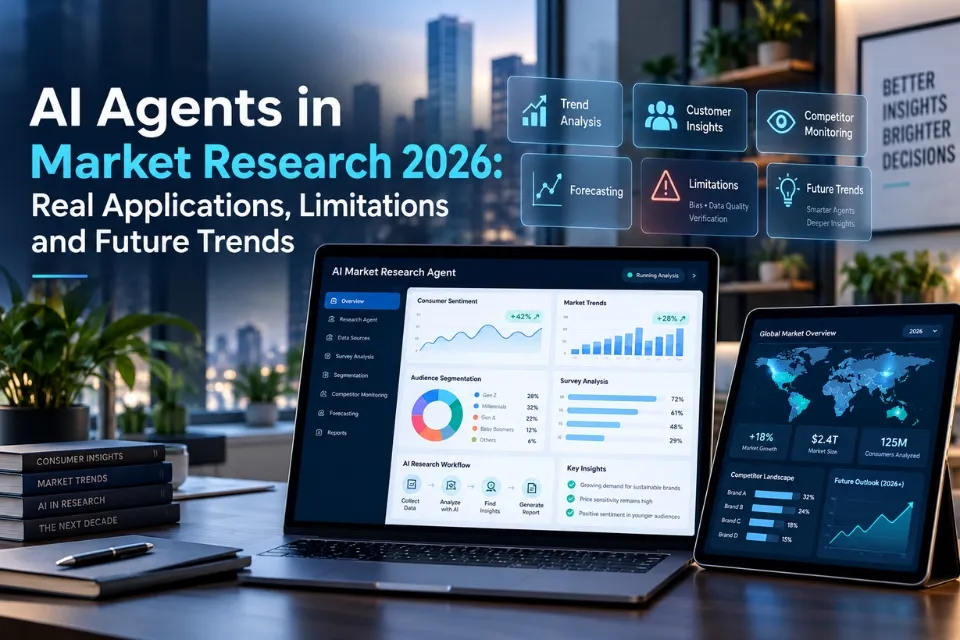
AI agents in market research are changing how organizations discover information, analyze customer feedback, monitor competitors and prepare business intelligence reports. Unlike conventional automation, some agentic AI systems can plan multiple research steps, access connected tools, evaluate intermediate results and adjust their approach.
Yet faster research does not automatically mean better research. An AI-generated report may contain convincing conclusions that are based on incomplete datasets, unrepresentative consumer opinions or incorrectly interpreted sources.
By October 2026, multi-step AI research capabilities had become practical tools for information discovery and analysis. However, replacing real consumer research with autonomous software remained a much more difficult proposition.
The essential distinction is that AI agents can automate parts of the research process, but the credibility of their findings still depends on the quality of the evidence, the research method and human oversight.
This guide examines what the technology actually delivers, which claims remain exaggerated, and how market researchers can use AI agents responsibly.
AI Agent Basics
AI agents in market research are software systems that use artificial intelligence to plan, execute, and adapt sequences of research tasks toward a defined objective.
Depending on their design and permissions, these systems may search information sources, retrieve documents, query databases, organize evidence, analyze records, and produce structured findings.
An AI agent typically combines several capabilities:
- Task planning: Breaking a research objective into smaller activities.
- Information retrieval: Searching authorized websites, databases, and connected applications.
- Tool use: Running queries, calculations, scripts, or analytical workflows.
- Iterative processing: Revising searches or analysis when new information appears.
- Reporting: Producing summaries, comparisons, and research deliverables.
- Human checkpoints: Requesting approval before sensitive or consequential actions.
Not every product labeled an AI agent possesses all these abilities. Some systems are conventional chatbots with limited tool access, while others can execute more substantial workflows.
For example, OpenAI introduced its multi-step Deep Research capability in February 2025, and Anthropic introduced Claude Research in April 2025. Both demonstrated agentic approaches to searching and synthesizing information, although generated findings still require verification.
Comparing Research Tools
The main difference concerns how independently a system can organize and execute a sequence of tasks.
| Technology | Typical capability | Main limitation |
|---|---|---|
| Traditional automation | Repeats predefined processes | Limited flexibility |
| Predictive machine learning | Identifies statistical patterns and generates forecasts | Depends on training data and validation |
| Generative AI chatbot | Responds to prompts and summarizes information | May lack current evidence or tool access |
| AI research assistant | Supports searches, analysis, and reporting | Often requires continuous direction |
| Tool-using AI agent | Plans and executes multiple steps | Can make errors across connected tasks |
| Multi-agent system | Coordinates specialized agent roles | More difficult to monitor and audit |
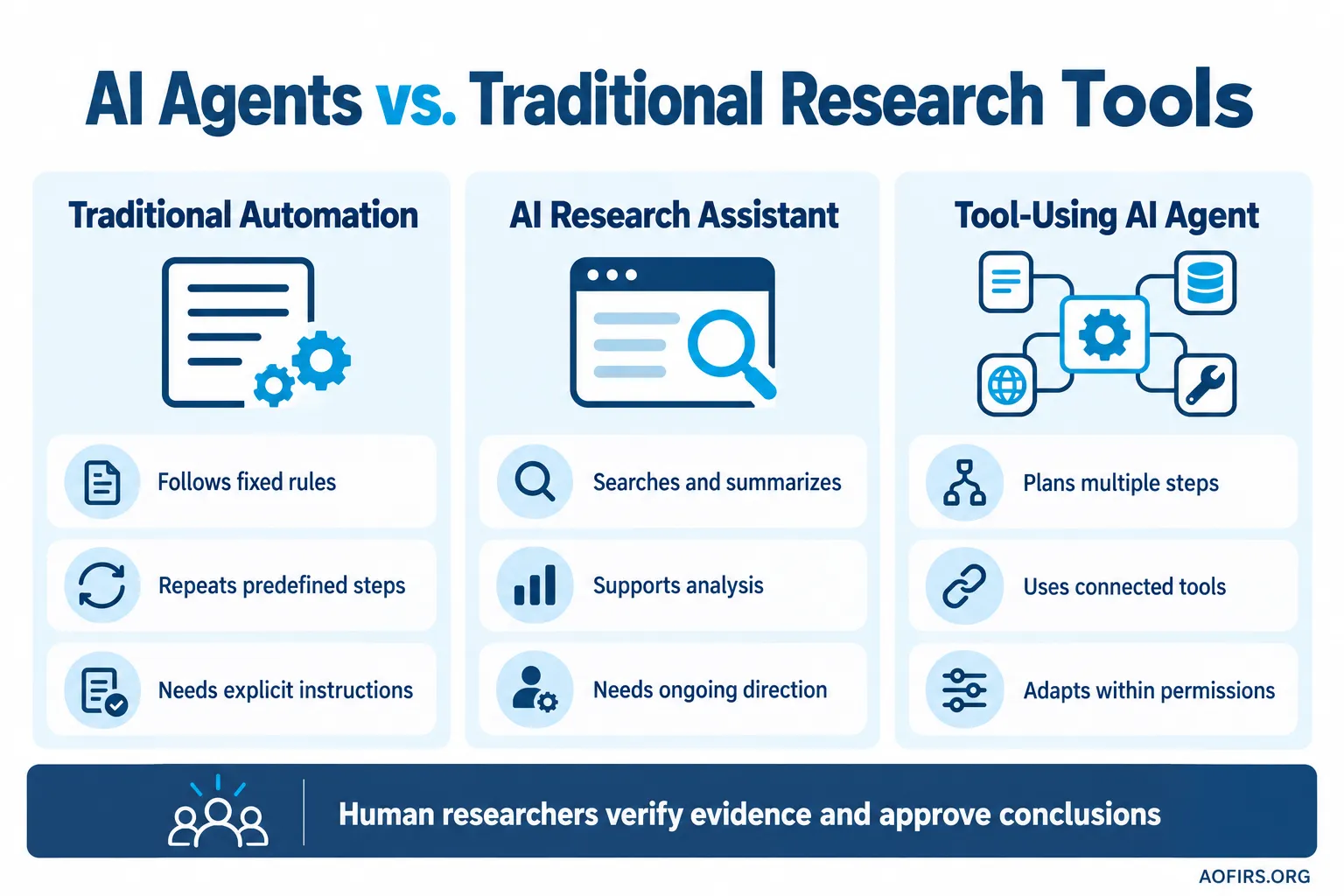
A predictive model estimating demand is not necessarily an AI agent. Similarly, an application that automatically categorizes survey responses may use advanced AI without independently planning a research project.
This distinction matters when businesses evaluate vendors. The relevant question is not whether a platform advertises artificial intelligence, but which research tasks it can perform, how it obtains information, and what evidence supports its outputs.
Real Research Applications
1. Market and competitor intelligence
AI agents can support competitive intelligence by searching official announcements, product catalogs, pricing pages, industry reports, and other authorized sources.
For example, an agent may help a researcher identify product changes across several competitors and organize the findings into a comparison table.
However, a competitor’s advertised price does not necessarily establish its actual transaction price, sales volume, or commercial strategy.
Researchers should preserve source URLs, dates, product specifications, and geographic context.
2. Consumer feedback and sentiment analysis
Customer reviews, survey responses, and support records often contain useful qualitative information.
AI-assisted systems can classify comments, extract recurring topics, and identify possible dissatisfaction with delivery, pricing, or product quality.
The limitation is representativeness. Customers who leave reviews may differ substantially from those who remain silent. Similarly, a model can misinterpret sarcasm, local expressions, or mixed sentiment.
An AI-generated sentiment score should therefore be treated as a classification result, not a direct measurement of the entire market’s opinion.
3. Survey design and response analysis
AI tools can assist researchers in drafting questions, reviewing wording, and organizing open-ended responses.
Potential applications include detecting duplicate questions, suggesting response categories, and highlighting answers requiring manual inspection.
They cannot independently guarantee that a questionnaire measures the intended concept.
Researchers must still examine sampling methods, leading questions, response bias, accessibility, and whether the results support the intended conclusions.
4. Trend detection and demand forecasting
AI agents can combine retrieval and analytical tools to examine historical sales, publicly available indicators, and changes in consumer discussions.
They can also organize potential forecasting inputs and generate scenarios.
Nevertheless, a narrative prediction from a language model is not equivalent to a statistically validated forecast.
Reliable forecasting requires appropriate historical data, explicit assumptions, out-of-sample testing, and performance monitoring.
5. Qualitative research and interview analysis
When supplied with authorized interview transcripts, AI systems can propose coding categories, locate recurring themes, and organize supporting passages.
This may help researchers examine larger qualitative datasets more efficiently.
However, qualitative interpretation also depends on context, participant meaning, and methodological judgment.
Researchers should inspect the original transcripts, review contradictory evidence, and avoid treating automated themes as independently established findings.
6. Automated market research reporting
Agents can help consolidate evidence into competitor matrices, research summaries, dashboards, and recurring intelligence reports.
This is especially useful when the same information sources need regular review.
The final document should identify where its information originated, what period the data covers, and which conclusions remain uncertain.
For a broader examination of source-based research, see the AOFIRS guide to original research.
Capabilities vs. Hype
The practical capabilities of agentic AI are meaningful, but marketing language often goes beyond what available evidence supports.
| Claim | Evidence-based assessment |
|---|---|
| AI agents can conduct multi-step information searches | Demonstrated in documented research products |
| AI can organize and summarize large document collections | Established capability, subject to quality checks |
| AI agents can analyze authorized customer feedback | Feasible with suitable data and evaluation |
| AI can predict consumer demand accurately in every market | Unsupported generalization |
| AI can eliminate research bias | Unsupported |
| Synthetic respondents can replace all human surveys | Not supported by current independent evidence |
| AI agents can produce error-free research reports | Unsupported |
| AI agents can replace all market research professionals | Not established |
An important distinction is the difference between technical feasibility and methodological reliability.
A system may successfully complete a sequence of web searches while failing to identify the strongest evidence. It may generate a professional-looking report while confusing an industry estimate with a measured statistic.
These failures can be difficult to detect because the writing itself appears coherent.
The Generative AI Profile, published in July 2024, identifies risks involving fabricated information, data quality, and unreliable generated content. These concerns remain relevant when generative models are incorporated into autonomous workflows.
Synthetic Respondents
Synthetic respondents are AI-generated simulations of human survey participants. They are created by asking language models to respond according to specified demographic characteristics, behavioral profiles, or fictional personas.
These systems can help researchers explore hypothetical reactions, test questionnaire wording, or develop preliminary ideas. However, simulated answers are not observations from actual consumers.
A significant study published by Pew Research Center on September 30, 2026, examined whether AI-generated survey responses could reproduce real public opinion polling results.
Researchers compared synthetic responses with human responses across nearly 300 questions from three survey waves. For the main model setup tested, the average absolute difference was 12.4 percentage points per response option across the three waves.
The study also identified problems with subgroup representation and differences between AI models.
These results concern public opinion polling rather than every possible commercial research application. Nevertheless, they demonstrate why researchers should not assume that convincing simulated answers accurately reflect real people.
Where synthetic respondents may be useful
They may support preliminary questionnaire testing, exploratory hypothesis development, and scenario generation.
They should not be presented as independent consumer testimony, validated purchase intentions, or representative population estimates without appropriate empirical validation.
For market research requiring genuine customer preferences, human surveys, interviews, experiments, and observed behavior remain important sources of evidence.
Practical Research Workflow
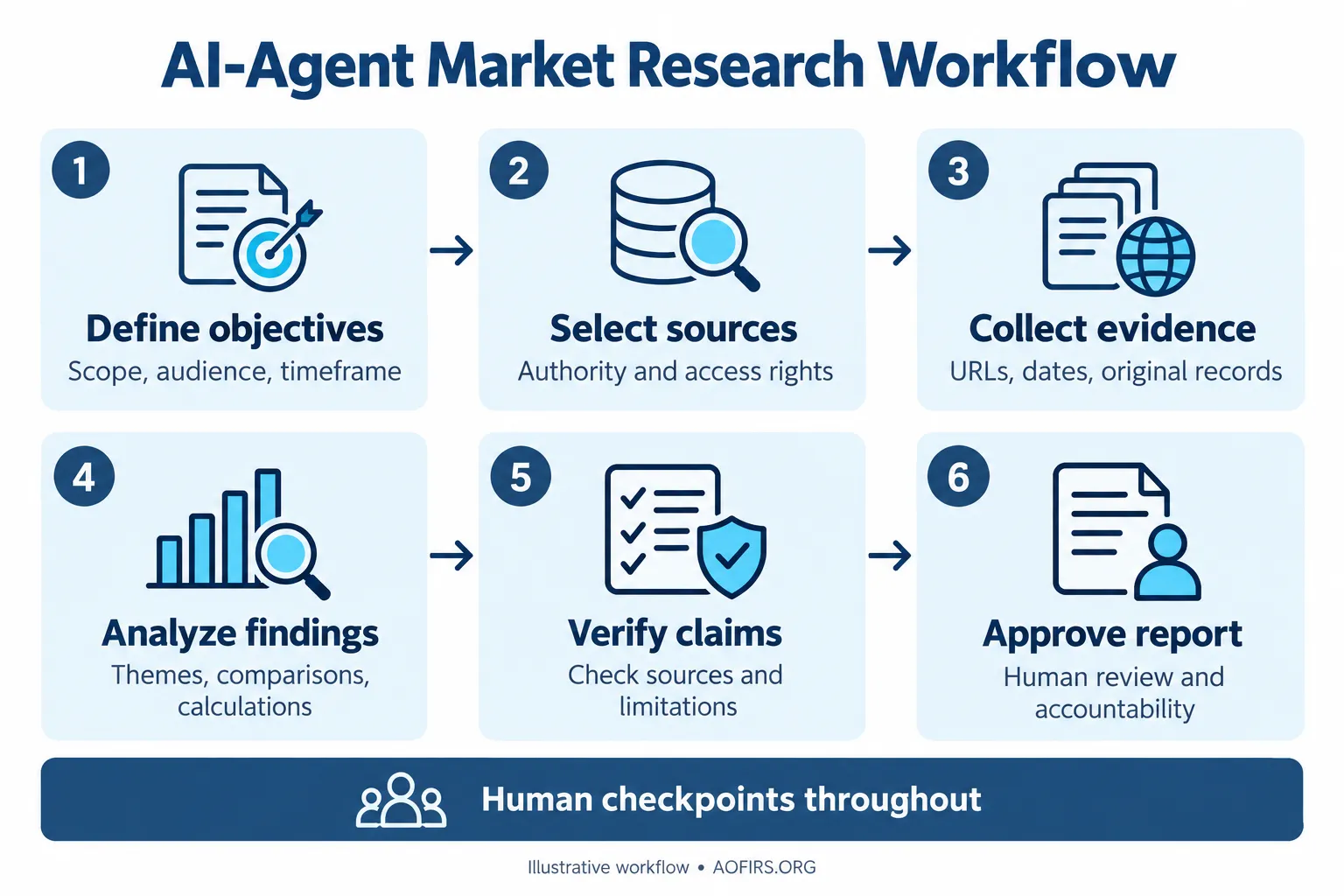
A reliable AI market research workflow should establish research requirements before allowing an agent to collect or interpret information.
| Research stage | AI agent’s role | Human verification |
|---|---|---|
| Define objectives | Suggest questions and subtopics | Approve research scope |
| Select sources | Identify relevant databases and websites | Check authority and access rights |
| Collect information | Retrieve authorized records | Examine completeness and provenance |
| Organize evidence | Extract data into structured tables | Check extraction accuracy |
| Analyse findings | Identify themes and comparisons | Test interpretations |
| Verify claims | Locate supporting references | Confirm original evidence |
| Produce report | Draft summaries and visualizations | Approve findings and conclusions |
A practical implementation follows ten steps:
- Define the decision. Identify what the organization needs to learn and what action the research will inform.
- Set boundaries. Specify the geographic market, population, timeframe, and required evidence.
- Choose credible sources. Prioritize primary records, original datasets, and authorized customer research.
- Select suitable tools. Match agent capabilities to the task rather than choosing software based on promotional claims.
- Configure permissions. Restrict access to necessary information and establish human approval checkpoints.
- Collect information. Record URLs, source dates, retrieval dates, and relevant context.
- Analyze findings. Compare evidence, calculate suitable metrics, and investigate contradictory results.
- Verify important claims. Examine underlying records rather than relying on generated citations.
- Assess limitations. Document missing information, sampling bias, and uncertainty.
- Approve the report. Have a responsible researcher review the final conclusions.
This approach creates a traceable research process rather than an unexamined collection of AI-generated statements.
For detailed instructions on checking outputs, use the AOFIRS verification guide.
Competitive Research Example
The following scenario is hypothetical. It illustrates a research method, not actual findings from a completed market study.
A UK business wants to introduce an environmentally positioned household cleaning product. Before investing in development, it needs to understand existing competitors, product claims, retail prices, and possible customer concerns.
Step 1: Define the research objective
The researcher asks:
What products currently compete in the UK eco-friendly household cleaning category, how are they positioned, and what questions should be investigated before launching another product?
The scope includes an agreed product category, current UK listings, identifiable competitors, and authorized review data.
Step 2: Collect competitor evidence
The agent searches approved sources and prepares a structured comparison.
| Research field | Evidence to collect | Verification |
|---|---|---|
| Product positioning | Published product descriptions | Check original listing |
| Retail price | Price and pack size | Record date and retailer |
| Environmental claims | Certifications and product claims | Check independent substantiation |
| Customer concerns | Authorized review data | Examine sampling limitations |
| Product availability | Retailer listings | Confirm location and date |
Step 3: Analyze customer information
Where the business has lawful access to reviews or customer feedback, an AI tool can group comments into possible themes.
These might include packaging, convenience, scent, perceived effectiveness, and value. Such themes are categories to investigate, not findings established by this hypothetical example.
Researchers should compare the automated categorization with a manually reviewed sample.
Step 4: Identify evidence gaps
The agent may discover that existing product pages provide little information about consumer willingness to pay.
That gap cannot be resolved reliably by asking a language model to invent a likely price.
The business may need a properly designed consumer survey, pricing experiment, or another suitable primary research method.
Step 5: Prepare a decision brief
The final report should include verified competitor information, evidence-based observations, limitations, unresolved questions, and recommendations for further research.
The value of the agent is its ability to assist the process from discovery to documentation. The validity of the business decision still depends on genuine evidence.
Tools and Platforms
Selecting suitable technology requires distinguishing general research agents from specialist market research products.
| Platform or approach | Relevant application | Important consideration |
|---|---|---|
| OpenAI Deep Research | Multi-step web research and evidence synthesis | Verify every material finding |
| Claude Research | Research across the web and authorized connected information | Check source access and citations |
| Enterprise agent workflows | Repeatable research processes across connected systems | Assess permissions and auditability |
| Survey research platforms | Questionnaire management and feedback analysis | Confirm specific AI functionality |
| Business intelligence systems | Analysis and visualization of structured data | Validate datasets and calculations |
| Custom research agents | Specialized retrieval and analysis workflows | Require substantial testing and governance |
OpenAI documentation describes Deep Research as a system for multi-step investigation and synthesis. Anthropic announcements describe iterative searches across web content and connected information sources. These are documented examples of agentic research, not independent proof of market research accuracy.
Providers such as Qualtrics, Ipsos, Kantar, and Nielsen may offer relevant research technology, but their individual products must be assessed separately. Conventional analytics or AI-assisted survey features should not automatically be classified as autonomous research agents.
When evaluating any product, researchers should examine its source access, evidence transparency, data protection, export options, human controls, and performance on representative tasks.
Risks and Limitations
The greatest risk in AI-powered market research is confusing automated output with verified knowledge.
Several challenges deserve particular attention.
Source accuracy and fabricated evidence
Generative systems may produce inaccurate statements or references that fail to support their associated claims.
Researchers should confirm that cited material exists, relates to the correct source, and supports the exact conclusion being presented.
Sampling and interpretation bias
An AI system can analyze a biased sample efficiently without recognizing that the sample is inappropriate.
Customer reviews, social media discussions, and voluntary surveys may overrepresent particular populations or experiences.
Privacy and confidential information
Market research may involve personal information, commercially sensitive records, or confidential customer data.
Organizations need appropriate access controls, lawful processing arrangements, and security safeguards. Requirements depend on the applicable jurisdiction and the nature of the information.
Autonomous actions and prompt injection
Connected agents may encounter malicious instructions embedded in webpages, documents, or other retrieved material.
A system should not treat external content as authority to disclose confidential data, modify records, or perform unrelated actions.
Restricting permissions and requiring approval for consequential operations helps reduce these risks.
Accountability
The NIST AI RMF provides a useful foundation for identifying, measuring, and managing AI risks throughout a system’s lifecycle.
For market researchers, an effective governance process should document data sources, analytical decisions, quality checks, errors, and the individual responsible for approving the results.
Future Trends
As of October 2026, the direction of agentic AI development suggested several areas worth monitoring.
- More integrated research workflows: Agents are likely to become more closely connected with authorized databases, business systems, and analytical applications. Such integration may reduce manual transfers between research stages.
- Specialized multi-agent systems: Organizations may experiment with separate agents for retrieval, classification, analysis, and evidence review. Whether these systems outperform simpler workflows will depend on testing.
- Multimodal research: Analysis involving text, images, audio, and video may help researchers work with more varied evidence. However, interpreting consumer reactions still requires appropriate research design.
- Continuous competitive monitoring: Scheduled agents may assist with detecting product changes and industry announcements, provided that data collection is permitted and results are reviewed.
- Stronger evaluation requirements: As organizations delegate more work to agents, reproducibility, security testing, and evidence traceability are likely to become increasingly important.
These developments represent plausible directions, not guarantees of successful commercial adoption.
The most meaningful progress will be measured by whether systems help researchers produce more reliable findings, not simply by how many tasks they can automate.
Frequently Asked Questions
1. What are AI agents in market research?
AI agents are software systems capable of planning and executing sequences of research tasks using artificial intelligence and connected tools. They can support information retrieval, analysis, and reporting.
2. How are AI agents different from AI chatbots?
A chatbot primarily responds to user inputs. An AI agent may independently execute several connected steps, use external tools, and modify its research approach within defined permissions.
3. What market research tasks can AI agents automate?
They can assist with competitor monitoring, information retrieval, document analysis, feedback categorization, data organization, and report preparation.
4. Can AI agents conduct market research independently?
They can complete some defined workflows with limited intervention. However, methodological validity, evidence quality, and consequential decisions still require appropriate human oversight.
5. Are AI-generated consumer insights reliable?
Their reliability depends on the underlying data, analytical method, and validation process. A generated insight should not be accepted solely because it appears plausible.
6. Can synthetic respondents replace real survey participants?
Current evidence does not support their general use as replacements for representative human surveys. Synthetic responses may be useful for exploratory simulations but require validation.
7. What are the main risks of using AI agents?
Important risks include fabricated information, incomplete sources, sampling bias, privacy violations, incorrect interpretations, and unauthorized actions.
8. How can researchers verify AI-generated findings?
Researchers should locate original sources, verify the claims they support, examine research methods, compare independent evidence, and record unresolved uncertainty.
9. How should businesses choose AI market research tools?
Evaluate the intended research tasks, accessible sources, measurable output quality, privacy protections, auditability, and opportunities for human review.
10. Will AI agents replace market research analysts?
AI agents may automate substantial portions of routine research work. However, research design, interpretation, ethics, and accountability remain important professional responsibilities.
Conclusion
AI agents are becoming increasingly useful for discovering, organizing and analyzing information. They can support competitive intelligence, qualitative analysis, evidence synthesis, and recurring research processes.
Their limitations are equally important. Automated searches can overlook evidence, predictive systems may fail under changing conditions, and synthetic consumer responses cannot automatically substitute for observations from real people.
The appropriate goal is not fully autonomous research at any cost. It is more efficient research without sacrificing methodological quality, transparency, or accountability.
For researchers and organizations, the most valuable approach combines agentic AI capabilities with credible sources, clearly defined methods, and informed human judgment.