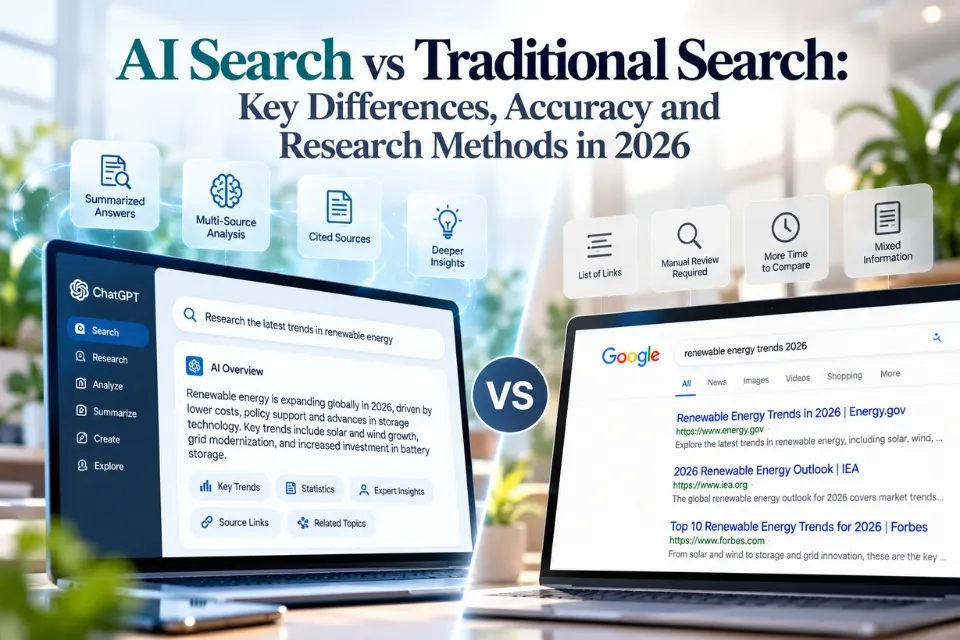

Benchmarking complex query optimization, source verification, and data synthesis
In today’s world, artificial intelligence tools are no longer simple Q&A bots. They are research partners, data synthesizers, and fact verifiers. Professionals, academics, and analysts increasingly rely on AI platforms to tackle deep, complex queries that span lengthy documents, conflicting sources, and nuanced arguments. This article rigorously compares four leading AI systems ChatGPT, Claude AI, Gemini AI, and Grok on their ability to conduct deep online research, focusing on query optimization, factual verification, and data synthesis. Our goal is to help you understand which platform performs best for serious research workflows.
1. Understanding the Foundations
Before evaluating performance, it’s crucial to understand what each tool represents:
ChatGPT (OpenAI)
A versatile large language model with extensive toolkit integrations, capable of handling multimodal inputs, code tasks, and complex reasoning. It is widely used across industries for research, writing, and analysis.
Claude AI (Anthropic)
Designed with a “safety-first” and quality-focused philosophy, emphasizing clear reasoning, structured output, and reduced hallucinations.
Gemini AI (Google)
Deeply integrated with Google’s ecosystem and optimized for long-context processing, real-time information, and multimodal understanding.
Grok (xAI)
Known for real-time data, particularly from social platforms like X (formerly Twitter), and a more conversational, less filtered style.
Each has strengths and limitations that influence their research performance.
2. Complex Query Optimization
ChatGPT: Balanced Reasoning and Tool Support
ChatGPT excels at breaking down complex queries into logical steps, especially when users leverage its structured prompt engineering features. It supports plugins and browsing tools that help extend research capability beyond the model’s training data. When handling multi‑part questions, ChatGPT’s reasoning chains often provide clear intermediate conclusions before final answers. (Data Studios ‧Exafin)
However, without explicit web browsing enabled, it can draw only on internal knowledge and may miss the most recent developments.
Pros:
- Strong reasoning and logical decomposition
- Broad toolkit and plugin ecosystem
Cons:
- Default real-time data access is limited without explicit search tools
Claude AI: Safety‑Centered Optimization
Claude’s design focuses on thoughtful, structured responses. It tends to be cautious, breaking down complex queries into detailed segments and returning high‑quality narrative explanations. Its “constitutional AI” approach means it is less likely to hallucinate or provide unfounded assertions.
In benchmarking studies, Claude often leads on accuracy, particularly when processing long documents or layered instructions. (Share Sneos)
Pros:
- Excellent at long‑form explanation and layered query breakdown
- Reduced error rates in complex reasoning
Cons:
- Can be slower and more verbose than competitors
Gemini AI: High‑Context and Multimodal Strengths
Gemini stands out for handling extremely long contexts and deep data fusion. With long token windows and native multimodal input, it can integrate text, images, and structured data in research tasks. This capability is valuable when analyzing lengthy reports or integrating visuals.
Gemini also leverages real‑time search integration for up‑to‑date information when enabled.
Pros:
- Exceptional long‑context handling
- Strong multimodal synthesis
Cons:
- Less dynamic reasoning compared with Claude in purely text‑driven logic tasks
Grok: Real‑Time and Conversational Insights
Grok’s real‑time connection to social streams like X provides immediacy that other systems lack, especially when evaluating trending topics or the latest developments.
However, real‑time integration alone does not guarantee scholarly reliability. Grok’s conversational style and real‑time focus make it useful for identifying emerging patterns, but verifying source quality remains a challenge.
Pros:
- Real‑time context and social trend awareness
- Fast responses
Cons:
- Limited deep reasoning structure
- Source quality varies based on social streams
3. Source Verification and Credibility
Accurate research depends on more than generating plausible text it requires verifying data against credible sources.
ChatGPT
ChatGPT’s verification depends heavily on the browsing or citation plugins users enable. Without these, it may present outdated information confidently. With browsing, it can access live sources and provide citations, improving reliability in academic or evidence‑driven work.
Strength: Effective when coupled with citation tools
Weakness: Standalone responses can be confidently wrong
Claude AI
In tests focused on hallucination and factual errors, Claude frequently outperforms alternatives due to its safety‑oriented architecture. Users report lower rates of fabricated content and stronger grounding when handling reference work.
Strength: Low hallucination and high narrative grounding
Weakness: Less real‑time data access
Gemini AI
Gemini’s real‑time capabilities and robust search integration help it retrieve current information with greater fidelity, especially in areas where static knowledge bases lag. This makes it a strong choice for research requiring up‑to‑the‑minute verification.
Strength: Reliable access to current data and extended context
Weakness: Integration complexity can vary by platform
Grok
Grok’s real‑time access to public social feeds offers up‑to‑date signals but not assured credibility. Social data often lacks the peer‑review or editorial standards required for academic research. As such, Grok should be paired with traditional research verification rather than used as a sole source.
Strength: Fast and current information
Weakness: Less reliable verification
4. Data Synthesis and Output Quality
The ability to synthesize insights from diverse sources is essential for deep research.
- ChatGPT produces cohesive summaries and structured outputs that integrate multiple perspectives, especially when directed with advanced prompts.
- Claude AI excels at narrative integration and can weave nuanced explanations across complex domains.
- Gemini AI is strong at compiling dense data, including long texts or paired multimodal content.
- Grok is best at quick contextual snapshots rather than deep synthesis.
When multiple sources conflict, Claude’s cautious tone and verification tendencies often produce clearer conclusions. Gemini shines where large document integration improves breadth of insight.
5. Practical Benchmark Outcomes
Independent evaluations suggest that no single model dominates all research dimensions. For example:
- In factual accuracy and long‑document handling, Claude often comes out ahead.
- ChatGPT leads in generalized reasoning and tool adaptability, especially with plugins.
- Gemini excels at handling extended contexts and integrating real‑time content.
- Grok provides rapid, real‑time context but lags in structured verification and synthesis.
Deep research workflows today benefit from combining outputs across models rather than relying on one alone. In rigorous tests, researchers find that synthesizing insights from two or more platforms yields the highest confidence in results.
Conclusion
When it comes to deep online research query optimization, credible source verification, and data synthesis each AI platform brings distinct strengths:
- Best for structured long‑form reasoning: Claude AI
- Best all‑around research partner: ChatGPT (with citation tools enabled)
- Best for multimodal and real‑time context: Gemini AI
- Best for rapid trend awareness: Grok
There is no universal “best” AI for research. Instead, the optimal choice depends on your workflow and priorities. For rigorous academic or professional research, combining tools often yields the most robust and credible insights.
In a landscape that changes quickly, these platforms continue to evolve. Your research success will depend not just on tool selection, but on how you guide and verify the answers they produce.