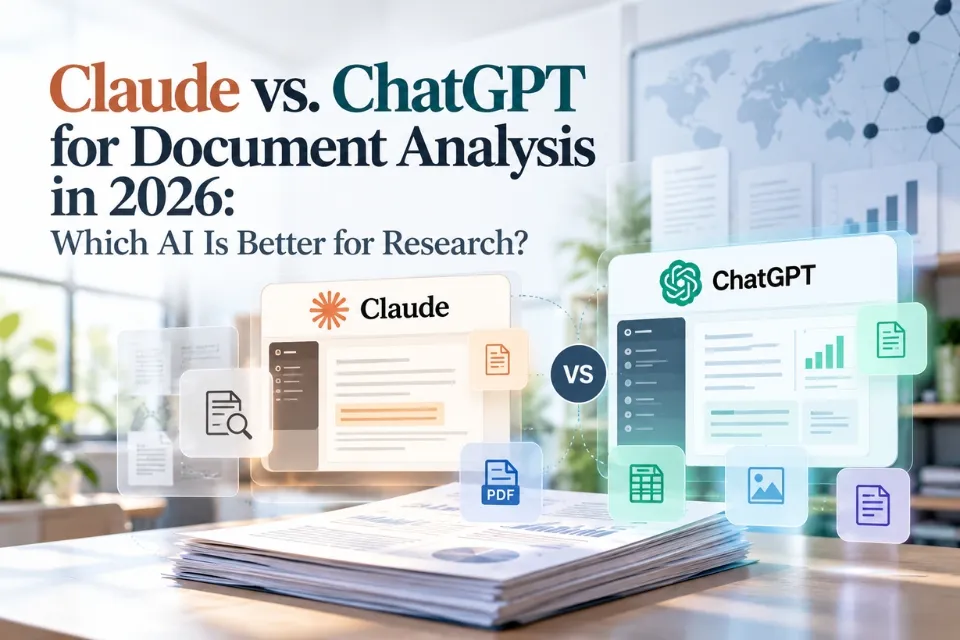
Artificial intelligence is changing how researchers examine documents, extract evidence, compare information, and produce research reports. Tasks that once required extensive manual reading can now begin with AI-assisted analysis of academic papers, financial statements, policy documents, legal records, and large collections of online information.
Two prominent platforms in this field are Claude and ChatGPT. Both can summarize documents, identify important information, compare sources, and support complex research questions. However, their capabilities depend on the models, tools, file-processing methods, and subscription features available.
The Claude vs ChatGPT for document analysis comparison is particularly important in 2026 because AI research tools now extend beyond text summarization. They increasingly support multimodal interpretation, code-assisted analysis, connected information sources, and multi-step research workflows.
For researchers, the question is no longer simply which AI can read more pages. It is which system can retrieve the correct evidence, interpret it accurately, preserve source context, and produce findings that can be independently verified.
This comparison emphasizes documented capabilities and practical verification methods. Product details were reviewed on October 21, 2026; availability can vary by account, model and workspace settings.
Claude or ChatGPT: Which Is Better for Document Analysis?
Neither Claude nor ChatGPT is universally better for document analysis. Both support document summarization, information extraction, and analytical reasoning. The best choice depends on the document format, research objective, required tools, and verification process.
Claude offers document-centered workflows, long-context model options, project knowledge, and file analysis. ChatGPT combines document understanding with data analysis, coding tools, connected research sources, and structured research reporting.
Both platforms can make factual mistakes, misinterpret visual content, overlook evidence, or generate unsupported citations.
For high-stakes research, the appropriate choice should be established through testing on representative documents rather than assumptions about which provider has the most advanced model.
What Has Changed in AI Document Analysis in 2026?
Document analysis has developed from basic summarization into a broader research process involving source retrieval, information extraction, reasoning, verification, and reporting.
Several developments have made this possible.
Choose Models by the Research Task
Model names and availability change frequently. Record the model, account plan, enabled tools and test date when comparing platforms. A newly released model does not establish superior extraction accuracy, source completeness or citation reliability.
From Summarizing Files to Analyzing Evidence
Modern AI assistants can help researchers:
- Extract specific statements from uploaded documents.
- Compare information across multiple sources.
- Identify contradictions and missing evidence.
- Organize findings into structured tables.
- Analyze numerical data using computational tools.
- Produce reports supported by source references.
OpenAI’s research documentation describes investigations across multiple sources and reports that users can review. Anthropic’s file-analysis guidance describes computational file workflows. Both still require source checks.
These capabilities expand what researchers can accomplish, but automated analysis still requires human oversight.
Claude vs. ChatGPT: Document Analysis Capabilities Compared
The following comparison focuses on documented platform functions rather than unsupported accuracy rankings.
| Research capability | Claude AI | ChatGPT |
|---|---|---|
| PDF summarization | Supported | Supported |
| Multiple-document comparison | Supported | Supported |
| Long-context analysis | Available with supported models | Available with supported models |
| Document images and charts | Supported for eligible PDF workflows | Depends on upload method and plan |
| Spreadsheet analysis | Supports computational workflows | Supports computational workflows |
| Code-assisted calculations | Available | Available |
| Project-based research | Supported | Supported |
| Web-assisted research | Available through supported tools | Available through supported tools |
| Source-based research reports | Requires source verification | Requires source verification |
| Research accuracy | Task-dependent | Task-dependent |
Sources: Claude upload guidance, Claude file analysis and ChatGPT file guidance.
The table does not represent a controlled benchmark. It describes supported capabilities, and some features may be restricted by the user’s account, workspace configuration, or selected model.
Context Windows vs. Effective Document Understanding
A context window is the amount of information an AI model can process within a particular interaction. It is measured in tokens, which represent pieces of text and other encoded information.
Longer context windows can help researchers analyze extensive documents without manually dividing them into smaller sections. However, context capacity is not the same as comprehension, accurate retrieval, or reliable reasoning.
Why a Larger Context Window Does Not Guarantee Better Analysis
Suppose a researcher uploads a 400-page annual report and asks an AI assistant to identify inconsistencies between financial disclosures and risk statements.
The assistant must do more than process the text. It needs to locate relevant passages, interpret their meaning, compare statements, and identify whether the apparent inconsistencies are genuine.
Liu and colleagues’ Lost in the Middle study found that performance on the tested retrieval tasks varied with the position of relevant information, with poorer results when evidence appeared in the middle of long inputs.
Although the research predates the latest 2026 models, it establishes an important evaluation problem: long-context capability should be tested, not assumed.
A practical assessment should consider:
- Retrieval accuracy: Can the model find the requested information?
- Source completeness: Does it identify all relevant passages?
- Contextual understanding: Does it preserve qualifications and surrounding meaning?
- Cross-document reasoning: Can it connect related evidence accurately?
- Citation reliability: Can readers independently locate the supporting material?
These criteria are more meaningful than context-window size alone.
How Retrieval-Augmented Generation Supports Research
Retrieval-augmented generation, or RAG, combines language-model responses with information retrieved from external or indexed sources.
Rather than depending exclusively on the model’s learned knowledge, a retrieval system selects relevant material to inform an answer.
Lewis and colleagues’ foundational RAG research describes combining retrieval with generation for knowledge-intensive language tasks.
However, retrieval introduces its own risks. If relevant passages are missed, the resulting answer may be incomplete even when the model summarizes the retrieved material correctly.
Researchers should therefore verify both the answer and the evidence-selection process.
Analyzing PDFs, Scanned Documents, and Complex Layouts
PDF analysis is among the most useful applications of AI in research. Yet PDFs differ significantly in their underlying structure.
A digitally generated academic paper may contain selectable text, whereas a scanned historical record may consist entirely of page images. Financial documents can combine charts, footnotes, tables, and multi-column layouts.
These differences affect extraction quality.
Claude’s PDF Analysis Capabilities
Anthropic documents support for PDFs, text documents, spreadsheets, and other common file formats.
Anthropic’s PDF upload guidance states that supported PDFs of up to 100 pages receive text and visual analysis. For PDFs of 101–1,000 pages, the documented workflow processes text only. Confirm the applicable limits before uploading.
The distinction matters when investigating charts, diagrams, handwritten material, or scanned documents.
Claude also provides code-assisted file-processing capabilities. Researchers can use these tools for structured extraction, computational analysis, and preparing outputs.
ChatGPT’s PDF Analysis Capabilities
ChatGPT supports document uploads, information extraction, summarization, and comparison.
For data-oriented tasks, ask for structured outputs, explicit formulas and reproducible calculations using the computational tools available in your account.
Visual PDF processing depends on the product surface and upload workflow. Confirm whether the selected ChatGPT workflow reads page images or extracts text, particularly when evidence is contained in a chart or scanned table. API file-processing rules should not be assumed to describe every ChatGPT upload path.
Researchers should check whether a particular workflow analyzes the page images themselves or primarily extracts text.
Common PDF Analysis Errors
Neither platform should be assumed to interpret every PDF perfectly. Problems can include incorrectly paired table rows, omitted footnotes, unreadable scans, missing chart labels, and numerical transcription errors.
For reliable results, use text-based source documents where possible. When examining scanned records, verify the extracted text against the original page images.
Analyzing Large Document Collections and Online Sources
Professional research often involves several sources rather than a single document.
A policy researcher might compare legislation, consultation papers, government reports, and public statements. An investigative journalist may need to reconstruct a timeline using hundreds of documents.
Claude and ChatGPT can support these workflows, but the method of organizing the evidence remains important.
Working Across Multiple Documents
A reliable multi-document analysis should preserve three types of information:
- Source identity: Which document supplied each statement?
- Evidence location: Where does the relevant passage appear?
- Interpretation: What conclusion follows, and what remains uncertain?
A useful evidence table might look like this:
| Document | Finding | Evidence location | Verification |
|---|---|---|---|
| Annual Report A | Revenue increase reported | Page 18 | Pending |
| Annual Report B | Risk disclosure expanded | Page 42 | Pending |
| Policy Document C | New reporting requirement | Section 4 | Pending |
Illustrative example only. The entries are not findings from actual documents.
This approach reduces the risk of losing source attribution during synthesis.
Web Research and Source Verification
AI-assisted web research introduces additional challenges. A source may have changed since publication, a retrieved page may be incomplete, or multiple websites may repeat the same unsupported claim.
For historical web evidence, researchers should preserve source URLs, access dates, and archived copies when appropriate.
For the wider research process, see the AOFIRS deep research guide.
Accuracy, Hallucinations, and Citation Reliability
A hallucination occurs when an AI system generates information that is unsupported or incorrect while presenting it as a plausible answer.
In document analysis, hallucinations may involve invented quotations, incorrect document references, fabricated citations, or conclusions that extend beyond the available evidence.
Is Claude More Accurate Than ChatGPT?
There is no defensible universal answer.
Performance depends on the exact models being compared, the documents, the task instructions, available tools, and the criteria used to measure success.
A model that performs well in summarizing long academic papers may not be the most reliable choice for extracting financial figures or interpreting scanned tables.
Vendor-published benchmarks can provide useful information, but they should not be treated as independent proof that one platform is consistently superior.
How to Reduce AI Research Errors
Researchers should establish an evidence-verification process before accepting AI-generated findings.
Document Verification Checklist
- Every important claim has a traceable source.
- Page numbers, quotations, and figures match the originals.
- Contradictory or missing evidence has been identified.
- Numerical calculations have been independently checked.
- Interpretations are clearly separated from factual findings.
- Final conclusions have received human review.
A second model can help identify possible errors, but agreement between AI systems is not independent verification. Both may reproduce the same inaccurate source or reasoning mistake.
For detailed checks, see the AOFIRS verification guide.
Qualitative vs. Quantitative Document Analysis
Different research tasks require different analytical methods.
Qualitative Research
Qualitative document analysis examines themes, language, concepts, relationships, and changes in meaning.
Both platforms can assist researchers in identifying recurring themes, comparing policy language, and organizing coded passages.
For example, a researcher investigating changes in public-health policy could ask an AI assistant to compare how different government documents define risk, responsibility, and public communication.
However, AI-generated themes should be treated as preliminary interpretations.
Researchers must assess whether the extracted passages support those themes and whether alternative explanations exist.
Quantitative Research
Quantitative analysis involves numerical information, calculations, statistical procedures, and structured datasets.
Both platforms offer file-oriented analysis workflows. ChatGPT file guidance explains creating and reviewing structured files, and Claude’s documentation describes code execution and data processing. When calculations matter, request the code or formulas and verify the source values.
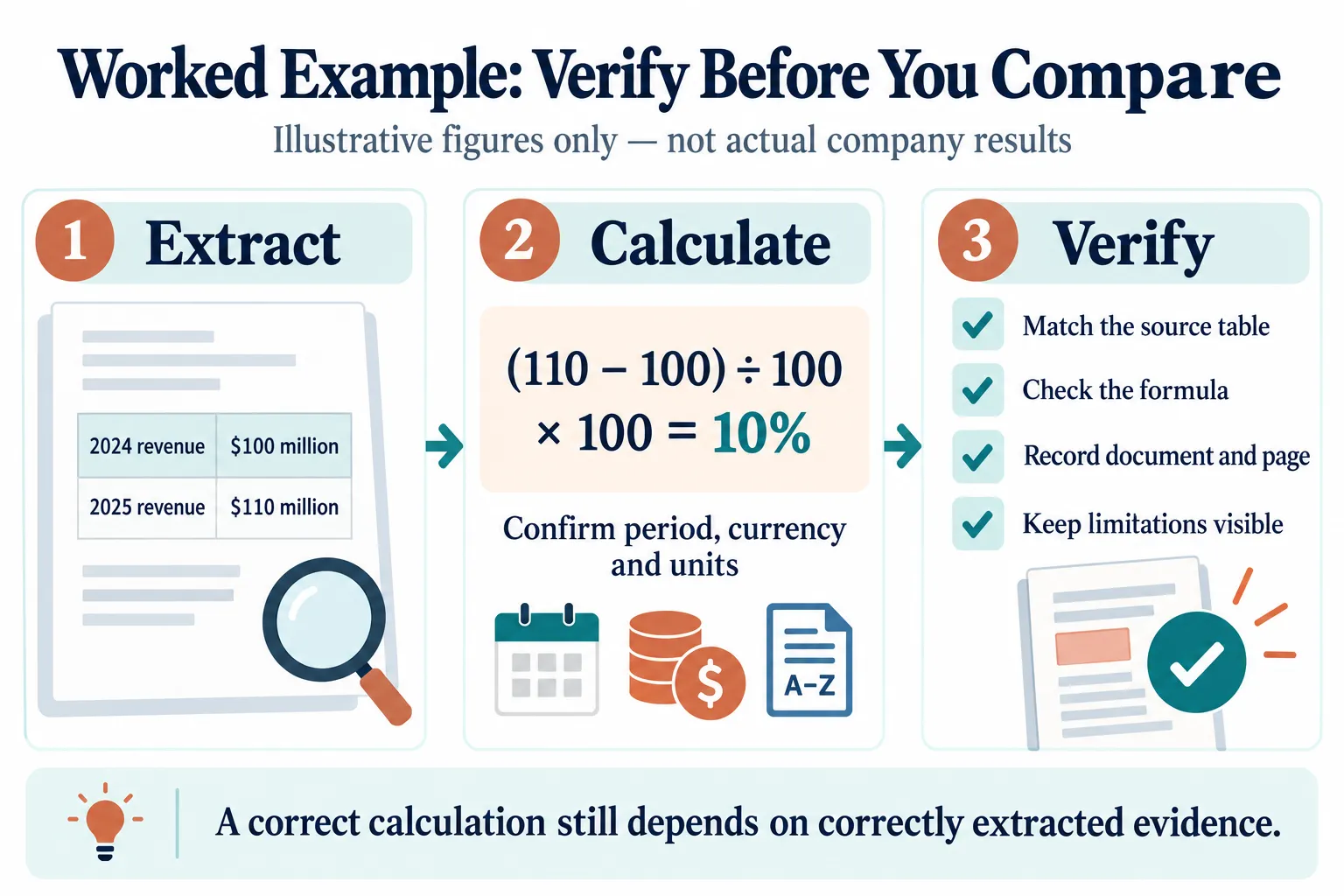
When analyzing financial statements, researchers should distinguish between extracting a number correctly and calculating a result correctly.
Even a mathematically sound calculation can produce an incorrect conclusion if the source values were transcribed inaccurately.
For numerical research, original spreadsheets and machine-readable datasets are preferable to screenshots or scanned tables whenever available.
How AI Agents Are Changing Document Research
AI agents extend document analysis by combining reasoning with tools and multi-step operations.
Depending on the platform and configuration, an AI research workflow may retrieve documents, extract information, execute code, organize evidence, and prepare a structured report.
This can reduce repetitive work, but it also introduces risks.
For instance, a system might retrieve the wrong document, misinterpret a tool response, or perform an unintended action.
Tool-using research systems need explicit permissions, monitoring and a record of important actions. Restrict each tool to the access needed for the research task, and review consequential actions before execution.
Researchers using agentic workflows should therefore apply human approval to sensitive operations and maintain an auditable record of important analytical steps.
Claude vs. ChatGPT for Different Research Tasks
The following recommendations describe reasonable starting points rather than proven performance rankings.
| Research task | Suggested approach |
|---|---|
| Academic literature review | Test both for evidence extraction and synthesis |
| Investigative journalism | Prioritize citation traceability and source completeness |
| Financial statement analysis | Use code-assisted verification in either platform |
| Large text collections | Compare retrieval accuracy on representative documents |
| Scanned historical records | Confirm visual processing and OCR quality |
| Legal-document review | Require expert verification of every consequential finding |
| Research reports | Select based on source access, output requirements, and auditability |
For example, ChatGPT may be convenient when a project requires substantial Python-based data manipulation alongside research writing. Claude may be convenient when the workflow centers on project knowledge, document synthesis, and supported file-processing tools.
Neither preference establishes superiority without testing.
A Practical AI Document Analysis Workflow
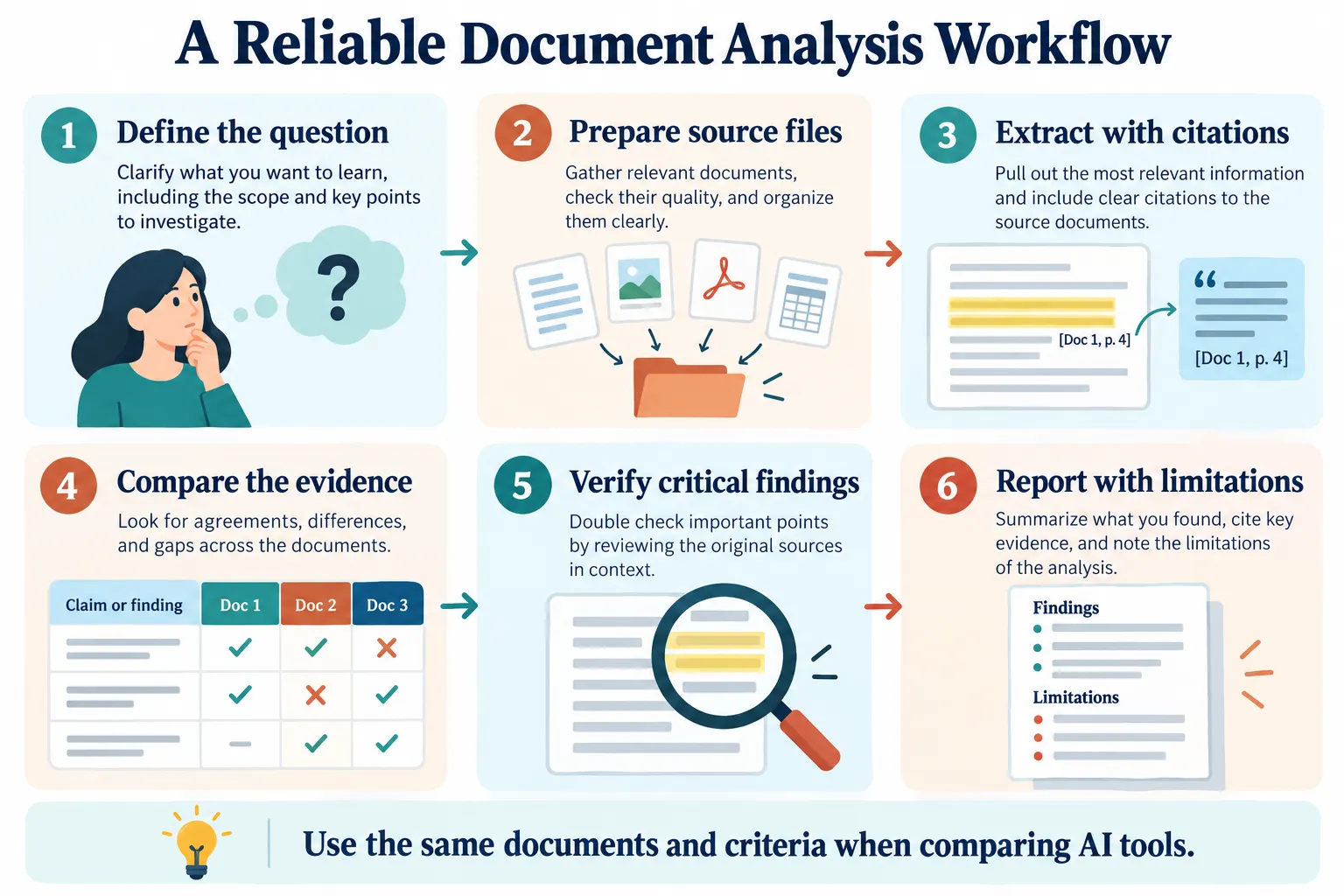
- A structured process can make AI-assisted research more reliable, regardless of the platform. Define the research question.
- Identify the precise information needed, the documents to be examined, and the intended output. Prepare the source documents.
- Remove duplicate files, check scan quality, preserve original filenames, and assign document identifiers. Request evidence-based extraction.
- Ask the AI to extract relevant information with source references before producing interpretations. Compare findings across documents.
- Identify agreements, contradictions, missing information, and differences in terminology. Verify critical findings.
- Check cited passages, calculations, and material statements against the original evidence. Prepare the final research report.
Reusable Prompts for Document Analysis
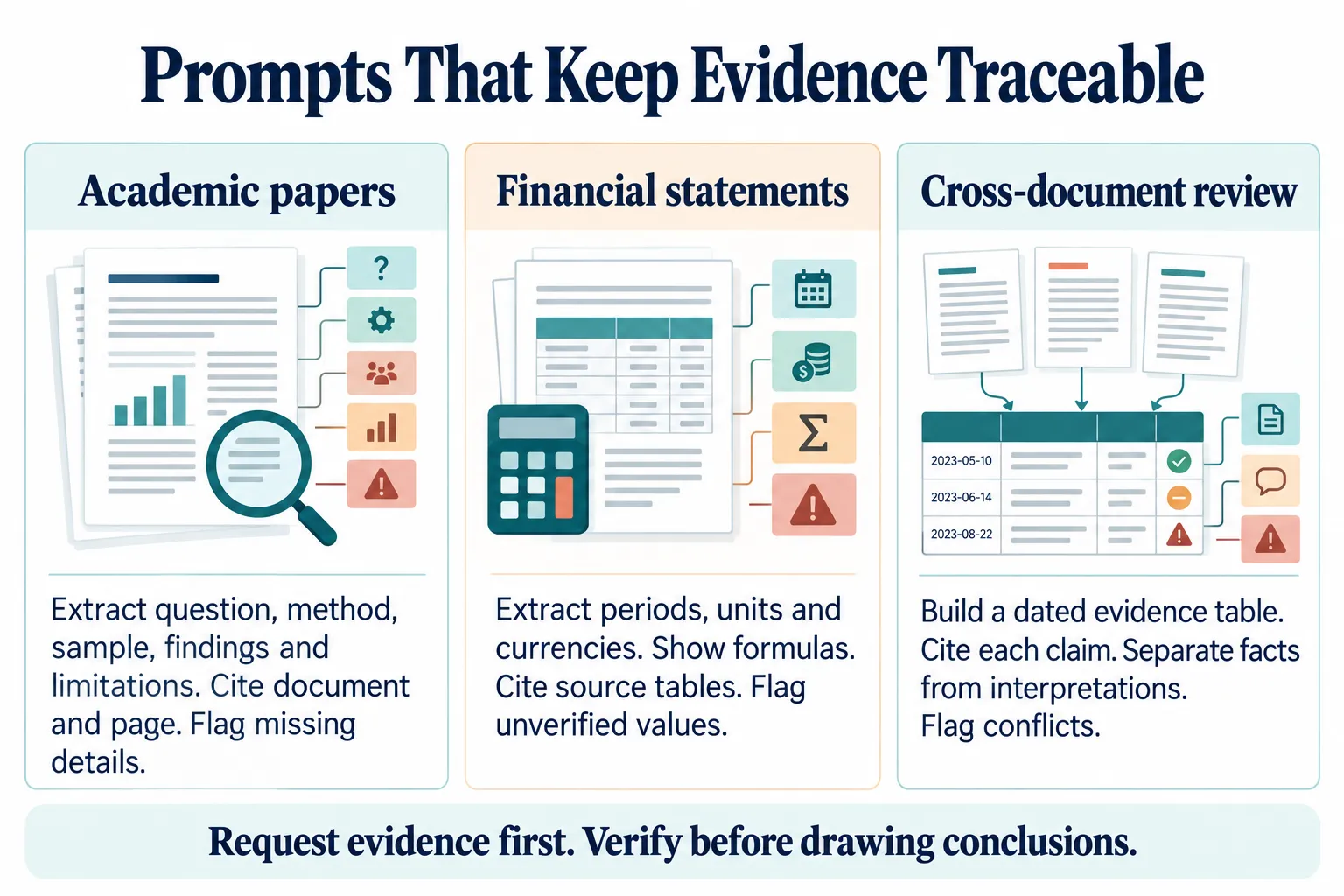
- Separate verified facts, analytical interpretations, limitations, and unanswered questions.
Example 1: Academic Paper Analysis
Analyze the uploaded academic papers. Extract each study’s research question, methodology, sample size, principal findings, and limitations. Present the findings in a comparison table with document names and page references. Do not invent missing information. Identify contradictions and areas requiring further verification.
Example 2: Financial Document Analysis
Review the uploaded financial statements. Extract revenue, operating expenses, net income, and relevant reporting periods. Preserve the original units and currencies. Calculate year-on-year changes using code where available. Show the formulas and identify each source table. Flag any figures that cannot be verified.
Example 3: Cross-Document Evidence Analysis
Compare the uploaded documents to identify statements concerning the same event, policy, or decision. Create a chronological evidence table containing dates, claims, source documents, and page references. Distinguish documented facts from interpretations. Highlight conflicting accounts without assuming which is correct.
Privacy, Copyright, and Research Ethics
AI-assisted research also raises questions about confidentiality, data governance, and intellectual property.
Before uploading documents, researchers should determine whether they contain personal information, confidential business material, restricted research data, or copyrighted content subject to specific access conditions.
Important safeguards include removing unnecessary personal identifiers, checking institutional data-handling requirements, reviewing provider privacy settings, and obtaining appropriate authorization before processing sensitive material.
Researchers should also disclose material AI assistance when required by their institution, publisher, employer, or research protocol.
Neither Claude nor ChatGPT should replace professional judgment in legal, medical, financial, or other consequential decisions.
Which AI Should Researchers Choose in 2026?
The most effective choice depends on how the research will be conducted.
Choose a Claude workflow when its available document-handling, project organization, or file-processing tools match the structure of the research materials.
Choose a ChatGPT workflow when its available data-analysis, connected-source, or research-reporting tools meet the project’s requirements.
For complicated investigations, researchers may test both platforms using the same documents and assessment criteria.
A fair comparison should measure extraction correctness, completeness, citation accuracy, reproducibility, time required, and the extent of human correction needed.
The better research tool is the one that produces more verifiable findings for the task, not necessarily the one that produces the longest or most confident answer.
Frequently Asked Questions
Is Claude better than ChatGPT for analyzing PDFs?
Not universally. Both support PDF analysis, but results depend on the document’s layout, the selected model, and the available processing features. A representative test is the most reliable way to compare them.
Which AI is better for academic research?
Both can support literature reviews, document comparisons, and research synthesis. Researchers should prioritize source accuracy, transparent citations, and methodological verification.
Can ChatGPT analyze large documents?
Yes. ChatGPT supports document uploads and analysis, subject to product and file limits. However, successful uploading does not guarantee complete understanding or retrieval of every passage.
Can Claude analyze scanned PDFs?
Claude supports visual analysis of eligible PDFs. Its documented processing rules differ according to document size and page count. Researchers should confirm that the required visual content is actually being examined.
Can Claude and ChatGPT analyze spreadsheets?
Yes. Both offer supported workflows for spreadsheet and data analysis. Their available computational tools can help perform calculations, create structured outputs, and investigate numerical patterns.
Which AI produces fewer hallucinations?
There is no universal answer covering every model and research task. Hallucination rates must be evaluated using comparable tests, defined error categories, and independently verified reference answers.
Does a larger context window improve research accuracy?
Not automatically. Longer context allows more information to be processed, but retrieval quality, reasoning, source completeness, and attention to relevant evidence remain important.
Can AI-generated citations be trusted?
They should be checked. AI systems may cite the wrong passage, misrepresent a source, or generate references that do not support the claim. Researchers should verify each important citation directly.
Can AI replace human document analysis?
AI can accelerate extraction, organization, and preliminary interpretation, but human researchers remain responsible for verifying evidence, evaluating uncertainty, and defending conclusions.
What is the best way to compare Claude and ChatGPT for research?
Use the same representative document set, equivalent instructions, a verified answer key, and predefined assessment criteria. Evaluate accuracy, completeness, citation reliability, and ease of correcting mistakes.
Conclusion
The comparison between Claude and ChatGPT for document analysis in 2026 reflects a wider change in how research is conducted.
Modern AI assistants can process documents, organize evidence, perform calculations, and support complex investigations. New model families and research tools are expanding these capabilities, but they have not eliminated the risks of hallucinations, incomplete retrieval, and inaccurate source interpretation.
Claude provides document-analysis and project-based workflows, while ChatGPT combines document processing with data analysis and research tools. Both can be valuable when used with appropriate verification.
For academic researchers, investigative journalists, information professionals, and business analysts, the central principle remains unchanged: AI should accelerate the examination of evidence, not replace the responsibility to verify it.