
Research integrity in AI-assisted research means keeping a transparent, verifiable connection between evidence and conclusions. Researchers must identify where information came from, assess its limits, disclose material AI assistance, and remain accountable for the work they publish.
A report can cite genuine sources and still mislead. Several references may repeat one original study, a summary may omit contrary findings, or confident wording may exceed what the methods support. Checking whether a link opens is only the beginning.
For tool selection and the wider workflow, see AOFIRS’ guide to conducting deep research with AI. This article focuses on whether the resulting evidence and reporting justify professional confidence.
What research integrity requires when AI is involved
AI assistance does not remove obligations to use honest methods, provide attribution and report transparently. ALLEA’s European Code of Conduct for Research Integrity, revised in 2023, provides a framework across disciplines and research settings.
Ask whether another qualified reviewer could understand the support for each major conclusion, recognize the limitations, and identify who approved the interpretation. Fluent prose cannot supply those records.
NIST’s 2024 Generative AI Profile identifies confabulation, information-integrity risks and human overreliance. Its action MS-2.5-003 recommends reviewing and verifying generated sources and citations during pre-deployment evaluation and ongoing monitoring.
A six-part integrity review framework
This proposed editorial framework organizes review of claims that could affect the main conclusions. It is not a validated scoring system or a substitute for discipline-specific standards.
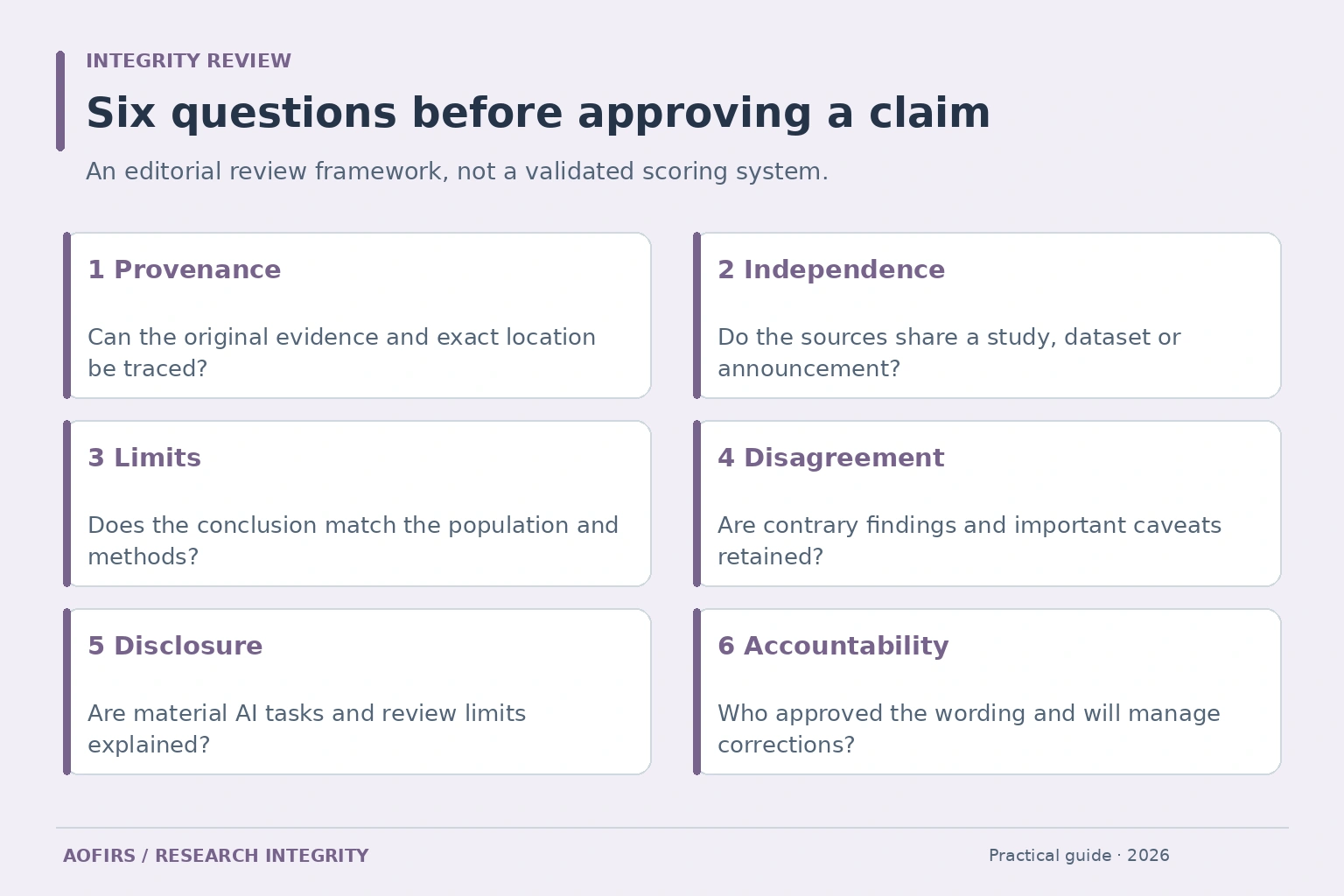
1. Provenance: can the evidence be traced?
A bibliography lists sources. A provenance record connects a particular claim to its supporting evidence and shows how that evidence entered the report.
For each consequential claim, record:
- The original document, author or issuing organization, and stable identifier.
- Publication date, version, and access date.
- The relevant passage, page, table, dataset, or section.
- Any extraction, translation, calculation, or paraphrase.
- The reviewer decision and approved wording.
Distinguish material actually examined from material cited secondhand. If only an abstract was accessible, record that limit. An AI description of a paper’s methods does not establish that anyone reviewed those methods.
For the detailed checking procedure, use AOFIRS’ guide to verifying AI-generated answers and citations. Confirm both source identity and support for the attached claim.
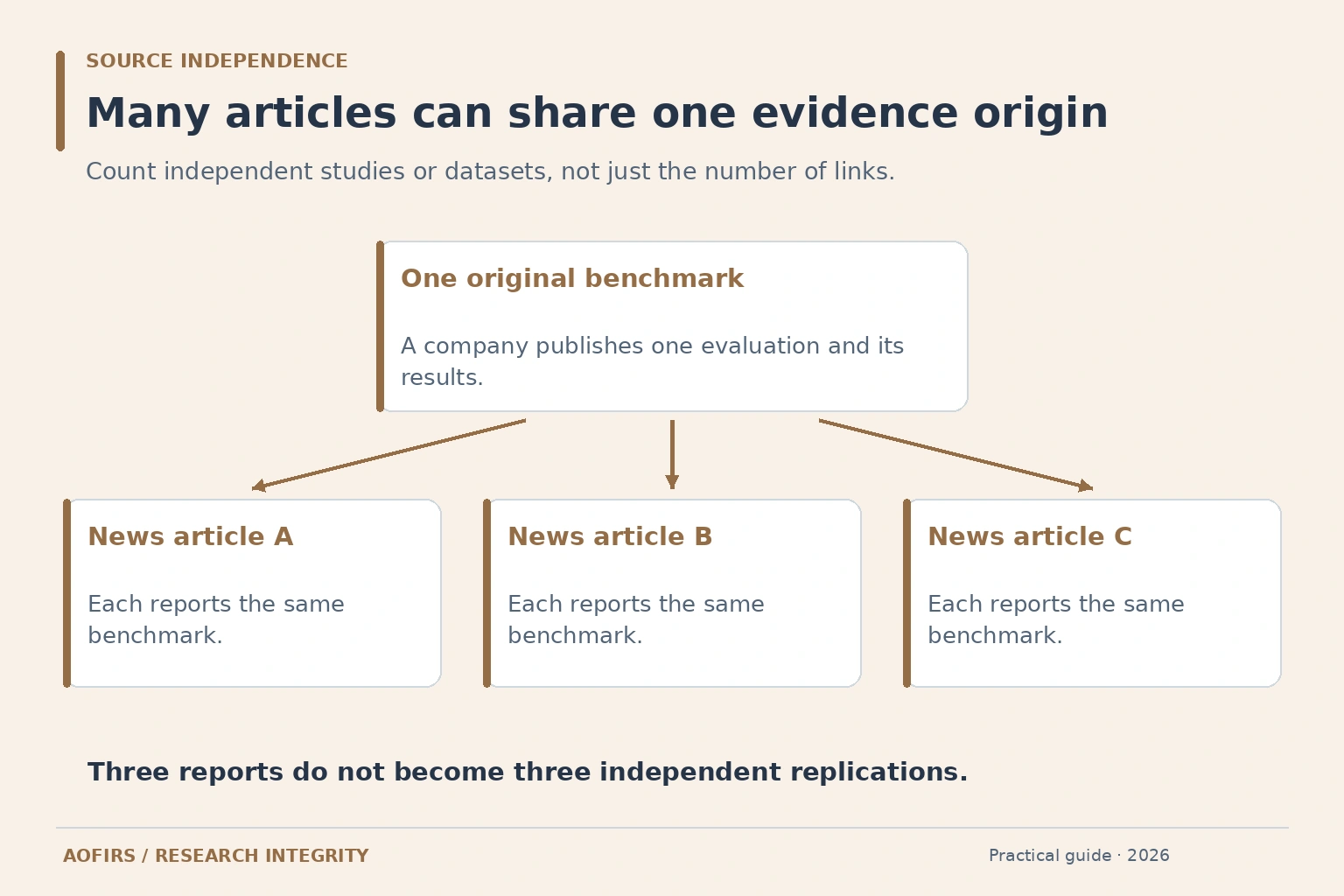
2. Independence: Are these separate evidence sources?
Five articles discussing one company’s benchmark remain reports about one evaluation. They may add commentary, but they are not five independent replications.
Record the evidence origin as well as the publisher. Check whether apparently separate studies reuse participants or datasets. Agreement between AI systems also fails to establish independent corroboration when their answers rely on the same material.
Examine relevant financial and nonfinancial interests. In medical publishing, ICMJE’s disclosure guidance calls for transparency about relationships and activities that may affect judgment. A relationship does not automatically invalidate findings; it gives readers context for evaluating them.
3. Methodological limits: does the conclusion match the study?
An accurate quotation can still support an excessive generalization. Check what the researchers actually tested before accepting the draft’s broader interpretation.
- Which population, language, setting, or model was studied?
- Was the comparison appropriate to the question?
- What outcome was measured, and how?
- Were exclusions and missing observations reported?
- Does the design support association, prediction, or a causal conclusion?
For AI evaluations, distinguish benchmark performance from performance in a particular deployment. One dataset cannot establish reliability across all subjects. Preserve units, denominators, comparison groups, and uncertainty measures when extracting quantitative findings.
4. Conflicting evidence: is disagreement represented fairly?
Compare disagreements before combining findings. Different definitions, populations, periods, or methods may explain conflicting results. Preserve uncertainty when available evidence cannot resolve the difference.
Check summaries for omitted adverse results, relevant null findings, and qualifications. Record defensible reasons for excluding important sources, especially those challenging the preferred conclusion. Seek stronger evidence rather than assigning every view equal weight.
For news-based research, AOFIRS’ learning publication on media framing and source selection offers related exercises on omissions, attribution, and wording. Apply those questions to the source material rather than assuming deliberate distortion.
5. Disclosure: Can readers understand AI’s role?
Describe substantive tasks. Naming a chatbot does not reveal whether it drafted prose, screened records, extracted values, or influenced analytical decisions.
Where appropriate and permitted, record the tool, available model identifier, use dates, material supplied, and human oversight. Follow the relevant publisher, funder, institution, or client policy.
ICMJE’s guidance for authors requires disclosure of AI assistance in medical-journal submissions and retains human responsibility for submitted material. Describe only checks actually completed. Do not claim comprehensive citation verification when some sources remain inaccessible.
6. Accountability: Who owns the final decision?
Assign a person who can explain why each important claim was accepted, qualified, or excluded. Obtain specialist review when interpretation exceeds the team’s expertise. An automated audit cannot approve its own conclusions.
Establish a correction process before publication. If a source is corrected, retracted, or substantially updated, identify dependent claims, reassess conclusions, and record what changed and why. Retain sufficient version history to explain the decision.
Build an audit trail that supports review
An audit trail should let a reviewer move from a conclusion back to its evidence without reconstructing the entire project. Use stable claim identifiers and link decisions to specific source versions.
| Audit field | What to record |
|---|---|
| Claim identifier | Stable label and exact statement under review |
| Evidence origin | Original document or dataset, identifier, version, and dates |
| Support location | Passage, page, table, or analysis output |
| Independence and interests | Shared origins and relevant relationships |
| Interpretation limits | Population, methods, uncertainty, and access gaps |
| Review decision | Supported, qualified, unsupported, or unresolved, with reasons |
| Accountability | Reviewer, review date, approved wording, and subsequent changes |
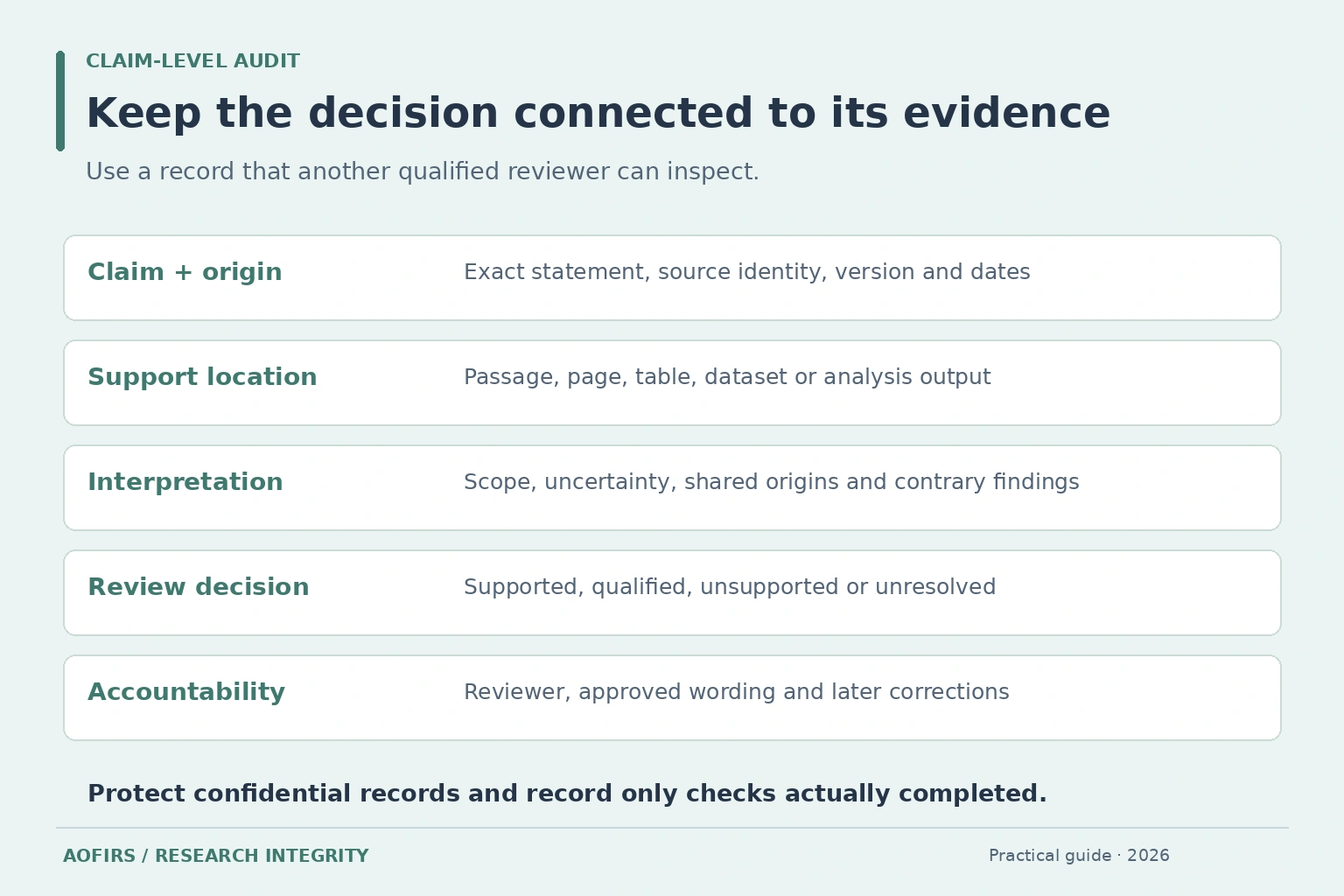
Keep records proportionate to the project and protect confidential material. Retain only what you are authorized to keep. Provide controlled access where public disclosure would be inappropriate.
AOFIRS’ report on verification debt in online research examines risks from accumulating unchecked AI claims. A claim register makes outstanding checks visible before they disappear into polished prose.
Evidence assessment: does RAG guarantee factual answers?
Claim under review: “Adding retrieval makes an AI research assistant completely accurate.” This example examines what a published study can support. It is not a new experiment or a comprehensive review of retrieval-augmented generation systems.
RAG supplies retrieved material to a generative model. In Lewis and colleagues’ original RAG paper, evaluated generation tasks showed factuality benefits relative to a BART baseline. Table 4 reports human assessments for Jeopardy question generation. These findings concern specified models, tasks, and comparisons.
Improvement against a baseline does not establish complete accuracy. The paper’s Broader Impact section acknowledges that external knowledge sources may contain inaccuracies and bias. It does not guarantee the performance of future products.
| Statement | Assessment | Appropriate wording |
|---|---|---|
| Retrieval improved factuality in the original tested comparisons | Supported within the study’s scope | The study reported improvement against its baseline on evaluated tasks. |
| RAG guarantees factual answers everywhere | Unsupported generalization | Remove the guarantee. |
| A particular assistant is reliable for a new specialist collection | Unresolved by this paper | Deployment-specific evaluation is needed. |
The practical implication is to test the actual collection, retrieval process, model, and intended use. Assess missed evidence, extraction errors, and unsupported conclusions. Retrieval can help ground answers, while reliability claims still need relevant evidence.
One focused integrity-audit prompt
Audit this draft and its supplied evidence for research integrity. For each consequential claim, identify evidence origin, supporting location, source independence, methodological limits, conflicting findings, relevant interests and disclosure needs.
Classify each claim as supported, qualified, unsupported or unresolved. Explain the decision and propose narrower wording where needed. Separate reported findings from analytical inference.
Flag selective reporting, missing review records and checks requiring human expertise. State when a source is inaccessible. Do not invent evidence, reviewer actions or disclosures. Return a claim-level assessment table and issues requiring human approval before publication.
This prompt structures a review. Its output is another assessment to examine, not independent certification of research integrity.
Frequently asked questions
What should an AI research audit trail contain?
Link important claims to original evidence, precise locations, limits, review decisions, and responsible reviewers. Preserve relevant tool details and changes while protecting restricted material.
Does a conflict of interest make research unreliable?
Not automatically. Assess the methods and evidence, and disclose relevant relationships. Disclosure supplies context; it does not replace methodological review.
What counts as selective reporting?
Omitting relevant unfavorable findings, removing qualifications, or emphasizing one outcome while ignoring another that materially changes interpretation. Document justified exclusions.
Is saying “AI was used” enough disclosure?
Usually it is too vague for meaningful assessment. Follow the applicable policy and describe substantive tasks, boundaries, and actual human oversight.
Who is accountable for AI-assisted conclusions?
Responsible human authors and organizations must review and approve work under applicable standards. Accountability cannot be delegated to a generated answer.
Must confidential prompts and documents be published?
No universal requirement applies. Follow relevant policies, protect restricted information, and provide an appropriate method summary or controlled review record.
How should unresolved evidence be presented?
State what remains unknown, why it matters, and what evidence could resolve it. Distinguish unavailable evidence from findings showing no effect or contradicting a claim.
What happens after an important source changes?
Recheck dependent claims and conclusions. Record the evidence update, reviewer decision, and correction date. Communicate material changes through the publication’s correction process.