
An independent online research specialist finds, evaluates, and analyzes digital information to help organizations make informed decisions. To build a career in 2026, researchers need more than search skills. They must choose a specialization, demonstrate reliable research methods, develop a portfolio, find suitable clients, and use artificial intelligence responsibly.
AI research tools have made information gathering faster, but finding information is not the same as establishing its accuracy. Researchers who can verify sources, interpret evidence, and communicate useful findings have a clear way to distinguish their services from automated summaries.
This guide explains how to find online research jobs, develop professional skills, price freelance projects, and establish a sustainable independent research career.
What Does an Independent Online Research Specialist Do?
An independent online research specialist conducts structured investigations using search engines, specialized databases, public records, academic publications, and other authorized digital sources.
Unlike someone performing basic internet searches, a professional researcher develops a research question, selects suitable sources, tests their reliability, and produces findings that answer a client’s specific needs.
Common research assignments include:
- Market research and competitor analysis.
- Industry trends and business intelligence.
- Academic literature searches and evidence summaries.
- Open-source intelligence (OSINT) and public-record research.
- Fact-checking and AI-generated content verification.
- Product, supplier, and technology research.
- Data collection, cleaning, and analytical reporting.
Researchers may work as independent consultants, freelancers, contractors or employees. Some specialize in one industry, while others offer research services across several related subjects.
Online Research Career Opportunities in 2026
The research job market includes established analyst occupations and newer roles involving AI, information verification, and knowledge management.
The World Economic Forum’s 2025 jobs report identifies analytical thinking as a key employer skill and AI and big data among the fastest-growing skill areas. These are broad workforce findings, not a forecast for independent online researchers.
These findings suggest opportunities for professionals who combine research methods with technology literacy. They do not establish a specific growth rate for independent online research specialists.
Research Roles, Skills, and Compensation
| Career or specialization | Main responsibilities | Key skills | Employment or compensation evidence |
|---|---|---|---|
| Market research analyst | Analyzes consumers, competitors, and markets | Data analysis, surveys, reporting | US median annual wage: $78,760, May 2025 |
| Management or research consultant | Investigates business challenges and recommends improvements | Research design, consulting, communication | US management analyst median: $101,860, May 2025 |
| Operations research analyst | Uses analytical models to solve organizational problems | Statistics, modeling, quantitative analysis | US median annual wage: $88,940, May 2025 |
| OSINT researcher | Investigates publicly available information | Source tracing, verification, documentation | No directly comparable US national median established for this title |
| AI research evaluator | Assesses AI-generated findings and factual accuracy | Domain knowledge, evidence checking, AI literacy | Compensation varies by project and employer |
| Freelance online researcher | Completes commissioned research assignments | Search strategy, synthesis, client reporting | Project-based earnings vary by specialization and contract |
Sources: BLS profiles for market research analysts, management analysts, and operations research analysts. Figures are U.S. employee medians for May 2025, not freelance earnings or guaranteed income. Related occupations should not be treated as salaries for every independent researcher.
The important career distinction is between gathering readily available facts and producing specialist analysis. Clients may pay for information discovery, but the value of professional research also depends on accuracy, interpretation, completeness, and relevance.
How to Find Work as an Independent Online Research Specialist: 10 Steps
1. Choose a Research Specialization
A well-defined research niche helps potential clients understand what problems you can solve.
Choose an area that combines your existing knowledge, available research resources, and identifiable client needs.
For example, an eCommerce research specialist might investigate competitors, product categories, and supplier information. An academic research assistant might prepare structured literature searches or organize published evidence.
Before committing to a niche, review relevant job listings, study client requirements, and identify the skills needed to complete assignments professionally.
Be cautious about offering medical, legal, or financial conclusions without the appropriate qualifications. Information research does not automatically authorize regulated professional advice.
2. Build Research Skills That AI Cannot Reliably Replace
Professional internet research requires more than familiarity with Google.
Essential skills include:
- Advanced search: Boolean logic, quotation marks, domain filters, and specialized search techniques.
- Source evaluation: Assessing authorship, publication dates, conflicts of interest, and supporting evidence.
- Research methodology: Developing search plans, inclusion criteria, and reproducible procedures.
- Data analysis: Using spreadsheets, basic statistics, and visualizations.
- AI literacy: Writing structured prompts and recognizing model limitations.
- Research reporting: Turning information into findings, conclusions and documented recommendations.
For example, the query site:gov.uk “market research” filetype:pdf can help identify government-hosted PDF documents about market research. Search operators vary across platforms, so researchers should test results rather than assume every query behaves identically.
Check AI-generated citations against original material. The AOFIRS verification guide provides a dedicated source-checking workflow.
3. Create a Professional Research Portfolio
A portfolio helps potential clients judge your abilities before awarding a project.
Include two or three research samples showing the question, methods, evidence, and final outcome.
Example portfolio project: Competitor Research for an Online Retailer
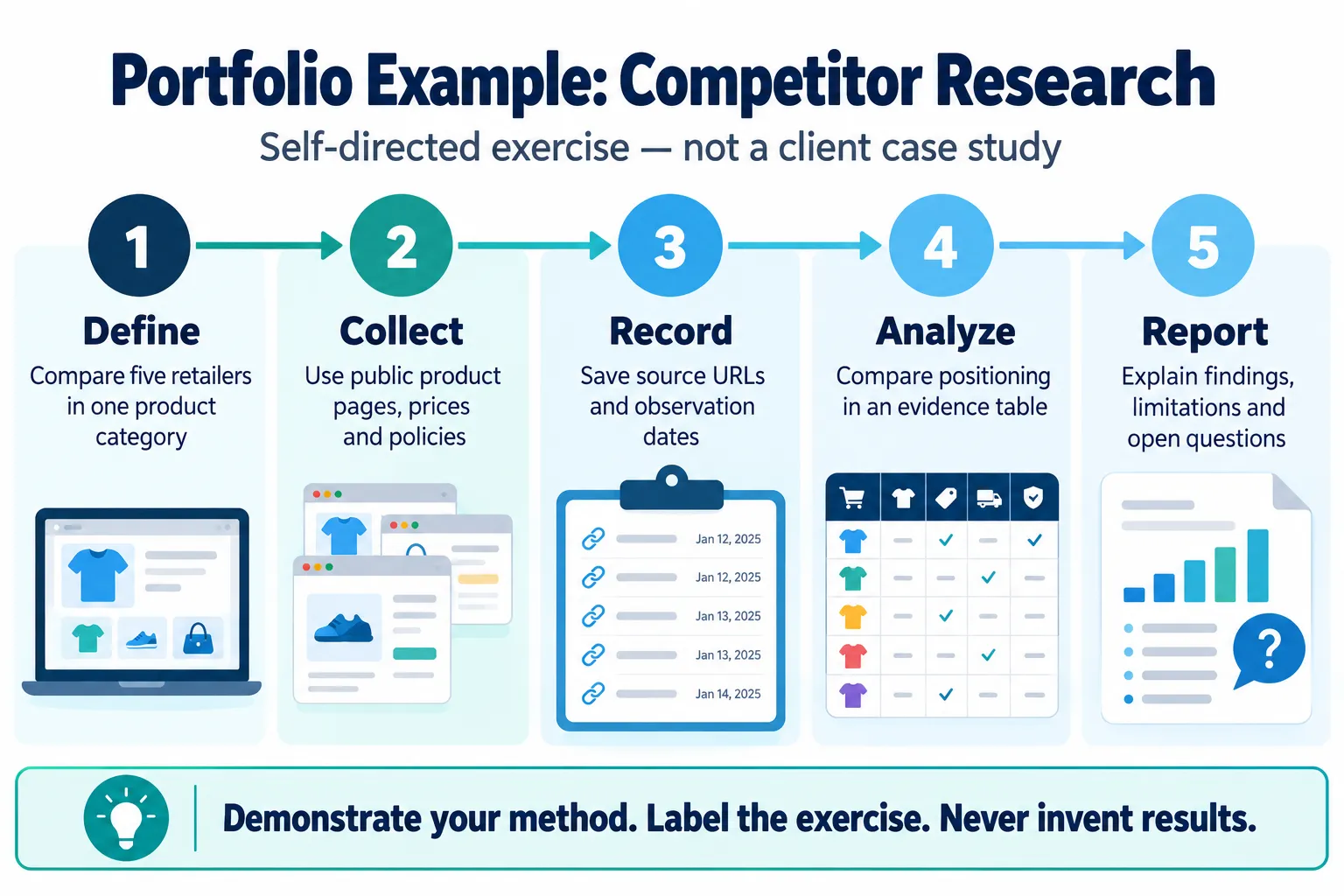
- Research question: How do five competing retailers position similar products?
- Method: Review publicly accessible product pages, pricing information, and published policies.
- Evidence: Record source URLs, observation dates, and relevant product details.
- Analysis: Compare differences using a spreadsheet and summary table.
- Deliverable: A concise report describing observed patterns, limitations, and possible business considerations.
This is an illustrative portfolio exercise, not a real client case study.
Do not invent results or reveal confidential client information. Clearly label self-directed projects.
4. Find Freelance Research Jobs and Remote Opportunities
Research work appears under many job titles. Searching only for “internet researcher” may exclude suitable analyst and consulting assignments.
Useful channels include:
| Platform | Suitable approach |
|---|---|
| Search research, intelligence,, and analyst vacancies; connect with relevant professionals | |
| Upwork | Find project-based research and analysis assignments |
| Fiverr | Offer clearly defined research services and packages |
| Indeed | Explore employee, contract, and remote research positions |
| Glassdoor | Research employers and advertised opportunities |
| FlexJobs | Investigate remote and flexible positions |
| Guru | Explore freelance research projects |
Try search phrases such as “competitive intelligence analyst,” “freelance market researcher”, “research consultant,” “OSINT analyst,” and “AI evaluation specialist”.
Set alerts and examine requirements carefully. For example, review LinkedIn research roles and Upwork’s job-search guidance. Academic networking sites can support collaboration, but they are not dedicated job boards.
Verify employers and investigate suspicious offers. Do not pay someone for the promise of a job. The FTC’s job-scam guidance explains common warning signs.
5. Write a Targeted resume and Research Proposal
A generic application rarely demonstrates why a researcher is suitable for a specific assignment.
Your resume or professional profile should highlight relevant research methods, industry knowledge, software skills, and portfolio examples.
For freelance applications, explain the client’s problem and the process you would use to investigate it.
Example research proposal:
Hello,
I can help investigate your target market and develop a structured competitor comparison. My approach would include defining research criteria, collecting information from appropriate sources, checking important findings and preparing a concise report with supporting references.
I can provide a sample of my research format and agree on the deliverables before starting.
Adjust the proposal to the assignment. Avoid promising outcomes before examining the available evidence.
6. Develop a Practical Research Pricing Strategy
Freelance research fees depend on expertise, project scope, complexity, access costs, and verification requirements.
Common pricing models include hourly fees, fixed-price projects, milestone payments, and monthly retainers.
Illustrative calculation: If a researcher estimates eight hours at a proposed rate of $30 per hour, the initial labor estimate is $240. Additional costs, revisions, platform charges, and taxes may affect the final quotation.
The $30 rate is only an arithmetic example, not a verified market average.
Before quoting, establish the research questions, source requirements, deliverable format, number of revisions, and deadline. A clearly defined scope reduces disagreements.
7. Use AI Research Tools Responsibly
AI tools can assist with research planning, document organization, summarization, comparison, and drafting. However, their outputs should not be treated as automatically verified evidence.
| Tool | Potential research application |
|---|---|
| ChatGPT | Research planning, document analysis, structured synthesis, and data-related tasks |
| Claude | Reviewing supplied documents and organizing lengthy source material |
| Gemini | Research assistance, information synthesis, and work across supported Google services |
| Perplexity | Discovering web sources and exploring questions with linked references |
| Elicit | Supporting academic literature discovery and evidence extraction |
| Consensus | Finding and exploring research questions through academic publications |
Features, source access and subscription requirements differ. Check the tools’ current documentation before selecting one for a client assignment.
A responsible workflow should distinguish between source discovery and evidence verification.
Use AI to organize possible findings, then inspect the original sources, verify figures, and record unresolved uncertainties. Never upload confidential client records into an external system without appropriate permission and safeguards.
Practical AI Prompts for Research Assignments
Use these templates to organize your work. Remove confidential information unless you have permission to use it in the selected system.
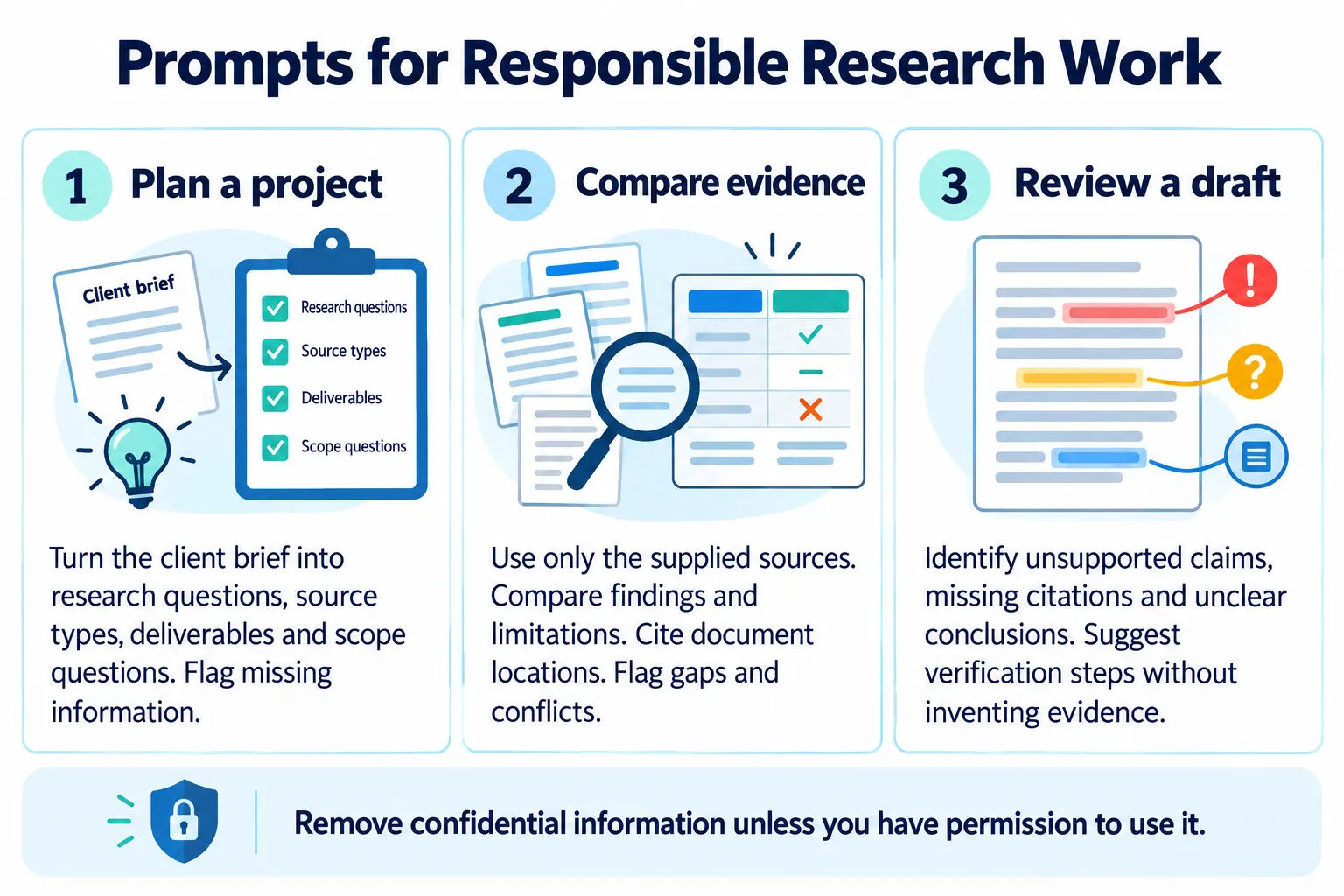
Plan a Project
Turn this client brief into research questions, suitable source types, proposed deliverables and scope questions. Flag missing information. Do not assume facts that the brief does not provide.
Compare Evidence
Use only the supplied sources. Compare findings and limitations in a table. Cite each document and evidence location. Flag gaps and conflicts without inventing missing information.
Review a Draft
Review this draft for unsupported claims, missing citations and unclear conclusions. Suggest source checks and verification steps. Do not create references or evidence that has not been supplied.
For a fuller methodology, see the AOFIRS deep research guide.
8. Improve Professional Visibility and Networking
A researcher needs to be discoverable by potential employers and clients.
Create a consistent professional identity across LinkedIn, freelance marketplaces, and, where appropriate, your own website.
Use descriptive headings such as “Freelance Market Research and Competitor Analysis” rather than vague claims of being an expert in every field.
Publish useful research examples, describe your methods, and include clear contact information.
Professional associations, research communities, industry discussions, and referrals can also introduce relevant opportunities.
Search engine optimization can improve the accessibility and discoverability of a professional website, but it cannot guarantee inquiries or rankings.
9. Manage Projects with a Verifiable Research Workflow
Reliable project delivery is central to professional reputation.
A structured process follows eight stages:
- Client brief
- Research question
- Search strategy
- Evidence collection
- Source verification
- Analysis
- Report
- Delivery
At the beginning of an assignment, confirm what the client needs to know and how the findings will be used.
Record sources, publication dates, and search limitations. Separate observed evidence from interpretation, and disclose AI assistance when required by contractual or professional standards.
Tools such as Notion, Trello, or Asana can help track tasks and deadlines. A spreadsheet or reference manager can maintain the evidence record.
The final report should explain what the research establishes, what remains uncertain, and which conclusions the evidence supports.
10. Build a Sustainable Independent Research Career
After completing assignments, review which services clients value and which projects match your expertise.
Consider developing repeatable offerings such as monthly competitor monitoring, regular industry research or literature updates.
Long-term client relationships can reduce repeated prospecting, but retaining clients depends on service quality, suitable pricing, and consistent communication.
Independence also involves administration, irregular income, client acquisition and contractual responsibilities. Salaried research positions may provide greater stability and access to institutional resources.
Choose the working model that suits your circumstances rather than assuming every researcher must expand into an agency.
How to Start an Independent Online Research Career in 30 Days
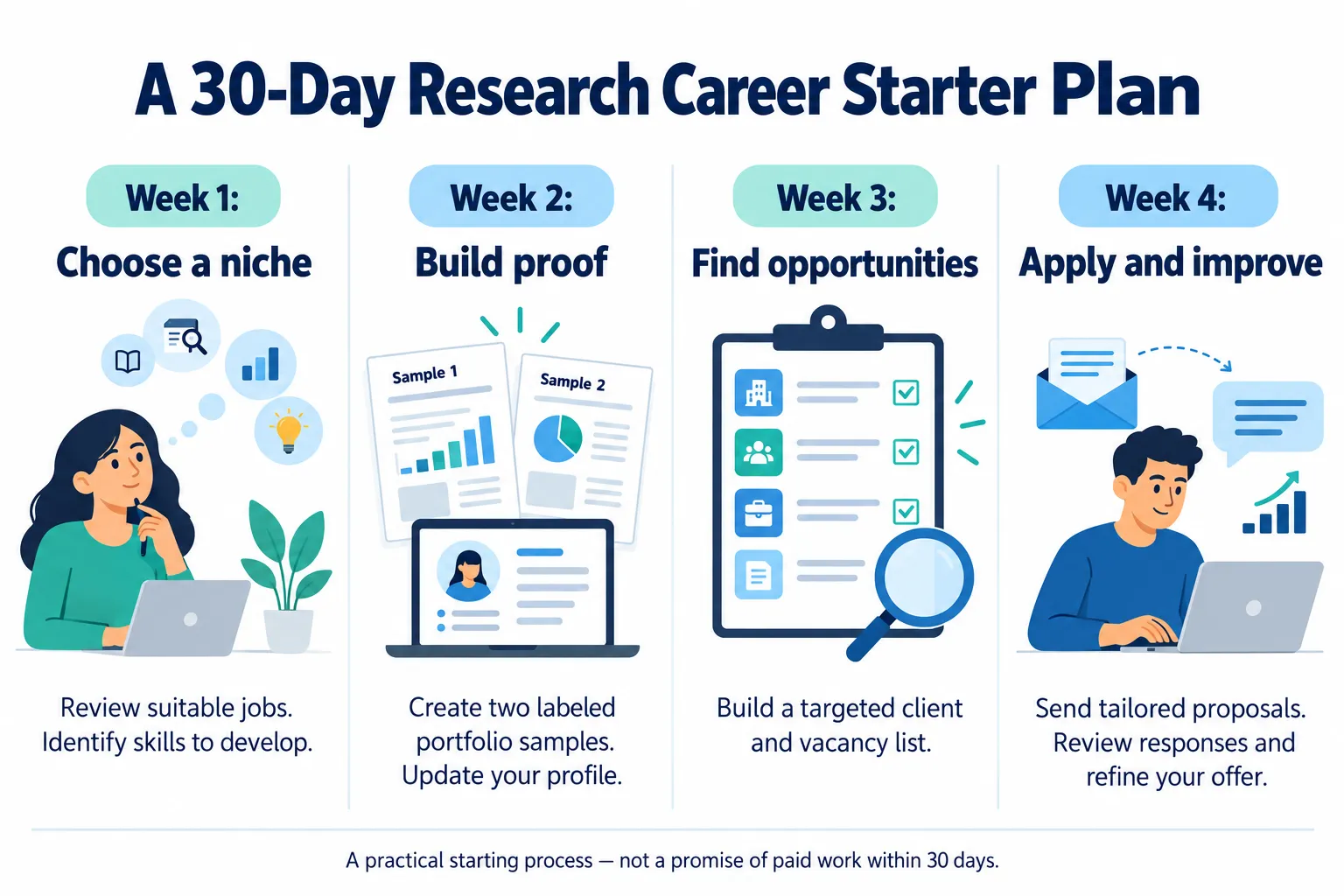
A short action plan can help beginners move from learning to building a credible professional presence.
| Period | Priority | Practical outcome |
|---|---|---|
| Week 1 | Choose a niche, review suitable jobs, and assess research skills | Defined specialization and learning plan |
| Week 2 | Prepare two research samples and update professional profiles | Initial portfolio |
| Week 3 | Identify relevant clients, vacancies, and professional contacts | Targeted opportunity list |
| Week 4 | Submit tailored proposals and review responses | Improved applications and clearer service positioning |
Track the quality of applications rather than only the number submitted. Ask whether each proposal demonstrates an understanding of the client’s actual research problem.
This roadmap establishes a starting process. It does not guarantee employment or paid projects within 30 days.
The Future of Independent Online Research Careers: 2026–2030
AI agents and research automation are likely to influence how researchers collect, organize, and review information.
Some repetitive activities, such as extracting standard details or preparing first-draft summaries, may require less manual effort. However, accurate research still depends on selecting appropriate evidence, recognizing missing information, and evaluating competing interpretations.
The World Economic Forum’s 2025 findings highlight analytical thinking, AI, and technological literacy. They do not provide a dedicated forecast for freelance online researchers.
A reasonable professional strategy is to develop three complementary abilities: domain knowledge, efficient use of research technology, and rigorous source verification.
Future opportunities may involve AI output evaluation, evidence provenance, research quality assurance, and maintaining specialized knowledge collections. These are potential areas of work, not guaranteed growth markets.
Professional Development and Research Certification
Independent researchers can strengthen their abilities through practical assignments, structured training, and continuing education.
AOFIRS offers the CIRS program, covering online search, research methodology, AI in research, data analysis, and internet law and ethics. Review the curriculum against the skills required for your intended work.
Such training may help practitioners organize their knowledge and identify skill gaps. However, certification alone does not establish competence in every specialist field or guarantee employment, employer recognition, or higher earnings.
A strong professional profile combines relevant education with demonstrated research experience, reliable methods, and practical work samples.
Frequently Asked Questions
What does an independent online research specialist do?
An independent online research specialist gathers, verifies, analyzes, and presents digital information for clients or organizations. Projects may include market research, competitor analysis, public-record investigations, literature searches, and fact-checking. The work typically involves defining a question, selecting reliable sources, evaluating evidence, and delivering findings in a usable format.
How can I become a freelance online researcher in 2026?
Start by selecting a research niche and learning the methods commonly used in that field. Create portfolio samples that demonstrate your approach to source discovery, verification, and reporting. Build professional profiles, identify appropriate freelance opportunities, and submit tailored proposals. Develop client communication and project management skills alongside technical research abilities.
Where can I find legitimate online research jobs?
Research opportunities may appear on LinkedIn, Indeed, Upwork, Guru and specialist recruitment websites. Search using several titles, including research analyst, market researcher, competitive intelligence analyst, and research consultant. Verify the employer, review the assignment details and avoid unsolicited offers promising unusually high earnings for minimal work.
Do I need a degree to work as an online research specialist?
Requirements depend on the assignment and employer. Some freelance clients assess portfolios and practical ability, while established analyst positions may require a relevant degree. Specialist work involving scientific research, regulated industries, or advanced statistical methods may need additional qualifications. Check the requirements of the specific role rather than assuming one pathway fits every research career.
What skills are most important for professional online research?
Important skills include advanced search, source verification, research planning, data analysis, and clear reporting. Researchers also benefit from industry knowledge, critical thinking, project management, and familiarity with AI research tools. Being able to explain why evidence is reliable can be more valuable than producing a large collection of unverified links.
How much can an independent online researcher earn?
Earnings vary with specialization, geography, experience, and project scope. BLS reports a May 2025 median annual wage of $78,760 for market research analysts. This is an employee occupation, not a freelance rate benchmark. Independent researchers should price work according to actual costs, scope, and client requirements.
Can artificial intelligence replace freelance online researchers?
AI can automate or accelerate parts of the research process, including summarization, preliminary searching, and information extraction. It remains important to verify sources, resolve contradictions, evaluate methodology, and interpret findings. The effect on individual jobs depends on the work involved. Researchers should develop AI literacy alongside specialist and analytical skills.
Which AI tools are useful for independent researchers?
ChatGPT, Claude and Gemini can support research planning and document-based work. Perplexity can assist with source discovery, while Elicit and Consensus focus on academic research use cases. Capabilities vary by product and subscription. Researchers should select tools according to the assignment and verify significant factual claims against original sources.
How can beginners build a research portfolio without clients?
Complete self-directed research projects using lawful, publicly available information. Choose a specific question, document your search process, compare sources, and produce a short report. Include limitations and verification notes. Clearly identify these examples as independent exercises rather than paid client work or commissioned case studies.
Is professional certification useful for an online research career?
Relevant certification can provide structured learning and help demonstrate commitment to professional development. Its practical value depends on curriculum quality, applicability, and recognition by potential employers or clients. The AOFIRS CIRS program is one option focused on internet research methods. Certification is best supported by practical research experience and a credible portfolio.
Conclusion: Building a Research Career Based on Evidence and Trust
A successful independent online research career depends on solving real information problems rather than simply finding material online.
In 2026, researchers can strengthen their position by developing a specialization, demonstrating reliable methods, using AI appropriately, and delivering clear, evidence-based work.
Begin with a manageable portfolio, target relevant opportunities, and improve your services through practical experience. Professional credibility develops when clients can understand your methods, inspect your evidence and trust the conclusions you provide.