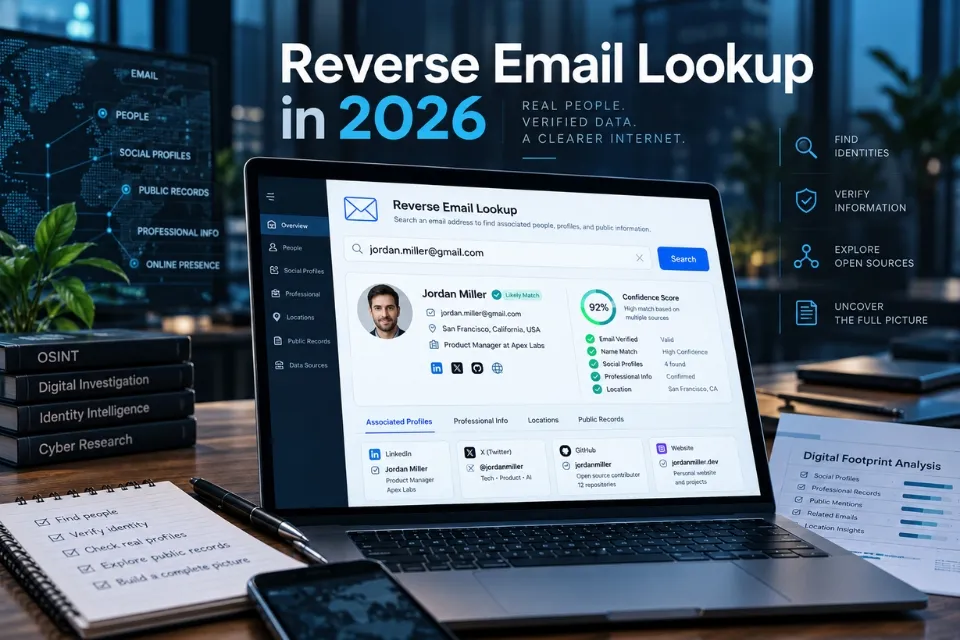
An unfamiliar email address can raise a simple question: Who is behind this message? A reverse email lookup can help answer part of that question by uncovering publicly available information associated with an address, such as a name, username, organization, website, professional profile, or historical reference.
But finding an association is not the same as confirming identity.
A company domain does not prove who controls an individual mailbox. A valid SPF, DKIM, or DMARC result does not identify the person who pressed Send. A people-search result does not prove that the person named in the record currently owns the email account.
A reliable investigation therefore separates four different questions:
| Evidence Type | What It Can Establish | What It Does Not Automatically Establish |
|---|---|---|
| Public association | An email address appears publicly alongside a name, profile, company, document, or username | That the named person currently controls the mailbox |
| Domain ownership | A company or registrant is associated with the email domain | That a particular employee owns or sent from the address |
| Sender authentication | The message passed or failed technical authentication checks such as SPF, DKIM, or DMARC | The real-world identity of the human sender |
| Confirmed identity | Multiple independent and authoritative sources support the connection between the address and a specific person | Absolute proof of who was physically using the account at a specific moment |
This distinction should guide the entire investigation.
Quick Answer: Investigating an Unknown Email Sender
To investigate an unknown email sender, search the exact address, examine the username and domain, look for legitimate public associations, inspect message headers when a message is available, and independently verify important findings. Treat search results and lookup-service matches as leads until other reliable evidence supports the same identity.
What Is a Reverse Email Lookup?
A reverse email lookup starts with an email address and works backward to discover information that may be associated with it.
For example:
alex.jordan@example.commight appear on:
- an organization’s staff page;
- a conference biography;
- a professional profile;
- a public PDF;
- an author page;
- a forum account;
- an archived webpage;
- a people-search database.
Each result tells you something about where the address has appeared.
It does not necessarily tell you who currently controls it.
This is why professional researchers distinguish discovery from verification. AOFIRS’s guide on how professional researchers verify people-search results explains that aggregator records can be incomplete, duplicated, outdated, or drawn from overlapping data sources. The important question is not how many sites repeat an identity, but what independent evidence supports it.
The Four Evidence Levels in an Email Investigation
Many reverse email investigations become unreliable because different types of evidence are blended together. Keeping them separate makes the conclusion much easier to defend.
1. Public Association
A public association means that an email address appears publicly in connection with a person, organization, username, website, document, or profile.
For example, suppose:
jane.morris@example.orgappears on a 2025 conference page beside the name Jane Morris.
That provides evidence that the address was publicly associated with Jane Morris in that context.
It does not necessarily establish:
- that Jane still uses the address;
- that Jane owns the domain;
- that Jane sent a message you received;
- that the conference page was accurate;
- that someone else cannot access the mailbox.
A public association should therefore be described precisely:
The email address is publicly associated with Jane Morris.
That is different from:
Jane Morris owns and controls this email address.
The second statement requires stronger evidence.
2. Domain Ownership
The domain is the part after the @ symbol.
For:
jane@example.orgthe domain is:
example.orgInvestigating the domain can reveal the organization, registrar, technical infrastructure, website, or other contextual information behind it.
If example.org belongs to a university, business, government agency, or nonprofit organization, that can provide a strong organizational clue.
However:
domain ownership ≠ mailbox ownership
An organization may own thousands of email accounts.
Some addresses may also be:
- shared;
- forwarded;
- aliases;
- automated;
- departmental;
- abandoned;
- catch-all addresses.
Knowing who controls example.org does not automatically tell you who currently controls jane@example.org.
3. Sender Authentication
When you have an actual email message, technical authentication provides another layer of evidence.
Relevant mechanisms include:
- SPF;
- DKIM;
- DMARC.
These systems help determine whether a message was authorized or cryptographically validated according to the sending domain’s email configuration.
Authentication can help answer questions such as:
- Did the message originate through infrastructure authorized for this domain?
- Was a DKIM signature valid?
- Did DMARC alignment succeed?
- Does the visible From domain align with authenticated domains?
It still does not answer:
Which human being sent the message?
A legitimately authenticated corporate email may have been sent by an employee, automated system, delegated assistant, shared mailbox user, or attacker who compromised a valid account.
4. Confirmed Identity
Confirmed identity requires substantially more evidence.
A strong identity conclusion may involve:
exact email + name + organization + first-party source + independent corroboration
For example, confidence becomes much stronger if:
- the exact address appears on the person’s employer website;
- an independent conference biography lists the same person and address;
- professional details match across the sources;
- the information is recent;
- no credible evidence contradicts the association.
Even then, researchers should distinguish between:
confirming the likely identity associated with an address
and:
proving who sent a particular email at a particular time
Those are not always the same thing.
What Can an Email Address Reveal?
An email address can contain more clues than it initially appears to.
Depending on the address and how it has been used publicly, researchers may discover:
- a possible full name;
- a username or handle;
- an organization;
- a professional role;
- an employer;
- a personal or business website;
- a public social profile;
- publications;
- conference appearances;
- public contact information;
- historical references.
Consider:
rachel.wong@northstaranalytics.comThe domain suggests a possible connection to Northstar Analytics.
The local part suggests a person named Rachel Wong.
Neither conclusion should be accepted without verification.
The investigation should now ask:
- Does Northstar Analytics actually control the domain?
- Does Rachel Wong work there?
- Is this exact email address publicly connected to her?
- Is the information current?
- Are independent sources consistent?
That converts a guess into a research process.
How to Investigate an Unknown Email Sender
A structured investigation should proceed from low-risk public discovery toward stronger verification.
Step 1: Examine the Address
Break the email into:
Local part
rachel.wongDomain
northstaranalytics.comThe local part might represent:
- a person’s name;
- initials;
- nickname;
- employee identifier;
- brand;
- username.
The domain might represent:
- an employer;
- university;
- nonprofit;
- government body;
- personal website;
- commercial email provider;
- disposable-email service.
Do not assume that either component is truthful.
An attacker can create an address designed to look believable.
Step 2: Search the Exact Email Address
Search the complete address in quotation marks:
"rachel.wong@northstaranalytics.com"Exact-match searches can help identify pages where the complete address appears rather than pages containing only similar words.
Then add contextual terms:
"rachel.wong@northstaranalytics.com" company
"rachel.wong@northstaranalytics.com" conference
"rachel.wong@northstaranalytics.com" profile
"rachel.wong@northstaranalytics.com" author
"rachel.wong@northstaranalytics.com" filetype:pdf
Quotation marks are commonly used to request exact-word or exact-phrase matches in search systems.
The purpose is not to accumulate as many results as possible.
Ask:
- Where does the address appear?
- Who published the page?
- When was it published?
- What does the page actually say?
- Is the source first-party?
- Can another source corroborate it?
Professional searching increasingly involves query design, source selection, primary-source research, verification, and documentation rather than simply reviewing the first search results. AOFIRS explores this methodology in its guide to advanced internet search skills.
Step 3: Investigate the Username
If the full email address produces limited results, examine the local part separately.
For:
alex.hughes87@example.comsearch:
"alex.hughes87"You might also try:
"alex.hughes87" profile
"alex.hughes87" developer
"alex.hughes87" company
or relevant site searches.
This technique is often called username pivoting.
AOFIRS’s guide on finding someone using only a username explains how public username reuse can connect profiles, forums, blogs, developer communities, and other parts of an online footprint.
But username reuse must be interpreted carefully.
Finding the same handle on three websites does not prove that the same person owns all three accounts.
Look for corroborating details such as:
- matching full name;
- employer;
- location;
- website;
- occupation;
- biography;
- profile photograph;
- other identifiers.
A useful principle is:
username match = lead
username + matching context + independent evidence = stronger association
Step 4: Investigate the Domain
Business and organizational email addresses often provide more context than addresses hosted by general consumer providers.
Suppose the address is:
m.turner@researchgroup.orgVisit the organization’s official website.
Search for:
site:researchgroup.org "M Turner"
site:researchgroup.org "m.turner@researchgroup.org"
site:researchgroup.org "Michael Turner"
Relevant first-party evidence may appear on:
- staff pages;
- leadership biographies;
- contact pages;
- publications;
- press releases;
- reports;
- PDF documents;
- conference pages.
An official staff page showing Michael Turner at Research Group supports his organizational affiliation.
A separate document that publishes the exact email address strengthens the association further.
Still, the evidence should be described correctly:
The address is publicly associated with Michael Turner at Research Group.
It does not necessarily prove:
Michael Turner personally controls the mailbox today.
Step 5: Check Domain Registration Information
Researchers may also examine domain-registration data.
For generic top-level domains, ICANN states that the Registration Data Access Protocol, or RDAP, became the definitive source for gTLD registration information on January 28, 2025, replacing sunsetted WHOIS services for that purpose.
RDAP may provide information about:
- registrar;
- registration status;
- registration dates;
- nameservers;
- publicly available registrant information.
Personal registration information may be redacted or unavailable.
Most importantly, domain-registration data describes the domain, not necessarily the person using a mailbox on that domain.
If an organization owns:
example.comthat does not establish who operates:
finance@example.comor:
jane@example.comSearch Engines as Reverse Email Research Tools
Search engines remain useful because email addresses can appear across many different public sources.
Relevant sources may include:
- organizational websites;
- PDFs;
- professional directories;
- conference pages;
- academic publications;
- blog archives;
- forums;
- press releases;
- public documents.
Different retrieval systems may expose different material.
A result missing from one search engine may appear elsewhere.
AOFIRS’s research report on information retrieval in the age of AI examines how modern retrieval now combines traditional keyword search, semantic discovery, conversational systems, and AI-assisted research while still requiring source validation.
That distinction matters for reverse email research.
Search technology can expand discovery.
It cannot remove the need to verify what was discovered.
Reverse Email Lookup Tools: Know What the Tool Is Actually Checking
Not every service described as an email lookup tool answers the same question.
Some services check:
Is this mailbox technically deliverable?
Others attempt to answer:
What person or organization is publicly associated with this address?
Others examine:
Has this address appeared in known breach data?
And message-analysis tools may ask:
Was this email technically authenticated?
These should never be treated as interchangeable.
Email Verification Is Not Identity Verification
A technical email verifier may check:
- syntax;
- domain existence;
- MX records;
- mail-server responses;
- disposable addresses;
- catch-all behavior.
This can help determine whether an address appears capable of receiving email.
It cannot necessarily identify the person behind it.
A valid result means roughly:
This address appears deliverable.
It does not mean:
This address belongs to John Smith.
This difference should remain explicit throughout any professional investigation.
People-Search Results Are Leads
People-search services sometimes connect email addresses with:
- names;
- phone numbers;
- addresses;
- relatives;
- employers;
- other identifiers.
These records can provide useful investigative leads.
But aggregated data may be:
- outdated;
- duplicated;
- incorrectly merged;
- incomplete;
- copied between providers.
Before accepting a result, ask:
- What is the source?
- When was it updated?
- Can the original record be identified?
- Are other websites merely repeating it?
- Is an authoritative source available?
- Does contradictory evidence exist?
This is why multiple people-search websites showing the same name do not automatically count as multiple confirmations.
Social Media Research
Public social and professional profiles can sometimes help connect an email-derived username with a broader digital identity.
A public profile may reveal:
- name;
- employer;
- profession;
- personal website;
- biography;
- location;
- other usernames.
However, researchers should not rely on outdated advice claiming that every platform allows direct email-address searches.
Platform discovery systems, privacy settings, APIs, and account-search functionality change.
A stronger method is to examine legitimate public connections.
For example:
natalie.rivera91appears as an email username.
The same handle appears on a professional profile.
That profile links to a personal website.
The website identifies Natalie Rivera as working for the organization associated with the email domain.
This creates several connected signals.
It still requires corroboration.
AOFIRS’s Social Media Intelligence 2026 highlights both the research value of social platforms and the need to account for misinformation, unreliable identity signals, and platform-specific limitations.
Investigating Business Email Addresses
A corporate address provides a natural research path because the domain can be connected with an organization.
Suppose you receive:
d.miller@horizonconsulting.comFirst determine whether Horizon Consulting controls the domain.
Then investigate whether someone with a matching name or initial appears in legitimate first-party sources.
Useful evidence may include:
- staff biographies;
- company reports;
- press releases;
- conference biographies;
- professional publications;
- presentations;
- current contact pages.
Suppose the company website lists:
Daniel Miller, Senior Consultant
and an independent conference biography lists:
Daniel Miller — d.miller@horizonconsulting.com
That creates a much stronger public identity association.
But if you received a suspicious message from that address, another question remains:
Did Daniel Miller actually send this message?
For that, message authentication and header analysis become relevant.
Email Headers vs Reverse Email Lookup
Reverse email lookup investigates:
Who or what is publicly associated with this address?
Email-header analysis investigates:
What technical evidence exists about this particular message?
When investigating a suspicious sender, both may be necessary.
Important header fields can include:
- From;
- Reply-To;
- Return-Path;
- Received;
- Message-ID;
- Authentication-Results;
- SPF;
- DKIM;
- DMARC.
AOFIRS’s research on email verification, OSINT, phishing detection, and header analysis specifically examines message-level investigation, including spoofing, delivery routes, timestamps, authentication, and sender verification.
A companion AOFIRS learning resource, Beyond the Inbox: The Forensic Guide to Email Verification in the AI Era, provides a structured overview of email authentication, suspicious-message analysis, digital identity verification, and AI-assisted email investigation.
SPF: Was the Sending Server Authorized?
SPF, or Sender Policy Framework, allows a domain to specify which mail servers are authorized to send email on its behalf.
An SPF pass can support the conclusion that the sending infrastructure was authorized according to the relevant SPF policy.
It does not prove the identity of the human sender.
A compromised corporate account can still send mail through legitimate infrastructure.
DKIM: Was the Message Cryptographically Signed?
DKIM, or DomainKeys Identified Mail, allows an email system to apply a cryptographic signature to outgoing mail.
A valid DKIM result can provide evidence that:
- a domain signed the message;
- relevant signed content has not been altered after signing.
Again:
valid DKIM ≠ confirmed human identity
The domain may have authenticated the message while the actual person using the account remains unknown.
DMARC: Does Authentication Align With the Visible Domain?
DMARC builds on SPF and DKIM and evaluates alignment with the domain shown to the recipient.
This can help identify spoofing and domain-impersonation problems.
But a DMARC pass establishes technical alignment, not human authorship.
A legitimate employee, automated system, shared mailbox, compromised account, or attacker using valid credentials could all potentially send technically authenticated mail.
From, Reply-To, and Return-Path
Researchers should also compare:
From: what the recipient sees as the sender.
Reply-To: where replies are directed.
Return-Path: where certain delivery-related responses are sent.
Unexpected differences can be worth investigating.
For example:
From:
accounts@trustedcompany.comReply-To:
paymentdesk@unrelated-domain.exampledoes not automatically prove fraud.
But it creates a reason to investigate further.
Received Headers
Received headers can document parts of the message’s routing path between mail systems.
They can sometimes help identify:
- mail servers;
- routing sequence;
- timestamps;
- infrastructure.
They should be interpreted carefully.
Not every IP address identifies the human sender, and modern webmail, privacy infrastructure, corporate gateways, and cloud email systems can prevent a header from exposing the sender’s personal device or location.
Public Association vs Sender Authentication
These evidence types can support completely different conclusions.
Suppose:
anna@company.comappears on Anna’s official staff biography.
That establishes a strong public association.
Now suppose you receive a message from:
anna@company.comand the message passes SPF, DKIM, and DMARC.
That provides sender-authentication evidence.
Together, these facts support a stronger conclusion than either alone.
But they may still not prove:
Anna personally typed and sent the message.
Her account could be:
- delegated;
- shared;
- automated;
- compromised.
This is why evidence must be described at the level it actually supports.
Public Association vs Domain Ownership
Another common mistake is treating domain registration as identity evidence.
Suppose:
ceo@companyexample.comcontacts you.
RDAP confirms that companyexample.com is associated with Company Example.
That helps establish domain context.
It does not establish:
- who operates
ceo@companyexample.com; - whether the person is actually the CEO;
- whether that mailbox is shared;
- whether the sender is authorized to represent the company.
Domain research and individual identity verification should remain separate stages.
AI-Assisted Reverse Email Research
AI can help investigators process large amounts of information more efficiently.
Useful tasks include:
- extracting names;
- identifying organizations;
- comparing documents;
- grouping repeated identifiers;
- creating timelines;
- detecting inconsistencies;
- suggesting search queries;
- summarizing long records.
However, AI-generated identity matches should never be treated as evidence by themselves.
AI systems may:
- merge two people with similar names;
- infer a relationship not stated by any source;
- rely on stale information;
- misread context;
- fabricate URLs;
- produce unsupported citations.
For example, an AI tool might find:
Sarah Williams + Acme Corporation
in one document and:
s.williams@example.com
in another, then incorrectly conclude that both refer to the same Sarah Williams.
That is an inference.
It still needs verification.
A useful rule is:
AI can organize evidence. AI should not replace evidence.
How to Verify an Apparent Email Identity
The strongest reverse email investigations rely on multiple independent signals.
A useful model is:
Email address + name + contextual match + independent evidence + authoritative source
Example
Suppose you are investigating:
michael.lee@samplefirm.comYou find:
- Sample Firm owns the domain.
- The company’s current team page lists Michael Lee.
- A conference biography independently lists
michael.lee@samplefirm.com. - A recent company PDF associates the same address with Michael Lee.
- No credible source contradicts the identification.
This creates a strong public association between Michael Lee and the address.
If the question is:
Who is publicly associated with this address?
you may now have high-confidence evidence.
If the question is:
Did Michael Lee send a particular suspicious email yesterday?
you still need to examine the message itself.
Evaluate Evidence by Type
| Evidence | Supports | Does Not Prove |
|---|---|---|
| Exact email on official biography | Strong public association | Current mailbox control |
| Domain registration | Domain ownership/context | Individual mailbox ownership |
| Matching username | Possible identity connection | Same person across platforms |
| People-search record | Investigative lead | Confirmed identity |
| SPF pass | Authorized sending infrastructure | Human sender |
| DKIM pass | Valid domain signature | Human sender |
| DMARC pass | Domain authentication/alignment | Human sender |
| Message headers | Technical routing/authentication evidence | Real-world identity by themselves |
| Multiple independent primary sources | Strong identity association | Who physically used the account at a specific time |
Check Source Independence
A common research mistake is assuming:
five matching webpages = five sources
They may all have copied the same record.
Imagine five people-search services list:
Robert Davis, Boston
If all five obtained the information from the same commercial database, you effectively have one underlying source repeated five times.
Try to establish whether evidence is genuinely independent.
Stronger combinations might include:
- official company page;
- conference organizer;
- government record where appropriate;
- independent publication;
- professional organization.
AOFIRS’s people-search verification methodology emphasizes corroboration, source provenance, recency, discrepancies, and independent evidence rather than merely counting database matches.
Check Recency
Identity data changes quickly.
An email association published in 2018 may have been correct in 2018.
It does not necessarily establish the situation in 2026.
Employees leave companies.
Domains change hands.
Accounts become inactive.
Telephone numbers are reassigned.
Websites remain indexed long after circumstances change.
Always distinguish:
historical association
from:
current association
Look for Contradictory Evidence
Do not only search for material confirming your initial theory.
Suppose a directory says:
j.wilson@example.com = Jane Wilsonbut a current company document identifies:
j.wilson@example.com = James WilsonThat contradiction needs investigation.
Professional verification includes searching for evidence that could disprove your assumption.
If important conflicts cannot be resolved, lower the confidence of the conclusion.
Confidence Levels for Reverse Email Research
Using confidence levels can prevent uncertain information from being overstated.
Low Confidence
Examples:
- one username match;
- one people-search result;
- one outdated page;
- an AI-generated connection;
- an email pattern guess.
Conclusion:
Possible association only.
Moderate Confidence
Examples:
- matching name;
- consistent employer;
- same username;
- several independent secondary sources.
Conclusion:
Probable association, additional verification desirable.
High Confidence
Examples:
- exact email address;
- full name;
- current organization;
- first-party source;
- independent authoritative corroboration;
- no significant contradictory evidence.
Conclusion:
Strongly supported public identity association.
High confidence still does not necessarily prove who operated the account during a specific email exchange.
Why Reverse Email Results Can Be Wrong
False matches often arise from predictable problems.
Outdated Records
An address may still appear beside a former employee years after that person left.
Shared Addresses
Addresses such as:
support@example.com
press@example.com
billing@example.com
may be used by multiple employees.
Aliases
One person may have several addresses routing to the same mailbox.
Forwarding
A public address may forward to another internal or external mailbox.
Catch-All Domains
Some mail servers accept messages sent to many or all addresses at a domain.
This can make technical email-validation results less useful for identifying real mailboxes.
Disposable Addresses
Temporary email addresses may contain little reliable identity information.
Privacy Relay Addresses
Relay services can intentionally hide a user’s underlying email address.
Recycled Usernames
The same username can belong to unrelated people on different platforms.
Compromised Accounts
A real person’s legitimate account may be controlled temporarily by an attacker.
Spoofed Senders
The visible From address may not accurately represent the sending source.
Duplicate Datasets
Several search tools may repeat the same incorrect information.
Free vs Paid Reverse Email Lookup
Many useful investigation steps can be completed using legitimate free sources:
- search engines;
- company websites;
- public documents;
- professional profiles;
- username searches;
- RDAP;
- email headers;
- public publications.
Paid databases may improve discovery speed or provide access to additional aggregated records.
Payment does not guarantee accuracy.
A paid report should still be treated as a source requiring evaluation.
The useful question is not:
Did I pay for this data?
It is:
Can I independently verify it?
Breach Information and Email Research
An email address may sometimes appear in a legitimate breach-notification database.
This may show that the address appeared in data associated with a known security incident.
It does not necessarily establish:
- who owned the address;
- who owns it today;
- whether the person’s real identity was used;
- whether the account remains active;
- whether a particular suspicious message came from that person.
Breach exposure should therefore be treated as historical security context rather than standalone identity proof.
Researchers should never attempt to obtain passwords, stolen credentials, private communications, or unauthorized account access.
Privacy and Ethical Boundaries
Reverse email research can involve personal information.
That does not mean every discoverable detail is necessary or appropriate to collect.
A responsible investigation begins with a defined question.
For example:
Does this sender appear to represent Company X?
Answering that question may require only:
- company affiliation;
- domain evidence;
- public contact details;
- sender authentication.
There may be no legitimate reason to collect:
- relatives;
- home addresses;
- personal relationships;
- unrelated accounts.
Collect only what is relevant to the research purpose.
Researchers should also consider:
- applicable privacy laws;
- platform terms;
- contractual restrictions;
- data-protection obligations;
- permissible-purpose requirements;
- regulated screening rules.
In the United States, for example, the Fair Credit Reporting Act places restrictions on obtaining and using consumer reports for covered purposes. The Consumer Financial Protection Bureau states that obtaining a consumer report without a permissible purpose is prohibited.
Reverse email research should never be used to facilitate:
- stalking;
- harassment;
- impersonation;
- credential theft;
- password attacks;
- doxxing;
- unauthorized access;
- unlawful acquisition of private information.
A Professional Unknown-Sender Investigation Workflow
A repeatable methodology reduces false conclusions.
Define
Decide what you are actually trying to establish.
Possible questions include:
- Is the email technically valid?
- What organization is associated with the domain?
- Who is publicly associated with the address?
- Is this specific message authenticated?
- Can the sender’s claimed identity be independently corroborated?
Do not treat these as one question.
Discover
Search the exact address and collect legitimate public leads.
Do not declare an identity yet.
Pivot
Investigate relevant clues such as:
- username;
- full name;
- company;
- domain;
- professional role;
- public website.
Authenticate
If an actual message is available, examine:
- headers;
- SPF;
- DKIM;
- DMARC;
- sender-domain alignment;
- Reply-To differences;
- routing evidence.
Authentication answers technical questions.
Keep it separate from identity attribution.
Corroborate
Find sources that do not depend on the same underlying dataset.
Compare important identifiers.
Verify
Prefer:
- first-party sources;
- primary records;
- current official pages;
- authoritative documents.
Document
Record:
- source URL;
- publication date;
- access date;
- evidence discovered;
- what the evidence supports;
- what it does not support;
- contradictory information.
Assess
Assign an appropriate confidence level.
A good research conclusion is not necessarily:
We identified the owner.
It may be:
The available evidence strongly supports a public association between this address and Jane Miller, but the evidence does not independently establish who operated the mailbox when the message was sent.
That is a more precise and defensible conclusion.
Common Reverse Email Investigation Mistakes
Treating a Search Result as Identity Proof
Search results show associations.
They do not automatically prove account control.
Confusing Domain Ownership With Sender Identity
A legitimate corporate domain can contain thousands of mailboxes.
Treating SPF, DKIM, or DMARC as Human Identification
Authentication validates aspects of the message and domain.
It does not identify the person behind the keyboard.
Assuming a Deliverable Email Has a Known Owner
Email validation and identity verification are separate processes.
Trusting One People-Search Database
Aggregators can contain outdated or merged records.
Counting Duplicate Records as Independent Evidence
Trace the source whenever possible.
Assuming Username Reuse Proves Identity
Use contextual identifiers and corroboration.
Ignoring Dates
Historical information should not automatically be presented as current.
Trusting AI-Generated Identity Matches
Return to the underlying source.
Ignoring Contradictory Evidence
Contradictions often reveal false identity matches.
Reverse Email Investigation Checklist
Before concluding that an unknown sender has been identified, ask:
- Did I search the exact email address?
- Did I investigate the username separately?
- Did I identify the organization behind the domain?
- Am I distinguishing domain ownership from mailbox ownership?
- Did I locate a direct public association?
- Is the association current?
- Did I use independent sources?
- Am I relying on duplicated aggregator data?
- Do I have an actual message to analyze?
- Did I examine SPF, DKIM, and DMARC where relevant?
- Am I distinguishing authentication from human identity?
- Could the mailbox be shared or delegated?
- Could the account be compromised?
- Could the From address be spoofed?
- Did I investigate contradictory evidence?
- Does my conclusion say only what the evidence actually supports?
If several answers remain uncertain, the sender should not be described as definitively identified.
Frequently Asked Questions
What is reverse email lookup?
Reverse email lookup is the process of starting with an email address and searching for publicly available information associated with it, such as a possible name, username, company, website, or professional profile. A lookup result should be treated as a research lead unless independent evidence verifies the association.
Can you find someone’s identity from an email address?
Sometimes. An address may be publicly connected with a name, employer, profile, publication, or other identifying information, but those associations should be independently verified before claiming that a particular person owns the account.
Does owning the domain prove who owns the email address?
No. Domain ownership can identify the organization or registrant associated with the domain, but individual mailboxes may belong to employees, teams, automated systems, aliases, or shared accounts.
Does SPF prove who sent an email?
No. SPF can help determine whether sending infrastructure was authorized under the domain’s SPF policy, but it does not identify the human being who composed or sent the message.
Does DKIM prove the sender’s identity?
No. DKIM provides cryptographic evidence associated with a signing domain and message integrity, but it does not independently prove the real-world identity of the person using the account.
Can email headers identify an unknown sender?
Headers can provide important technical evidence about routing, authentication, domains, timestamps, and mail infrastructure. They usually need to be combined with other evidence before making a real-world identity attribution.
Are reverse email lookup services accurate?
Accuracy varies. People-search and data-aggregation services can contain outdated, duplicated, incomplete, or incorrectly matched records, so consequential information should be verified against independent and preferably authoritative sources.
What is the strongest way to verify an email identity?
Look for multiple independent signals, including the exact email address, matching name, organizational context, first-party documentation, current information, and independent corroboration. If investigating a particular message, analyze sender authentication separately because public identity association and message authentication answer different questions.
Conclusion
Reverse email lookup is most reliable when it is treated as a structured investigation rather than a shortcut for naming an unknown sender. Search engines, usernames, professional profiles, company records, domain-registration data, people-search services, AI tools, and message headers can all contribute evidence, but they answer different questions. A public association can connect an address with a person, domain research can identify the organization behind the address, and SPF, DKIM, or DMARC can provide technical evidence about a message. None of those signals should automatically be described as confirmed human identity.
A defensible conclusion comes from combining independent evidence and describing exactly what that evidence proves. Researchers should verify important associations with current, first-party or authoritative sources, investigate conflicting information, and keep sender authentication separate from identity attribution. The central rule remains simple: finding an association is discovery; establishing who is actually behind an email requires verification.