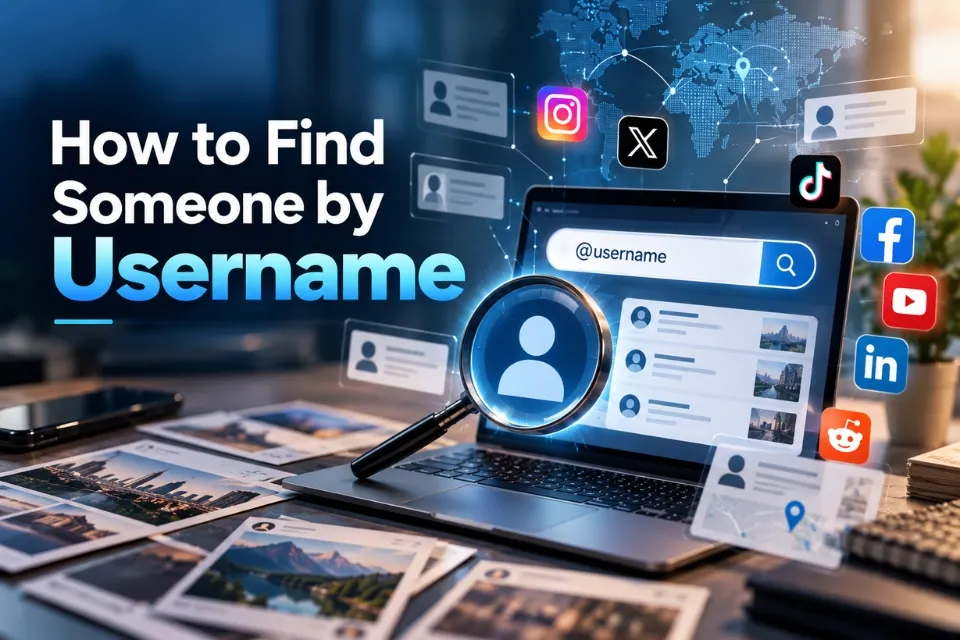
A username can be a useful starting point for finding a person’s publicly accessible online accounts, but it is not proof of identity. A professional username investigation combines enumeration, username variants, search-engine discovery, profile comparison, historical research, verification, and careful documentation before connecting accounts to the same person.
This approach follows the broader principle used in professional OSINT research and verification workflows: finding information is only the collection stage. A researcher still has to evaluate the source, corroborate important details, document contradictions and decide how much confidence the available evidence actually supports.
The central rule is simple:
A matching username is a lead, not an identity match.
Two unrelated people can use the same handle. A username can also be recycled, copied, impersonated, changed, or automatically assigned. An OSINT username search therefore isn’t simply about finding matching strings. It is to determine which results, if any, independent evidence supports.
This guide explains a practical username investigation workflow for 2026 using publicly accessible information.
Quick Answer: How to Research a Username
Preserve the original handle, search it across engines and platforms, and inspect candidate profiles. Compare independent details and direct profile links, check contradictions, and document your confidence before connecting accounts to one person.
A matching username is a lead, not proof of identity.
What Is Username Enumeration?
Username enumeration is the process of checking whether the same username appears across multiple websites, platforms or online services.
For example, if the starting username is northstar27, a researcher might check whether that exact handle exists on:
- GitHub
- X
- TikTok
- YouTube
- Twitch
- forums
- gaming communities
- developer platforms
- blogging services
- specialist communities
Enumeration is primarily a discovery technique.
It answers:
Where does this username appear?
It does not automatically answer:
Do all these accounts belong to the same person?
That second question requires verification.
This distinction is central to professional OSINT. AOFIRS’ broader 2026 OSINT methodology describes open-source intelligence as structured collection, verification, analysis and reporting of lawfully accessible information rather than simple information gathering. For username investigations, that means enumeration should generate candidates, while corroboration and source evaluation determine whether any of those candidates can reasonably be connected.
Why Usernames Can Be Valuable OSINT Identifiers
People frequently create usernames from something meaningful or memorable to them. A handle may be based on a name, nickname, hobby, profession, location, gaming identity, year, organization or phrase.
Some users also reuse the same or similar handle on several services.
This can make usernames useful for connecting public digital traces, including:
- public social profiles
- forum contributions
- GitHub activity
- gaming accounts
- creator profiles
- blog comments
- community memberships
- personal websites
- archived pages
- public posts
- linked profiles
But reuse should never be assumed.
A handle such as alex1988 has far less identifying value than an unusual username appearing alongside matching biographical information.
The rarer the username, the more useful it may be for discovery. Even an unusual username, however, still requires corroboration. AOFIRS’ guidance on verifying people-search results similarly stresses cross-referencing results rather than relying on one database or identifier, particularly when different sources may contain outdated, incomplete or conflicting information.
Step 1: Preserve the Exact Username Before Searching
Start by recording exactly what you know.
Do not immediately alter the username or search dozens of variations.
Record:
- exact spelling
- capitalization
- numbers
- underscores
- periods
- hyphens
- source platform
- profile URL, if available
- display name
- date discovered
- context in which the username appeared
For example:
Observed username: nora_finch92
Source: public forum profile
Observed: September 30, 2026
Keeping the original identifier separate from researcher-generated variations prevents an important OSINT problem: gradually treating your own hypothesis as if it were original evidence.
This preservation step also supports the auditable research-trail approach described in AOFIRS’ guide to advanced internet search skills. Professional researchers record searches, URLs, dates, important evidence, conflicting findings and limitations so another person can understand how a conclusion was reached.
Step 2: Search the Exact Username Across Search Engines
Before using specialist tools, search the exact username with conventional search engines.
Start with quotation marks:
"nora_finch92"Exact-match searching can reveal indexed references that are not obvious from platform searches.
Then add context:
"nora_finch92" profile
"nora_finch92" forum
"nora_finch92" developer
"nora_finch92" photography
"nora_finch92" London
You can also restrict the search to a specific domain:
"nora_finch92" site:reddit.com
"nora_finch92" site:github.com
"nora_finch92" site:youtube.com
The site: operator narrows results to a chosen domain, while quotation marks help preserve an exact username string. Other operators can help remove noise or locate usernames within titles, URLs and page text. AOFIRS’ 2026 Google search operator reference covers exact phrases, exclusions, intext:, intitle:, inurl: and related filters that can make username discovery more precise.
Do not limit the investigation to one search engine. Different engines maintain different indexes, rankings and retrieval systems, so an account or old reference absent from one engine may still appear in another.
The AOFIRS Search Query Matrix for cross-engine research extends this idea by comparing query syntax and retrieval methods across different engines. For username OSINT, that means the research question should stay consistent while the researcher adapts the query to the system being searched rather than expecting identical results everywhere.
Step 3: Enumerate the Username Across Multiple Platforms
Manual searching becomes inefficient when you need to check a username across dozens or hundreds of websites.
Username-enumeration tools automate the discovery stage.
WhatsMyName
WhatsMyName is a community-maintained username-enumeration dataset used to check whether a username appears across large numbers of websites.
It is useful for broad initial discovery without manually searching every platform.
A returned result should still be opened and inspected.
Sherlock
Sherlock checks supported social networks and other websites for the existence of a specified username.
It is useful for quickly producing a candidate list of matching handles.
Again, an automated “found” result should be treated as a candidate account, not a verified identity.
Maigret
Maigret performs large-scale username enumeration and can collect additional information from discovered public profile pages.
Large-scale enumeration is useful when the researcher needs broad coverage, but the number of results should never be confused with the number of accounts actually attributable to one person.
The Important Rule for Enumeration Tools
Never report:
“The person has 37 accounts.”
when the tool actually established only:
“The username returned possible matches on 37 services.”
Those statements mean very different things.
Enumeration produces candidates.
Verification establishes what the candidates mean.
That distinction mirrors the AOFIRS principle that effective OSINT depends on method rather than the number of tools used. Collecting more candidate accounts does not improve an investigation unless those results are subsequently evaluated, corroborated and documented.
Step 4: Search Username Variants
An exact username search may miss related accounts because people alter handles when their preferred username is unavailable.
Suppose the known handle is:
nora_finchReasonable variations might include:
norafinchnora.finchnora-finchnorafinch92nfinchfinchnoranora_fnorafinch_
Also consider transformations involving:
- removed separators
- added separators
- initials
- shortened names
- common number suffixes
- birth years, when independently known and appropriate to use
- location abbreviations
- professional abbreviations
- old aliases already supported by evidence
This is essentially query expansion. AOFIRS’ material on advanced query formulation and search vocabulary recommends identifying synonyms, alternate terminology, previous names, spelling variants and related terms before narrowing a search. In username research, the same principle can uncover handles that have evolved without treating every variation as belonging to the target.
Do not generate hundreds of speculative usernames and then treat every hit as related.
Variants widen discovery. They also sharply increase false positives.
Maintain a distinction in your research notes:
Observed identifier: directly found in a source.
Generated variant: created by the researcher for exploratory searching.
That small documentation habit prevents weak assumptions from contaminating later analysis.
Step 5: Search the Major Platforms Directly
Search important platforms individually after enumeration.
Depending on the investigation, relevant services may include:
- X
- TikTok
- YouTube
- GitHub
- Twitch
- Medium
- Substack
- gaming communities
- specialist forums
Direct searches matter because some profiles are poorly indexed by general search engines.
The reverse is also true. Search engines may preserve references to pages that are difficult to locate through a platform’s native search.
Use both approaches.
Social-media investigation is one branch of OSINT commonly described as SOCMINT. The AOFIRS 2026 OSINT guide notes that researchers may examine public account histories, statements, relationships between public accounts and patterns of content distribution, but these traces still require source evaluation and contextual verification before they are used as intelligence.
Do not attempt to bypass private profiles, authentication controls or technical access restrictions. OSINT concerns lawfully accessible information, not defeating controls designed to keep information private.
Step 6: Compare the Candidate Accounts
Finding the same handle twice is only the start.
Now ask whether the candidate accounts contain independent signals connecting them.
Useful comparison points include:
Display Name
Do the accounts use the same real name, nickname or distinctive pseudonym?
A common name provides limited evidence. An unusual matching name may carry more weight.
Biography
Compare:
- profession
- education
- employer
- location
- interests
- organizations
- recurring phrases
- personal websites
Repeated distinctive details are more useful than broad statements such as “love travel and coffee.”
Profile Images
The same profile photograph can strengthen a connection, but it is not proof.
Images can be:
- copied
- stolen
- reposted
- used by fan accounts
- generated by AI
- shared across unrelated accounts
Reverse-image searching can help determine whether an avatar has appeared elsewhere, whether an older version exists or whether the image has been reused in unrelated contexts. AOFIRS’ 2026 guide to reverse-image and visual search tools recommends combining independent systems such as Google Lens, TinEye, Bing Visual Search and Yandex because no single visual-search index provides complete coverage.
A matching picture should therefore be treated as another corroborating signal, not as automatic identification.
Websites and Link Pages
A public personal website that links directly to two different social profiles provides stronger evidence than matching usernames alone.
Likewise, examine public:
- personal websites
- portfolio pages
- Linktree-style pages
- author pages
- company biographies
- GitHub profile links
Self-declared cross-links are particularly valuable because they establish an explicit relationship between accounts.
Location
Matching location information can support an identification, especially when combined with other evidence.
But “New York,” “London” or “Toronto” is weak evidence by itself.
Employment and Education
Matching employers, universities, job roles or professional specialties can strengthen a hypothesis when independently visible on more than one source.
Interests and Communities
Distinctive combinations matter more than generic interests.
Two profiles mentioning photography provide little evidence.
Two profiles mentioning the same obscure camera, local climbing club and niche software project may deserve closer examination.
Step 7: Test for Contradictory Evidence
OSINT verification should not become an exercise in collecting only evidence that supports your first theory.
Search for contradictions.
Ask:
- Are the locations incompatible?
- Do the ages appear inconsistent?
- Are the profiles active simultaneously in clearly different contexts?
- Do profile photographs depict different people?
- Do they use different real names?
- Are languages inconsistent?
- Does one account explicitly link to someone else?
- Does the timeline make the supposed connection impossible?
Contradictory evidence is often more valuable than another superficial match.
A strong investigation tries to disprove its own hypothesis before accepting it.
This reflects the verification-first model described in AOFIRS’ OSINT guidance, which recommends preserving the original information, corroborating it independently, recording contradictions and assigning confidence rather than simply accumulating supporting material.
How Strong Is a Username Match?
Not every signal deserves the same weight.
| Signal | Indicative value | Main limitation |
|---|---|---|
| Same username | Low to moderate | Handles can be shared or recycled |
| Similar username | Low | Variants create many false positives |
| Same display name | Low to moderate | Names can be common |
| Same profile image | Moderate | Images can be copied |
| Same location | Moderate | Many people share locations |
| Same niche interests | Moderate | Still circumstantial |
| Same public email | Strong | More specific identifier, but verify ownership |
| Same personal website | Strong | Creates a clearer relationship |
| Profile A explicitly links Profile B | Very strong | Direct self-attribution |
| Several independent matching signals | Stronger collectively | Still requires contradiction checking |
These are investigative indicators, not mathematical identity scores.
Context determines evidentiary value.
AOFIRS’ broader source-confidence framework examines factors such as identity, independence, corroboration, timeliness, provenance and consistency. Those same questions are useful when deciding whether multiple username profiles genuinely support the same identity hypothesis.
Step 8: Search Historical Username Traces
Current profiles show only the present state of an account.
Historical material can reveal:
- previous usernames
- old biographies
- deleted pages preserved by archives
- old forum posts
- outdated profile links
- earlier websites
- historical mentions
- old developer accounts
Search combinations such as:
"username"
"username" forum
"username" profile
"username" archive
You can also investigate relevant pages through web archives.
AOFIRS’ guidance on professional internet research workflows specifically includes web archives among the source classes researchers should consider when ordinary search results no longer provide enough context. Archived versions can help reconstruct account histories, but they must still be interpreted in relation to date, provenance and later changes.
Historical evidence requires extra care. A username associated with one person ten years ago may later have been released and registered by somebody else.
Do not assume username ownership remains continuous across time.
Step 9: Document Every Meaningful Finding
Documentation is one of the largest differences between casual searching and professional OSINT.
For every important candidate, record:
- URL
- platform
- username
- display name
- discovery date
- page title
- relevant public attributes
- screenshot when appropriate
- archived copy when appropriate
- why the result may be relevant
- contradictory evidence
- verification status
A simple research table can work:
| Candidate | Source | Supporting Evidence | Contradictions | Status |
|---|---|---|---|---|
| Profile A | GitHub | Same username + website | None found | Possible |
| Profile B | Username only | Different location | Weak | |
| Profile C | Personal website | Links directly to Profile A | None found | Strong connection |
Professional documentation makes research reproducible.
It also helps prevent a later researcher, editor or investigator from mistaking an unsupported assumption for a verified fact.
The documentation principle is also built into AOFIRS’ advanced search-skills framework, which recommends maintaining searches, URLs, publication dates, key evidence, conflicting findings, decisions and limitations as part of an auditable research trail.
Step 10: Assign a Confidence Level
Do not force a binary conclusion when the evidence does not support one.
A useful reporting model is:
Confirmed Connection
Use only when there is direct evidence connecting the profiles, such as explicit self-linking or another independently verified identifier.
High-Confidence Match
Multiple independent and distinctive signals agree, with no material contradiction found.
Possible Match
Some evidence agrees, but it is insufficient for attribution.
Weak Match
The main connection is the same or similar username.
Contradicted
Available evidence indicates the accounts likely belong to different people.
This style of reporting makes uncertainty visible instead of hiding it.
The principle is consistent with AOFIRS’ guidance for professional people-search verification, which recommends reporting verified information, showing uncertainty where necessary and avoiding conclusions based on assumptions or speculation.
Common Causes of False Positives in Username Searches
False positives are one of the main risks of username enumeration.
They can occur because:
- the username is common
- a service returns misleading status codes
- a username appears inside an unrelated URL
- an old account has been deleted
- a handle has been recycled
- automated tools misread a page
- the platform has changed its response behavior
- anti-bot systems interfere with checking
- the username belongs to a fan or impersonator
- a generated variant happens to belong to another person
This is why automated output should never be treated as final evidence.
Professional research requires corroboration. AOFIRS’ online-information verification guide emphasizes that misleading, manipulated and AI-generated material increases the importance of verifying sources rather than relying on apparent plausibility or confident presentation.
Why Username Searches Sometimes Fail
A genuine account may also fail to appear.
Possible reasons include:
- the account is private
- the profile is not indexed
- the platform blocks search-engine crawling
- the account changed usernames
- the profile was deleted
- the platform requires authentication
- the user adopted a different alias
- punctuation differs
- transliteration differs
- the service exists mainly inside a mobile app
- the account is too new to have been indexed
- a search engine has dropped the page from its index
“No result” therefore does not necessarily mean “no account.”
It means the chosen method did not discover one.
This is another reason to use multiple retrieval paths. AOFIRS’ search-literacy guidance notes that different search systems can expose different material because of their indexes, rankings, contextual signals and freshness mechanisms.
Can AI Help With Username OSINT?
Yes, but AI is more useful for organizing and analyzing evidence than establishing identity by itself.
AI can help researchers:
- organize candidate profiles
- extract recurring details
- compare biographies
- identify apparent contradictions
- create timelines
- normalize large result sets
- generate additional search queries
- summarize research notes
But an AI system can also merge two different people, invent relationships or present an unsupported inference confidently.
The safest workflow is:
AI suggests → researcher checks → primary source confirms.
AOFIRS’ OSINT methodology makes the same distinction through the principle that AI output should be treated as a lead rather than evidence. Its verification process recommends opening the underlying source, confirming that it exists, checking whether it supports the claim and searching for independent corroboration before accepting an AI-generated conclusion.
This is particularly important in username investigations because entity-resolution mistakes can cause an AI system to combine details belonging to different people who happen to share similar names or handles.
A Practical Username OSINT Workflow
For repeatable investigations, use this sequence:
- Record the exact username.
- Preserve its original source and context.
- Search the exact handle across multiple search engines.
- Check major platforms manually.
- Run one or more username-enumeration tools.
- Create reasonable username variants.
- Separate observed usernames from generated variants.
- Open candidate profiles instead of trusting automated hits.
- Compare names, bios, images, links, locations and timelines.
- Search for historical traces.
- Look actively for contradictory evidence.
- Document relevant sources and discovery dates.
- Assign a confidence level.
- Report uncertainty rather than overstating identity.
This converts username searching from a simple lookup exercise into a defensible OSINT methodology.
Researchers who want a broader structured framework can also study the Certified Internet Research Specialist curriculum. Its modules combine advanced query construction, research methodology, information verification, AI-assisted research, data analysis, privacy and internet law, which closely match the skills required for defensible username investigations.
Username Verification Checklist
Before connecting two accounts to the same individual, ask:
- Is the exact username the same?
- Is the username distinctive?
- Do display names agree?
- Do profile images agree?
- Do locations agree?
- Do professional details agree?
- Do biographies contain distinctive overlap?
- Do both profiles reference the same website?
- Does either account directly link to the other?
- Do timestamps and account histories make sense?
- Have historical versions been checked where relevant?
- Have contradictory signals been investigated?
- Has the conclusion been independently corroborated?
- Is uncertainty documented?
The more consequential the investigation, the stronger the verification standard should be.
Ethical Username Research
The fact that information can be found does not mean every possible use of it is justified.
Responsible username OSINT should remain focused on legitimate research questions and lawfully accessible information.
Researchers should not:
- bypass authentication or access controls
- obtain private account content without authorization
- impersonate another person
- use deceptive access methods
- harass the person being researched
- expose unnecessary sensitive information
- publish speculative identity claims as facts
- treat automated matches as proven attribution
Researchers should also consider applicable privacy laws, contractual restrictions, professional standards and platform terms.
The AOFIRS research report on verification methods for public and private information is particularly relevant here because it treats the boundary between accessible public information and private information as both a verification and research-governance problem. The fact that data can technically be located does not eliminate questions about lawful access, necessity, reliability and appropriate use.
The same principles appear in the CIRS internet law and ethics curriculum, which covers privacy law, cyber law, intellectual property, ethical research practice and responsible handling of online information.
The objective of professional OSINT is not to collect as much personal information as possible.
It is to collect only what is relevant, lawful and necessary to answer the research question, then evaluate it accurately.
The Most Important Lesson: Discovery Is Not Attribution
Username enumeration is valuable because it can transform one small identifier into a map of possible online accounts.
But the easiest part is finding matches.
The harder professional work is determining what those matches actually mean.
A defensible username investigation follows this sequence:
Username → Enumeration → Variants → Candidate Profiles → Correlation → Verification → Documentation → Confidence Assessment
That sequence closely reflects AOFIRS’ broader verification-first approach: define what needs to be established, collect relevant material, move toward stronger evidence, corroborate independently, document conflicts and communicate the appropriate level of confidence.
It reduces false positives, makes the research easier to audit and prevents one of the most common errors in username OSINT: confusing a matching handle with a verified person.
A username tells you where to investigate next.
Evidence tells you whether the accounts are actually connected.
Frequently Asked Questions
Can you find someone using only a username?
Yes. A username can reveal publicly accessible profiles, forum posts, developer accounts and other digital traces, especially when the same or similar handle is reused. A username match alone, however, does not establish the person’s identity.
What is username enumeration in OSINT?
Username enumeration is the systematic process of checking whether a handle exists across multiple websites or online services. The resulting accounts are investigative leads that should be manually reviewed and verified.
What are the best tools for OSINT username searches?
WhatsMyName, Sherlock and Maigret are useful username-enumeration tools for generating candidate profiles. No tool should be treated as an identity-verification system, because returned matches still require source inspection and corroboration.
How do I check whether two username profiles belong to the same person?
Compare independent signals such as linked websites, biographies, public contact identifiers, locations, profile images and direct cross-links. Several consistent independent signals are considerably more informative than the username alone.
Should I search username variations?
Yes, because users often alter punctuation, initials, numbers or spelling when their preferred handle is unavailable. Keep generated variants clearly separated from usernames actually observed in source material.
Why do username-search tools return false positives?
Website behavior changes, usernames can be shared or recycled, and automated tools may incorrectly interpret site responses. Always open and inspect important results before using them as evidence.
Can AI identify someone from a username?
AI can help organize candidate accounts, compare attributes and generate follow-up searches, but it should not be trusted to establish identity by itself. Verify material conclusions against original sources.
Is searching for someone by username legal?
Searching lawfully accessible public information is different from bypassing privacy controls or accessing restricted information. Researchers should follow applicable laws, platform requirements and ethical standards, and avoid unnecessary collection or disclosure of personal information.