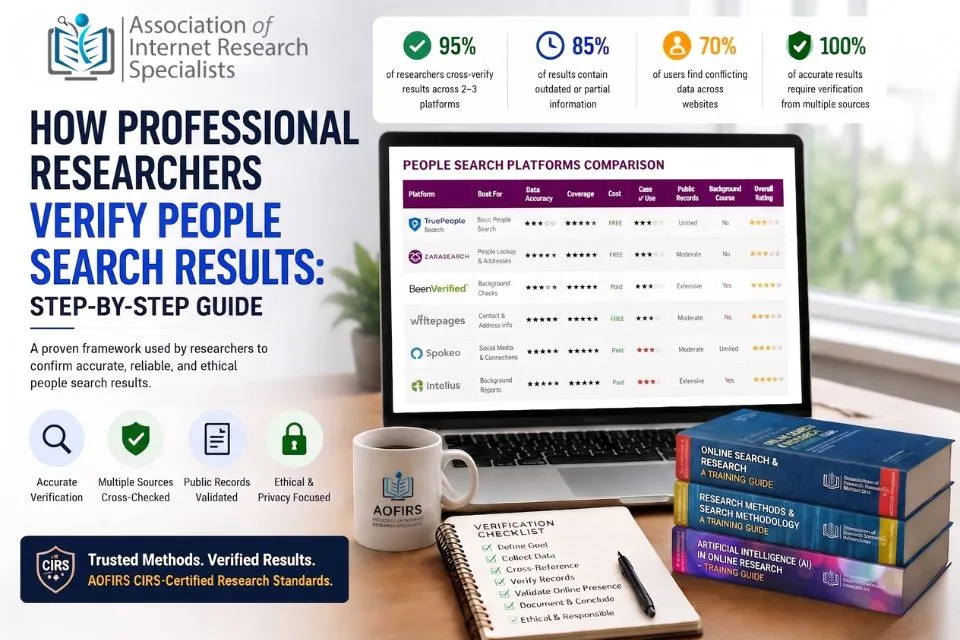
Finding information about someone online can take only a few minutes. Determining whether that information actually belongs to the right person is much harder.
People-search websites can provide names, phone numbers, addresses, relatives, previous addresses, and other publicly or commercially available information. But these services are aggregators. Their records may come from different sources, may be updated at different times, and may contain duplicate or incomplete information.
That is why professional researchers do not treat a people-search result as a verified fact.
Instead, they use a structured verification process. They establish the research purpose, examine the information returned by aggregators, compare it with independent sources, verify important details against appropriate primary records, document discrepancies, and consider privacy and legal limitations before drawing a conclusion.
This guide explains how professional researchers verify people-search results, why different databases can disagree, how to corroborate identity information, and where ethical and permissible-purpose boundaries apply.
Why People-Search Results Conflict
A people-search website does not necessarily maintain a single authoritative record for every person.
Aggregators can combine information from public records, commercial datasets, directories, property records, historical records, and other sources. Those sources may have different update schedules and different standards for identifying individuals.
As a result, one service may show an old address while another shows a newer one. A phone number may appear under more than one person’s name. A common name may produce records belonging to several different individuals.
These differences do not automatically mean that one website is deliberately providing false information. They may simply reflect how data is collected, matched, updated, and redistributed.
For professional research, the important question is therefore not:
Which people-search website has the correct answer?
The better question is:
What independent evidence supports this particular piece of information?
That shift in approach separates a search result from a research finding.
What Professional Researchers Verify
The exact information being verified depends on the research question.
A researcher trying to establish whether two records refer to the same person may compare a name, location, approximate age, known address history, professional affiliation, and other legitimate identifiers.
A journalist may need to establish whether a person associated with a phone number is actually connected to a company mentioned in a story. A business researcher may need to distinguish between two executives with similar names. A genealogist may be trying to determine whether historical records refer to the same family.
The goal is not to collect as much personal information as possible. The goal is to collect enough relevant evidence to answer the defined research question.
This principle is important because excessive collection can introduce unnecessary privacy risks without improving the quality of the conclusion.
Step 1: Define the Research Purpose
Professional verification starts before the first people-search query.
The researcher should establish what needs to be determined and why the information is necessary.
For example, “How to Find Anyone Online”
is not a useful research objective. A more precise question might be:
Does the individual identified in this public business record correspond to the person associated with this professional profile?
The second question establishes a defined research task. It also helps determine what evidence is relevant and what information to avoid collecting.
The purpose matters for another reason: not every type of people-search information is appropriate for every use.
Personal research, journalism, business due diligence, genealogy, and regulated employment screening are different activities. The applicable legal requirements can therefore differ substantially.
Step 2: Treat the People-Search Result as a Lead
Once the research purpose is established, an aggregator can support initial discovery. The researcher might obtain a possible name variation, historical address, phone number, email address, or professional association. At this stage, treat these details as leads rather than established facts.
For example, suppose a people-search platform associates a phone number with a person named Daniel Smith in Chicago.
That result does not, by itself, establish that the number belongs to Daniel Smith, that Daniel Smith is the person the researcher is looking for, or that the information is current.
The result simply provides a starting point for further verification.
Step 3: Build an Identity Picture
Professional researchers compare multiple relevant identifiers rather than relying on a single match.
Names are useful, but common names have limited identifying value. Additional context can make a match more meaningful, such as a consistent location, professional affiliation, company connection, historical address, publicly stated contact information, or another independently verifiable identifier.
The important principle is convergence.
If several independent pieces of evidence point to the same person, confidence may increase. If the evidence points in different directions, the researcher should investigate the discrepancy rather than selecting whichever result appears most convenient.
Why One Database Is Not Enough
People-search services are useful for discovery, but no single aggregator should automatically be treated as authoritative.
Different services may use different datasets, update at different times, and apply different matching methods. Their records may therefore disagree.
For example:
| Source | Result |
| People-search aggregator A | Address in Boston |
| People-search aggregator B | Previous address in New York |
| Company website | Professional role in Boston |
| State business record | Company connection in Massachusetts |
| Property record | Different person with similar name |
The apparent conflict becomes an investigation rather than a reason to choose one result.
The researcher should determine whether the records refer to one person, multiple people, historical information, or a data-matching error.
This is why cross-referencing is not simply checking the same fact on several websites. It means comparing evidence that has different origins and, ideally, different failure modes.
Step 4: Verify Against Primary or Authoritative Records
When an important claim can be checked against an original or authoritative record, that source generally deserves more weight than an aggregator’s summary.
Depending on the research question and jurisdiction, relevant records might include government business filings, property records, court records, professional licensing records, official organizational pages, or other primary documentation.
For example, if a people-search service reports that an individual is associated with a particular company, a researcher may look for an official corporate filing or an authoritative professional source that independently supports the relationship.
Likewise, if an aggregator reports an address, the researcher should ask what type of evidence could appropriately confirm or challenge that information.
The purpose is not to assume that every government record is automatically correct. Primary records can also contain errors. The point is to trace an important claim closer to its original source rather than relying indefinitely on a data aggregator’s interpretation.
AOFIRS’s Verification Methods in Private & Public Information report provides a broader framework for working with public and private information, including the relationship between research methods, verification, and legal considerations.
Step 5: Check Social and Professional Information Carefully
Public online profiles can provide useful contextual evidence, particularly when verifying professional identity.
A LinkedIn profile, company biography, professional website, published article, or public social-media account may help establish that a particular person has a relationship with an organization or location.
But social media should not be treated as an automatic authority on identity.
A username can be copied. A profile image can be reused. A biography can be inaccurate. An account can be impersonated.
Researchers should therefore consider whether the profile connects to other independently verifiable information.
The question is not simply:
Does this profile have the same name?
It is:
What evidence connects this profile to the specific individual being researched?
Step 6: Investigate Conflicting Results
Conflicting information is not necessarily a failure of the research process. It can be one of the most useful findings.
Suppose one database reports an address in Texas while another reports an address in Florida. Rather than choosing one, the researcher can investigate the dates, source types and contextual evidence associated with each record.
The Texas address might be historical. The Florida address might belong to another person with the same name. One database might have copied an outdated record.
A useful verification record can therefore look like this:
| Claim | Source | Result | Assessment |
| Current location | Aggregator A | Florida | Lead only |
| Previous address | Property record | Texas | Independently documented |
| Professional location | Company website | Florida | Consistent with current evidence |
| Name match | Business filing | Confirmed | Strong supporting evidence |
The objective is not to eliminate every discrepancy. It is to understand the discrepancy and determine whether it changes the conclusion.
Step 7: Document the Verification Process
Documentation is one of the clearest differences between casual people searching and professional research.
A researcher should be able to explain where an important claim came from, when they accessed it, what they found, what conflicted with it, and why they reached the final assessment. For significant research, a verification record can include the source URL, publisher or record owner, access date, relevant observation, original claim, corroborating source, discrepancy, and final assessment.
Documentation also protects against a common research problem: forgetting why you reached a conclusion days or weeks later. A finding that cannot be traced back to its supporting evidence is difficult to reproduce or defend.
Step 8: Assess Confidence Instead of Forcing a Yes or No
Not every people-search result can be conclusively verified.
Professional researchers should be comfortable reporting uncertainty.
For example:
- High confidence: Multiple independent sources consistently connect the relevant identifiers to the same individual.
- Moderate confidence: Several sources support the connection, but one or more meaningful gaps remain.
- Low confidence: The evidence is indirect, incomplete or potentially attributable to multiple people.
- Unresolved: The available evidence does not justify identifying the records as belonging to the same person.
This approach matters most when people share common names or records have incomplete identifiers.
A professional report should not turn uncertainty into certainty simply because the client wants a definitive answer.
When a People-Search Result Should Not Be Used
A people-search result can be a useful research lead but is not appropriate for a consequential decision.
This distinction is especially important in the United States when information is being used for purposes regulated by the Fair Credit Reporting Act (FCRA).
Consumer people-search services and regulated consumer reporting agencies are not interchangeable. Some people-search companies expressly state that their services are not consumer reports and cannot be used for employment, housing, credit, insurance, or similar eligibility decisions.
For example, current Intelius terms state that its service is not a consumer reporting agency and that its information cannot be used for FCRA-regulated purposes. BeenVerified similarly states that it is not a consumer reporting agency and restricts use of its information for employment, housing, credit, and other FCRA purposes.
The practical lesson is simple:
The fact that information is available online does not automatically give a researcher permission to use it for every purpose.
Before using personal information in a consequential decision, researchers and organizations should determine whether a specific legal framework, permissible-purpose requirement, consent process, disclosure requirement, or other restriction applies.
This article is educational information, not legal advice. Requirements vary by jurisdiction and use case.
Publicly Available Does Not Mean Ethically Unlimited
Professional research also requires consideration of proportionality and necessity.
If a researcher needs to verify a person’s professional affiliation, collecting unrelated information about family members, neighbors or personal contacts may add little value while increasing privacy risks.
A responsible research process therefore asks:
Is this information necessary to answer the research question?
and:
Is there a less intrusive way to establish the same fact?
This approach is consistent with the broader AOFIRS focus on the boundary between public and private information. AOFIRS’s 2026 visual guide, Navigating the Boundary of Public and Private Information, specifically addresses how legal frameworks, privacy regulations, and OSINT methodologies affect what information can be accessed, processed, and ethically used.
What Professional Researchers Do When Sources Disagree
When people-search results conflict, researchers do not simply average the results or choose the platform they trust most. They examine each record’s provenance.
A newer address from an aggregator may conflict with an older government record because the person moved. A phone number may have been reassigned. Two people with similar names may have been merged into one database profile. A company affiliation may have ended even though an old webpage remains online.
The researcher therefore considers source origin, date, context, identifiers, and independence. This is why source verification is more important than the number of databases searched. Three websites repeating the same underlying record are not necessarily three independent confirmations.
A Practical Verification Example
Consider a hypothetical researcher investigating whether a person named Michael Johnson is the same individual listed in a company’s public filing.
A people-search platform produces a Michael Johnson with an address in Atlanta and a possible phone number. The researcher does not immediately conclude that the person has been identified.
Instead, the researcher checks the company’s official filing, which provides the individual’s name and role. A professional profile independently associates a person with the same name and company. The dates are consistent. An older company webpage also identifies the same executive.
The evidence now converges. However, suppose the people-search result lists a different middle initial and an unrelated address. That discrepancy should remain in the research record rather than being silently ignored.
The final assessment might state that several independent sources support the professional identity, while the address information from the aggregator remains unverified. That is a much stronger research conclusion than simply saying, “The people-search website confirmed the identity.”
How Technology Supports Verification
Technology can speed up the research process, but it does not eliminate the need for human verification.
Search engines can help discover relevant pages. People-search databases can provide initial leads. Reverse phone and email tools can surface possible connections. Web archives can reveal historical information. Data-analysis tools can help organize records.
AI can also assist with tasks such as extracting names and organizations from documents, comparing large collections of records, translating material, and identifying possible contradictions.
However, an AI-generated match is still a lead.
AI systems can misidentify people, combine information from different sources, invent citations or present an inference as an established fact. The researcher should therefore return to the original source before relying on an AI-generated claim.
The technology should accelerate the verification workflow, not replace it.
What Makes AOFIRS’s Approach Different
Many people-search articles focus on which website provides the most information, which platform is cheapest, or which service is easiest to use.
Those comparisons can be useful when the question is simply which consumer service to try.
Professional research requires a different question:
How do you know the result is correct?
AOFIRS’s research approach focuses on methodology. People-search databases are treated as information sources within a broader verification process, not as final authorities.
That means the researcher considers the purpose of the research, the origin of the information, source reliability, independent corroboration, primary records, documentation, privacy, ethics, and appropriate confidence.
This methodology-first approach also aligns with AOFIRS’s broader people-search guidance, which states that professional researchers should cross-reference information, verify public records, evaluate consistency, and document findings rather than rely on a single database.
A Simple Professional Verification Framework
The complete process can be reduced to six questions:
| Stage | Question |
| Purpose | What exactly am I trying to establish? |
| Discovery | What information do the initial sources provide? |
| Identity | What evidence connects the records to the same person? |
| Corroboration | Can important claims be confirmed independently? |
| Documentation | Can another researcher trace how the conclusion was reached? |
| Assessment | What does the evidence support, and how confident should I be? |
This framework is intentionally simple. The complexity should come from the research question and evidence, not from unnecessary tools or procedures.
Frequently Asked Questions
Are people-search websites accurate?
People-search websites can provide useful information, but their records may be incomplete, outdated, duplicated, or incorrectly matched. Important information should be independently verified against appropriate sources.
Why do different people-search websites show different information?
Different services can use different data sources, update schedules, and matching methods. They may also contain historical records or records belonging to different people with similar identities.
How do professional researchers verify a person?
They define the research purpose, use initial search results as leads, compare multiple relevant sources, verify important claims against appropriate primary or authoritative records, document discrepancies, and assess confidence before reporting a conclusion.
Is one people-search website enough?
Usually not for important research. A single aggregator can provide a useful starting point, but professional verification normally requires corroboration from independent sources.
Are public records more reliable than people-search websites?
Primary or authoritative records can provide stronger evidence for particular claims, but they are not automatically error-free. Researchers should consider the origin, date, scope, and relevance of every record.
Can I use a people-search website for an employment background check?
Do not assume that you can. Consumer people-search services may expressly prohibit FCRA-regulated employment use. Employment screening in the United States can involve specific FCRA requirements, including permissible purpose, disclosure, authorization, and adverse-action procedures.
Does publicly available information have privacy protections?
Potentially, yes. The fact that information can be found online does not automatically remove all legal or ethical considerations. Applicable privacy laws, platform terms, purpose of use, and jurisdiction can all matter.
Should researchers verify social-media accounts?
Yes, when social-media information is relevant to the research question. A username, photograph or profile description alone should not be treated as proof of identity.
What should I do when two sources disagree?
Do not simply choose one. Investigate the source of each record, compare dates and identifiers, look for independent evidence, and document the discrepancy. The conflict itself may reveal a historical change, duplicate identity, or data-matching error.
Can AI verify someone’s identity?
AI can assist with information extraction, comparison, and research organization, but an AI-generated identity match should not be treated as proof. Verify important identity claims against original, independently corroborated evidence.
How should professional researchers document verification?
At minimum, important research should record the source, URL or record reference, access date, relevant information, discrepancies, corroborating evidence, and final assessment. The level of documentation should match the importance and sensitivity of the research.
Conclusion
Professional people-search verification is not about finding the largest database or collecting the most personal information. It is about determining whether the information you found actually supports the question you are trying to answer.
People-search platforms can provide valuable starting points, but their records may conflict because they draw from different sources, update at different times, and use different matching methods. Professional researchers therefore treat aggregator results as leads, corroborate important claims with independent evidence, consult primary or authoritative records where appropriate, document discrepancies and report uncertainty honestly.
The same principle applies to social media, AI-generated results, reverse lookups, and other online research tools. Finding information is easy. Establishing what the evidence actually proves is the professional research skill.