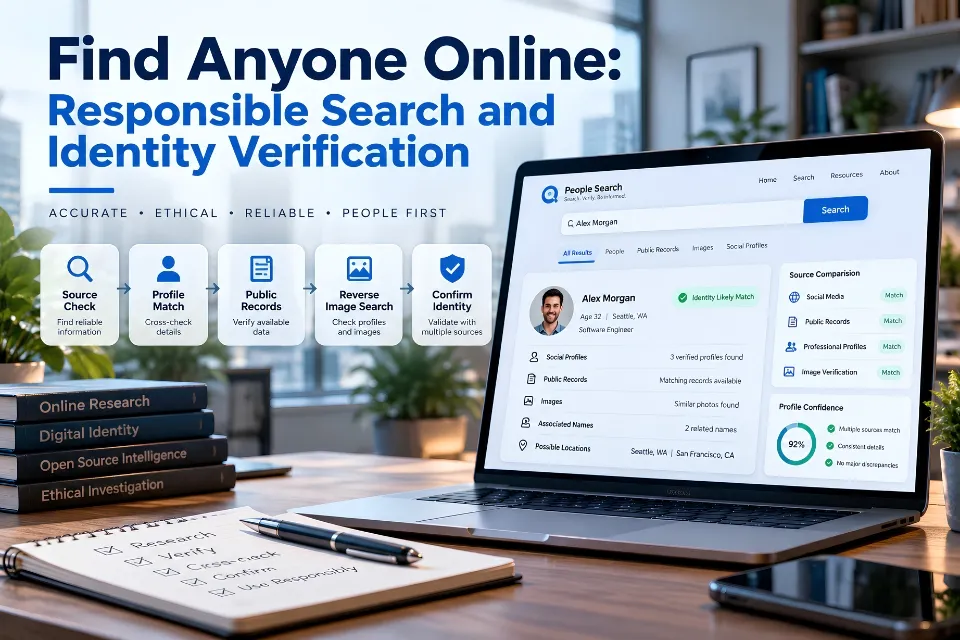
Finding someone online is often easier than establishing that the information belongs to the right person. Search engines, official directories, and people-search services can produce possible matches, but outdated records and mistaken associations can turn a plausible lead into a false conclusion.
Start with a defined research question, use relevant public sources, and corroborate important claims independently. A matching name, photograph, username, or contact record is a lead, not proof of identity. This guide retains the six people-search services from the original article while explaining how to use discovery tools responsibly.
Quick Answer: How to Find Someone Online Responsibly
Begin with a name and legitimate professional context. Search official organizational pages and relevant public records before relying on aggregators. Compare source origins and dates, document uncertainty, and use an independently obtained official channel to confirm consequential claims.
People Search and Identity Verification Are Different
People searching locates information that may concern an individual. Verification asks what a source actually establishes and whether separate records refer to the same person.
| Research activity | Purpose | Result |
|---|---|---|
| People search | Discover relevant public information | Possible matches |
| Identity matching | Compare records and identifiers | Supported or uncertain connections |
| Claim verification | Check a specific statement | Supported, disputed or unresolved finding |
| Formal identity verification | Follow an authorized proofing process | Assurance appropriate to the transaction |
One person may have several profiles, while several people may share one name. Do not merge records automatically. AOFIRS’s guide to verifying people-search results explains why aggregator conflicts require independent corroboration.
Six People-Search Services at a Glance
The appropriate starting point depends on the question and jurisdiction. These services are discovery options, not official identity-proofing systems. This overview does not claim an independently tested accuracy ranking. Current pricing, coverage, and access limits should be checked directly with each provider.
| Service | General discovery focus | What to verify before relying on it |
|---|---|---|
| TruthFinder | Aggregated people-search reports | Source dates, permitted use and payment terms |
| FastPeopleSearch | Basic people-search leads | Whether records are current and correctly associated |
| PeopleFinders | Public-record aggregation | Original record custodian and report coverage |
| ZabaSearch | Basic people-search discovery | Completeness and links to other providers |
| PeekYou | Public online-profile discovery | Whether linked profiles concern the same person |
| TruePeopleSearch | People-search and record discovery | Attribution, dates, and privacy procedures |
1. TruthFinder
TruthFinder is a people-search report service. Its potential value is organizing leads for further checking. A detailed report should not be described as a verified identity record simply because it combines many entries. Trace any important employment, affiliation, or record claim to an appropriate original source. Review the provider’s current terms before purchasing or using a report.
2. FastPeopleSearch
FastPeopleSearch is associated with basic people-search lookups. A possible result can help identify a question to investigate, but it may concern another person or historical information. For professional affiliation, prefer a current official directory over a contact listing. Avoid collecting residential or family information when it is irrelevant to the purpose.
3. PeopleFinders
PeopleFinders aggregates information for people-search reports. Treat any summarized public record as a pointer to its issuing authority. Check the jurisdiction, record date, and identifiers before drawing a conclusion. More entries or a paid report do not necessarily provide stronger evidence; the quality and independence of the underlying sources matter.
4. ZabaSearch
ZabaSearch provides people-search discovery. Basic results can be incomplete, and a page may direct readers to another provider for additional information. Before continuing, distinguish the original listing from advertising or a separate report service. Confirm access and billing terms, then independently check the specific claim that matters.
5. PeekYou
PeekYou focuses on discovering public online profiles. A profile connection is a hypothesis to examine, especially when names or usernames are common. Compare professional context, published work, and links from official organizations. A reused photograph or username is insufficient to establish that two accounts share an owner.
6. TruePeopleSearch
TruePeopleSearch is another source of people-search leads. Do not equate a displayed association with current ownership of a contact record or a confirmed identity. Check dates and corroborating sources. For reconnecting, use a public professional channel and respect a person’s decision not to respond.
Free vs. Paid Tools
Cost does not measure accuracy. Free sources may provide useful leads, while paid reports may collect more categories of information without resolving attribution errors. Before paying, check what the report includes, whether billing recurs, and cancellation conditions, and permitted uses. An authoritative source supporting one relevant claim can be more useful than a lengthy collection of unrelated personal details.
A Seven-Step Method for Responsible Research
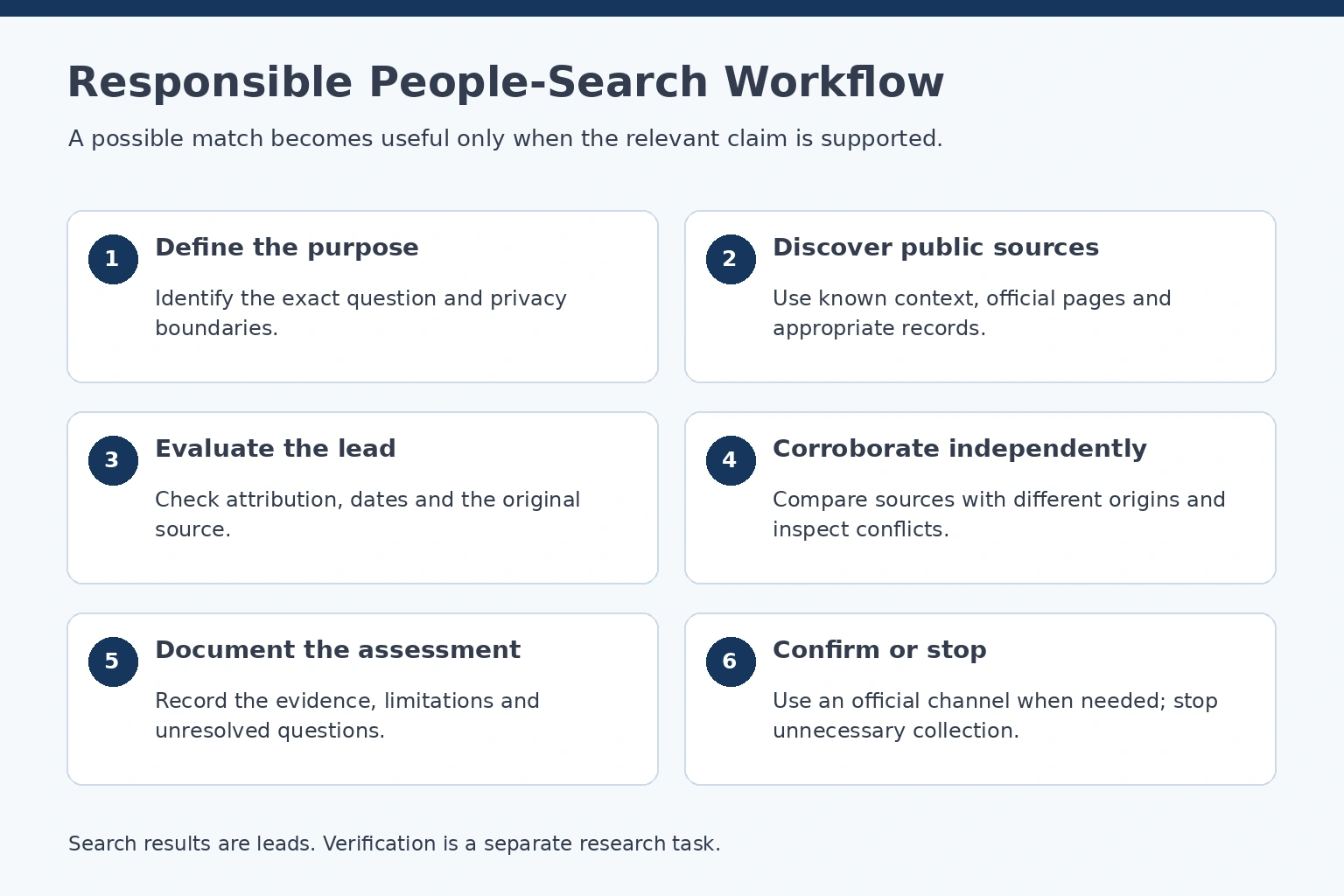
The seven practical steps below follow this discovery and verification workflow.
1. Define the Purpose and Boundaries
Write the question before searching. “Does this speaker work for the university named in the conference program?” is more useful than “Find everything about this person.” Decide what evidence is necessary and what information to avoid. An organizational affiliation normally does not require investigating home addresses or relatives.
2. Begin With Known Information
Use accurate, lawfully obtained context such as a name, employer, profession, or published work. In a fictional example, searching for conference speaker Daniel Morgan with the conference subject narrows unrelated name matches. Treat remembered details as provisional because employment and affiliations can change.
3. Search Strategically
Combine a name with relevant context, for example:
"Daniel Morgan" "environmental research"
Quotation marks can target a phrase. A domain restriction such as site:example.edu can focus discovery on an institution. Search engines do not index everything, and syntax differs between systems. The AOFIRS Search Query Matrix explains cross-engine syntax and query refinement.
4. Inspect Professional and Official Sources
Review company biographies, university directories, conference programs, and published work. Self-reported profiles require corroboration. For a license or registration, consult the relevant issuing authority and check the current status, jurisdiction, and scope. An authentic record can establish a specific fact without proving every claim attached to a name.
5. Use Aggregators as Leads
If a people-search service provides a possible match, record what needs checking rather than accepting the whole profile. Determine whether the information is historical, incomplete, or potentially associated with someone else. Three websites copying one database represent one underlying claim, not three independent confirmations.
6. Corroborate and Resolve Conflicts
Compare genuinely independent sources. An official organizational biography and a separately published conference program may support an affiliation more strongly than repeated directory entries. Examine contradictory dates and identifiers. An old employer listing and a newer biography can both describe different stages of a career. If the conflict remains unresolved, keep the records separate.
7. Document the Assessment
Record the source URL or reference, publisher, access date, claim, supporting evidence, and limitations. Separate directly observed facts from inferences. For consequential business claims, contact the organization through an official channel obtained independently of the disputed profile or message. Record uncertainty rather than forcing a match.
Avoiding False Identity Matches
Common names, outdated employment, copied biographies, recycled contact details, and impersonated accounts can create misleading associations. Matching occupation and location may still describe several people. Photographs can be reused, edited or generated, so visual similarity should not determine identity.
AOFIRS’s visual verification toolkit for identifying fakes provides context for assessing synthetic media. Image analysis can challenge suspicious evidence, but it cannot independently prove who controls an account.
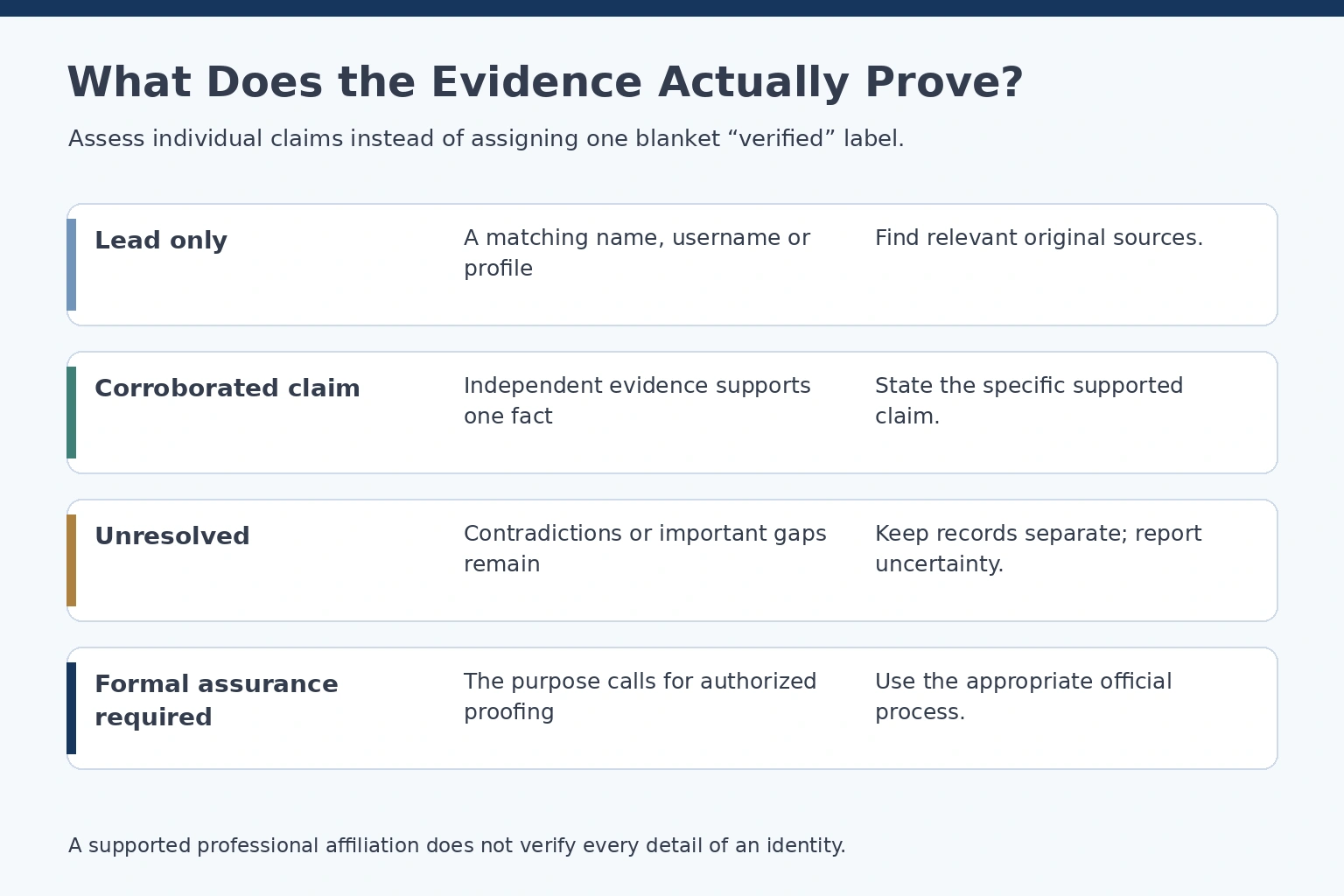
Assess each claim separately and record what remains unverified.
| Assessment | Meaning | Appropriate action |
|---|---|---|
| Lead only | A plausible result without corroboration | Investigate relevant original sources |
| Corroborated claim | Independent evidence supports a specific fact | State exactly which fact is supported |
| Unresolved | Gaps or contradictions remain | Preserve uncertainty and separate records |
| Formal assurance required | The purpose requires authorized proofing | Use the appropriate official process |
Confidence belongs to a particular claim. Strong evidence of an affiliation does not automatically verify an address, credential, or authorization to make a transaction.
Can AI Help Verify Someone?
AI can organize documents, compare employment dates, and highlight inconsistencies. It can also combine unrelated people, invent associations, or cite sources that do not support its conclusion. An AI-generated match remains a lead.
The AOFIRS report on verification debt in online research examines accumulated risks from unchecked AI claims and sources. Open original records and verify important statements. Follow organizational rules before uploading personal information to an AI service, including authorization, retention, and confidentiality requirements.
Privacy, Legal Use and Opt-Outs
Public availability does not authorize every use. Access rules, privacy obligations, and platform terms vary by jurisdiction and purpose. Do not bypass privacy controls, use deception, expose private addresses, or pursue unwanted contact.
In the United States, certain background reports and eligibility decisions fall under the Fair Credit Reporting Act. Consumer people-search results are not a substitute for an appropriate regulated screening process. The FTC’s employer background-check guidance explains disclosure, permission, and procedural obligations for covered employment reports. Housing, credit, and other purposes require their own applicable checks.
For your own information, follow each service’s official opt-out procedure and periodically check for reappearance. The FTC’s people-search privacy guidance explains that removal from an aggregator does not delete original public records and that information can remain elsewhere. Retain only information necessary for the research purpose and protect the resulting notes.
Three Practical Examples
Reconnecting With a Former Colleague
Use a published conference program to locate a professional page. Send a respectful message through a public business channel instead of searching for residential information. Stop if contact is declined.
Verifying a Business Representative
A message claims to come from a supplier. Check the supplier’s official website and contact its published corporate office independently. Ask whether the person is authorized to make the specific request. A profile alone cannot establish that authorization.
Separating Authors With Identical Names
Compare institutional affiliations, academic subjects, publication dates, and official biographies. If the evidence indicates different authors, keep their records separate. Do not combine publication lists merely because the names match.
Before Relying on a Result
Confirm that the purpose is legitimate, sources are appropriate, important claims have independent support, dates and contradictions have been examined, and the conclusion states its limits. Protect sensitive information and use formal procedures whenever the intended decision requires them.
Frequently Asked Questions
How can I find someone using public information?
Start with a name and relevant professional context. Search official directories, published work, and appropriate public records. Corroborate possible matches before treating them as findings.
What are useful free starting points?
General search engines, institutional directories, and official registries are useful. Availability varies, and free access does not guarantee reliable identity matching.
Can a name alone identify someone?
Sometimes it locates a candidate, but common names produce unrelated results. Additional relevant evidence is usually needed.
Are people-search websites accurate?
They can contain useful leads, but entries may be outdated, incomplete, or misattributed. Verify consequential claims independently.
Do matching profiles prove a shared identity?
No. Compare independent evidence and dates. Names, usernames, and photographs can be copied or shared.
Can AI prove someone’s identity?
AI can assist comparison and organization. Its conclusions do not replace original evidence or an authorized identity-proofing process.
Is searching public information legal?
Rules depend on access, jurisdiction, purpose, and intended use. Public visibility does not permit harassment or prohibited eligibility decisions.
Does opting out remove every record?
No. It may remove a service’s listing, but original public records and other providers’ copies can remain. Check periodically for reappearance.
Conclusion
Finding someone online is a discovery task. Establishing that a record belongs to the correct person requires relevant evidence, independent corroboration, and honest handling of uncertainty. Choose tools according to the question, verify the specific claim, and stop when sufficient evidence has been obtained without unnecessary intrusion.