
Conversational AI search lets people ask questions in natural language, receive generated explanations and refine an investigation through follow-up questions. It can combine information retrieval with synthesis, while researchers remain responsible for evaluating the evidence.
Platforms such as ChatGPT Search, Google AI Mode, Microsoft Copilot and Perplexity offer conversational information tools. Features and source access vary. Product documentation in this guide was reviewed on October 22, 2026.
It is important to differentiate between coming up with an answer and verifying the factual accuracy of that answer. The main difficulty for researchers, journalists, students, and information professionals consists in understanding the methods that these systems use to retrieve evidence to support their responses, to construct the answers, and to locate authoritative sources.
What Is Conversational AI Search?
Conversational AI search is a method for retrieving information that allows users to carry out searches using natural language and thus get answers to relevant questions without having to start separate searches for each one.
This method combines interactive interfaces with various advanced technologies, such as large language models, natural language processing, search indexes, and in some cases retrieval augmented generation.
For example, a traditional search might begin with:
renewable energy adoption Europe 2026 statistics
A conversational search could begin with:
What are the most recent verified trends in the uptake of renewable energy in Europe, and in which countries has the greatest progress been made?
The researcher could then ask which figures come from official statistical agencies, or how measurement methods differ between countries.
A response may rely on model knowledge, retrieved web material, uploaded documents or a combination. Confirm whether a particular interaction actually used current external sources before treating its answer as up to date.
How Does Conversational AI Search Work?
Conversationally oriented search systems are created with the aim of understanding the questions posed by users, spotting information that might be relevant, and producing responses which may include evidence obtained from outside sources.
Even though each platform might have its own technical architecture, a standard workflow usually involves a number of successive stages.
A Conceptual Conversational Search Workflow
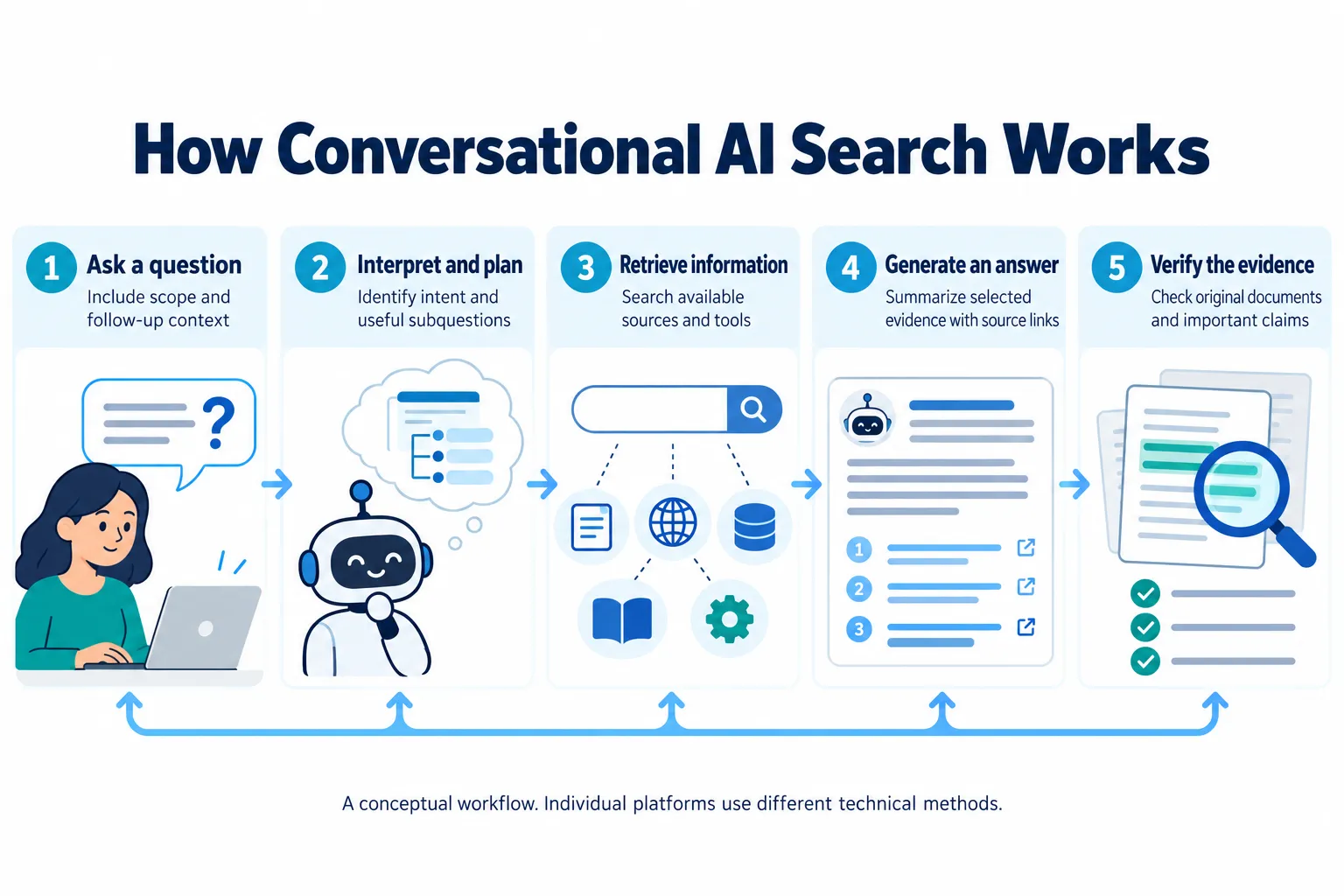
- User question: Natural-language request and follow-up context.
- Query interpretation and planning: Identify intent, rewrite queries, or create subqueries.
- Information retrieval: Search indexes, documents, databases, or tools.
- Answer generation and source links: Synthesize selected information into a response.
- Human verification: Check original evidence before relying on important claims.
The workflow given here is only an example; different platforms might include extra stages or adopt alternative technical methods.
Understanding questions and conversational context
Language models enable the understanding of questions that are expressed in natural language; they can identify relevant terminology, resolve some ambiguous references, and take into account the context given by the earlier exchanges.
For example, if a researcher asked about the adoption of electric vehicles, they might then ask, “What about the charging infrastructure?” In this case, the system would use the earlier part of the conversation to understand the new question.
Retrieving and ranking information
A system, according to its design, might search public web indexes, connected documents, specialized databases, or external APIs.
Search methods may involve keyword matching, semantic retrieval, vector embeddings, and ranking models; semantic search strives to identify information that is related by meaning rather than depending only on exact keyword matches.
Certain systems combine conventional retrieval with semantic techniques in order to improve the selection of relevant material.
Generating answers with retrieved evidence
Retrieval-augmented generation involves carrying out external information retrieval alongside language generation. The reason for this is to ensure that the model has access to relevant information when formulating a response.
Lewis and colleagues’ foundational RAG paper describes combining retrieval with generation for knowledge-intensive language tasks.
While RAG can enhance access to relevant information, the fact that information is retrieved does not ensure its accuracy. It is still possible for a model to misinterpret the evidence, fail to include any qualifications, or provide an inappropriate citation.
Maintaining a conversation
Because conversational interfaces let users improve their requests, question answers and look into other questions, they are useful for initial investigations and for topics that involve evolving research questions.
Conversational AI Search vs Traditional Search
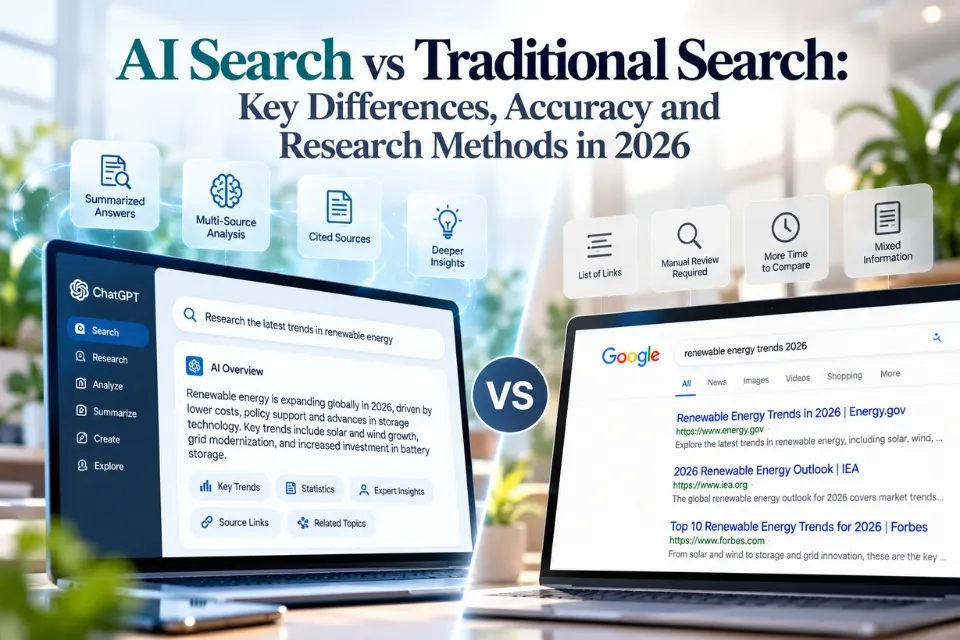
Traditional and conversational search have overlapping but different purposes.
| Feature | Traditional search | Conversational AI search |
|---|---|---|
| Input | Keywords or questions | Natural-language questions and dialogue |
| Results | Ranked links, snippets, other search features | Synthesized answers with possible citations |
| Follow-ups | Often requires new searches | Can retain conversational context |
| Source inspection | Original pages are directly accessible | May require opening cited sources |
| Complex comparisons | User usually combines findings | AI can organize initial comparisons |
| Reproducibility | Results can vary by time and context | Answers may also vary between runs |
| Main limitation | Requires manual interpretation | May introduce unsupported claims |
Traditional search is still useful when it comes to finding documents accurately, carrying out systematic reviews, dealing with original records, and in any investigations that require transparent search strategies.
Conversation-based tools are especially useful when it comes to explaining subjects that are unfamiliar, in identifying the relevant terminology, and in planning the next searches.
A top-level professional method usually involves using both techniques.
Leading Conversational AI Search Platforms in 2026
The search market that is conversational consists of dedicated answer engines, search platforms that have AI enhancement, and general-purpose assistants equipped with the ability to retrieve web information.
| Platform | Main approach | Useful capability | Important limitation |
|---|---|---|---|
| ChatGPT Search | Conversational assistant with web search | Contextual questions and linked web sources | Generated summaries still need checking |
| Google AI Mode | AI-powered search experience | Complex queries and follow-up exploration | Feature availability and results vary |
| Google AI Overviews | AI summaries within Google Search | Quick orientation with supporting links | Not a complete source review |
| Microsoft Copilot | AI assistance with web-connected experiences | Search, explanation and synthesis | Capabilities depend on product context |
| Perplexity | Source-linked answer and research engine | Web research with visible citations | Citation relevance must be verified |
| Gemini | AI assistant with relevant Google integrations | Multimodal questions and grounded responses | Grounding depends on mode and access |
ChatGPT Search
OpenAI’s search documentation describes conversational web search and deeper multi-source research. Source links help users inspect the evidence, while account and workspace settings affect availability.
Researchers can use it in order to investigate questions, compare different explanations, and spot possible references; but they have to tell the difference between material obtained from the web and that which has been interpreted by the system.
Google AI Mode and AI Overviews
Google’s AI feature guidance describes AI Overviews and AI Mode alongside supporting web links and related searches. AI Overviews provide an overview within Search, while AI Mode supports more extensive exploration.
In its October 2026 update, Google announced more prominent inline links and tests of a dedicated section for official web pages. Announced tests should not be assumed available to every user.
AI Overviews usually give summaries in the Search results, while AI Mode is intended for more in-depth AI-assisted exploration.
Perplexity and other platforms
Perplexity’s Pro Search guidance describes searching across sources, synthesizing results and providing links. Researchers should still check whether the cited material supports the generated interpretation.
Microsoft Copilot and Gemini support information tasks in their relevant products and modes. Google’s Gemini source guidance notes that not every response includes source links. Check the sources actually used in each interaction.
Just because an answer on a particular platform includes citations does not mean that the platform should be regarded as an independent authority.
Microsoft’s Copilot announcement introduced Copilot Search in Bing in April 2025, bringing traditional and generative search together.
Key Technologies Shaping Conversational Search
Various technologies are enabling conversational search to go beyond text-based question answering.
Retrieval-augmented generation and semantic search
By using external information, RAG enables models to generate their responses. Semantic retrieval helps to find documents that are related to the meaning of the question. Hybrid systems combine both semantic relevance and exact terms, a feature that can be especially useful in research dealing with names, technical identifiers, and specialist terminology.
Multimodal search
Multimodal systems are capable of processing combinations of text, images, audio, and other kinds of information.
For instance, a user could upload a photo of some equipment and request information about its likely identity, the manufacturer’s documentation, or the maintenance requirements. However, the identification still has to be checked against reliable records.
Agentic search and deep research
Agentic research systems are able to break down general questions into smaller tasks, carry out several searches, check the sources, and put together reports.
OpenAI’s research guidance describes multi-source investigations and reviewable reports. The available sources, controls and tools depend on the selected product and account.
It does not follow that increased automation will result in better evidence, since research involving multiple stages is still capable of making errors or choosing inappropriate sources.
How to Use Conversational AI Search for Professional Research
Use a structured process to preserve a clear path from the question to the evidence.
- State the research question. Identify the subject, geographic scope, period, and information required.
- Explore terminology and possible sources. Use AI to identify relevant concepts, alternative keywords, and authoritative institutions.
- Retrieve original documents. Locate technical reports, academic papers, government records, or primary datasets.
- Compare evidence. Identify conflicting findings, methodological differences, and missing information.
- Verify and document findings. Check key claims against their original sources and preserve a reproducible research record.
Prompt Patterns for Research
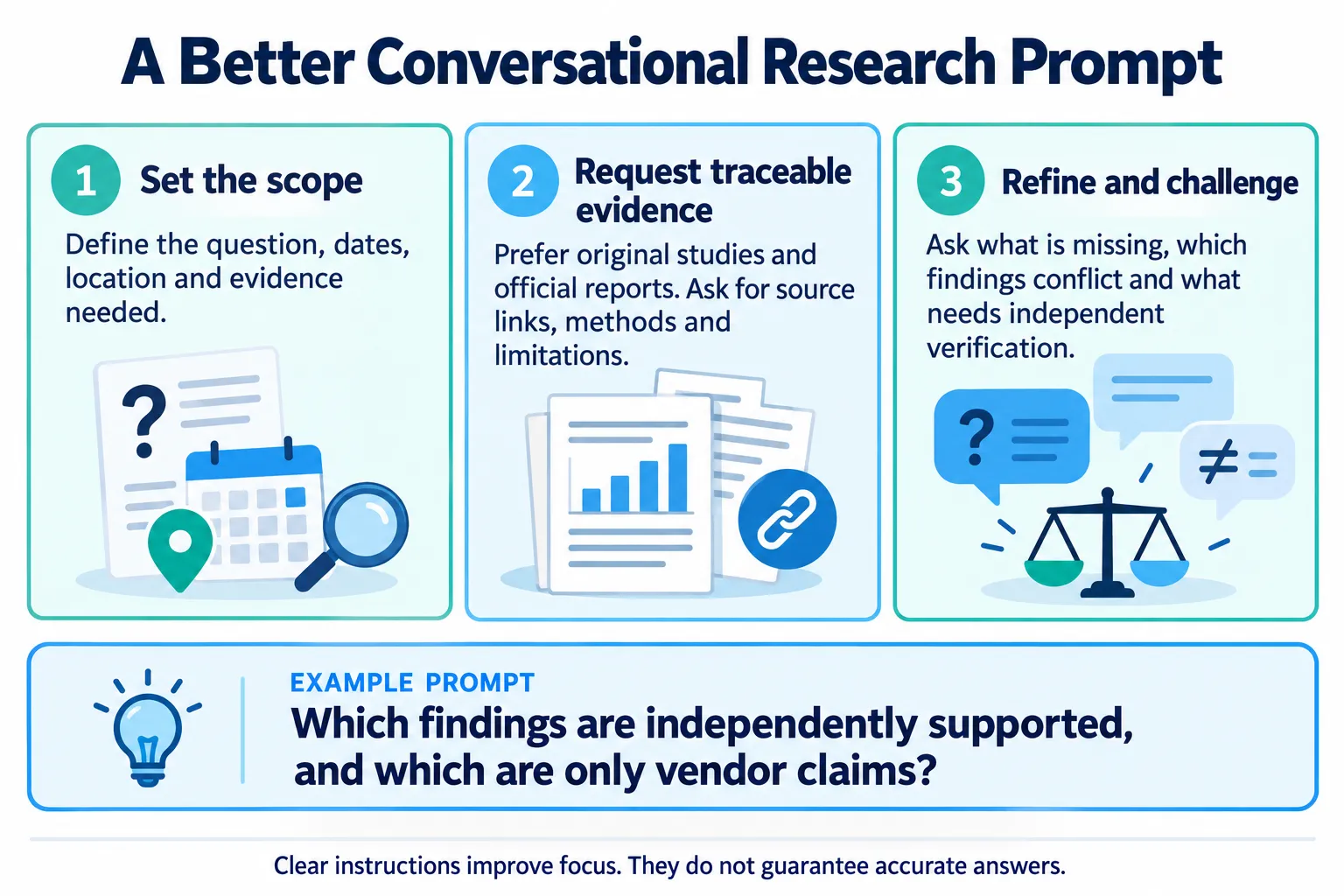
Start with a clear question and evidence requirements, then test the answer with focused follow-ups. OpenAI’s prompting guidance recommends requesting search when current information matters.
- Scope: What dates, locations and administrative tasks should this investigation cover?
- Evidence: Which original studies or official reports support each finding?
- Challenge: Which findings are independently supported, and which are only vendor claims?
Worked example: Investigating AI in healthcare administration
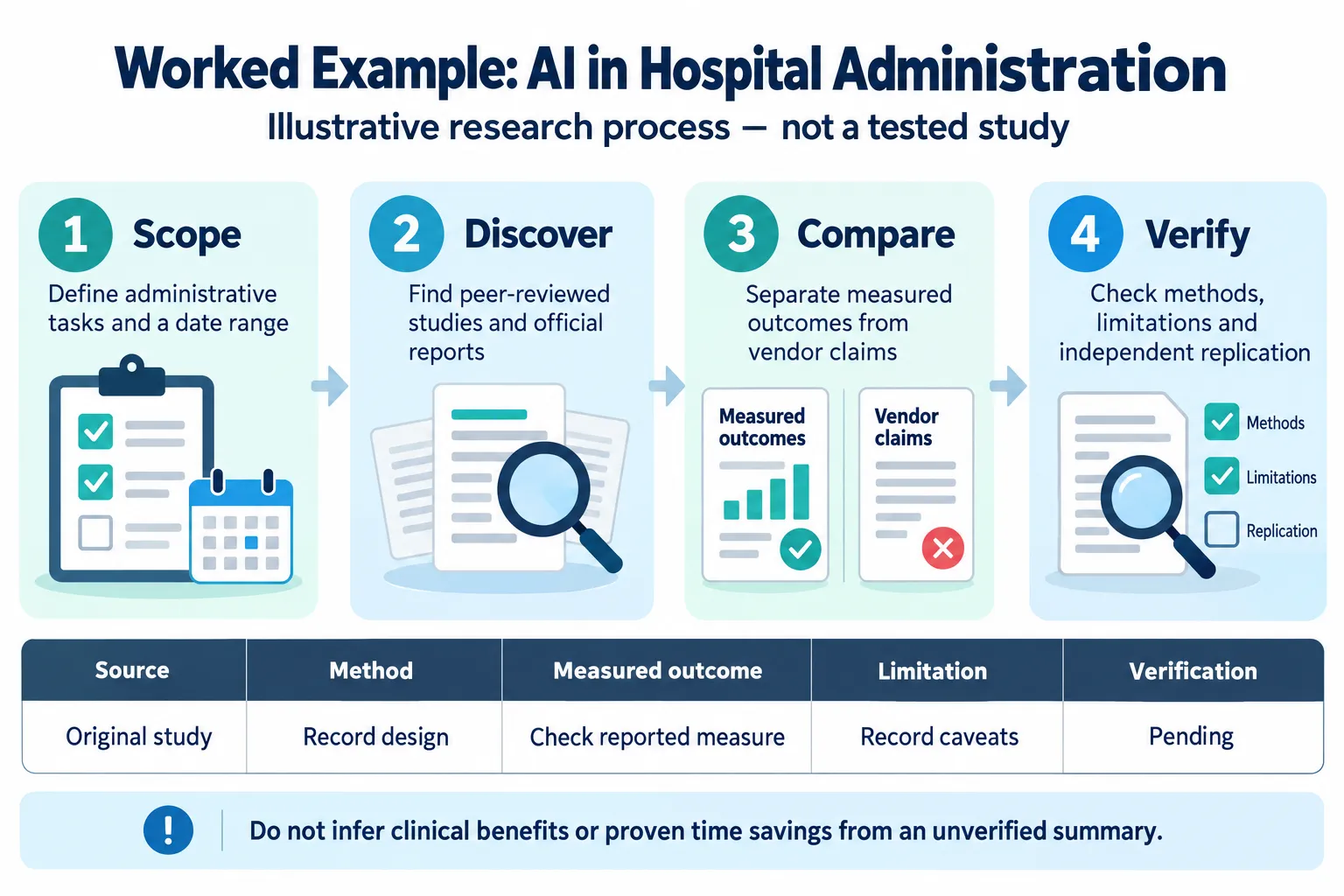
Suppose a researcher wants to examine how AI is being adopted for hospital administrative work.
An appropriate opening prompt would be:
“Identify peer-reviewed studies and official reports published between 2023 and October 2026 on the use of AI for hospital administrative tasks. Separate documented outcomes from vendor claims. Provide original source links, methods, limitations and publication dates. Mark findings that cannot be verified.”
Useful follow-up questions could examine whether studies measured actual administrative time savings, which institutions were involved, and whether the findings were independently reproduced.
The researcher should then inspect the original studies, compare methodologies, and distinguish observed outcomes from projections.
This is an illustrative research process, not a claim that such a search was experimentally conducted for this article.
For further guidance, see the AOFIRS AI research guide.
Benefits and Limitations of Conversational AI Search
Conversational search can make information exploration more accessible. It helps users clarify unfamiliar subjects, identify research directions, organize complex material, and formulate more precise follow-up questions.
Its main limitations arise from the difference between finding information and verifying it.
AI-generated responses may omit relevant evidence, misinterpret documents, or present uncertain conclusions confidently. Furthermore, search results may vary because of differences in indexing, location, source access, model behavior, and retrieval settings.
Researchers also need to consider confidentiality. Unpublished data, personal information, and restricted documents should not be submitted to external systems without suitable authorization and safeguards.
How to Verify Conversational AI Search Answers
A cited AI answer should be treated as a starting point for verification, not as confirmed evidence.
A citation can point to a genuine document while failing to support the statement attached to it. This distinction is especially important in academic, financial, medical, legal, and investigative research.
Use the following checklist:
- Confirm that the cited source exists and matches its description.
- Inspect the original document rather than relying on a summary.
- Check that the cited passage supports the particular claim.
- Verify publication dates, statistics, quotations, and methodology.
- Look for independent corroboration.
- Identify conflicts of interest and important omissions.
- Record unresolved uncertainty and relevant research limitations.
The AOFIRS verification guide provides a detailed source-checking procedure.
Human verification becomes more important as systems generate increasingly detailed reports and recommendations.
What Conversational AI Search Means for SEO, AEO and GEO
AI-generated search experiences are also changing how publishers think about online discoverability.
Search engine optimization (SEO) remains concerned with making relevant, valuable content accessible to search engines and users. It includes technical accessibility, internal links, descriptive metadata, and content quality.
Answer Engine Optimization (AEO) focuses on presenting information clearly enough that users and answer-oriented systems can identify useful responses to questions.
Generative Engine Optimization (GEO) concerns how content may be discovered, interpreted, and referenced by generative search systems.
For publishers, the most defensible approach is to produce useful original information, cite evidence accurately, and maintain accessible web pages.
Google’s publishing guidance says established SEO practices remain relevant to AI search features, including technical accessibility and helpful, reliable content. AEO and GEO are industry terms whose usage varies; they do not imply a guaranteed inclusion method.
A practical publishing approach includes clear definitions, informative headings, verified research, relevant links, and readable page design.
No formatting technique or structured data type guarantees inclusion in AI-generated answers.
The Future of Conversational AI Search
Conversational search is likely to develop further through multimodal interaction, improved retrieval, more capable research agents, and stronger connections between search tools and digital workflows.
A particularly important challenge is the relationship between automation and accountability.
Systems may become better at locating documents and synthesizing information, yet professional users will still need ways to determine whether a result is accurate, complete, and reproducible.
The future of search is therefore unlikely to be a simple replacement of traditional search engines by chatbots. Instead, information retrieval may increasingly combine ranked results, direct answers, specialized databases, automated research, and human judgment.
For internet research professionals, the essential skills remain the ability to formulate precise questions, identify authoritative information, evaluate evidence, and explain how conclusions were reached.
Frequently Asked Questions About Conversational AI Search
1. What is conversational AI search?
It is a search approach that uses natural-language interaction to help people find information, receive explanations, and explore topics through contextual follow-up questions.
2. How is conversational AI search different from traditional search?
Traditional search primarily presents results and links for users to inspect. Conversational search can synthesize information into responses and maintain dialogue across related questions.
3. What are examples of conversational AI search engines?
Examples include ChatGPT Search, Google AI Mode, Copilot Search in Bing, and Perplexity. Their specific capabilities and source access differ.
4. Does conversational AI search use live internet information?
Some systems retrieve current information through web search or connected sources. Others may respond using model knowledge or uploaded documents. Users should confirm which mode is active.
5. What role does RAG play in AI search?
Retrieval-augmented generation supplies relevant external information to a language model when producing answers. It can improve grounding, but it does not eliminate factual errors.
6. Can conversational AI search produce incorrect answers?
Yes. Errors can involve incorrect facts, incomplete context, unreliable sources, or citations that do not support the response.
7. How can researchers verify AI search citations?
Researchers should open original sources, check bibliographic details, inspect the supporting passages, and independently corroborate important findings.
8. Is conversational AI search suitable for academic research?
It can assist with exploration, terminology, document discovery, and preliminary synthesis. Formal research still requires appropriate scholarly databases, transparent methods, and source verification.
9. Will conversational AI replace traditional search engines?
There is no established basis for concluding that traditional search will disappear. Conversational and conventional methods serve different information needs and are increasingly integrated.
10. What skills will researchers need as conversational search evolves?
Advanced query formulation, information literacy, source authentication, research documentation, critical analysis, and responsible AI use will remain important.
Conclusion
Conversational AI search has expanded the ways people discover and examine digital information. By combining natural-language interaction with information retrieval and AI-generated explanations, these systems can simplify exploration and assist with complex research questions.
Their effectiveness, however, depends on the quality of retrieved information, the accuracy of generated interpretations, and the user’s ability to evaluate evidence.
For professional researchers, conversational search is most valuable when used alongside conventional search techniques, trustworthy primary sources, and a documented verification process.
The central research principle remains unchanged: a useful answer is not necessarily a verified finding.