Short answer: The boundary between public accountability and personal privacy is governed by statutory access rights, permissible purpose doctrines, and strict data minimization mandates. While government filings, civil court dockets, and corporate registries are publicly verifiable, non-public personal identifiers, sealed police intelligence, unredacted banking records, and educational files are shielded by federal statutes including the Privacy Act of 1974, FCRA, GLBA, and FERPA. In the 2025–2026 regulatory landscape, automated AI data extraction must strictly adhere to statutory boundaries, metadata redaction protocols, and human-in-the-loop compliance.

Figure 1: Architectural guide to investigative verification methods, statutory boundaries, and the 2025–2026 privacy compliance landscape.
Learn more: Explore the companion visual breakdown on The Modern Investigator’s Map: Navigating Public & Private Data, dive into the authoritative white paper on Verification Methods in Private & Public Information, and benchmark cross-domain workflows with Identifying Fakes in the AI Era, Spotting the Shadows: A Researcher’s Guide to Identifying Fake Websites, and The Search Architect’s Toolkit.
The Central Paradox of Investigative Research
Modern online research operates within a profound constitutional tension: the democratic demand for Public Accountability versus the individual right to Personal Privacy. Every legitimate investigation must navigate this delicate line:
- Public Accountability: Comprises information fixed in a retrievable medium by judicial, legislative, or administrative governmental bodies. Its public disclosure is mandated to preserve transparency, monitor corporate conduct, and uphold the rule of law.
- Personal Privacy: Shields sensitive details from unwarranted disclosure unless an individual has deliberately and voluntarily placed those records into the public domain. Mere online existence does not extinguish privacy rights.
A certified researcher must never mistake technical accessibility for legal authorization. Modern open-source intelligence (OSINT) tools and generative AI scrapers can harvest petabytes of indexed personal data in seconds; however, using that data in commercial due diligence, forensic litigation, or corporate intelligence without statutory compliance risks severe administrative penalties and criminal prosecution.
The Three-Tier Information Access Ring
To establish rigorous operational hygiene, the CIRS™ investigative standard organizes all retrievable data into three distinct concentric tiers:
Unrestricted Legal Access
Information officially entered into public registers. Includes recorded deeds, civil litigation dockets, bankruptcy filings, corporate registration disclosures, and published statutory gazettes. Publicly inspectable by any citizen or credentialed researcher.
Statutorily Governed Records
Restricted data pools governed by federal frameworks such as the Fair Credit Reporting Act (FCRA) and Gramm-Leach-Bliley Act (GLBA). Access strictly requires a documented permissible purpose (e.g., credit extension, post-judgment collection, child support enforcement) and formal compliance certification.
Subpoena or Explicit Consent Only
Non-public personal records, sealed law enforcement dossiers, IRS tax filings, wiretap intercepts, and medical files. Access without a court-ordered subpoena, search warrant, or explicit written waiver constitutes a serious federal violation.
Verification Before Ingestion
Presence on an internet portal, social media aggregate, or data broker index does not guarantee accuracy or legal admissibility. Every data point must trace back to an authenticated primary source record.
Mapping Public Records & FOI Officer Procedures
Navigating municipal, state, and federal public records requires understanding statutory retention timetables and Freedom of Information (FOI) processing protocols:
1. Standard Statutory Lookback Periods
- Traffic & Vehicle Records: Generally subject to a 7-year statutory lookback window for major driving convictions (such as DUIs and vehicular manslaughter) and a 3-year window for minor infractions. Commercial licensing databases maintain stricter retention.
- Civil Vital Records: Birth certificates, marriage licenses, death indexes, and divorce decrees. While indexes are frequently public, certified certified copies often require direct familial relationship or documented legal interest.
- Criminal Court Records: Open court dockets, indictment filings, plea agreements, and verdict transcripts represent public judicial records. Crucial distinction: Active or sealed police intelligence files, informant logs, and ongoing investigative notes are strictly exempt from public disclosure.
2. The Three-Step FOI Officer Lifecycle
- Step 1 — Submission & Scope Definition: Filing a formalized request with certified identity verification, narrow search parameters, and precise date delimiters.
- Step 2 — Statutory Acknowledgment: FOI officers are statutorily required to acknowledge formal receipt within 10 working days, providing a unique tracking identifier.
- Step 3 — Adjudication or Justified Refusal: Agencies are bound by a 4-week standard determination window to either produce the requested records, assess statutory copying fees, or issue a written refusal detailing specific statutory exemptions.
The FOIA Gateway: Navigating the Core Statutory Exemptions
Under the federal Freedom of Information Act (5 U.S.C. § 552), the legal burden of proof never rests on the researcher—it falls squarely on the government agency to justify withholding any requested record. When agencies redact or deny disclosures, they must invoke one of nine statutory exemptions:
| Exemption | Statutory Category | Investigative Scope & Legal Boundaries |
|---|---|---|
| Exemption 1 | National Defense | Properly classified national security, defense, and foreign policy secrets protected by executive order. |
| Exemption 3 | Statutory Exclusions | Records specifically exempted from release by independent federal statutes (e.g., CIA operational files, patent applications). |
| Exemption 4 | Commercial & Financial | Trade secrets, proprietary corporate formulas, commercial financial statements, and privileged commercial intelligence. |
| Exemption 5 | Inter-Agency Deliberations | Pre-decisional deliberative process materials, attorney-work-product doctrine files, and attorney-client communications. |
| Exemption 6 | Personnel & Medical Privacy | Personnel files, medical dossiers, and human resource evaluations whose release would constitute an unwarranted invasion of personal privacy. |
| Exemption 7(C) | Law Enforcement Privacy | Investigatory records compiled for law enforcement where disclosure could reasonably be expected to constitute an unwarranted invasion of personal privacy for targets, witnesses, or officers. |
The Taxonomy of Identifiers: Federal Firewalls & Boundaries
Cross-referencing individuals across disparate jurisdictions requires a deep understanding of primary identity numbers and their legal constraints:
Social Security Number (SSN)
Originally engineered exclusively for wage tracking and Social Security benefit distribution, the 9-digit SSN evolved into a de facto universal identifier. Under the Privacy Act of 1974, unauthorized acquisition, fraudulent distribution, or unredacted publication of another person’s SSN violates federal law. Permissible uses are narrowly confined to authorized child support enforcement, statutory tax reporting, financial underwriting, and court-authorized fraud investigations.
Individual Taxpayer Identification Number (ITIN)
Issued by the Internal Revenue Service to foreign nationals, non-resident aliens, and individuals without legal permanent residency who have tax filing obligations. Critical legal firewall: An ITIN does not grant legal immigration status or work authorization, cannot be used on Form I-9 employment verification, and is protected by a strict statutory firewall under IRC Section 6103 that prohibits the IRS from sharing ITIN tax files with immigration enforcement agencies.
Canadian Identity Architecture
Cross-border investigations involving Canadian corporate entities or individuals interact with three distinct identifiers overseen by the Canada Revenue Agency (CRA):
- Social Insurance Number (SIN): 9-digit personal identifier strictly governed by Canadian privacy law; illegal to demand or disseminate outside mandated federal programs.
- Business Number (BN): 9-digit public identifier assigned to corporations, sole proprietorships, and partnerships. Fully verifiable via the CRA Corporate Registry.
- Trust Account Number: 8-digit specialized tax identifier assigned to estates and institutional fiduciary trust structures.
Core Statutory Protections: FERPA, FCRA, HIPAA & IRC Section 6103
Professional investigative ethics require absolute clarity on which personal domains are federally sealed:
Family Educational Rights and Privacy Act
Protects student educational records, grade transcripts, disciplinary dockets, and enrollment files. Third-party background screening firms cannot legally access student records without explicit written consent. Degree verifications must proceed through authorized clearinghouses such as the National Student Clearinghouse.
Fair Credit Reporting Act
Strictly regulates consumer credit scores, payment histories, and background screening dossiers. Requires unambiguous written consent and a legally defined permissible purpose. If adverse action is taken based on a report, the subject must receive a formal notice and a copy of the report with dispute rights.
Federal Tax Confidentiality
Federal tax returns and IRS filings are confidential by law. Unauthorized inspection or disclosure of federal tax data by investigators or government personnel is a federal felony carrying mandatory fines and imprisonment. Legitimate access requires explicit execution of IRS Form 4506 (certified copy) or Form 4506-T (tax transcript).
Gramm-Leach-Bliley Act
Prohibits the use of false pretenses, deceptive representations, or impersonation (“pretexting”) to extract non-public account balances, transaction records, or banking data. Investigators who pretext financial institutions face direct criminal liability under 15 U.S.C. § 6821.
The Investigative Search Depth Gauge
Every due diligence assignment should be scoped to a proportionate depth level to balance evidentiary necessity against statutory compliance:
| Investigation Level | Primary Focus | Permitted Data Points | Statutory Restrictions & Prohibitions |
|---|---|---|---|
| Surface Screening | Preliminary due diligence & candidate vetting | Deed/property records, open bankruptcy filings, civil court dockets, adverse media | Must comply with FCRA notice requirements if used for employment or tenancy decisions |
| Mid-Level 1: Employment | Entity verification & corporate affiliations | Employer verification, confirmed job titles, tenure dates, business licensing | Salary history, confidential compensation, and payroll records are strictly restricted without court order |
| Mid-Level 2: Skip Tracing | Locating relocated subjects & missing witnesses | 90-day utility connect records, historical address clusters, public SSN issuance states | Live cell geolocation, unlisted utility call records, and pretexted carrier queries are illegal |
| Deep Forensic Inquiry | High-stakes M&A, C-suite vetting, asset recovery | Cross-border corporate registries, UCC filings, offshore entity nodes, litigation trails | Requires multi-jurisdictional compliance review, data minimization filters, and chain-of-custody logging |
Asset Tracing & GLBA Section 6802(e)(3)(D) Boundaries
Locating hidden financial assets in post-judgment enforcement, probate disputes, or corporate fraud demands strict adherence to the Gramm-Leach-Bliley Act. Investigators operating under GLBA Section 6802(e)(3)(D) must understand what is statutorily permitted versus strictly criminalized:
Criminal Penalties Apply
- Pretexting bank tellers, customer service representatives, or the subject to obtain banking intelligence.
- Extracting exact account numbers without an active court-issued subpoena or formal writ of execution.
- Purchasing stolen ledger dumps, wiretap records, or illicit financial intelligence from dark-web brokers.
Authorized Post-Judgment Scope
- Identifying the banking institution name and branch location holding debtor funds.
- Confirming general account types (e.g., checking, commercial money market, certificates of deposit).
- Assessing approximate balance ranges to determine whether garnishment or writ execution is viable.
The 2025–2026 Regulatory Wave: From Notice-and-Consent to Data Minimization
The regulatory landscape governing data collection in the United States and internationally underwent a seismic shift between 2025 and 2026. The historic model of “notice-and-consent”—where entities could harvest unlimited user data as long as it was buried in a terms-of-service agreement—has been replaced by strict Data Minimization statutes:
- The Maryland MODPA Standard: Enacted as one of the nation’s most rigorous state privacy frameworks, the Maryland Online Data Privacy Act strictly forbids collecting sensitive personal data unless it is strictly necessary to deliver a specific requested service. Investigative profiling tools cannot legally vacuum excess metadata under the guise of general research.
- Multi-State Enforcement Wave: New comprehensive data privacy regimes across New Jersey, Minnesota, Tennessee, and Rhode Island mandate robust consumer opt-out mechanisms, universal deletion rights, and mandatory impact assessments for investigative data processing.
- Automated Decision-Making Technology (ADMT): Modern statutes strictly regulate automated AI algorithms used for screening, profiling, or background scoring. Mandates require transparent logic disclosures, algorithmic impact audits, and mandatory human oversight before any automated assessment can impact an individual’s legal or economic standing.
Watch: Media Reality Splits & Narrative Verification
Understanding how public information is framed, partitioned, and manipulated is an essential skill for modern investigative analysts. Watch this masterclass by AOFIRS on narrative bias and investigative verification:
Heightened Scrutiny: Minors, Data Brokers & The California Delete Act
Investigators utilizing commercial aggregators and skip-tracing repositories face heightened regulatory oversight under two landmark 2025–2026 legal standards:
1. Protection of Minors (COPPA Overhaul & CCPA Amendments)
Following the FTC’s comprehensive Children’s Online Privacy Protection Act (COPPA) overhaul, collecting, processing, or sharing data regarding minors requires verifiable parental consent. Concurrently, the California Consumer Privacy Act (CCPA) automatically classifies all personal data belonging to consumers under 16 as sensitive personal information. Ingesting, profiling, or aggregating information concerning minors in commercial background investigations without statutory court appointment triggers severe civil liability.
2. The California Delete Act (2026 Enforcement Mandate)
The California Delete Act fundamentally alters commercial data brokerage operations:
- Mandatory Annual Registration: All commercial data brokers (including background screening vendors, skip-tracing portals, and intelligence aggregators) must register annually with the California Privacy Protection Agency (CPPA).
- Universal Accessible Deletion Mechanism: Mandates a single, centralized portal enabling consumers to request deletion of their personal records across all registered brokers simultaneously.
- Enforcement Bite: Non-compliant brokers face statutory administrative fines of $200 per day per violation. Professional researchers must audit the compliance status of commercial databases before incorporating their findings into investigative reports.
International Frameworks: GDPR Digital Omnibus & The 2026 Metadata Standard
Cross-border data retrieval requires adherence to international privacy directives with extraterritorial jurisdiction:
- The GDPR Digital Omnibus Package: Modernized EU standards clarify the integration of artificial intelligence governance within General Data Protection Regulation protocols. Organizations processing EU resident data globally must maintain rigorous incident logging and respect the fundamental right to erasure.
- The 2026 Metadata Standard: Modern courts and data protection authorities have clarified that visual redaction (e.g., drawing a black digital box over a name in a PDF) is legally defective. Compliance requires true cryptographic metadata scrubbing: underlying source code, revision histories, EXIF tags, and latent document author properties must be permanently purged.
- Global Counterparts: Brazil’s LGPD and China’s PIPL impose strict extraterritorial sanctions on foreign investigators extracting resident telemetry, biometrics, or behavioral profiles without jurisdictional compliance.
The Paradox of Modern OSINT: Capability vs. Compliance
The central operational challenge confronting modern analysts is no longer technical capability—it is legal and ethical compliance:
Technological Capability
AI automated scraping, mass facial recognition querying, synthetic persona deployment, automated reverse-phone bulk lookups, and unconstrained OSINT aggregation across public, deep, and dark web vectors.
Regulatory Compliance
Strict purpose limitation, proportional data minimization, mandatory human verification over automated scoring, respect for statutory privacy exemptions, and evidentiary chain-of-custody validation.
Automated artificial intelligence collection without human verification actively violates modern data minimization mandates. Finding an answer is useless if the method used to obtain it invalidates the evidence in court, breaches federal privacy statutes, or exposes the client to civil litigation.
The Golden Rules & Red Flags for Certified Researchers
To preserve professional standing and evidentiary integrity, every CIRS™ practitioner adheres to three non-negotiable principles:
- Never Pretext Financial or Medical Institutions: Impersonating an account holder, misrepresenting identity to a bank teller, or deploying deceptive spoofing to extract non-public assets violates federal criminal law under the Gramm-Leach-Bliley Act.
- Distinguish Public Filings from Sealed Dossiers: Court-filed indictments, civil complaints, and recorded judgments are public records; sealed law enforcement intelligence files, confidential informant reports, and wiretap transcripts are strictly protected.
- Enforce Rigorous Chain of Custody: Every harvested artifact must include verifiable timestamping, cryptographic hashing, clear origin attribution, and documented proof that acquisition conformed to all governing federal and state statutes.
Advance Your Career with the CIRS™ Certification
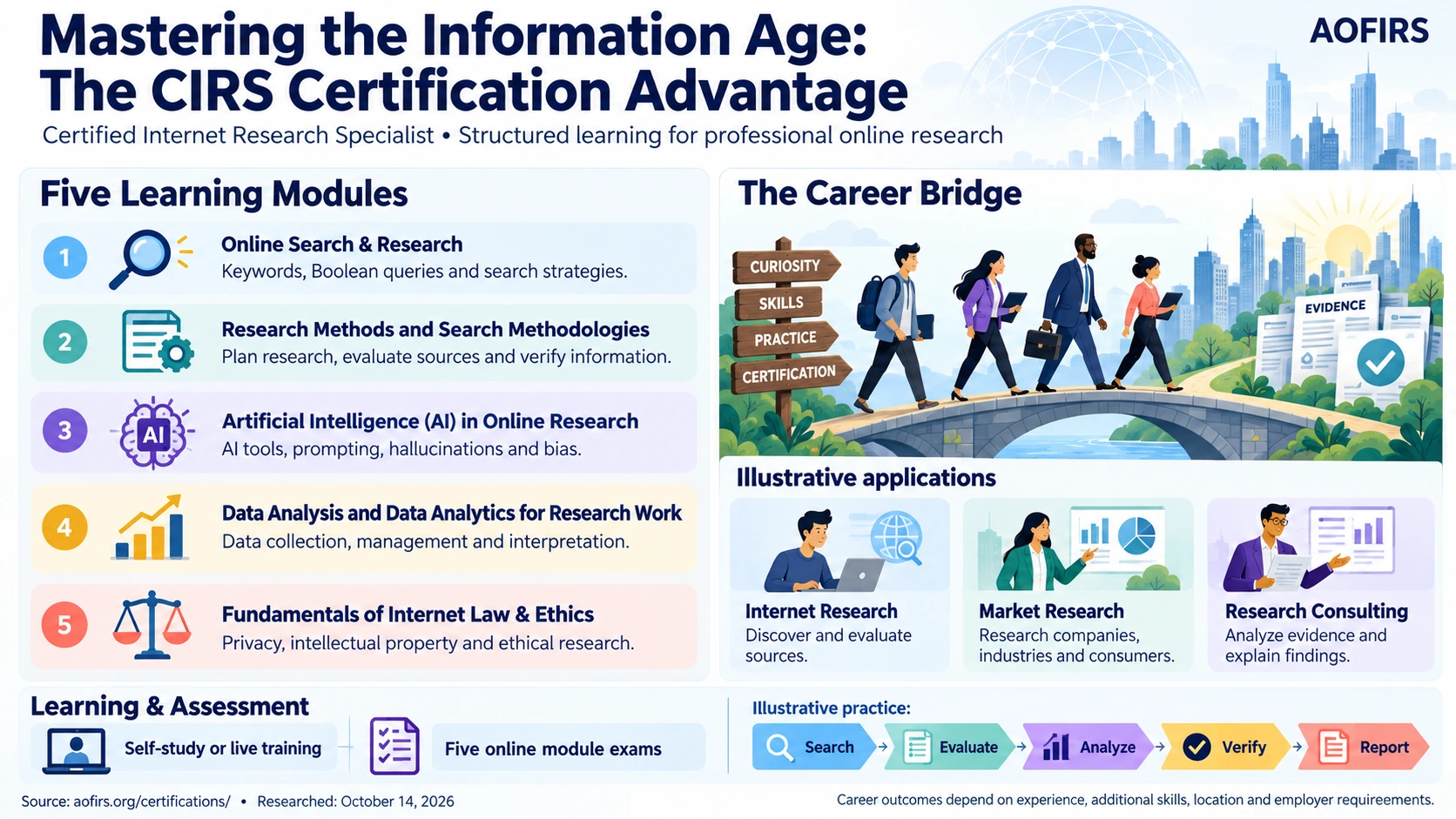
Master the balance between deep information retrieval and legal compliance. The CIRS Learning Package & Certification Program delivers comprehensive training on advanced online search methodologies, statutory compliance, OSINT verification protocols, and ethical investigative techniques.
Essential Research Resources
- The Modern Investigator’s Map: Navigating Public & Private Data
- Research Report: Verification Methods in Private & Public Information
- The Search Architect’s Toolkit: Advanced Search Methods & Precision Query Engineering
- Identifying Fakes in the AI Era: A Visual Verification Toolkit
- AI vs. The Hidden Web: The 2026 Reality Check
Frequently Asked Questions
What is the legal difference between public records and private personal data?
Public records are government-created documents maintained for civic transparency, such as court filings, deeds, corporate registries, and legislative dockets. Private personal data encompasses sensitive identifiers, financial balances, educational transcripts, and medical files protected from unwarranted disclosure under statutes such as the Privacy Act of 1974, FCRA, GLBA, and HIPAA.
Can an investigator legally obtain bank account balances under GLBA?
Under GLBA Section 6802(e)(3)(D), an investigator operating on an authorized post-judgment collection matter may identify the banking institution name, branch location, and general account type to evaluate collection viability. However, extracting exact balances or account numbers through pretexting or misrepresentation is strictly illegal and punishable under federal law.
How does the 2025–2026 data minimization shift affect OSINT investigations?
Legislation such as the Maryland MODPA and the California Delete Act moves beyond simple notice-and-consent, requiring organizations and investigators to collect only the minimum data strictly necessary for a stated lawful purpose. Bulk harvesting of irrelevant personal metadata is prohibited, and automated profiling tools require mandatory human oversight.
Why is visual redaction insufficient under modern metadata compliance standards?
Placing a black digital rectangle over sensitive text in a PDF document merely covers the display pixels; the underlying text string, document revision history, and XML metadata often remain fully readable by search engines and scrapers. True compliance requires permanent cryptographic scrubbing and source code sanitization.
What is the statutory firewall between ITIN numbers and immigration enforcement?
Individual Taxpayer Identification Numbers (ITINs) are issued by the IRS solely for tax processing. Under Internal Revenue Code Section 6103, federal tax filings and ITIN disclosures are strictly confidential, creating a statutory legal firewall that prevents the IRS from sharing taxpayer records with immigration enforcement authorities.
Published by the Association of Internet Research Specialists (AOFIRS). Updated October 2026.