Short answer: Professional investigative research requires balancing the democratic mandate for public transparency against statutory personal privacy protections. While government dockets, corporate filings, property deeds, and tax liens are legally accessible public records, sensitive identifiers such as Social Security numbers, credit histories, non-public banking data, and utility telemetry are shielded by federal statutes including the Privacy Act of 1974, FCRA, GLBA, and DPPA. Under modern 2026 standards, credentialed investigators must operate within the strict “Permissible Purpose” doctrine, deploy proportionate search depth protocols, and verify all automated findings against authenticated primary registers.

Figure 1: Comprehensive operational map detailing public records access, private data protections, permissible purpose doctrines, and professional search protocols.
Learn more: Examine the structured 14-slide presentation deck on Navigating the Boundary of Public and Private Information, read the definitive white paper on Verification Methods in Private & Public Information, and explore advanced cross-domain methodologies in The Search Architect’s Toolkit, Identifying Fakes in the AI Era, and AI vs. The Hidden Web.
The Foundational Divide: Transparency vs. Privacy
Modern online research operates at the intersection of two competing constitutional principles: the public right to inspect government conduct and the fundamental individual right to privacy:
Mandated Civic Transparency
Information officially entered into public registers and maintained by governmental bodies under statutory transparency mandates. Designed to prevent clandestine judicial proceedings, preserve commercial integrity, and enable civic oversight of democratic institutions.
Shielded Personal Spheres
Sensitive personal, financial, biometric, and medical records shielded from unauthorized commercial harvesting. The law presumes privacy unless an individual has deliberately and voluntarily placed those records into the public domain.
The Anatomy of Public Records: Primary Source Categories
Public records represent the bedrock of legitimate investigative verification. When conducting due diligence, forensic accounting, or background inquiries, credentialed analysts focus on three primary tiers of government filings:
Court Dockets & Judgments
- Criminal indictment filings, plea transcripts, and sentencing orders.
- Civil litigation complaints, motion dockets, and recorded settlement judgments.
- Bankruptcy filings (Chapter 7, 11, 13) via federal court electronic records (PACER).
- Probate records, estate petitions, and letters of administration.
County Recorder Registers
- Recorded warranty deeds, quitclaim instruments, and real estate conveyances.
- County tax assessor valuations, property tax payment histories, and parcel maps.
- Mortgage filings, deeds of trust, and promissory notes.
- Mechanics liens, municipal code violations, and lis pendens notices.
Secretary of State Registries
- Articles of incorporation, organization certificates, and statutory bylaws.
- Annual corporate filings listing officers, directors, and registered agents.
- Uniform Commercial Code (UCC-1) financing statements on collateralized equipment.
- State and municipal business licensing disclosures and trade name (DBA) filings.
The “Permissible Purpose” Mandate: Legal Thresholds for Sensitive Data
One of the most dangerous traps for online researchers is assuming that because a commercial database or broker contains sensitive identifiers, those data points are legally accessible for any purpose. Under federal statutory jurisprudence, access to restricted personal data requires a strictly documented Permissible Purpose:
| Governing Statute | Regulated Data Points | Mandatory Legal Threshold | Prohibited Investigative Conduct |
|---|---|---|---|
| Fair Credit Reporting Act (FCRA) | Credit scores, payment histories, background check dossiers, employment vetting | Explicit written authorization from the consumer and a certified permissible purpose (e.g., credit extension, employment screening, tenancy evaluation). | Extracting consumer reports for informal curiosity, unverified personal vetting, or unauthorized commercial profiling. |
| Gramm-Leach-Bliley Act (GLBA) | Non-public banking balances, financial account numbers, credit card transaction streams | Statutory exceptions under 15 U.S.C. § 6802(e)(3)(D) for post-judgment debt collection, authorized fraud investigations, or formal court subpoenas. | Pretexting financial institutions, impersonating account holders, or buying unauthorized ledger dumps. |
| Driver’s Privacy Protection Act (DPPA) | State Department of Motor Vehicles (DMV) driver licensing, registered vehicle titles, residential addresses | Fourteen narrow statutory exceptions under 18 U.S.C. § 2721 (e.g., official court litigation, auto recall notices, insurance underwriting, commercial fleet verification). | Querying state motor vehicle registries for personal curiosity, stalking, political research, or unapproved commercial marketing. |
| Privacy Act of 1974 | Social Security Numbers (SSNs), federal personnel dockets, military service records | Explicit statutory authorization for mandated tax collection, court-ordered fraud prosecutions, or written subject waiver. | Publishing unredacted SSNs, exploiting illegal database breaches, or acquiring leaked identity matrices. |
Professional Search Protocols: The Three Core Methodologies
To convert raw records into legally admissible, actionable intelligence, the CIRS™ investigative standard defines three rigorous procedural workflows:
Locating Relocated Subjects
Methodical geolocation and contact retrieval for elusive debt evaders, witnesses, or heirs. Involves analyzing utility connect histories (within 90-day active windows), postal forwarding databases, historical address clusters, corporate registered agent listings, and professional licensing registries.
Concealed Wealth Mapping
Systematic tracing of real property, corporate equity, commercial aircraft, maritime vessels, and financial balances to satisfy enforceable civil judgments. Correlates county deed indices, UCC collateral liens, offshore corporate filings, and legitimate GLBA judgment recovery queries.
Comprehensive Background Audits
A multi-layered forensic inquiry evaluating C-suite candidates, potential merger partners, or high-profile vendors. Integrates civil litigation dockets, bankruptcy history, regulatory sanction lists, adverse media analysis, and corporate entity structure mapping.
The Investigator’s Depth Gauge: Scoping Search Breadth Proportionately
A certified researcher matches the depth of inquiry to the legal scope and evidentiary requirements of the assignment:
| Investigation Level | Primary Application | Key Data Sources | Compliance & Evidentiary Rules |
|---|---|---|---|
| Level 1: Surface Verification | Basic identity confirmation & vendor pre-qualification | State corporate registries, business websites, professional licensing portals, social media verification | Verify active corporate standing; authenticate web domain registrations; maintain digital source archives. |
| Level 2: Public Record Inquest | Litigation support & tenant/employee due diligence | County property records, municipal tax dockets, civil court indices, open criminal records | Enforce strict FCRA compliance if output impacts hiring or housing; confirm identity matches across full DOB. |
| Level 3: Multi-Jurisdictional Tracing | Skip tracing, complex fraud & judgment enforcement | State UCC databases, federal bankruptcy registers (PACER), cross-state deed indexes, vehicle registries (DPPA compliant) | Document permissible purpose certifications; log every query in a tamper-evident audit trail; confirm current address viability. |
| Level 4: Forensic Asset & Corporate Mapping | High-stakes M&A, international arbitration, offshore recovery | Cross-border corporate registers, maritime registries, FAA aircraft dockets, beneficial ownership transparency filings | Audit multi-national privacy boundaries (GDPR, LGPD, PIPL); scrub extracted metadata; establish formal chain of custody. |
Watch: Media Reality Splits & Narrative Verification
Investigative researchers frequently encounter distorted public information narratives, coordinated media spin, and synthetic reality splits. Watch this essential AOFIRS masterclass on narrative bias, reality splits, and investigative verification methodologies:
The 2026 Regulatory Landscape: Data Minimization & Automated Profiling
The transition between 2024 and 2026 introduced strict statutory restrictions on how personal data can be aggregated, analyzed, and stored by private investigators:
1. The Shift to Statutory Data Minimization
Historically, investigators and data aggregators collected comprehensive personal profiles under broad notice-and-consent provisions. Pioneered by the Maryland Online Data Privacy Act (MODPA) and mirrored in comprehensive privacy statutes across New Jersey, Minnesota, and Rhode Island, current law mandates strict data minimization: entities are prohibited from collecting or retaining sensitive personal records unless strictly necessary for a specified, lawful transaction.
2. Regulating Automated Decision-Making Technology (ADMT)
Modern statutes strictly regulate the deployment of artificial intelligence algorithms and automated scoring engines in background investigations. When an investigative report impacts an individual’s credit, employment, or housing eligibility, algorithms cannot act autonomously. Laws mandate transparent logic disclosure, regular algorithmic bias audits, and mandatory human-in-the-loop verification prior to report finalization.
3. Data Broker Accountability: The California Delete Act
Under the California Delete Act, all commercial data brokers, investigative repositories, and people-search portals must register annually with the California Privacy Protection Agency (CPPA) and connect to a unified deletion mechanism. Certified researchers must ensure that commercial databases utilized in due diligence comply with state registry mandates.
Ethical Red Lines & Best Practices for Certified Researchers
To protect client confidentiality, preserve legal admissibility, and avoid civil and criminal liability, every investigator must adhere to these non-negotiable operational standards:
Criminal & Civil Liabilities
- No Pretexting: Never misrepresent identity or use deceptive representations to induce financial institutions, telecom carriers, or hospitals to release private records.
- No Wiretap or Hacking Exploits: Deploying spyware, exploiting unauthorized database backdoors, or intercepting private electronic communications violates the Computer Fraud and Abuse Act (CFAA).
- No Dark-Web Credential Ingestion: Ingesting stolen database dumps or leaked identity dossiers exposes investigators to receiving stolen property charges.
Operational Integrity & Evidence
- Primary Source Verification: Never rely on third-party aggregators as final truth. Always pull the certified court pleading, county deed, or corporate charter.
- Cryptographic Hashing: Generate SHA-256 hashes of digital evidence immediately upon acquisition to verify chain of custody in judicial proceedings.
- Audit Trail Documentation: Maintain written logs documenting the permissible purpose, statutory justification, and query parameters for every investigative search.
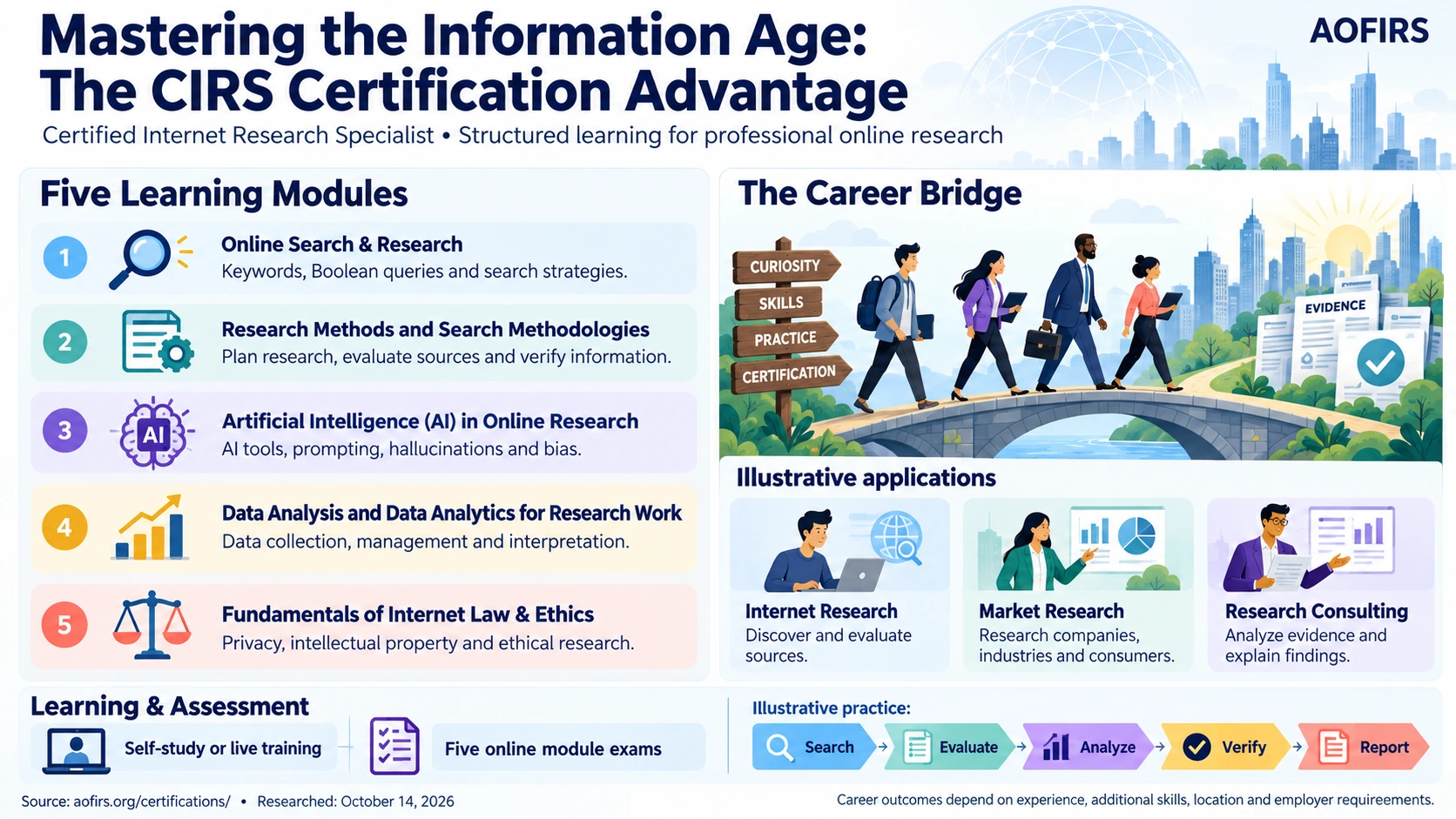
Become a Certified Internet Research Specialist (CIRS™)
Bridge the gap between advanced open-source intelligence and professional legal compliance. The CIRS Learning Package & Certification Program provides deep-dive training on cross-engine syntax, public records retrieval, legal firewalls, and ethical investigation protocols.
Essential Investigative Resources
- Navigating the Boundary of Public and Private Information: 14-Slide Deck & Architectural Guide
- Research Report: Verification Methods in Private & Public Information
- The Search Architect’s Toolkit: Advanced Search Methods & Precision Query Engineering
- Identifying Fakes in the AI Era: A Visual Verification Toolkit
- Spotting the Shadows: A Researcher’s Guide to Identifying Fake Websites
- AI vs. The Hidden Web: The 2026 Reality Check
Frequently Asked Questions
What types of records are classified as official public records?
Official public records include documents filed with and maintained by government bodies for public transparency. Key examples include recorded property deeds, mortgage filings, civil and criminal court dockets, bankruptcy filings, corporate registration charters, and tax assessment rolls.
What legal requirements govern accessing an individual’s credit report or SSN?
Under the Fair Credit Reporting Act (FCRA) and the Privacy Act of 1974, accessing consumer credit reports or sensitive identification numbers requires an explicit statutory permissible purpose (such as credit underwriting, employment screening with consent, or court-mandated debt recovery) and formal compliance certification.
How does the Gramm-Leach-Bliley Act (GLBA) apply to asset searches?
Under GLBA Section 6802(e)(3)(D), investigators operating on authorized post-judgment collection or fraud recovery matters may identify banking institution names and branch locations to determine collection viability. However, extracting exact balances or account numbers through pretexting or false representations is a federal crime.
What is skip tracing, and what tools are legally permissible?
Skip tracing is the process of locating elusive subjects or witnesses. Permissible methods include analyzing 90-day active utility connection records, postal forwarding databases, historical address clusters, corporate filings, and public court records. Deploying real-time cell phone geolocation pings or pretexting carrier customer service is strictly illegal.
Why is human verification mandatory for automated AI background checks in 2026?
Modern state privacy statutes and Automated Decision-Making Technology (ADMT) regulations mandate human oversight to prevent algorithmic discrimination, false positive identity mismatches, and data minimization violations before any automated report can impact an individual’s legal or financial standing.
Published by the Association of Internet Research Specialists (AOFIRS). Updated October 2026.