
To explore complementary diagnostic frameworks, examine the foundational visual slides in Identifying Fakes in the AI Era: A Visual Verification Toolkit for Investigators, review our investigation of search blind spots in AI vs. The Hidden Web, and read the comprehensive analytical report in Identifying Fakes in Website Content Pages.
The AI-Era Threat Landscape: Scale, Speed, and Automation
The economics of digital fraud have transformed fundamentally. Creating a convincing fake website formerly required manual web design, copywriting, domain spoofing, and backend integration—limiting the volume of active campaigns. In 2026, large language models (LLMs), neural rendering pipelines, and automated scraping frameworks allow threat actors to deploy thousands of bespoke, highly convincing phishing and impersonation nodes within hours.
Identified semi-annually by the Anti-Phishing Working Group (APWG), driven by autonomous cloning toolkits.
Share of global phishing infrastructure created autonomously via programmatic LLM deployment scripts.
Unaided human accuracy when differentiating synthetic deepfake faces from authentic portraits—barely above coin-flip chance.
Compounding this challenge is the financial velocity of synthetic impersonation: U.S. financial losses directly attributed to deepfake fraud and cloned corporate portals have exceeded $1.1 Billion annually, with European Parliament and cybersecurity research forecasts projecting over 8 Million synthetic deepfake vectors circulating online simultaneously.
Three Pillars of Professional Verification Red Flags
Because synthetic generators produce syntactically polished prose and visually stunning layouts, traditional heuristics like checking for spelling errors or looking for the browser padlock are obsolete. Professional researchers rely on three structural anomalies:
Scammers scrape legitimate corporate visual assets or generate fictitious executive leadership using text-to-image models. Cross-referencing portrait images against stock image repositories and professional identity graphs immediately exposes synthetic personas.
Key Indicator: Reused headshots across disparate corporate domains or identical ear/pupil GAN artifacts.
Threat actors routinely clone Terms of Service, Privacy Policies, and Refund Agreements verbatim from legitimate enterprises, swapping only the visible brand name while leaving original corporate entity numbers, address fragments, or typos intact.
Key Indicator: Exact-phrase Google queries reveal the same policy string across dozens of unrelated storefronts.
To expedite deployment, fraudulent sites frequently implement superficial interface facades: homepages assembled from flattened screenshot banners, navigation menus where secondary links route to #, and fake review carousels without interactive state.
Key Indicator: Broken breadcrumbs, dead footer links, and unlinked social media icon widgets.
Masterclass: The 5-Step Fraud Audit for Cloned Websites
When assessing an unfamiliar domain or corporate portal, investigators follow a standardized 5-step operational protocol to expose AI-generated facades, assess server provenance, and verify digital legitimacy.
Investigative Protocol: Heuristics vs. Systematic Forensics
The table below summarizes the operational shift required when auditing modern digital assets:
| Investigation Layer | Superficial / Outdated Heuristic | Professional OSINT Verification Protocol | Primary Forensic Tools |
|---|---|---|---|
| Domain & Registration | Assuming HTTPS padlock guarantees security | Inspect registration creation timestamp, registrar history, DNS hosting clusters, and ASN allocation | WHOIS lookup, SecurityTrails, ViewDNS, Shodan |
| Visual & Leadership Identity | Checking if executive headshots look professional | Reverse image search, facial symmetry analysis, eye pupil reflection checks, and cross-platform identity corroboration | Google Lens, TinEye, Yandex Visual, PimEyes |
| Legal & Policy Text | Skimming for professional legal terminology | Quoted exact-phrase search on specialized clauses to reveal shared boilerplate across deceptive networks | Google Advanced Operators, Sourcegraph, PublicWWW |
| DOM & Navigation Interface | Testing whether the main checkout or contact button works | Inspect anchor tags for stubbed href="#", verify external social profiles, check for flattened canvas images |
Chrome DevTools, Wappalyzer, WayBack Machine |
| Corporate Entity Presence | Trusting the physical address listed in the footer | Cross-reference jurisdictional registry filings, verify virtual office addresses, and check trade license registries | OpenCorporates, SEC EDGAR, Companies House, Google Street View |
Advanced Google Dorking for Cloned Website Detection
Investigators can uncover syndicated phishing rings and cloned page networks using targeted Google search operators:
“This Privacy Policy governs the manner in which” AND “support@customercare-billing.com” -site:targetcompany.com
# Locate unindexed subdirectories or staging environments:
site:suspectdomain.com (inurl:admin | inurl:login | inurl:staging | inurl:test | inurl:dev)
# Identify identical copyright notices across unrelated infrastructure:
“© 2026 All Rights Reserved” “Authorized Reseller” intext:”terms and conditions” -site:authorizedpartner.com
Master Digital Verification & Online Investigation
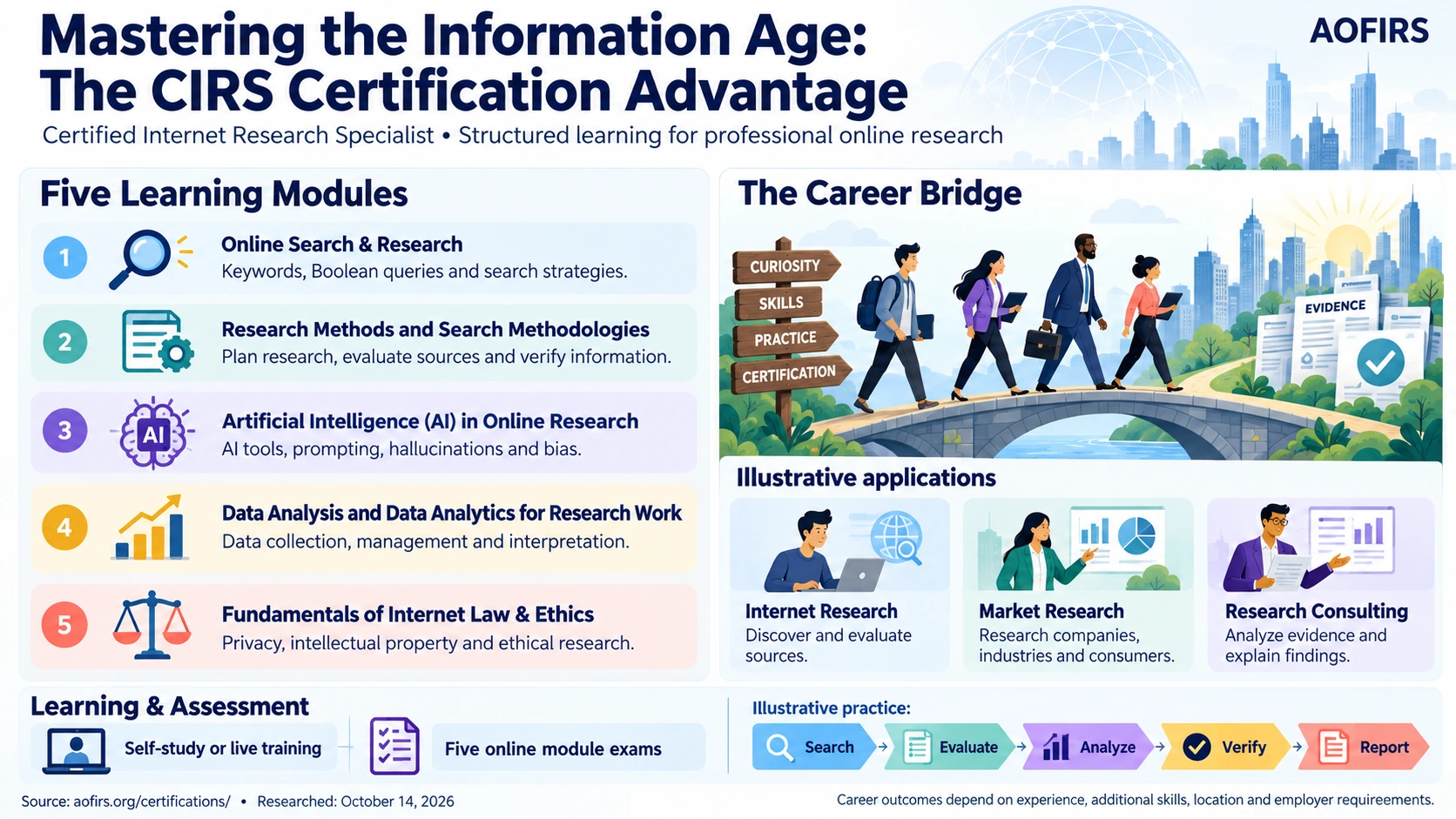
Equip yourself with industry-standard OSINT workflows, open-source intelligence frameworks, and forensic information verification methodologies through the Certified Internet Research Specialist (CIRS) program.
Essential Research Resources & Verification Toolkits
Continue strengthening your investigative skill set with specialized resources from the AOFIRS knowledge network:
- Online Investigative Research & Verification Methods Course — Hands-on field training in digital asset tracking and corporate fraud detection.
- Identifying Fakes in Website Content Pages (Research Report) — Deep technical study on forensic website analysis.
- Identifying Fakes in the AI Era: Visual Verification Toolkit — 15-slide operational deck covering visual anomalies and scam signals.
- The AI Trust Illusion: Why Language Models Sound Confident When Wrong — Analysis of automated consensus traps.
- AOFIRS Masterclass Video Archive — Full library of investigative tutorials and digital forensic lectures.
Frequently Asked Questions
Why is the HTTPS padlock no longer an indicator of website trust?
SSL/TLS certificates have been fully automated and provided free of charge (via automated certificate authorities like Let’s Encrypt) for years. Obtaining an SSL certificate requires only proving ownership of a domain name, not organizational verification. Threat actors routinely generate valid SSL certificates within seconds of registering a fraudulent domain to bypass basic browser security warnings.
How can researchers distinguish AI-generated portraits from authentic photos?
Generative adversarial networks (GANs) and diffusion models frequently leave microscopic anomalies: mismatched earrings, inconsistent background lighting, irregular pupil shapes, blurred hair boundaries against high-contrast backgrounds, and identical eye positions across different faces. Cross-referencing executive names against active LinkedIn profiles, publications, and external conference appearances provides definitive corroboration.
What is an exact-phrase search and why is it effective against cloned sites?
Enclosing a unique sentence from a site’s Privacy Policy, Terms of Service, or About Us section in quotation marks (e.g., "We take your privacy seriously and guarantee satisfaction under license number") forces search engines to return only exact matches. Fraudsters rarely write bespoke legal copy; querying distinct sentences often exposes the entire ring of cloned websites sharing the same template.
What are the first three checks an investigator should conduct on a suspicious URL?
First, check domain registration age via WHOIS (newly registered domains under 90 days carry high risk). Second, test navigation links and footer elements to see if they resolve to valid unique endpoints rather than empty hashes (#). Third, perform a reverse image search on corporate logos and leadership headshots.