AI has made it much faster to find information, but faster retrieval does not mean better verification. An AI-generated answer can cite a real source while misrepresenting what that source actually says. A search result can point to a legitimate website while presenting an outdated or incomplete claim. A statement can also appear across multiple websites without those websites providing independent evidence.
For professional researchers, the central question is therefore not simply whether information looks credible. It is:
What exactly is being claimed, where did the information come from, what evidence supports it, and can that evidence be independently verified?
A practical verification process can be reduced to:
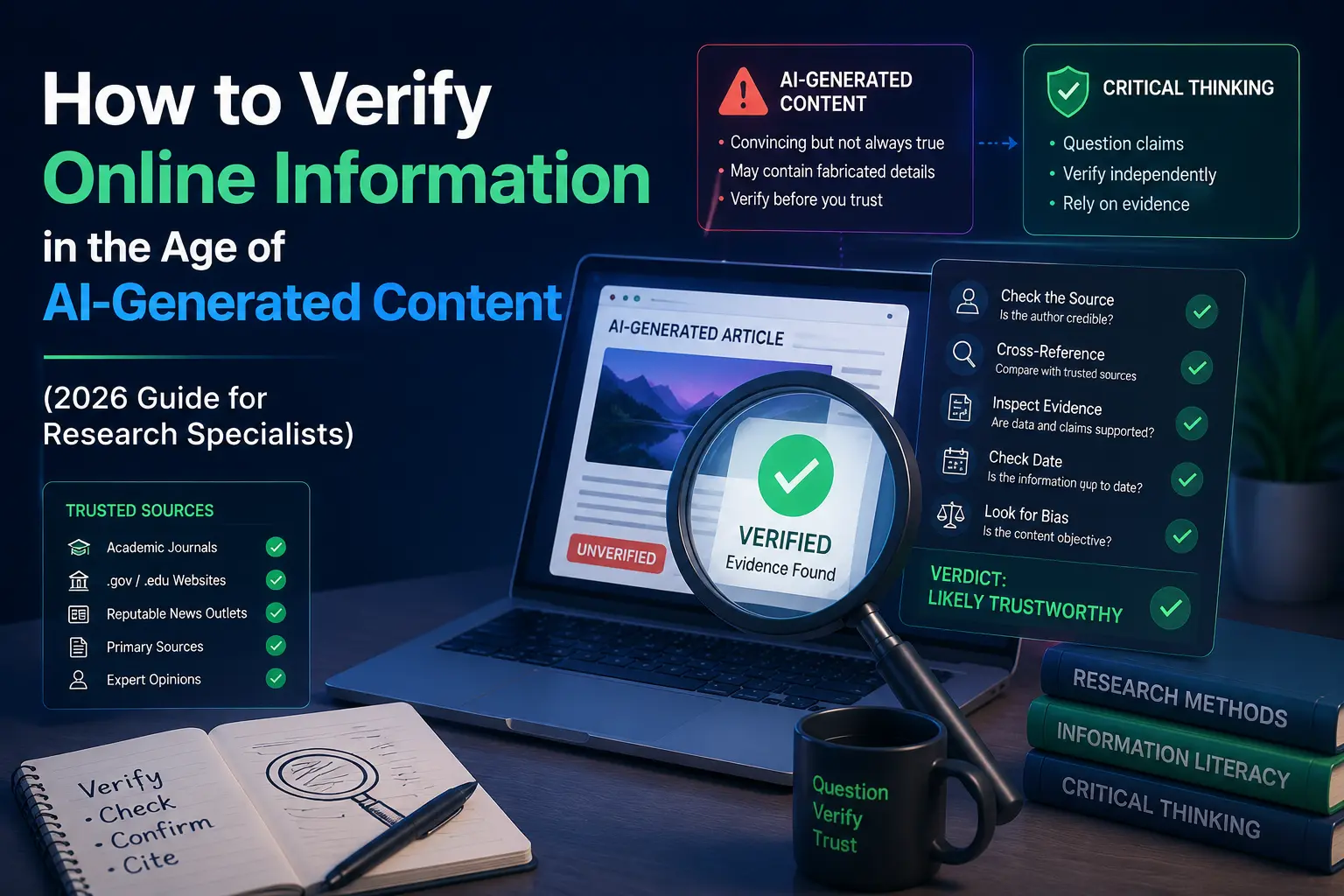
Claim → Source → Citation → Context → Corroboration → Documentation
This method matters especially when researching information retrieved or summarised by AI systems.
How to Verify an Online Claim
Verify online information claim by claim rather than accepting it as one complete block. Start by identifying the exact statement you need to establish, then trace it back to its source and test whether the evidence supports it.
1. Isolate the Claim
Before searching for evidence, identify the specific factual statement you need to verify.
For example:
“Company X received a government penalty in 2026.”
That statement contains several elements that may need separate verification:
- the identity of Company X;
- the existence of a government action;
- the type of action;
- the date;
- the amount or consequence, if stated;
- the government agency involved.
Do not attempt to verify an entire paragraph as though it were one claim.
Break complex statements into individual claims and verify each material element separately.
This is especially important with AI-generated answers because one response can combine accurate facts, outdated information, unsupported assumptions, and incorrect citations in the same paragraph.
2. Trace the Claim to the Original Source
Once you isolate the claim, determine where the information originated.
A useful source trail may look like this:
AI answer → article → cited report → original source
Or:
Social media post → news article → organization statement → official record
The further you move from the original source, the greater the risk that information has been summarised, interpreted, shortened, or taken out of context.
- If an article cites a government report, open the government report.
- If an AI answer cites an article, open the article.
- If the article cites a study, locate the study.
The objective is to verify the claim against the strongest available source, not simply confirm that another website repeated it.
3. Check Whether the Citation Supports the Claim
A citation can exist and still fail to support the statement attached to it.
Check five things:
| Citation check | Question |
| Exists | Does the cited source actually exist? |
| Identity | Is it the source identified by the author or AI system? |
| Relevance | Does the source actually discuss the subject? |
| Support | Does it support the specific claim being made? |
| Interpretation | Has the claim been extended beyond what the source actually establishes? |
The final question is particularly important.
A source may say:
“The study found an association between A and B.”
An article may then state:
“The study proved that A causes B.”
Those statements are not equivalent.
The citation may be genuine. The subject may be correct. The source may be authoritative. Yet the claim can still be unsupported because the interpretation goes beyond the evidence.
4. Read the Source, Not Just the Citation
Opening a citation is only the beginning.
Locate the specific passage, table, dataset, filing, statement, or evidence that supposedly supports the claim.
Check the surrounding context.
Ask:
- What does the source actually say?
- Who produced the information?
- What date does it refer to?
- What population or geographic area does it cover?
- Are there qualifications or limitations?
- Is the cited passage describing a finding, opinion, estimate, allegation, or established fact?
Treat a citation as a path to evidence, not as proof by itself.
5. Read Laterally
Do not evaluate a source only by reading the source itself. Read laterally by opening additional sources to establish who produced the information, what evidence supports it, and how other credible sources describe the same claim.
For example, if you encounter an unfamiliar organization making a major factual claim, search for:
- independent reporting;
- official records;
- primary documents;
- relevant academic research;
- statements from authoritative organizations;
- other independent sources.
The purpose is not to find another website that repeats the same statement. The purpose is to determine whether independent evidence supports it.
6. Check Date, Context and Scope
A source can be authentic and still be unsuitable for the claim.
Before accepting evidence, check:
Date: Is the information current enough for the question?
Context: Does the source mean what the article or AI response says it means?
Scope: Does the evidence apply to the same country, industry, population, organization, or situation?
Version: Are you looking at the relevant version of the document, policy, dataset, or webpage?
A genuine statistic from 2019 does not automatically answer a question about 2026.
Likewise, research conducted on one population should not automatically be presented as evidence about another.
7. Corroborate With Independent Evidence
Compare important claims with independent evidence whenever possible.
Independence matters.
Five websites repeating the same press release are not necessarily five independent sources.
Look for evidence produced separately, such as:
- government records;
- primary documents;
- academic research;
- official company filings;
- independent reporting;
- professional databases;
- original datasets.
The goal is not to collect the largest number of sources. It is to determine whether different lines of evidence support the same conclusion.
8. Record Conflicting Evidence
Verification does not always produce a simple true-or-false answer. Credible sources can disagree because they use different dates, definitions, datasets, methodologies, or reporting standards. When sources conflict, record the disagreement rather than selecting the source that best fits the original claim.
Ask:
- What exactly do the sources disagree about?
- Are they using the same definition?
- Are they referring to the same period?
- Do they use different datasets?
- Is one source closer to the underlying event?
- Can a primary record resolve the disagreement?
If it cannot be resolved, the appropriate conclusion may be that the claim remains disputed or unverified.
How to Verify AI-Generated Information
AI-generated answers require the same verification discipline as other online information, but they introduce an additional problem: the answer may combine information from multiple sources without making the relationship between each claim and its evidence clear.
An AI response can also provide a citation that is real but does not support the exact statement being made.
For that reason, treat an AI answer as a research lead, not as the final evidence.
Break the AI Answer Into Individual Claims
Do not fact-check an entire AI response at once.
Extract the factual claims that matter to your research.
For each claim, identify:
- what is being asserted;
- the source cited by the AI system;
- whether the source exists;
- whether the source is authoritative;
- whether the source supports the specific claim;
- whether additional evidence is required.
This turns a general AI response into a series of verifiable research questions.
Check Every Important AI Citation
When an AI system provides a citation, follow the link to the underlying source.
Then compare the AI’s statement with the actual source.
A useful sequence is:
AI claim → cited source → relevant passage → independent source
Do not stop when the citation opens successfully.
A working URL does not establish that the citation supports the claim.
Look for Unsupported Inferences
AI systems can move from evidence to interpretation without clearly identifying the transition.
For example, a source may report that two events occurred at approximately the same time.
An AI response might then imply that one event caused the other.
That conclusion requires additional evidence.
Researchers should therefore identify the difference between:
What the source states
and
What the AI system concludes from the source.
The second requires separate verification.
Check for Missing Context
An AI-generated summary can accurately reproduce a sentence while leaving out information that changes its meaning.
Check whether the source includes:
- limitations;
- exceptions;
- uncertainty;
- methodological qualifications;
- later updates;
- conflicting findings.
The shorter an AI summary becomes, the more important context checking can become.
Document the AI Retrieval
For professional research, record enough information to reconstruct how the AI-assisted finding was obtained.
| Field | What to record |
| AI system | Tool and relevant mode or model, where available |
| Date and time | When the retrieval occurred |
| Prompt | Exact research prompt |
| Response | Relevant AI-generated text |
| Citations | Sources supplied by the system |
| Sources opened | Sources actually reviewed |
| Claims checked | Material claims verified |
| Conflicting evidence | Relevant disagreement or limitation |
| Final status | Verified, partially supported, disputed, or unverified |
This record is particularly useful when AI is used repeatedly during a research project. AI responses can change over time. Recording the retrieval allows another researcher to understand what was actually returned and which sources were subsequently checked.
How to Verify Statistics and Data
Treat numbers as claims that require evidence.
When an article, report, social post, or AI system provides a statistic, trace it to the original dataset, study, survey, government record, or other primary source where possible.
Then check:
- publication date;
- sample or population;
- geographic scope;
- measurement period;
- methodology;
- definitions;
- units;
- whether the number is an estimate or observed value.
Do not assume that a statistic is reliable simply because it appears precise. A precise number without appropriate context can still be misleading. If an AI response gives a statistic, verify the number against the cited source and determine whether the source actually reports the same figure.
How to Evaluate the Source Behind a Claim
Source quality matters, but source reputation should not replace evidence checking.
A professional evaluation should consider:
- who produced the information;
- why it was produced;
- what evidence supports it;
- whether the source identifies its methodology;
- whether the information is current;
- whether relevant limitations are disclosed;
- whether independent sources corroborate the claim.
A familiar organization can publish an incorrect statement, while an unfamiliar source can contain valuable primary evidence.
The question is therefore not simply:
“Is this a trustworthy website?”
It is:
“What evidence does this source provide for this particular claim?”
How Researchers Document Verification
A documented verification process makes research easier to review, reproduce, and defend.
For each important claim, record the original source, relevant evidence, access date, corroborating sources, conflicting information, and final assessment.
A useful status system is:
| Status | Meaning |
| Verified | Appropriate evidence supports the claim. |
| Partially supported | Some elements are supported, but the complete statement goes beyond the evidence. |
| Disputed | Credible sources provide conflicting information. |
| Unverified | Available evidence is insufficient to establish the claim. |
This approach is more useful than forcing every finding into a simple true-or-false category.
For example, if an AI system reports a figure but the cited source cannot be located, the correct status may be unverified. If the source exists but supports only part of the AI’s statement, the finding may be partially supported.
If two credible primary sources provide different figures for the same period, the finding may be disputed until you can explain the difference.
What If You Cannot Verify a Claim
Not every online claim can be conclusively verified.
When evidence is insufficient, document the limitation.
Do not turn:
“I could not verify this.”
into:
“This is false.”
Likewise, do not treat repetition as proof.
A claim repeated across many websites may still trace back to one unsupported source.
Professional research should make uncertainty visible rather than hiding it.
Online Information Verification Checklist
Before relying on an important online claim, ask:
- Have I isolated the exact claim?
- Have I identified the original source?
- Does the cited source actually exist?
- Is it the source represented by the author or AI system?
- Does the source support the specific claim?
- Have I read the relevant passage rather than relying on a citation alone?
- Have I checked the date and context?
- Does the evidence apply to the correct population, location, and period?
- Have I read laterally?
- Have I checked independent sources?
- Have I looked for conflicting evidence?
- If AI was involved, have I recorded the prompt, response, citations, and sources reviewed?
- Have I documented what remains uncertain?
- Have I assigned an appropriate verification status?
If the answer to several of these questions is no, the claim may require further research before it is treated as established information.
Frequently Asked Questions
How do you verify information found online?
Start by isolating the specific claim, tracing it to the original source, checking whether the citation supports the claim, reading the source in context, comparing independent evidence, and documenting the result.
How do I verify an AI-generated answer?
Break the answer into individual factual claims. Follow each important citation to its underlying source, check whether the source supports the claim, look for missing context or unsupported inferences, and corroborate important information with independent evidence.
How do I verify an AI citation?
First, confirm that the cited source exists. Then confirm it is the source the AI system identified, locate the relevant passage, and determine whether that passage supports the specific claim in the AI response.
What is claim isolation?
Claim isolation is the process of breaking a larger statement or paragraph into individual factual claims that can be independently tested against evidence.
What is lateral reading?
Lateral reading means evaluating a source by leaving the source and checking other independent sources to establish its origin, credibility, context, and supporting evidence.
What should I do when credible sources disagree?
Identify exactly what the sources disagree about, compare their dates, definitions, methodologies, and proximity to the underlying evidence, and document the disagreement if you can’t resolve it.
What does “unverified” mean in research?
“Unverified” means the available evidence is not sufficient to establish the claim. It does not necessarily mean that the claim is false.
Conclusion
Verifying online information in the AI era requires more than checking whether a website looks professional or whether an AI answer includes citations.
- The strongest approach is systematic: Identify the claim. Trace the source. Check the citation. Read the evidence. Read laterally. Check context. Corroborate independently. Document the result.
- For AI-assisted research, add one more discipline: record how you retrieved the information and which sources you actually checked.
The objective is not to prove every claim true or false as quickly as possible. It is to establish what the available evidence supports, identify what remains uncertain, and make the verification process transparent enough for another researcher to examine.