In 2026, social media intelligence (SOCMINT) has transitioned from an informal monitoring activity into an indispensable forensic discipline. Spanning over 5.24 billion global active users—representing more than 64% of the world’s population—digital networks generate massive repositories of real-time intelligence. However, as AI-generated content (AIGC) surges to an estimated 15–20% of all public posts and synthetic personas proliferate across walled gardens, isolating verified signal from algorithmic noise requires rigorous methodologies combining agentic investigation, visual chronolocation, and predictive behavioral modeling.

The 2026 Digital Landscape: Navigating the 5.24 Billion User Deluge
The contemporary information ecosystem is characterized by unprecedented scale, velocity, and complexity. Social media platforms are no longer secondary channels of casual communication; they have become the primary recording medium for eyewitness events, corporate developments, geopolitical conflict, and consumer sentiment.
Over 64% of the global population is active on social media networks, generating petabytes of real-time multi-format data every second.
The World Economic Forum (WEF) ranks misinformation and disinformation as the top short-term global threat for the second consecutive year.
Synthetic posts, AI avatars, and LLM-assisted bots now constitute an estimated one-fifth of all publicly indexed social media content.
This massive volume gives social media research a unique ability to uncover qualitative insights on a quantitative scale. However, this scale introduces the data deluge paradox: the sheer volume of conversations obscures factual signal behind manufactured consensus, commercial promotion, and coordinated inauthentic behavior. For CIRS™-certified analysts, overcoming this challenge requires moving beyond raw data harvesting to structured verification frameworks.
Advanced AI Investigative Tools: From Passive Aggregation to Agentic Reasoning
Traditional social media monitoring relied on static keyword alerts, basic sentiment scrapers, and Boolean search strings. In 2026, forensic analysts deploy a new generation of cognitive tools designed to analyze contextual relationships and model complex information trajectories:
Predictive Trend Modeling
Modern machine learning models forecast sociocultural and behavioral shifts up to 90 days in advance. By modeling lexical momentum, semantic diffusion, and cluster propagation across fragmented sub-networks, analysts detect emerging crises before they surface in mainstream reporting.
Agentic AI Investigation
Autonomous AI agents no longer operate as passive scrapers; they actively reason, synthesize hypotheses, and simulate behavioral scenarios. Multi-agent frameworks orchestrate cross-platform entity resolution, trace sockpuppet funding trails, and map coordinated bot swarms in real time.
GeoSeer Visual Geolocation
When platforms strip EXIF metadata from uploaded images and videos, multimodal AI systems determine precise GPS coordinates. By cross-referencing architectural silhouettes, botanical vegetation distributions, infrastructure signage, and solar shadow vectors (SunCalc), tools pinpoint coordinates without explicit location tags.
Platform Research Value Matrix: Cross-Ecosystem Tradecraft
Different social ecosystems present distinct evidentiary affordances, algorithmic architectures, and threat vectors. Professional researchers must tailor their collection and verification protocols to the native characteristics of each platform:
| Platform | Primary Research Value | Key Intelligence Methods | Forensic Vulnerabilities & Risks |
|---|---|---|---|
| Corporate hierarchy mapping, executive attribution, B2B procurement tracing, employee movement, vendor due diligence. | Advanced Boolean syntax, search field operators, company employee cross-referencing, alumni network tracing. | Fabricated corporate credentials, AI-generated executive profile photos, ghost shell-company pages. | |
| TikTok | Emerging cultural trends, Gen Z behavioral patterns, hyper-local breaking video, meme-driven disinformation tracking. | Audio fingerprint tracking, hashtag velocity monitoring, stitch/duet narrative mapping, viral trend deconstruction. | Aggressive algorithmic echo-chambers, non-chronological feeds, ephemeral video editing masking real dates. |
| Consumer sentiment, demographic modeling, local community dynamics, marketplace fraud, hyper-local group intelligence. | Facebook IQ vertical insights, audience demographic analysis, group post graph queries, public page history audits. | Commercial click farms, automated engagement bait, synthetic group administrators, closed-group opacity. | |
| X (Twitter) | Real-time crisis monitoring, geopolitical breaking news, official government communiqués, narrative emergence tracking. | List curation, advanced search filters (until:, since:, min_faves:), timestamp forensics, retweet cascade mapping. | Coordinated bot swarms, paid verification spoofing, algorithmic manipulation of trending topics. |
| YouTube | Long-form evidentiary footage, technical demonstrations, eyewitness livestream archives, propaganda propagation. | Frame-by-frame scrubbing, reverse thumbnail indexing, comment section sentiment analysis, transcript NLP parsing. | AI voice cloning, generative video b-roll inserts, decontextualized historical re-uploads. |
Video Masterclass: The OSINT Architecture — Raw Data to Predictive Intelligence
Detecting Synthetic Content & Inauthentic Networks
The proliferation of generative AI has fundamentally altered the threat landscape. Today, malicious actors deploy multimodal AI to construct entirely synthetic digital personas that mimic genuine human activity over months before executing targeted influence operations.
According to the AOFIRS Social Media Intelligence Training Guide, researchers must categorize and evaluate AI-generated content across three operational tiers:
- AIGC Type 1 (Textual Generation): LLM-generated commentary designed to flood public comment sections, skew algorithmic engagement, and create an illusion of public consensus. Detection relies on perplexity scoring, repetition metrics, and stylized syntax markers.
- AIGC Type 2 (Multimodal Visual & Audio): Photorealistic synthetic headshots (StyleGAN) and cloned voice notes. Detection focuses on ocular reflections, pupillary asymmetry, earlobe topology, and spectral voice inconsistencies.
- AIGC Type 3 (Autonomous Agent Networks): Coordinated swarms of automated personas that converse with one another, share varied content, and react dynamically to breaking news to evade traditional rate-limit heuristic filters.
Legal Restrictions, Privacy Compliance & Ethical Boundaries
Social media intelligence is subject to stringent regulatory boundaries. Operating ethically and legally is vital to maintain evidentiary admissibility and prevent civil liability:
1. Privacy Compliance (PIPEDA, GDPR, CCPA): Canadian privacy law (PIPEDA/PIPA) and European regulations (GDPR) strictly regulate the collection and storage of personal information from social networks. Collecting publicly accessible data for background checks or hiring decisions without explicit permissible purpose or consent creates severe compliance risks.
2. False Positives & Entity Disambiguation: Common names, shared profile characteristics, and outdated account data frequently lead to catastrophic false positives. Investigators must never establish legal culpability or adverse findings without corroborated multi-point identity verification (e.g., matching unique email hashes, phone numbers, or cross-referenced official registrations).
3. Prohibition on Deceptive Infiltration: Fabricating undercover accounts to friend targets, pretexting under false pretenses, or circumventing private group access boundaries violates platform terms of service and compromises the integrity of findings in judicial proceedings.
The CIRS™ 5-Step Social Verification Protocol
To establish defensible findings, researchers must execute this rigorous 5-step operational protocol:
- Account Provenance Audit: Evaluate account creation date, username history, posting velocity, and engagement ratios. Flag accounts exhibiting sudden spikes in activity after years of dormancy.
- Multimodal Reverse Search: Isolate key video keyframes and profile imagery. Execute reverse searches across PimEyes, Yandex, and Google to locate prior appearances or synthetic origins.
- Chronolocation & Environmental Corroboration: Corroborate stated weather conditions, solar angles, and geographic features against historical satellite data and meteorological archives.
- Network Cluster Analysis: Map follower-following graphs using specialized OSINT tools (ShadowDragon Horizon, Social Links Pro). Identify coordinated inauthentic clusters exhibiting synchronized posting behaviors.
- Primary Source Triangulation: Never treat social media posts as standalone proof. Corroborate digital assertions against independent commercial registries, court records, or verified institutional documentation.
Elevate Your Tradecraft with CIRS™ Certification
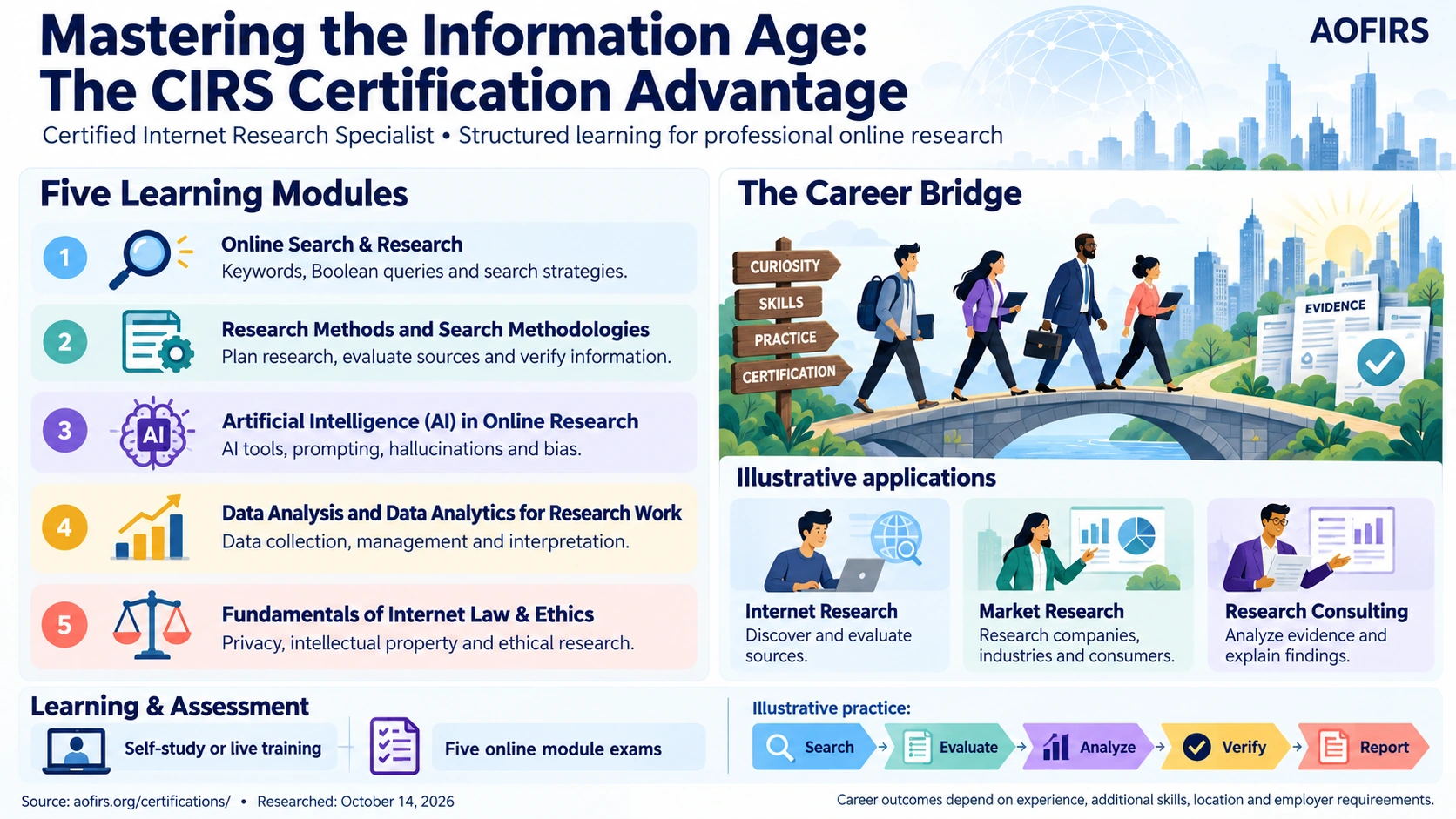
Gain credentialed mastery in social media intelligence, deepfake detection, cross-platform OSINT, and predictive analytics through the globally recognized Certified Internet Research Specialist program.
Essential SOCMINT Research Resources
Technical slide presentation on multi-agent extraction architectures and AI-driven forensic workflows.
Foundational principles for evaluating digital testimony and qualitative data at scale.
Comprehensive forensic framework for analyzing manipulated video and detecting generative deepfakes.
Practical verification workflows for tracking source provenance and breaking story timelines.