The internet produces an overwhelming stream of news, social posts, research papers, public records, corporate updates, videos, and commentary. For researchers, journalists, analysts, investigators, and communications teams, the problem is no longer finding information. It is finding the right information, from credible sources, at the right time.
Boolean search provides the structure needed to turn broad keywords into reproducible queries. It remains a core part of professional internet research even as AI answer engines change how people explore and summarize information. The wider AOFIRS guide to professional internet research explains how query design fits into a complete evidence workflow that continues through source evaluation, corroboration, analysis, and reporting.
Quick Answer: What Is Boolean Search?
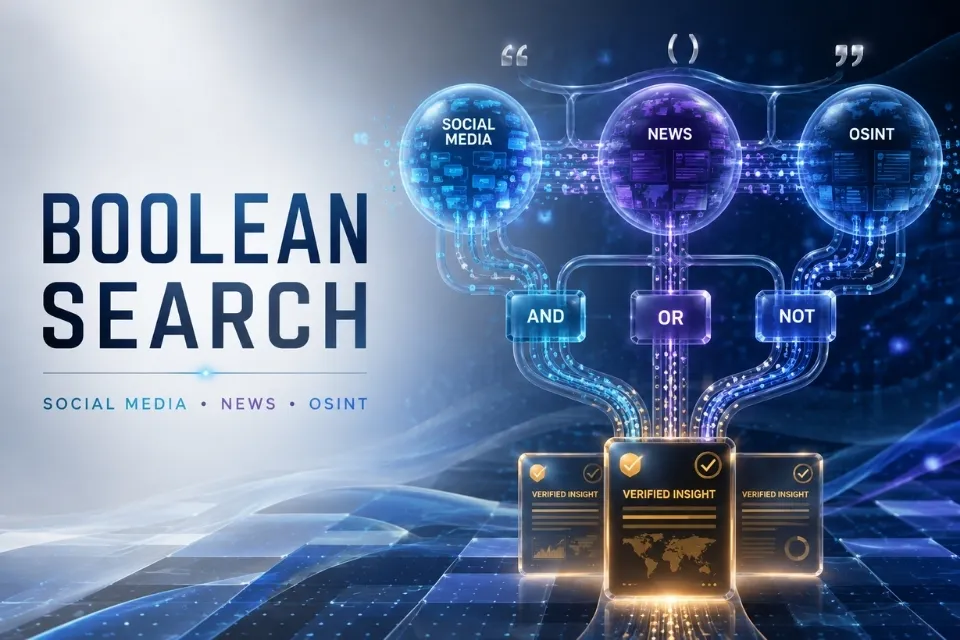
Boolean search is a query-building method that combines concepts with logical operators such as AND, OR, and NOT, together with quotation marks and parentheses. It helps researchers narrow, broaden, or exclude concepts so that search engines, databases, social listening platforms, and research tools return more relevant results.
AI regulation("artificial intelligence" OR AI) AND (regulation OR legislation OR policy)The second query captures alternative terminology while requiring a regulatory concept. It gives the researcher a clearer, testable starting point rather than an uncontrolled collection of loosely related results.
Why Boolean Search Still Matters in the Age of AI
AI search systems can summarize documents, propose queries, extract entities, and identify possible patterns. They do not remove the need to control what evidence enters the research process. A poorly scoped question can still produce incomplete, biased, or confidently incorrect output.
Define the scope
Specify entities, topics, locations, time periods, products, risks, and exclusions before collecting material.
Improve precision
Require important concepts and remove predictable noise when a plain-language search is too broad.
Capture variations
Include synonyms, abbreviations, former names, misspellings, hashtags, and multilingual alternatives.
Support verification
Repeat queries across engines and record what was searched, when it was searched, and which filters were applied.
AOFIRS explores this human-and-AI relationship in its white paper on why generative AI still requires Boolean logic and advanced search queries, which positions structured retrieval as a control layer rather than an obsolete skill. The practical goal is not “Boolean versus AI”; it is Boolean retrieval + AI-assisted analysis + human verification.
The Core Boolean Operators
Boolean syntax is not implemented identically everywhere. Database platforms often support formal Boolean logic, while public search engines may interpret the same words differently or use their own exclusion syntax. Treat every query as a hypothesis to test, and consult the AOFIRS Search Query Matrix visual guide when moving a query between search engines because syntax portability cannot be assumed.
AND: Require More Than One Concept
AND narrows a result set by requiring multiple ideas to be present. Many web search engines already treat separated words as an implicit AND, but explicit AND remains useful in databases, monitoring tools, and documented research strategies.
"artificial intelligence" AND cybersecurity AND regulationThis query focuses on material connecting all three concepts. Use AND when results are broad and the research question depends on a relationship between topics.
OR: Capture Synonyms and Alternative Language
OR broadens a search by accepting any listed alternative. It is essential for monitoring because journalists, communities, companies, and government agencies may describe the same subject differently.
("electric vehicle" OR EV OR "electric car") AND (battery OR charging)Build OR groups for brand names, abbreviations, product names, former names, hashtags, spelling variants, translations, and technical terminology.
NOT or Minus: Exclude Predictable Noise
NOT removes unwanted concepts on platforms that support formal Boolean logic. Google commonly uses a minus sign instead, such as python programming -snake. Because exclusion behavior varies, test the query and compare the result count before expanding it.
Quotation Marks: Search an Exact Phrase
Quotation marks tell many search systems to look for words in a specific order. Useful examples include "zero trust architecture", "artificial intelligence governance", and "misinformation campaign".
Exact-phrase searching is especially useful for names, quotations, report titles, error messages, policy language, and distinctive wording. It may reduce recall, so repeat the search without quotation marks when coverage matters.
Parentheses: Control the Logic
Parentheses group alternatives so the search engine or database evaluates them together. They are central to complex monitoring queries.
(deepfake OR "synthetic media") AND (election OR campaign) AND (misinformation OR disinformation)Read a Boolean query as a sentence. Each OR group represents a concept family; each AND connects concept families; exclusions remove specific noise.
How to Build a Professional Boolean Query
- Define the decision or research question.
Replace a vague topic such as “What is happening with AI?” with a bounded objective such as “How are new AI regulations affecting healthcare organizations in North America?” - Identify the main concepts.
Separate the objective into topic, action, industry, geography, time, and named entities. - Build synonym groups.
List abbreviations, alternative spellings, product names, old names, translations, hashtags, and commonly used informal terms. - Add exclusions carefully.
Remove only predictable noise that has been observed in test results. - Adapt the syntax for each source.
Translate the query for the platform instead of pasting one universal string everywhere. - Test and log the query.
Record the exact query, platform, date, filters, useful results, and important gaps. - Verify before reporting.
Trace claims to original material and corroborate important findings across independent sources.
("artificial intelligence" OR AI OR "machine learning") AND (regulation OR legislation OR compliance OR policy) AND (healthcare OR hospital OR pharmaceutical)Boolean Search for Social Media Monitoring
Social platforms can surface early signals, eyewitness accounts, public reactions, product complaints, and emerging narratives. They also contain anonymity, reposting, manipulation, missing context, and demographic bias. Boolean search helps locate relevant conversations, but it does not authenticate them.
X: Real-Time Events and Crisis Signals
X is often used to monitor breaking developments, customer complaints, service interruptions, public announcements, and reputation risks. A strong query includes official names, abbreviations, product names, common misspellings, and issue vocabulary.
("company name" OR "product name" OR abbreviation) AND (outage OR breach OR complaint OR boycott) -jobs -hiringPlatform search behavior changes, so researchers should verify which operators work in the current interface and preserve URLs or screenshots when a post may later be removed.
LinkedIn: Professional and Organizational Intelligence
LinkedIn can support expert discovery, executive monitoring, company research, recruitment intelligence, and professional trend analysis. Boolean functionality is more complete in some paid recruitment products than in general LinkedIn search, so query design should match the interface being used.
("Chief Information Officer" OR CIO) AND (AI OR "artificial intelligence") AND healthcareDo not rely on job titles alone. Combine role, industry, skills, technology, location, and organization names, then verify employment claims through corporate pages or other reliable records.
Reddit: Community Signals and Qualitative Research
Reddit discussions can reveal product frustrations, alternative terminology, niche communities, and questions that have not reached mainstream coverage. Search results should be treated as qualitative leads, not representative public opinion.
("brand name" OR "product name") AND (problem OR issue OR review OR complaint OR alternative)Consider community rules, account history, self-selection bias, coordinated promotion, and the possibility that the same claim has been copied across threads.
YouTube: Video Titles, Transcripts, and Audience Discussion
YouTube monitoring can cover expert interviews, product reviews, creator commentary, conference talks, and video comments. Researchers can combine Boolean discovery with transcript review and AI-assisted summarization, but quotations and claims must be checked against the video itself.
("artificial intelligence" OR AI) AND ("future of work" OR automation)Boolean Search for News Intelligence
News monitoring supports crisis response, policy tracking, competitor intelligence, security research, market analysis, and investigative reporting. A professional workflow combines broad discovery with primary documents and verification. The AOFIRS research report on online news search and verification provides a complementary framework for tracing claims, comparing coverage, and assessing the reliability of news evidence.
Technology and Regulation Monitoring
("generative AI" OR "large language model" OR LLM) AND (governance OR regulation OR compliance) AND (Europe OR "United States" OR global)Separate proposals, consultations, court decisions, enacted law, regulatory guidance, and company statements. These sources carry different legal and evidentiary weight.
Cybersecurity Monitoring
(ransomware OR malware OR "data breach") AND ("company name" OR "product name")("zero day" OR vulnerability OR exploit OR CVE) AND ("product name" OR vendor)Do not treat an early social post or duplicated news report as confirmation. Check vendor advisories, government alerts, technical documentation, and the earliest credible source.
Competitor and Market Monitoring
("competitor name" OR "product name") AND (launch OR acquisition OR partnership OR pricing OR expansion)Add executives, subsidiaries, product families, trademarks, and former names to improve coverage. A change log helps distinguish new developments from repeatedly indexed older material.
Combining Boolean Logic With Search Operators
Search operators control where terms appear or which kinds of documents are returned. Support changes over time and differs across engines, so the AOFIRS comparison of Google, Bing, and Yahoo search operators should be used to translate rather than blindly reuse commands. For Google-focused examples, the Google Search Operator Cheat Sheet provides additional patterns and cautions.
| Operator | Purpose | Example | Research use |
|---|---|---|---|
site: |
Restrict results to a domain or site | site:gov "AI regulation" |
Government and institutional sources |
filetype: |
Request a document format | "AI policy" filetype:pdf |
Reports, papers, policies, presentations |
intitle: |
Look for terms in page titles | intitle:"cybersecurity report" |
Focused report discovery |
inurl: |
Look for terms in URLs | inurl:research "artificial intelligence" |
Specialized site sections |
-term |
Exclude a term on engines that support minus syntax | python programming -snake |
Remove a known ambiguous meaning |
Cross-Engine Research: Google, Bing, and Brave Search
No single index provides complete coverage. Search engines crawl, rank, refresh, and filter information differently, so important results may appear in one engine but not another. AOFIRS discusses this coverage problem further in its guide to searching the invisible web, where database search and specialized sources become necessary when ordinary indexes cannot reach the material.
Google Search
Best used for broad web discovery, site-restricted research, file discovery, date filtering, and a large ecosystem of specialized search surfaces. Operator behavior should be tested because unsupported or undocumented commands can change.
Bing
Provides an alternative index and ranking system that can reveal pages missed or buried elsewhere. It is useful for comparison searching and research connected to Microsoft products and services.
Brave Search
Offers an independent search index and a privacy-focused alternative for general discovery. Coverage can differ by topic, language, region, and freshness, so it works best as one layer of a multi-engine workflow.
Specialized Sources
Academic databases, public-record portals, archives, and deep-web research tools often provide fields and filters that web engines do not. The AOFIRS list of deep-web research tools helps researchers move beyond general search when the question requires specialist coverage.
Boolean Search and AI Search Work Better Together
AI systems can help expand synonym lists, translate queries, summarize retrieved documents, extract entities, compare sources, and organize notes. They should not be treated as original evidence or as a substitute for reviewing the source material.
| Research stage | Boolean contribution | AI contribution | Human responsibility |
|---|---|---|---|
| Scoping | Defines concepts and exclusions | Suggests terminology and variants | Sets the question and boundaries |
| Discovery | Controls retrieval | Supports conversational exploration | Chooses suitable sources |
| Analysis | Keeps the corpus relevant | Summarizes and extracts patterns | Checks context and evidence |
| Verification | Re-runs targeted searches | Flags inconsistencies for review | Confirms claims through primary sources |
| Reporting | Documents reproducible queries | Helps organize drafts | Owns conclusions, citations, and limitations |
ChatGPT
Useful for query brainstorming, terminology expansion, document comparison, structured extraction, and research-note organization. Important claims, quotations, identities, and citations must be checked against original sources.
Perplexity
Useful for source-oriented conversational exploration and quickly identifying candidate pages. Citations indicate where to look, not that the associated claim has already been verified.
Gemini
Useful for AI-assisted research and workflows connected to Google services. Output quality varies by question, source availability, and model behavior, so primary-source review remains essential.
Claude
Useful for reading and comparing long documents, extracting structured information, and drafting analytic summaries. Researchers should verify all factual outputs and preserve the source documents used.
Professional Social Listening and Media Monitoring Tools
Enterprise monitoring platforms can apply Boolean-style logic across large source collections, dashboards, alerts, and analytics. Syntax, data access, historical coverage, and pricing vary considerably. Test queries with known examples before relying on a dashboard for operational decisions.
Brandwatch
Designed for enterprise consumer intelligence, social listening, trend analysis, and reputation monitoring. It is suited to complex topic definitions and large-scale brand or market research programs.
Meltwater
Combines media intelligence, social listening, monitoring, and communications workflows. It is commonly evaluated by PR, corporate intelligence, and reputation teams that need cross-channel coverage.
Talkwalker
Supports global social and media monitoring, analytics, trend discovery, and brand intelligence. Query testing is important when projects span languages, regions, and multiple naming conventions.
Sprout Social
Combines social management, engagement, listening, reporting, and customer intelligence features. It is often more relevant to communications and social teams than to deep investigative research.
OSINT and Investigation Tools
Boolean searching is often the first stage of an OSINT investigation, followed by entity resolution, archive research, public-record checks, infrastructure analysis, geolocation, or relationship mapping. The AOFIRS guide explaining OSINT methods, tools, and ethics places search within a lawful collection and verification cycle rather than treating search results as finished intelligence.
Maltego
Supports link analysis and relationship mapping across people, organizations, domains, infrastructure, and other entities. Investigators must assess the provenance and reliability of every transform result.
SpiderFoot
Automates collection from many OSINT data sources to surface possible relationships and indicators. Automated findings require validation because matching strings do not necessarily prove identity or ownership.
OSINT Framework
Provides a categorized directory of tools and resources for different investigative tasks. It helps with source discovery but does not determine whether a tool is lawful, reliable, current, or appropriate for a particular investigation.
AOFIRS OSINT User Guide
The downloadable AOFIRS OSINT Framework user guide covers structured methodology, SOCMINT, multimedia verification, technical reconnaissance, and legal-compliance considerations for modern investigators.
News Discovery and Intelligence Platforms
Google News
Useful for broad news discovery, topic monitoring, source comparison, and tracking coverage over time. Ranking and personalization do not establish credibility, so researchers should identify the original report and primary evidence.
GDELT
Provides large-scale global news data for event, theme, entity, geographic, and media analysis. It is powerful for pattern discovery, but automated coding and source coverage must be understood before drawing conclusions.
Factiva
A professional news and business-information platform used for company, industry, media, and market research. Its controlled source collection and filtering can support precise monitoring programs.
LexisNexis
Provides legal, news, corporate, public-record, and business research products. Coverage and functionality depend on the subscribed service and jurisdiction.
The Boolean Intelligence Workflow
- Define the intelligence requirement.
State what must be known, why it matters, and which decision the research will support. - Create an entity and terminology map.
List people, companies, products, locations, aliases, former names, hashtags, translations, and related concepts. - Build modular Boolean strings.
Create reusable OR groups, connect them with AND, and document exclusions separately. - Run the query across suitable sources.
Use more than one search engine and add specialist databases, news sources, or platform search where relevant. - Monitor change over time.
Track new mentions, altered language, emerging narratives, official updates, and shifts in sentiment or volume. - Analyze without losing provenance.
AI can help summarize and categorize, but every note should remain traceable to the source that supports it. - Verify and report limitations.
Confirm key claims, disclose uncertainty, and distinguish fact, allegation, inference, and opinion.
Source Verification Checklist
| Check | Questions to ask | Action |
|---|---|---|
| Authority | Who published it, and are they in a position to know? | Check author, organization, expertise, and accountability. |
| Originality | Is this the original source or a repetition? | Trace quotations, statistics, images, and claims to their earliest reliable source. |
| Date and context | Is the material current and presented in its original setting? | Check publication date, event date, location, audience, and later corrections. |
| Evidence | Does the source show documents, data, methodology, or direct observation? | Examine the supporting evidence rather than relying on the headline or summary. |
| Corroboration | Do independent sources agree? | Look for genuinely independent confirmation, not copied reporting. |
| Bias and incentives | What might the publisher gain by framing the issue this way? | Compare language, omissions, funding, ownership, and conflicts of interest. |
For a practical demonstration of how conversational discovery can supplement structured searching, the AOFIRS video on mastering conversational search can be paired with this checklist so that speed does not replace verification.
AOFIRS Resources for Deeper Learning
AOFIRS publishes several resource types because a single article cannot cover every research context. These audited resources extend the method into visual syntax comparison, news verification, OSINT practice, professional development, and AI-search limitations.
Articles
The article on mastering Boolean search for high-precision searching expands the operator fundamentals, while the wider articles library covers tools, verification, search technology, and research methods.
Visual Guide
The Search Query Matrix visualizes cross-engine syntax so researchers can compare command support before translating queries between platforms.
Research Report
The Online News Search & Verification report extends Boolean discovery into claim tracing, source assessment, corroboration, and news-evidence management.
User Guide
The OSINT Framework user guide applies search techniques within a broader investigative framework that includes ethics, verification, and specialized collection methods.
Video
The video on Mastering Conversational Search demonstrates how natural-language exploration can complement structured queries without removing the researcher’s verification duties.
White Paper
The white paper on generative AI, Boolean logic, and advanced Google queries explains why precise retrieval remains necessary when AI systems mediate access to information.
Professional Boolean Research Skills and CIRS Certification
Boolean logic is a foundation, not the whole profession. Modern researchers also need advanced search operators, source evaluation, AI literacy, verification, data analysis, legal awareness, ethical judgment, and transparent reporting.
The AOFIRS Certified Internet Research Specialist (CIRS™) framework brings these skills together. Its online search and research curriculum covers query formulation, Boolean logic, advanced search techniques, verification, AI-assisted workflows, and the limits of automated systems.
Frequently Asked Questions
Are Boolean operators still useful in 2026?
Yes. Boolean logic remains useful because it makes research scope explicit, captures alternative terminology, reduces predictable noise, and produces queries that can be tested and documented.
Can AI replace Boolean search?
No. AI can accelerate query development and analysis, but Boolean search gives researchers more control over discovery. Both methods still require source verification and human judgment.
Does the same Boolean query work on every platform?
No. Search engines, databases, social platforms, and listening tools implement different syntax and limits. Translate and test the query for each platform.
How do researchers monitor social media effectively?
They combine Boolean queries, platform search, social listening tools, alerting, AI-assisted analysis, and human verification. They also account for anonymity, reposting, sampling bias, manipulation, and missing context.
What are the best Boolean search tools?
The best combination depends on the question. General search engines support broad discovery; news databases support media intelligence; listening tools support high-volume monitoring; OSINT tools support investigation; and AI tools support analysis.
How do journalists use Boolean search?
Journalists use Boolean queries to monitor breaking news, track organizations, identify sources, locate primary documents, compare terminology, investigate claims, and follow a story over time.
Final Verdict: Boolean Search Turns Information Into a Researchable Evidence Set
Boolean search remains one of the most valuable skills in professional online research. AI has changed discovery and analysis, but it has not removed the need for controlled retrieval, source evaluation, reproducible queries, and accountable judgment.
The strongest workflow combines advanced queries, multiple sources, AI assistance, verification, and human analysis. For social monitoring, news intelligence, and OSINT, that combination turns an overwhelming information stream into a focused and defensible research process.