Serious researchers stopped asking whether to use Google or ChatGPT some time ago. The useful question is which engine fits each stage of an investigation. Google is a retrieval engine: it points you to documents that exist, with URLs you can cite and check. ChatGPT is a generation engine: it reasons over language, breaks down messy questions and drafts summaries at speed, but it can also produce confident claims with no source behind them. The Dual-Engine Researcher framework puts each tool where it is strongest and has a human verify every result.
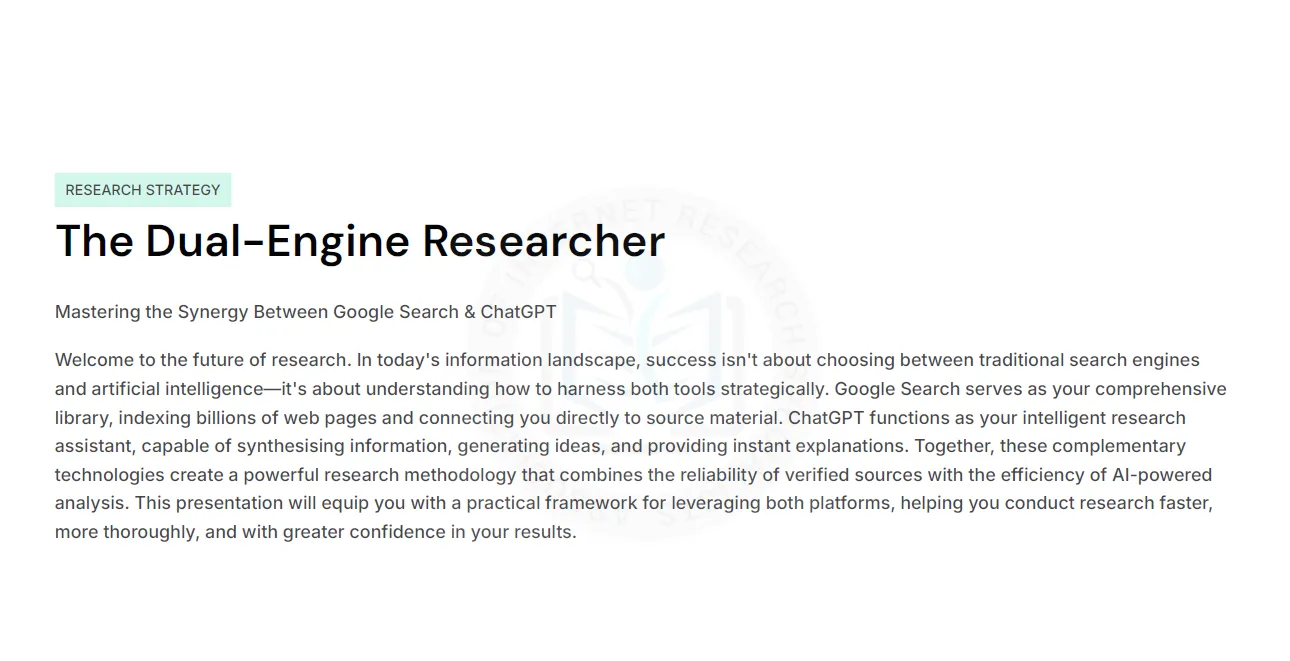
Interactive Presentation: The Dual-Engine Researcher
Browse the full 11-slide AOFIRS presentation below, or download it to use in training.
Two Engines, Two Different Jobs
Google Search: the library
Google crawls and indexes billions of pages and returns links to material that actually exists. Its value for research is provenance: every result has an author, a domain and a date you can examine. Operators such as site:, filetype: and exact-phrase quotes turn it into a precise discovery tool. For a deeper look at operator syntax, see Master Google Search: From Keywords to Precision Queries.
ChatGPT: the research assistant
A large language model predicts plausible text from patterns in its training data. That makes it excellent at explaining concepts, suggesting search terms, comparing viewpoints and structuring notes. It is not a source. Citations it produces have to be opened and checked, because generated references can be incomplete, outdated or invented.
| Dimension | Google Search | ChatGPT |
|---|---|---|
| Core function | Retrieves indexed documents | Generates and synthesizes language |
| Best for | Primary sources, current facts, citations | Brainstorming, decomposition, summarizing, explaining |
| Source traceability | High: every result has a URL | Low unless browsing is used and links are checked |
| Main risk | SEO noise, misinformation, filter bubbles | Hallucination, outdated knowledge, overconfidence |
| Researcher skill needed | Query syntax and source evaluation | Prompt design and claim verification |
The Four-Phase Dual-Engine Workflow
| Phase | Engine | What you do |
|---|---|---|
| 1. Frame | ChatGPT | Break the question into sub-questions, list key entities, synonyms and likely source types. |
| 2. Discover | Run targeted, operator-based queries to locate primary documents, official data and expert sources. | |
| 3. Verify | Human + Google | Open every source, check authorship, date and corroboration; confirm or discard any AI-generated claim. |
| 4. Synthesize | ChatGPT + Human | Use AI to organize verified notes and draft structure; the researcher edits, cites and signs off. |
The principle behind the workflow is simple: AI can propose, but only documented sources can confirm. Each conclusion in the final report should trace back to something you opened and read.
Practical Habits of a Dual-Engine Researcher
- Ask ChatGPT for search strategies and query variations, not final answers.
- Paste a verified source’s text into the AI to summarize it, instead of asking the AI to recall it.
- Cross-check any statistic, quote or citation from AI output against an original document found through Google.
- Log which tool produced each finding so your method can be audited.
- Re-run critical searches in other engines and databases to reduce single-index bias.
Video: AI in Independent Research
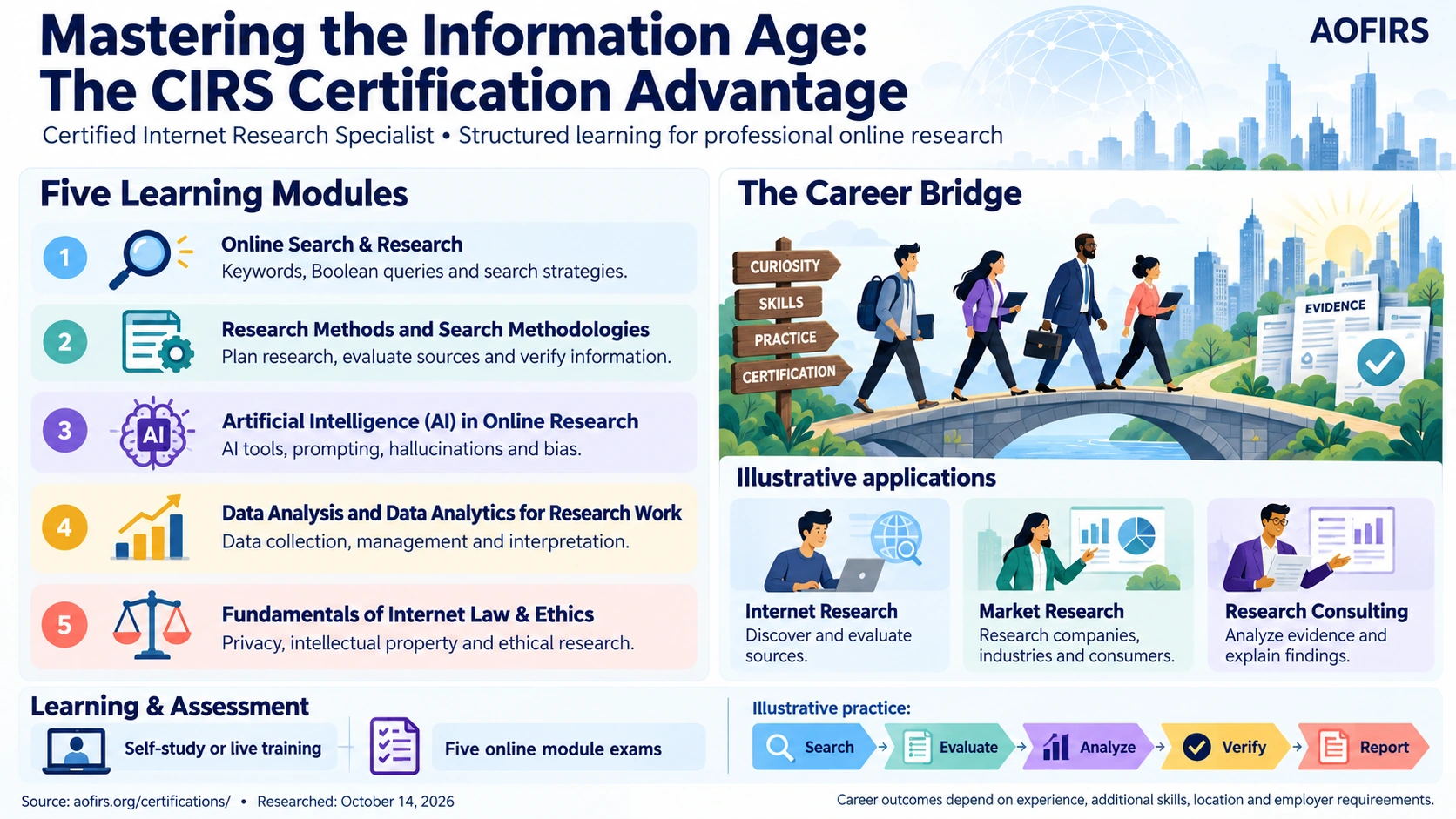
Become a Certified Internet Research Specialist (CIRS™)
Turn this hybrid method into a recognized professional skill. The CIRS program trains you in advanced search, AI-assisted analysis, source verification and ethical research practice.
Related Resources
- Google vs ChatGPT: Key Differences in Web Research
- Optimizing the Modern Research Workflow
- The Business of Online Research in the AI Era (Report)
- The AI Salary Split: Two Researchers
Frequently Asked Questions
Can ChatGPT replace Google for research?
No. ChatGPT generates text and can be wrong without signaling it. Google finds documents you can cite. Use both, with Google and the original documents as the basis for evidence.
What is the best first step in a dual-engine workflow?
Use ChatGPT to frame the problem: sub-questions, keywords, synonyms and source types. Then move to Google to find the real documents.
How do I verify a citation ChatGPT gives me?
Search the exact title, author and publication in Google or a scholarly database, open the original, and confirm that it says what the AI claimed.
Is it acceptable to summarize sources with AI?
Yes, if you give the AI the verified source text, check the summary against the original and follow your organization’s confidentiality rules.
Which skills matter most for dual-engine research?
Advanced search syntax, prompt design, source evaluation and disciplined documentation. These are the core skills covered by the CIRS certification.
Published by the Association of Internet Research Specialists (AOFIRS).