Google and ChatGPT are not rivals for the same job. Google is a retrieval engine: it finds documents that already exist and shows you where they came from. ChatGPT is a generation engine: it predicts language to write a new, synthesized answer. Professional researchers get the best results by using Google for truth and proof, ChatGPT for understanding and synthesis, and their own judgment to verify everything in between.
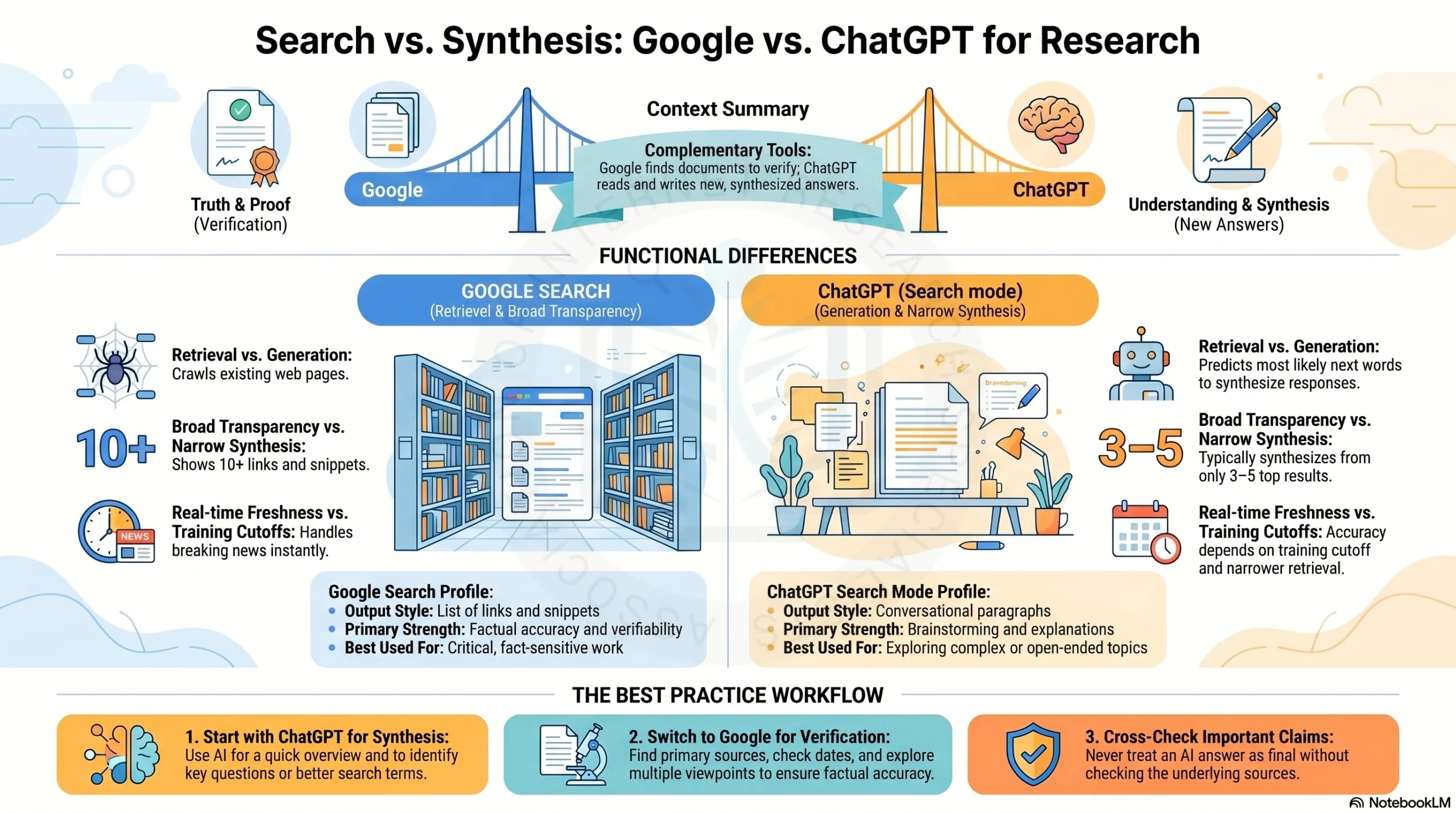
Search vs. Synthesis: how Google Search and ChatGPT differ in research, and how to combine them.
The Dual-Engine Researcher: Presentation Slides
Browse the 15-slide presentation below for a quick visual walkthrough of the hybrid research workflow.
For the full background, read the research report The Modern Internet Research Method, or see the related guides The New Research Landscape and Research Redefined: The AI-Augmented Era.
Two Powerful Tools, Two Different Problems
Google: The World’s Library
Information overload: a single query can return millions of results that must be filtered by hand.
Tab fatigue: answering a complex question often means opening 10–15 tabs and synthesizing them yourself.
ChatGPT: The Intelligent Assistant
Confident fabrication: AI can invent citations, statistics and sources that sound plausible but are false (hallucination).
The attribution problem: answers often lack clear sourcing, making claims hard to trace.
Retrieval vs. Generation: How Each Engine Works
Google: The Finder
Crawls and indexes billions of existing web pages and returns a ranked list of links, usually 10 or more with snippets. Its goal is to connect you with information that already exists, and it handles breaking news almost instantly.
ChatGPT: The Maker
Uses a language model to predict the most likely next words and generate an answer. In search mode it typically synthesizes from only a handful of top results, so accuracy depends on its training cutoff and narrower retrieval.
Google vs. ChatGPT Comparison Matrix
| Factor | Google Search | ChatGPT |
|---|---|---|
| Primary function | Find existing sources and link to them | Generate synthesized answers |
| Information source | Live web index, constantly updated | Training data with a cutoff, plus limited live retrieval |
| Accuracy | High (depends on source quality) | Variable (prone to hallucination) |
| Speed to answer | Slower: you read multiple sources | Fast: instant summary |
| Source attribution | Explicit URL for every result | Often vague or absent |
| Output style | Links and snippets | Conversational paragraphs |
| Best used for | Fact-checking, primary sources, navigation, critical work | Brainstorming, summarizing, explaining open-ended topics |
Where Google Remains Essential
- Real-time access: breaking news and time-sensitive data beyond AI training cutoffs.
- Source verification: visible URLs let you judge domain authority, date and author.
- Navigational efficiency: the fastest route to a known government report or study.
- Diverse perspectives: multiple viewpoints on contested topics, so you can identify consensus.
Where ChatGPT Adds Value
- Rapid synthesis: summarize long documents or several sources in seconds.
- Creative ideation: brainstorm angles, keyword variations and outlines.
- Data transformation: turn unstructured text into tables, charts or code.
- Adaptive explanation: explain a topic at any level, from beginner to technical.
The Pro Hybrid Model: A 4-Step Workflow
This is an iterative cycle, not a straight line: move between steps as new evidence appears.
1. AI as the Architect
Ask ChatGPT for a structured outline, key themes and search terms. Example: “Create a research outline on sustainable urban transport and suggest 5 key search terms for each section.”
2. Google as the Detective
Use those terms to find primary sources, academic papers and authoritative documents. You are executing a plan, not wandering.
3. AI as the Analyst
Paste excerpts back into ChatGPT and ask it to find patterns, contradictions and gaps. Example: “Summarize these three articles, highlighting where they agree and conflict.”
4. Human as the Editor
The non-negotiable step: verify every claim against the original source, check citations and add critical analysis. AI provides speed; you provide rigor.
The presentation reports that hybrid researchers see up to an 87% reduction in preliminary research time and a 23% lower error rate than AI-only methods. Treat such figures as indicative of the approach’s benefits rather than universal results.
AI confidence does not correlate with accuracy. Treat every AI-generated claim as a hypothesis, not a fact: a hallucinated citation looks identical to a real one.
Watch: Mastering Conversational Search
Become a Certified Internet Research Specialist
Learn to combine search engines and AI with professional verification standards in the CIRS™ program.
Essential Resources
- CIRS Program Overview
- The AI Search Revolution: From Keywords to Conversations
- The Search Query Matrix
- AOFIRS Research Reports
Frequently Asked Questions
Is ChatGPT better than Google for research?
Neither is better overall. Google is stronger for finding and verifying sources; ChatGPT is stronger for synthesis, explanation and brainstorming. Use both.
Can I cite ChatGPT as a source?
Not as evidence. Trace every claim to an original document found through search, and cite that source instead.
Why does ChatGPT invent citations?
It generates statistically likely text rather than retrieving records, so it can produce plausible but non-existent references.
Which tool is best for breaking news?
Google, because its live index updates continuously, while AI answers depend on training cutoffs and narrower retrieval.
What is the dual-engine research workflow?
A four-step cycle: AI builds the plan, Google finds sources, AI synthesizes findings, and a human verifies everything before publishing.