The transition from index-based lexical retrieval to conversational, agentic AI search represents the most profound paradigm shift in information science since the birth of the commercial web. Where traditional search engines functioned as passive routing directories—matching keyword tokens to inverted indices and returning ranked lists of external hyperlinks—modern AI search platforms operate as real-time generative synthesis engines. By ingesting multimodal inputs across text, voice, imagery, video, and documents, these systems synthesize unified answers on the fly. Yet, this generative convenience introduces severe epistemic hazards: synthetic consensus bias, citation laundering, ungrounded hallucinations, and the total opacity of model weights. For digital investigators, legal analysts, and intelligence professionals, surviving this revolution requires moving beyond passive consumption to implement rigorous validation protocols: source triangulation, lateral reading, and adversarial questioning.

For a quick-glance slide view of visual and multimodal AI discovery, explore the companion slide deck on The Lens and the Prism: Navigating Google’s Multimodal AI Search. For comprehensive technical modules on information retrieval mechanics, study the full research report on The Paradigm Shift in Information Retrieval, and compare syntax rules across platforms in The Search Query Matrix: Mastering Cross-Engine Syntax.
The Great Shift: Traditional Lexical Retrieval vs. AI-Enhanced Generative Search
For more than a quarter-century, web search operated on a predictable, mechanical paradigm: lexical indexing. In this traditional model, search engines deployed automated web crawlers to scrape HTML documents, parse text into discrete alphanumeric tokens, build massive distributed inverted indices, and calculate relevance scores using statistical algorithms such as TF-IDF (Term Frequency-Inverse Document Frequency) and BM25, combined with link-graph authority metrics like PageRank.
In lexical search, the division of labor was transparent and unambiguous: the search engine served as an information indexer and router, while the human researcher carried 100% of the cognitive burden for reading, synthesizing, verifying, and deciding credibility across a list of external blue links. The researcher retained complete visibility over source origins, publication dates, and institutional hostnames.
The AI Search Revolution fundamentally collapses this boundary. Modern conversational engines (such as Google AI Overviews, Perplexity AI, Microsoft Copilot, and OpenAI Search) replace passive routing with active generative synthesis. Instead of directing users to original primary source documents, the engine reads dozens of crawled pages in fractions of a second, embeds their text into dense multidimensional vector spaces, and uses a Large Language Model (LLM) to generate an original, coherent natural-language narrative directly on the search results page (SERP).
Multimodal Ingestion: Expanding Search Beyond Plaintext Strings
A primary catalyst of the AI search paradigm is the collapse of input boundaries. Historically, search engines were fundamentally text-bound: even when searching for images or videos, the engine relied on surrounding metadata, file names, HTML alt text, and structured schema tags.
Modern AI search engines natively ingest, process, and align diverse modalities within shared embedding spaces:
Text & Natural Dialog Conversational Querying
Users are no longer constrained by Boolean operators, keyword permutations, or rigid syntax strings. Natural language queries, multi-sentence prompts, conditional logic (“Compare X to Y assuming scenario Z”), and conversational follow-ups allow iterative refinement without resetting search parameters.
Visual & Video Streams Computer Vision Ingestion
Multimodal systems ingest raster images, schematics, vector diagrams, and video timestamps directly. Rather than reading image captions, visual transformers decompose pixels into spatial feature representations, matching visual entities against cataloged physical objects, architectural landmarks, or forensic artifacts.
Document & File Attachments Full-Document Ingestion
Investigators can upload complex PDF dossiers, financial balance sheets, scanned court transcripts, or corporate registry CSVs directly into the search interface. The AI parses table structures, extracts nested entities, and cross-references external web data against the uploaded source.
Agentic Functionality: Transitioning from Search Engine to Autonomous Task Agent
The most disruptive phase of the AI search transformation is the emergence of agentic search workflows. A traditional search engine is fundamentally reactive and episodic: it receives a single query string, matches it against an index, and returns static results, terminating its execution loop immediately.
In contrast, agentic AI search systems operate as autonomous, goal-directed reasoning loops:
- Query Decomposition & Sub-Goal Planning: When presented with a complex research objective (e.g., “Map the beneficial ownership network of Company X and identify all subsidiary filings in Delaware between 2022 and 2026”), the agent autonomously decomposes the prompt into sequential sub-queries.
- Automated Tool Use & API Invocation: The agent calls external calculators, web crawlers, translation APIs, and structured corporate databases, evaluating intermediate responses before determining the next retrieval step.
- Multi-Step Reasoning & Self-Correction: If an initial search path yields ambiguous, outdated, or conflicting corporate records, an agentic system refines its search parameters, seeks alternative jurisdictional registries, and iterates until its internal termination criteria are satisfied.
- Structured Output Generation: Rather than providing a list of websites, the agent synthesizes complete investigative dossiers, generates comparative tables, writes code scripts, and exports structured timelines on the user’s behalf.
The Epistemic Hazard: Hallucination Mechanics, Consensus Bias, and Citation Laundering
While generative and agentic search dramatically accelerates preliminary research, it introduces profound epistemological and forensic vulnerabilities that can compromise legal proceedings, financial due diligence, and intelligence assessments.
Hazard 1 Hallucination & Confident Fabrications
Large Language Models are probabilistic next-token prediction engines, not truth-verifying databases. When encountering gaps in crawled training data or retrieval context, models generate plausible-sounding but entirely fabricated case citations, docket numbers, statistical data, and biographical details with supreme stylistic confidence.
Hazard 2 Citation Laundering & Circular Hallucination
In modern Retrieval-Augmented Generation (RAG), AI search engines append footnote citations to their generated summaries. However, empirical testing reveals frequent citation mismatch: the cited source often does not support, or directly contradicts, the AI’s assertion. Furthermore, AI scrapers ingest AI-generated content from third-party blogs, creating a self-referential echo chamber where synthetic errors become codified as authoritative consensus.
Masterclass: Mastering Conversational Search in High-Stakes Research
In this instructional masterclass from the AOFIRS Video Library, forensic intelligence specialists analyze the mechanics of conversational search, demonstrating how to prompt generative engines with precision, dismantle synthetic consensus, and maintain evidentiary integrity in an AI-mediated research environment.
The Core Search Dimension Comparison Matrix
To understand the structural trade-offs between traditional index-based search and modern conversational AI platforms, researchers must evaluate how key operational dimensions diverge across the information retrieval lifecycle:
| Search Dimension | Traditional Keyword Search (Google / Bing / Yandex) | AI-Enhanced Conversational Search (Perplexity / Copilot / Gemini) | Analyst Implications & Evidentiary Risk |
|---|---|---|---|
| Input Style & Query Structure | Short, rigid keyword strings, Boolean operators (AND, OR, NOT), metadata syntax (site:, filetype:). |
Natural language prompts, multi-paragraph context, uploaded files (PDF, CSV), voice, and images. | Prompt construction dictates output depth; vague conversational phrasing produces superficial consensus summaries. |
| Underlying Index Architecture | Inverted index matching exact lexical tokens, n-grams, and PageRank link authority graphs. | Dense vector embeddings, semantic clustering, high-dimensional neural representations, and dynamic RAG retrieval. | Semantic matching surfaces conceptually related content without exact keywords, but obscures exact source boundary matching. |
| Results Presentation | Ranked list of ten external hyperlinks (SERP) with brief snippet previews and cached snapshots. | Unified, synthesized natural-language overview with embedded interactive footnote links. | Synthesized summaries tempt analysts into passive acceptance, skipping primary source inspection. |
| User Agency & Cognitive Role | Active manual evaluator: user selects links, verifies domains, reads text, and synthesizes findings. | Prompt engineer & adversarial auditor: user directs synthesis, challenges claims, and validates citations. | Cognitive burden shifts from finding information to stress-testing synthetic claims and hunting hallucinations. |
| Evidentiary Transparency | High transparency: raw document URLs, server headers, original page layout, and visible publication timestamps. | Low to moderate: synthesized prose obscures which exact sentence originated from which retrieved source snippet. | Synthesized summaries cannot be entered directly into legal exhibits or formal due diligence reports without primary source verification. |
| Execution Latency & Compute | Extremely low (50–200 milliseconds); runs lightweight distributed index lookups on CPU clusters. | Moderate to high (1–15+ seconds); requires massive multi-billion parameter neural inference across GPU clusters. | Agentic workflows trade real-time speed for multi-step reasoning, requiring deliberate query pacing. |
| Primary Failure Mode | Irrelevant keyword matches, SEO content farm manipulation, commercial link spam. | Probabilistic hallucinations, citation mismatch, temporal confusion, and sycophantic bias. | False positives in traditional search are obvious; false positives in AI search sound authoritative and persuasive. |
The SMART-M Verification Triad: Defensible Intelligence in AI Environments
To eliminate the risks of hallucination, citation mismatch, and synthetic bias, the AOFIRS framework establishes a rigorous three-pillar verification methodology that every professional researcher must deploy when utilizing conversational AI search:
Pillar 1 Source Triangulation
Never rely on an AI overview as a single source of truth. Every factual claim, statistical figure, regulatory date, or corporate officer attribution synthesized by an AI model must be independently triangulated across at least two distinct, authoritative primary sources (e.g., an official regulatory filing and a verified corporate registry record). Cross-model prompting—running identical queries across multiple proprietary LLM architectures—helps isolate model-specific hallucinations from verified consensus.
Pillar 2 Lateral Reading
When an AI search overview provides footnote citations, avoid simply reading vertically down the cited page. Deploy lateral reading: open multiple browser tabs to investigate the credibility, domain registration history, financial sponsorship, and editorial track record of the cited domain itself. Ensure the cited source is an authoritative primary publisher rather than an SEO content farm, a commercial PR wire, or an automated scraping blog.
Pillar 3 Adversarial Questioning
Large language models exhibit strong sycophancy—the tendency to agree with the user’s leading premises or validate biased assumptions. Researchers must systematically execute adversarial counter-prompting: explicitly instructing the AI to provide opposing evidence, outline regulatory exceptions, identify documented edge cases, or argue against the primary hypothesis (“Identify all legal filings or factual evidence that contradict this conclusion”).
Practical Protocols for Professional Intelligence Analysts
Operating effectively in the conversational search era requires adopting a disciplined four-stage intelligence workflow:
- Stage 1: Prompt Disaggregation: Break complex research hypotheses into modular, testable components. Isolate entity resolution from regulatory analysis, and avoid combining exploratory queries with definitive evidentiary retrieval in a single prompt.
- Stage 2: Footnote Audit & Grounding Check: For every footnote anchor generated in an AI overview, click through directly to the underlying document. Verify that the referenced sentence exists in the source text and that the AI did not invert negations, omit qualifying clauses, or extrapolate unsubstantiated conclusions.
- Stage 3: Hybrid Lexical-Semantic Search: Pair conversational AI tools with traditional lexical search engines. Use conversational search for conceptual scoping, document summarization, and query ideation; use precision lexical syntax (
site:,filetype:,intitle:) to pin down primary government registries and official PDF dockets. - Stage 4: Cryptographic Preservation: In legal due diligence and forensic investigations, AI chat transcripts possess limited evidentiary weight without underlying source verification. Archive the raw primary documents cited, capturing full URL strings, HTTP response headers, and cryptographic SHA-256 hashes to establish a defensible chain of custody.
Advance Your Research Competence: The CIRS™ Credential
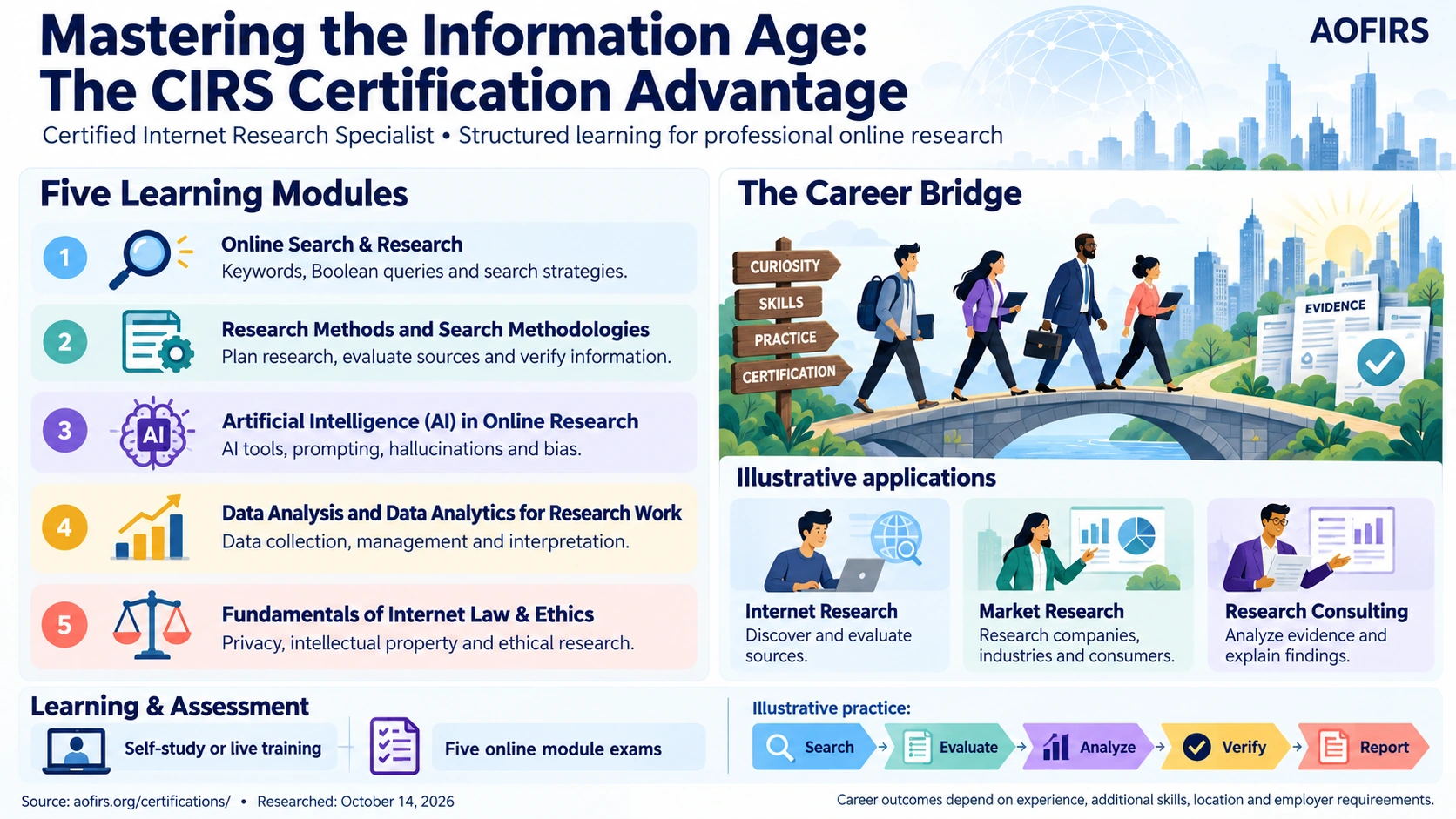
Navigating the convergence of artificial intelligence, conversational search, and forensic web investigation is the core focus of the Certified Internet Research Specialist (CIRS™) credential. Recognized internationally across intelligence, compliance, legal, and risk management sectors, the CIRS curriculum prepares analysts to leverage AI tools responsibly while maintaining uncompromising standards of evidentiary verification.
Essential Research Resources
- The Lens and the Prism: Navigating Google’s Multimodal AI Search — Specialized slide guide examining visual transformers and multimodal search interfaces.
- The Paradigm Shift in Information Retrieval — Comprehensive 27-page AOFIRS research report on AI search architectures and analyst oversight.
- The Search Query Matrix: Mastering Cross-Engine Syntax — Advanced operator grammar and Boolean matrix across Google, Bing, and Yandex.
- Hacking AI for Deep Research: The AI Override Architecture — Strategies for overcoming model guardrails, synthetic consensus, and cognitive bias.
- AOFIRS CIRS Certification Program — Official professional qualification for internet research specialists.
Frequently Asked Questions
How does conversational AI search differ fundamentally from traditional Google search?
Traditional Google search operates on an index-and-retrieve model: it scans an inverted index of web pages for keywords, applies ranking algorithms like PageRank, and displays a list of external links (SERP) for the user to visit and evaluate. Conversational AI search utilizes large language models and Retrieval-Augmented Generation (RAG) to read multiple crawled pages simultaneously and generate a cohesive, synthesized prose answer directly on the results page, fundamentally shifting the search engine from an index router to an answer synthesizer.
Why do AI search engines sometimes provide incorrect citations for factual claims?
This phenomenon, known as citation mismatch or citation laundering, occurs because LLMs generate text based on probabilistic word associations rather than deterministic database retrieval. In a RAG architecture, retrieved document snippets are passed into the model’s context window. If the model hallucinates a detail or misinterprets a nuance, it may still attach a footnote to an adjacent retrieved URL that mentions similar keywords, even if that source does not substantiate the specific claim.
What is lateral reading, and why is it essential when using AI search tools?
Lateral reading is the practice of evaluating a source’s credibility by leaving the original webpage and opening multiple adjacent browser tabs to research the publisher, author, funding sources, and institutional reputation through third-party references. In AI search, lateral reading is vital because AI models frequently cite content from SEO scraper farms or commercial aggregators that appear authoritative on the surface but lack journalistic or academic integrity.
What are the primary evidentiary risks of relying on AI overviews in legal or corporate investigations?
AI overviews cannot be entered directly into legal exhibits or due diligence filings because they are dynamic, non-reproducible, and prone to hallucinations and consensus bias. Relying on an unverified AI overview without inspecting, validating, and cryptographically preserving the underlying primary source documents exposes investigators to severe reputational damage, evidentiary exclusion in court, and regulatory non-compliance.
How does multimodal search alter open-source intelligence (OSINT) workflows?
Multimodal search allows investigators to bypass traditional text-based keywords by uploading images, video files, audio recordings, or complex PDF documents directly into the query interface. AI models analyze pixel structures, voice frequencies, and unstructured document layouts, cross-referencing visual features against global databases to geolocate images, identify physical equipment, and translate foreign-language signage in real time.
Published by the Association of Internet Research Specialists (AOFIRS) • Research & Educational Publications • Updated October 2026