AI research assistants are built to give the most likely answer, not the most authoritative one. Left on default settings, they skim the heavily indexed surface web and smooth over the rare, precise sources that serious research depends on. The AI Override Architecture is a disciplined way to take back control: by commanding the syntax, logic, context, and procedure of every request, researchers can direct AI into gray literature, institutional archives, and raw data — and make it admit when evidence is missing.
Presentation: The AI Override Architecture (12 Slides)
Browse the complete slide deck below.
Related reading: AI Deep Research Integrity Guide · Engineering the Query · Deep Research with AI in 2026 · CIRS Program
AI Operates on the Principle of Least Resistance
Generative search is optimized for consensus, not complexity. It mathematically favors broad, heavily indexed summaries from the clear web — SEO pages and aggregators — while the most valuable material sits deeper: .edu and .gov publications, raw datasets and gray literature that rarely ranks.
How Semantic Smoothing Erases Nuance
Vector databases group information by similarity. Highly specific references do not cluster with the mainstream consensus, and rare but accurate facts lack the mathematical weight to surface. The result: the system presents the statistically probable average and quietly drops the authoritative outlier.
From Passive Querying to Active Direction
| Dimension | Passive AI Querying (The Broad Librarian) | Active AI Direction (The Integrity Agent) |
|---|---|---|
| Search goal | Broad semantic approximation | Meticulous data extraction |
| Search depth | The clear web: SEO pages, aggregators | Gray literature: .edu, .gov, raw data |
| Output type | Smoothed or hallucinated summaries | Structured, verifiable citations |
| Missing information | Guesses or substitutes | Halts and reports the gap |
The Four Pillars of the Override Architecture
Pillar 1: Inject Search Logic to Command the Crawl
| Tactical Goal | Command Syntax to Embed | Impact on Retrieval |
|---|---|---|
| Domain restriction | Run strictly on site:.edu OR site:.gov OR site:.int |
Retrieves from academic, governmental and international institutions |
| Gray literature | Prioritize filetype:pdf OR filetype:xls |
Pulls reports and datasets rarely touched by SEO |
| Exact-match anchoring | You must include the exact phrase "qualitative evaluation standard" |
Stops the AI substituting semantic approximations |
Pillar 2: Force an Agentic Chain-of-Search
Instead of hoping the AI guesses the route to niche information, program it to run successive, verified searches:
- Query formulation: identify five highly technical, non-obvious search queries; avoid broad semantic terms.
- Retrieval and extraction: execute the searches and extract raw data points, ignoring high-level summaries.
- Synthesis and provenance: synthesize findings, giving a direct, verifiable URL for every technical claim.
Inside an integrity agent this becomes a closed feedback loop: the prompt is broken into granular tasks, searches run in parallel, and each finding passes a check — is this a primary source with a citation? If not, the agent searches again; only verified data reaches the final answer.
Pillar 3: Counter Semantic Smoothing with Step-Back Prompting
Result: fails — no study found or a hallucinated one, because the topic lacks mathematical weight.
Result: succeeds — the foundational context creates a landing zone for deep data.
Pillar 4: Hard-Code Data Provenance Rules
The Ultimate High-Integrity Prompt Stack
Combine all four pillars into one reusable instruction:
Phase 2 — Chain-of-search: Run five non-obvious searches within these archives using
site:.edu OR site:.gov and filetype:pdf.Phase 3 — Provenance: Extract the raw data. You are forbidden from inferring concepts. Exclude all aggregator sites. Append exact citations formatted as [Document – Domain].
A Behavioural Shift for Researchers
AI search defaults to broad librarianship. When you command the syntax, structure and logic, you force the machine past the surface. The shift from passive querying to active direction is what separates a convenient answer from a defensible one — and every output should still be opened, dated and verified by the researcher.
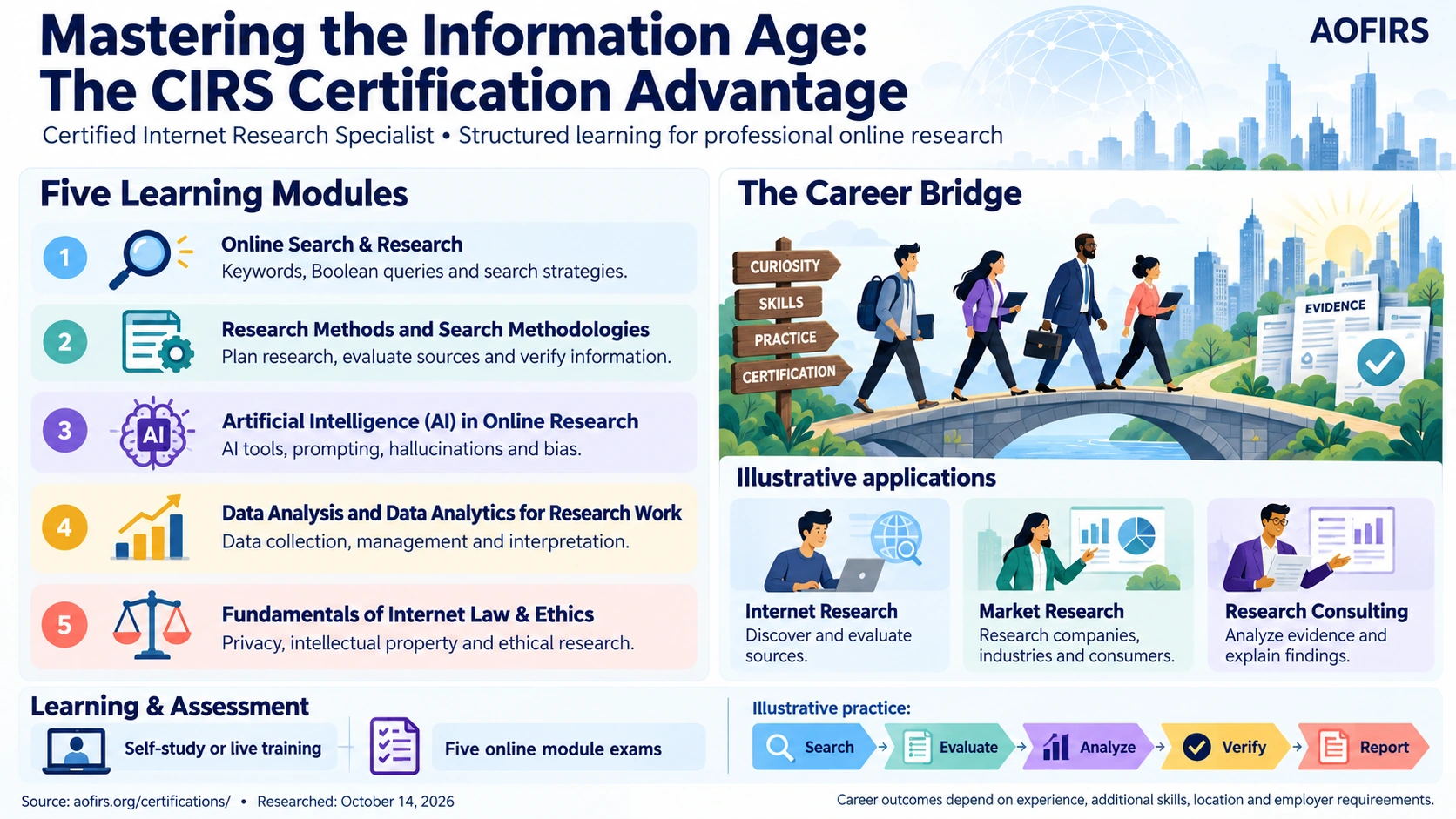
Become a Certified Internet Research Specialist (CIRS™)
Master advanced search operators, AI direction and source verification used by professional investigators.
Essential Resources
- Unearthing the Truth: AI Deep Research Integrity
- Engineering the Query: Cross-System Architecture
- The Search Query Matrix
- The Lens and the Prism
- OSINT and Google Hacking
Frequently Asked Questions
What is the AI Override Architecture?
A method for directing AI research tools instead of passively querying them. It combines four pillars — Syntax, Logic, Context and Procedure — to push AI past popular summaries into verifiable, high-integrity sources.
Why do AI search tools miss niche or authoritative sources?
AI follows the path of least resistance. Vector databases weight information by how common it is, so rare but accurate findings get “semantically smoothed” into the most statistically likely average answer.
What is AI-guided dorking?
Embedding search operators such as site:.edu OR site:.gov, filetype:pdf and exact-phrase requirements directly in your AI prompt, so retrieval is restricted to trusted domains and raw documents.
What is the Zero-Inference Rule?
A prompt constraint that forbids the AI from inferring or blending across sources. If no primary source is found, it must reply “Insufficient primary data retrieved” instead of guessing.
Does this replace human verification?
No. The architecture produces structured, cited output, but every citation should still be opened, dated and cross-checked by the researcher before it is relied on.