Generative AI has changed how information is found, but not who is responsible for getting it right. The AI-augmented researcher treats language models as a fast, tireless assistant — one that summarizes, extracts, classifies, and drafts on command — while keeping strategy, verification, and insight firmly in human hands. This 14-slide deck walks through that working model, from how LLMs actually function to the prompting techniques and guardrails that make them safe for professional inquiry.
From the Library of Links to the Expert Dialogue
Traditional search engines index the web in real time and hand you a ranked list of sources to evaluate. Large language models work differently: you converse with them and receive a synthesized answer drawn from their training data. Neither replaces the other. Search connects you to evidence; the LLM helps you reason through context-heavy questions faster.
| Dimension | Library of Links (Search Engine) | Expert Dialogue (LLM) |
|---|---|---|
| Interaction | You search for sources | You converse for answers |
| Output | Ranked links to external pages | Direct, synthesized prose |
| Freshness | Real-time index of the live web | Frozen at a training cutoff unless connected to the web |
| Best for | Locating and verifying primary sources | Nuanced questions where context matters |
| Main risk | Information overload | Confident but fabricated answers |
Decoding the Technology: From AI to LLMs
Artificial intelligence is the umbrella for systems that perform tasks normally requiring human intelligence. Machine learning is the subset that learns from data; deep learning uses layered neural networks; and transformers are the architecture that made modern text generation possible. GPT stands for Generative Pre-trained Transformer. These models process text as tokens — words, word fragments, or punctuation — and learn the statistical relationships between them. That is why they write fluently, and also why fluency is no guarantee of truth.
The Researcher Is the Strategist; the LLM Is the Tool
An LLM cannot take a proactive role. It follows instructions, which makes it an additional research method, never a co-author. Three limitations define where the human must stay in charge:
No Critical Thinking
AI cannot judge the relevance or credibility of sources for a specific research topic.
No Strategic Planning
It cannot set research objectives or choose the right methods for a project’s needs.
No Insight Generation
It cannot analyze results to form original, human-driven conclusions. That remains your domain.
The Researcher’s AI Toolkit
Four core functions cover most day-to-day work across the research lifecycle:
Synthesize
Summarization (extractive or abstractive) and inferring — sentiment analysis and topic modeling to surface hidden themes in reviews, surveys, or social posts.
Extract
Named Entity Recognition pulls names, organizations, locations, and quantities out of unstructured text; structured data scraping turns pages into tables.
Generate
Brainstorming angles, outlining reports, and drafting first versions you then verify and refine.
Transform
Rewriting, translating, and reformatting material for different audiences and deliverables.
The Four Critical Pitfalls
| Pitfall | What happens | Real-world example |
|---|---|---|
| Hallucinations | Confident, plausible, and false output | A New York lawyer was sanctioned for citing six court cases invented by ChatGPT |
| Inherent bias | Training-data bias reappears in answers | Prompts about a “soldier” default to “he”; a “teacher” defaults to “she” |
| Knowledge cutoffs | No awareness of events after training | Answers on recent developments are missing or outdated without live web access |
| Logical flaws | Pattern matching rather than true reasoning | Models stumble on simple logic puzzles a person solves instantly |
Copyright and privacy add a further layer. The U.S. Copyright Office will not register works produced entirely by a machine; the EU AI Act requires transparency for AI-generated content; and other jurisdictions are still reviewing their rules. Never paste confidential client data into a public model.
Mastering the Craft: Prompt Engineering
The quality of the output tracks the quality of the input. Give sufficient context (“Help me build an online recruiting strategy for my skincare shop in Canada” rather than “What are recruiting tips?”), break complex tasks into sequential steps, and treat prompting as a cycle: draft, evaluate, diagnose, refine.
| Technique | Basic prompt | Strategic prompt |
|---|---|---|
| Role playing | “Write about a new skincare product launch.” | “Imagine you are a marketing strategist for a Canadian skincare brand. Propose three launch strategies to establish a strong market presence.” |
| Few-shot prompting | “Classify this review as positive or negative.” | “Here are two labelled examples [positive], [negative]. Now classify this one.” |
| Chain-of-thought | “Compare surveys and focus groups.” | “Identify commonalities, then differences, then pros and cons of each, and conclude with the tasks each suits best.” |
Make the AI Your Prompting Coach
Meta-prompting uses the model to critique your own prompts: “You are an expert in prompt engineering for market research. Here is my prompt: [prompt]. Critique it and suggest three specific ways to improve clarity, context, and accuracy.” Google DeepMind research found that even simple framing — “Take a deep breath and work on this problem step by step” — can improve performance on complex reasoning tasks.
Watch: AI in Online Research
The Human Imperative
AI can summarize, but you must synthesize. AI can extract, but you must evaluate. AI can generate text, but you must generate insight. The future of research is not a choice between human intellect and machine speed; it is the disciplined combination of both.
Become a Certified Internet Research Specialist
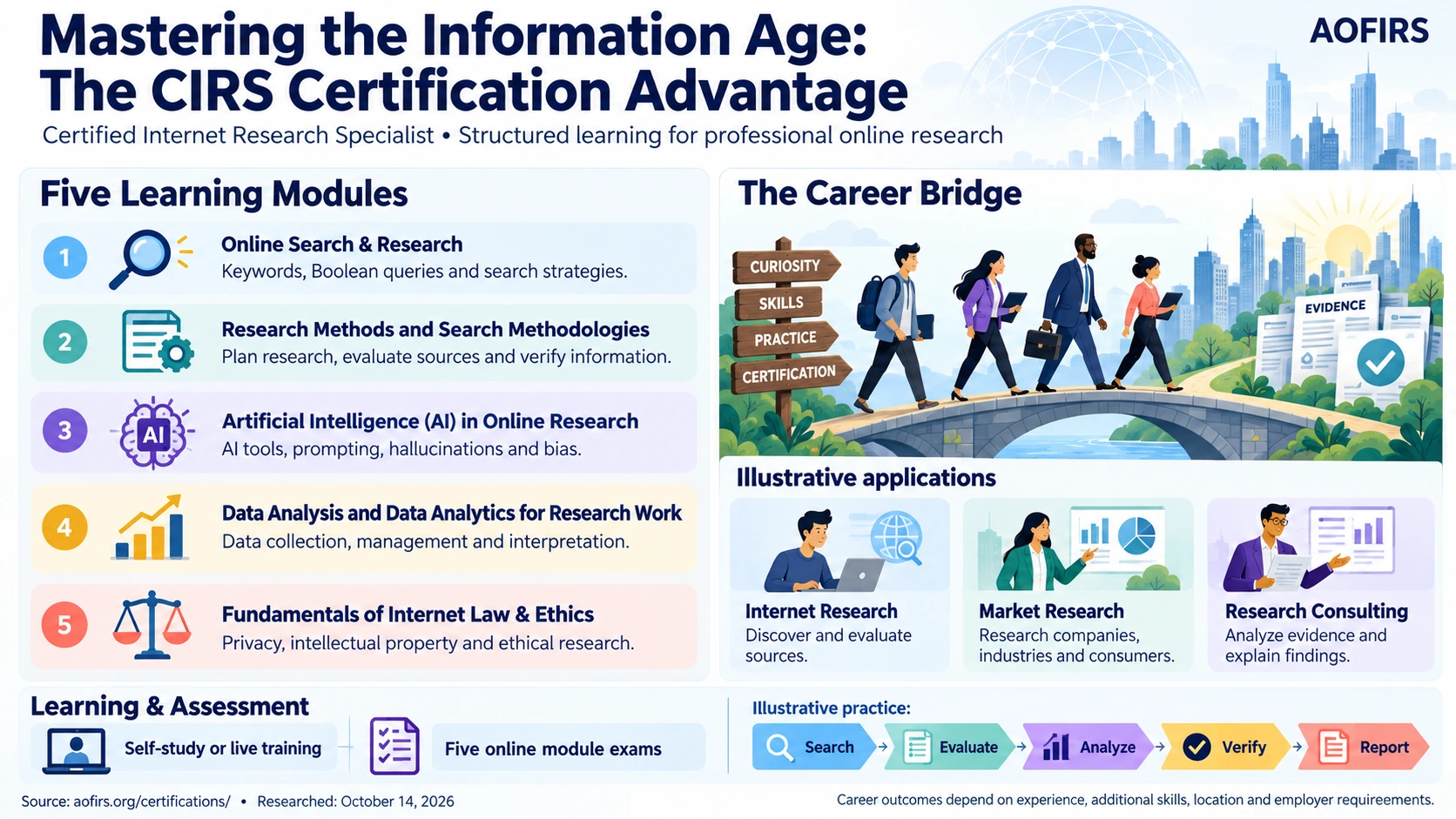
The CIRS Certification Course teaches the search techniques, verification methods, and AI-assisted workflows that define professional online research.
Frequently Asked Questions
What is an AI-augmented researcher?
A professional who uses generative AI to speed up summarizing, extracting, classifying, and drafting, while keeping research strategy, source verification, and final judgment under human control.
Should I use ChatGPT or Google Search for research?
Both, for different jobs. Use search to find and verify primary sources on the live web; use an LLM to reason through context-heavy questions and process material you already have. Verify every LLM claim against a source.
What is an AI hallucination?
A confident, plausible answer that is factually wrong — including invented statistics, quotes, or citations. It happens because models predict likely text rather than retrieve facts.
Which prompting techniques work best for researchers?
Role playing, few-shot examples, chain-of-thought step lists, and meta-prompting, combined with rich context and iterative refinement.
Does the CIRS course cover AI in research?
Yes. The CIRS Certification Course includes modules on integrating AI tools into a verification-first research workflow.