Two researchers start the same year with the same degree and the same job title. Five years later, one of them earns noticeably more, takes on bigger projects and gets asked for by name. The other is competing on price with freelancers and software. The difference is not talent. It is how each of them responded when AI tools arrived in the research workflow.
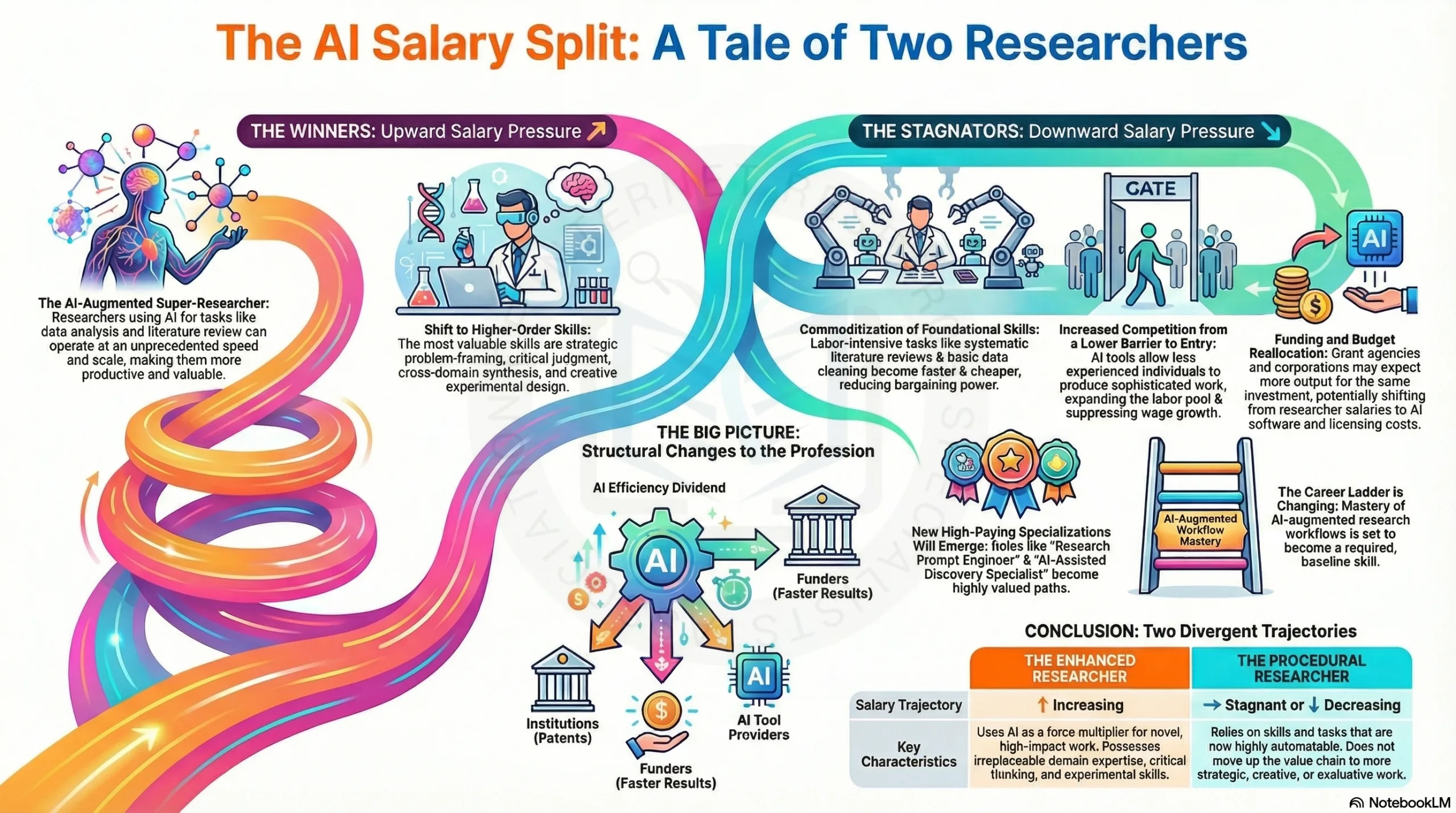
The Super-Researcher: Moving Up the Value Chain
Researchers who use AI for data analysis, literature scanning and first-draft synthesis can work at a speed and scale that was not possible before. That makes them more productive, but productivity alone is not what raises their pay. What raises it is where they spend the time AI gives back.
- Strategic problem framing: deciding which question is actually worth answering for the client.
- Critical judgment: checking AI output, spotting weak sources and catching errors before they reach a report.
- Cross-domain synthesis: connecting findings from law, finance, technology or public records into one clear picture.
- Creative research design: building methods that tools cannot invent on their own.
The Stagnator: Downward Salary Pressure
On the other side are researchers whose daily work is mostly procedural. Their pay is under pressure for four reasons the infographic sets out:
- Foundational skills are becoming commodities. Systematic literature reviews and basic data cleaning are now faster and cheaper, which weakens bargaining power.
- The barrier to entry is lower. AI lets less experienced people produce polished-looking work, which grows the labor pool and holds wages down.
- Budgets are being reallocated. Funders and companies may expect more output for the same money, moving spending from salaries toward AI software and licences.
- No move up the value chain. Without new strategic or evaluative skills, the work that remains is the work most easily automated.
The Big Picture: How the Profession Is Changing
The AI efficiency dividend
Faster results create a dividend, and the question is who keeps it: research institutions, AI tool providers, funders or the researcher. Researchers who can show that their judgment produced the result keep a larger share.
The career ladder is changing
Fluency with AI-augmented research workflows is becoming a baseline requirement, not a bonus. It will be expected in the same way search-engine skills are expected today.
New specializations will appear
Roles such as Research Prompt Engineer and AI-Assisted Discovery Specialist are emerging as well-paid paths for researchers who combine domain knowledge with tool expertise.
Two Trajectories Side by Side
| AI-Augmented Super-Researcher | Procedural Researcher | |
|---|---|---|
| Salary trajectory | Increasing | Stagnant or decreasing |
| How AI is used | As a force multiplier for new, high-impact work | As a replacement for tasks they used to be paid for |
| Core strengths | Domain expertise, critical thinking, research design | Skills and tasks that are now highly automatable |
| Where time goes | Framing, verification, synthesis, client advice | Searching, collecting and formatting |
| Market position | Hired for judgment | Compared on price |
How to Stay on the Rising Side
- Audit your week. List which tasks AI could already do and which depend on your judgment.
- Hand off the routine. Use AI for first-pass collection and summaries, then put the saved hours into analysis.
- Verify everything. Treat AI output as a lead, not a finding, and confirm it against primary sources.
- Specialize. Build depth in a domain where accuracy matters and mistakes are expensive.
- Prove your value. Show clients the method and the sources behind each conclusion, not only the answer.
Read the Full Report
The AOFIRS research report The Business of Online Research in an AI-Transformed Marketplace looks at how AI is reshaping independent research work, client demand for human-verified findings and the advantage certified specialists hold.
Watch: AI in Independent Research
Become the Researcher AI Cannot Replace
The CIRS Certification builds the judgment, verification and search skills that keep you on the rising side of the salary split.
Related Publications
- The Dual Engine Researcher
- The Professional Internet Researcher
- The New Research Landscape
- The Business of Online Research in an AI-Transformed Marketplace
Frequently Asked Questions
What is the AI salary split?
It describes researcher pay moving in two directions: up for those who use AI to do higher-value work, and flat or down for those whose work is mostly tasks AI can now do.
Will AI replace internet researchers?
AI is replacing routine research tasks, not the judgment needed to frame questions, verify sources and draw sound conclusions. Researchers who focus on those skills become more valuable.
Which research skills are losing value?
Basic literature reviews, simple data cleaning and routine information gathering are becoming faster and cheaper because of AI tools.
Which skills raise a researcher’s earnings?
Strategic problem framing, critical evaluation of sources, cross-domain synthesis, creative research design and deep domain expertise.
How does CIRS certification help?
CIRS trains advanced search, source verification and ethical research methods, giving clients evidence that your findings are reliable.