Anyone can search. Far fewer people can research. The difference is not access to better tools; it is discipline. A professional internet researcher works to a method, holds to an ethical code, and treats the work as a career with standards, clients and accountability. Those three pillars, craft, conscience and career, are what turn a skilled searcher into someone whose findings can be trusted.
This AOFIRS guide sets out what each pillar means in practice: the methods that make results repeatable, the ethics that keep them defensible, and the business habits that make the work sustainable.
Explore the 12-Slide Presentation
Browse the full guide below to see how methods, ethics and business practice fit together in modern online research.
Pillar One: Craft, the Method Behind the Result
Craft is the technical side of the profession. It starts before the first query is typed, with a clear question: what exactly must be found, for whom, and to what standard of proof? A defined question keeps the work focused and tells you when you are finished.
Plan the search
Professionals map the likely sources first: search engines, specialist databases, public records, archives, social platforms and the deep web. They choose keywords, synonyms and exclusions in advance, then build structured queries with Boolean logic and field operators such as site:, filetype: and intitle:. Our guide to precision Google queries covers these in depth.
Verify and corroborate
A single source is a lead, not a fact. Good researchers confirm each important claim through independent sources, check dates, authorship and provenance, and note where evidence is thin. AI tools can speed up discovery and summarising, but every AI answer and citation must be checked against the original source.
Document everything
Repeatable research needs a trail: the queries run, the sources consulted, the date of access and captures of key pages. Documentation lets a client, editor or court follow your reasoning and protects you if a page later changes or disappears.
Pillar Two: Conscience, the Ethics That Make Findings Defensible
Being able to find information does not mean you should use it. Conscience is the set of limits a professional sets on their own work.
- Legality: respect privacy, data protection and copyright laws in every relevant jurisdiction.
- Public versus private: work with openly available information; never use deception, hacking or credential misuse to get behind access controls. See our publication on public and private information.
- Proportionality: collect only what the task requires and handle personal data carefully.
- Honesty: report what the evidence shows, including gaps and contradictions, rather than what the client hopes to hear.
- Confidentiality: protect client details and findings, and secure your files.
Pillar Three: Career, Research as a Profession
The third pillar is the business of research. Whether you work in-house or independently, clients pay for reliable answers delivered on time.
- Scope clearly: agree the question, deliverables, deadline and budget in writing before starting.
- Report usefully: lead with findings, rate the confidence of each, and cite sources so the client can act.
- Keep learning: search engines, AI tools and platforms change constantly; ongoing training is part of the job.
- Prove your skills: recognised certification shows clients you work to a professional standard.
Watch: How to Think Like an Internet Detective
The Three Pillars at a Glance
| Pillar | Core question | Key practices | What goes wrong without it |
|---|---|---|---|
| Craft | Can I find it reliably? | Defined question, source mapping, structured queries, verification, documentation | Missed sources, unverified claims, results nobody can repeat |
| Conscience | Should I find and use it? | Legal compliance, public-only methods, proportionality, honest reporting, confidentiality | Legal risk, privacy harm, findings that cannot be used |
| Career | Can I deliver it professionally? | Clear scoping, useful reports, ongoing learning, certification | Scope creep, unclear deliverables, outdated skills, lost trust |
Become a Certified Internet Research Specialist
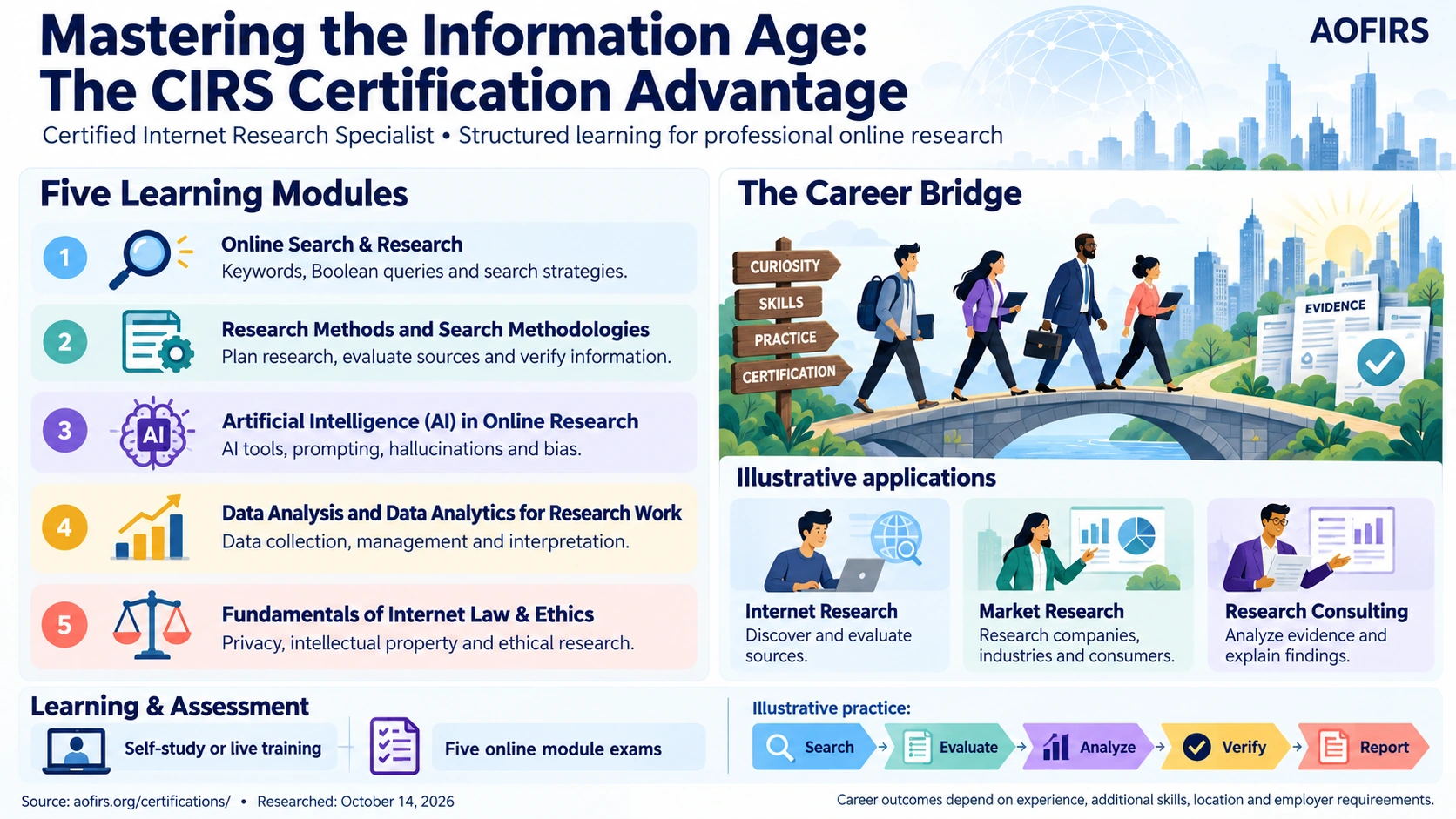
The CIRS certification trains you in all three pillars: advanced search methods, verification, research ethics and professional reporting.
Free Resources
- Master Google Search: From Keywords to Precision Queries
- The Art and Science of Precision Research
- Research report: Structured Query Building and Advanced Google Search Operators
- Search Mastery Toolkit (PDF)
Frequently Asked Questions
What does a professional internet researcher do?
They find, verify and report information from online sources for clients or employers, using a structured method, ethical limits and documented evidence.
What are the three pillars of professional research?
Craft (methods and verification), conscience (ethics and legality) and career (scoping, reporting and continued learning).
Is it legal to research people online?
Using publicly available information is generally lawful, but privacy and data protection rules vary by jurisdiction. Professionals avoid deception and any access to protected systems.
Can AI replace a professional researcher?
AI speeds up discovery and summarising, but it can invent facts and citations. A professional still verifies every claim and takes responsibility for the result.
How can I prove my research skills to clients?
A recognised credential such as the AOFIRS CIRS certification, plus clear, well-documented reports, shows clients you work to a professional standard.
Related Publications
- The Art and Science of Precision Research – how professional researchers turn vague questions into precise queries.
- The Dual Engine Researcher – pairing Google’s index with ChatGPT’s synthesis in one workflow.
- Google vs ChatGPT: Key Differences in Web Research – when to use each engine and how to verify AI output.
- Optimizing the Modern Research Workflow – integrating traditional retrieval with generative AI.
- Master Google Search: From Keywords to Precision Queries – the operators and structure behind professional searches.
By the Association of Internet Research Specialists (AOFIRS).