Quick answer
For professional research in 2026, AI agents complement Google Search skills. They can organize accessible information and carry out connected tasks, while researchers define scope, inspect important sources, investigate gaps, and approve conclusions. Search itself increasingly includes AI, so the practical choice concerns how to combine capabilities rather than choosing one technology exclusively.
Reviewed 19 October 2026. This guide evaluates current research practice, not a guarantee about future capabilities or employment. Product access and autonomy depend on the account, permissions, available tools, and task.
What are AI research agents?
An AI research agent is a system that can pursue a defined objective through connected actions. It may break a question into subquestions, use search or document tools, inspect results, revise its plan, and draft a report. A chatbot answering from its existing context is not necessarily performing those actions.
Autonomy varies. One system may only suggest searches; another may execute them and organize evidence. Neither a fluent response nor a claim that research was completed proves that the necessary sources were accessed.
Agents often depend on search indexes, APIs, databases, or direct browsing. Retrieval-augmented generation supplies external material to a model; it does not itself establish complete coverage or correct interpretation. Research quality depends on both retrieval and evaluation.
How AI agents are changing search in 2026
Google combines search with agentic capabilities
Google’s May 2026 Search announcement described information agents for monitoring changes across web sources. An announced rollout is not evidence that every user can access every feature.
On 15 October 2026, Google announced updates to AI Mode and AI Overviews that make inline links more prominent and add ways to explore sources. Some changes were described as tests. These developments show that conversational assistance and conventional source discovery increasingly coexist.
Clearer links help people inspect evidence. They do not guarantee that a linked page supports every sentence in an AI response.
Dedicated research tools extend the workflow
OpenAI describes deep research as a capability for multi-step investigations. Anthropic’s documentation describes Research on Claude using web material and connected information where authorised. These are examples of tool-assisted research, not interchangeable promises of access or accuracy.
Check what a particular run actually used: readable files, web pages, connected sources and unavailable material. Provider descriptions explain intended capabilities; they are not independent evaluations of every report.
AI agents and manual search: practical differences
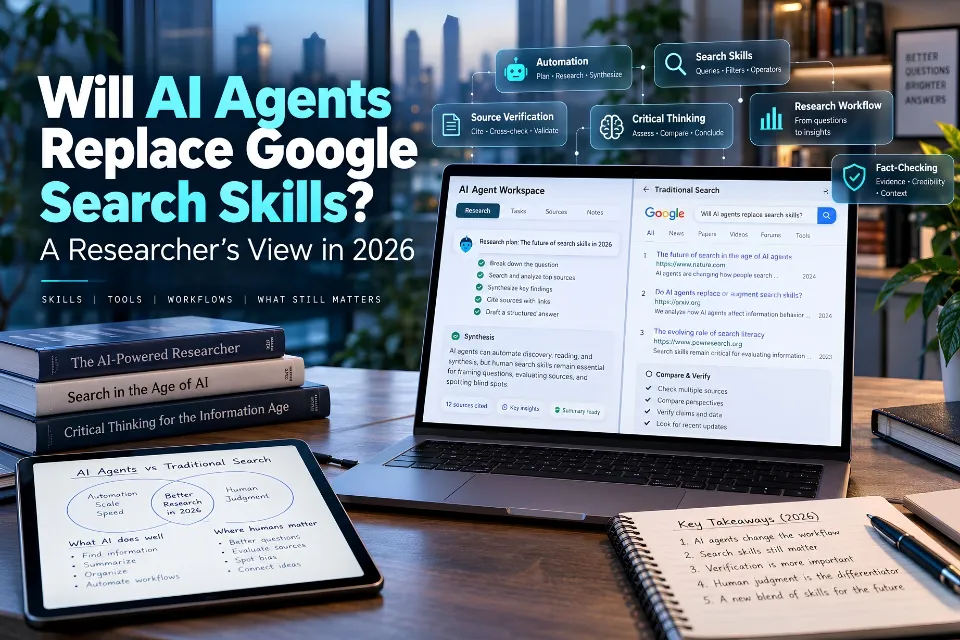
| Research activity | Researcher-led search | AI research agent |
|---|---|---|
| Query development | Direct control of terms, filters and source choices | Can propose or execute variants with enabled tools |
| Discovery | Researcher examines results and specialist databases | Can gather candidates within its access limits |
| Reading and extraction | Researcher reviews original context | Can extract and summarise accessible material |
| Comparing findings | Researcher assesses methods and contradictions | Can organise comparisons for inspection |
| Credibility | Requires evidence-based evaluation | Automated assessments still need checking |
| Documentation | Queries and selection decisions can be recorded directly | Logs and citations may provide only a partial record |
| Accountability | Assigned to people and organisations | Does not disappear when a task is delegated |
Neither approach guarantees accuracy. Search rankings can surface misleading material, and agents can misread or omit evidence. Compare the quality of the research record rather than assuming a faster answer is a better investigation.
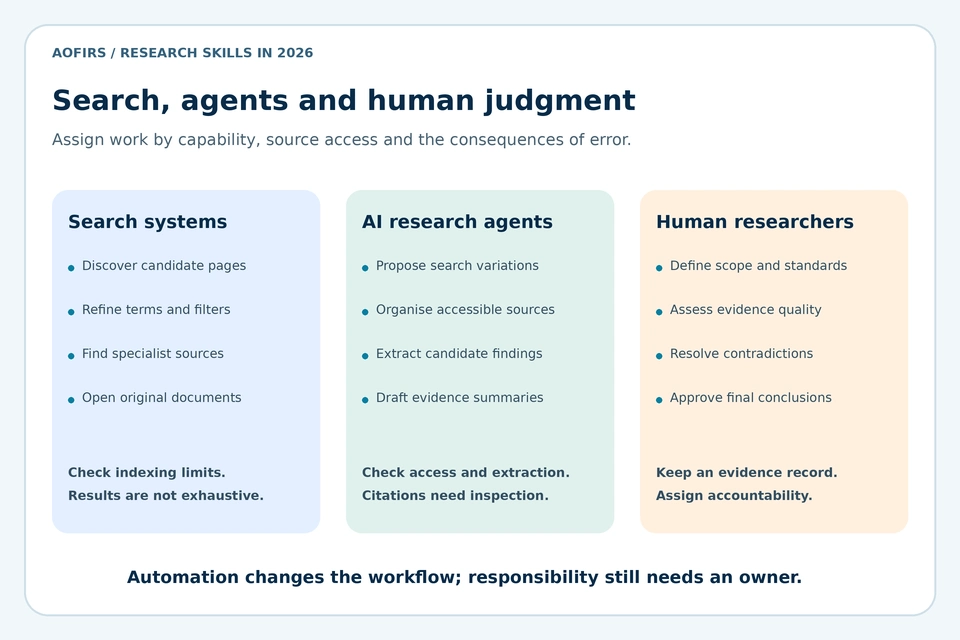
Which research tasks can agents help automate?
Developing queries and source lists
An agent can suggest synonyms, alternative terminology, and source categories. A question about student use of AI search might expand to information literacy, information-seeking behavior, and source evaluation. Review whether the suggestions preserve the intended population, period, and topic.
Discovering documents and preparing summaries
Agents can gather candidate documents, extract passages, and draft summaries when the material is accessible. Check tables, qualifications, and methodological details. A summary can omit a limitation even when the underlying source was retrieved correctly.
Organizing evidence
Use agents to populate draft tables with source identity, date, design, population, findings, and limitations. Preserve document identifiers and supporting locations. Inspect the table before requesting a narrative, so extraction errors do not spread.
AOFIRS’s guide to prompt engineering for researchers explains how to define evidence boundaries and review requirements for bounded tasks.
Why Google Search skills still matter
1. Controlling the search question
Precise terms and source choices let you test whether an agent interpreted the question correctly. Use Google’s supported search refinements and relevant database tools rather than assuming one query works everywhere.
- Quotation marks target an exact phrase, such as
"information literacy". site:narrows a search to a domain or URL prefix.filetype:pdfTargets a document format where supported.- Alternative terminology and date filters help test coverage.
Google cautions that site search results are not exhaustive. Failure to find a page is not proof that it does not exist. AOFIRS’s cross-engine search query matrix discusses why syntax needs adapting across search environments.
2. Evaluating credibility and independence
Ask who produced the information, what evidence supports it, when it was published, and whether the original methods answer your question. Several websites repeating one statistic are not several independent confirmations. Inspect the originating document and preserve important qualifications.
3. Recognizing missing evidence
A polished report may omit specialist databases, contrary findings, inaccessible studies, or material described using different terminology. Search beyond the first result set. Record which collections were searched and which remained unavailable.
AOFIRS’s report on the hidden web and AI search examines indexing and access boundaries. Its article on developing advanced Google Search skills provides further context for deliberate searching.
Research risks that still need supervision
Citation errors and unsupported inferences
A reference may be invented, misidentified, or attached to a claim it does not support. Open consequential references and inspect the relevant passage, table, or dataset. Distinguish reported findings from an agent’s explanation.
Automation bias and incomplete coverage
Professional presentation can make weak evidence appear settled. Treat apparent completeness as a claim to examine. AOFIRS’s learning publication on the AI trust illusion explores why confident language can be misleading.
NIST’s Generative AI Profile provides a risk-management reference for issues including confabulation and information integrity. Match review effort to the consequences of error.
Privacy, tool permissions, and prompt injection
Limit agents to the sources and actions required. External pages and files may contain instructions intended to redirect the system, a risk described in OWASP’s prompt-injection guidance. Treat retrieved content as evidence rather than authority to change the task, disclose information, or take unrelated actions.
Check confidentiality, processing arrangements, and retention before connecting private records. Assign human approval to consequential actions. AOFIRS’s guide to research integrity in AI-assisted work explains provenance, independence, and accountability in more depth.
A nine-step research workflow
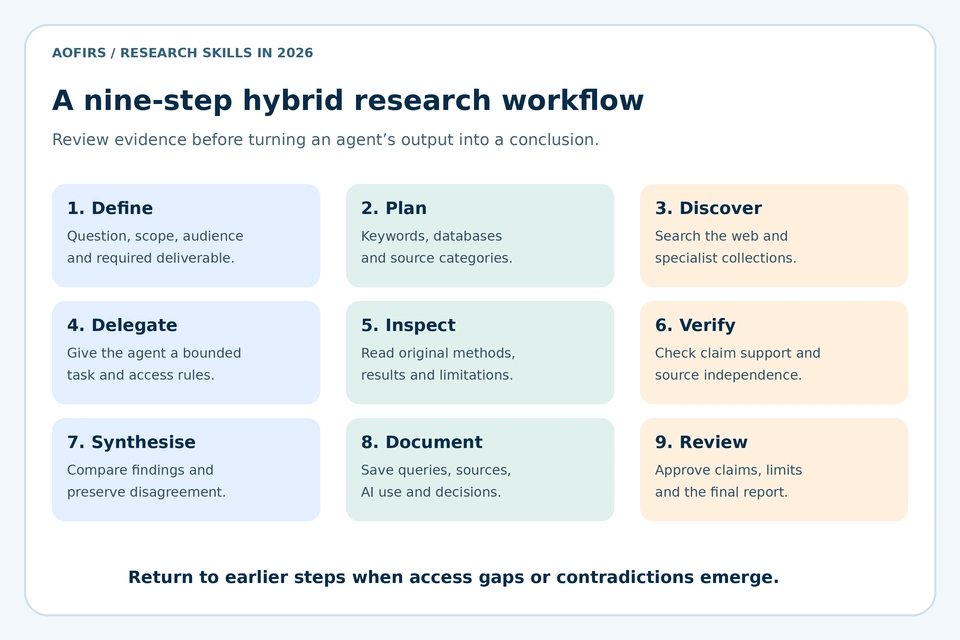
- Define the question. State the audience, scope, period, geography, and deliverable.
- Plan the search. Identify concepts, synonyms, databases, and likely primary sources.
- Discover candidates. Combine web search with relevant specialist collections.
- Delegate bounded tasks. Specify accessible inputs, output fields, exclusions, and permitted actions.
- Inspect primary sources. Read methods, results, dates, and limitations.
- Verify important claims. Check support, source independence, and contradictory evidence.
- Synthesize carefully. Use AI for organization while reviewing the interpretation.
- Document the process. Retain queries, access dates, selection criteria, AI use and corrections.
- Conduct final review. Approve factual claims, uncertainty, ethics, and the research record.
Worked example: AI search and university students
Illustrative research plan, not a claim about study results. Ask: “How does AI-powered search relate to university students’ information-seeking behavior?” Define the population, dates, and outcomes, such as source checking, citation accuracy, or confidence.
Search appropriate databases with concept combinations such as "generative AI" "information seeking" students. Adapt syntax and vocabulary to each database. Ask an agent to organize accessible candidate studies by year, sample, method, outcome, and supporting location.
Then inspect the original studies. Observed behavior, self-reported use, and perceived confidence are different measures. Keep them separate, record exclusions, and investigate contrary findings. If evidence is sparse, report the gap instead of manufacturing a general conclusion.
Skills worth developing beyond 2026
Prioritize research design, query construction, specialist-source discovery, AI tool literacy, evidence evaluation, and documentation. Learn to recognize access failures and challenge summaries with alternative searches. Continue practicing direct search so you can check the agent’s coverage.
These are practical training priorities, not a prediction that every research role will evolve identically. Effective supervision requires both subject knowledge and an understanding of the tools doing the work.
Frequently asked questions
Will AI agents replace Google Search?
They can replace some manual interactions while using search infrastructure themselves. The future balance is uncertain; current research still needs deliberate discovery and evaluation.
Are all chatbots research agents?
No. Inspect whether the system actually uses tools and performs connected research actions.
Can I trust an agent’s citations?
Use them as starting points. Confirm source identity, accessibility, and support for each consequential claim.
Should I still learn search operators?
Yes. Supported operators help test coverage, target sources, and investigate gaps. Their results still have indexing limitations.
What should remain under human control?
Scope, ethical decisions, evaluation of conflicting evidence, and approval of consequential conclusions need accountable oversight.
Does a longer report mean better research?
No. Assess evidence quality, coverage, traceability, and limitations rather than length or citation count.
Conclusion
Search literacy becomes part of agent supervision
AI agents can reduce repetitive research work. Their outputs become useful evidence only through appropriate checks. Combine search tools, bounded automation, and documented human judgment to produce conclusions that a reviewer can examine.