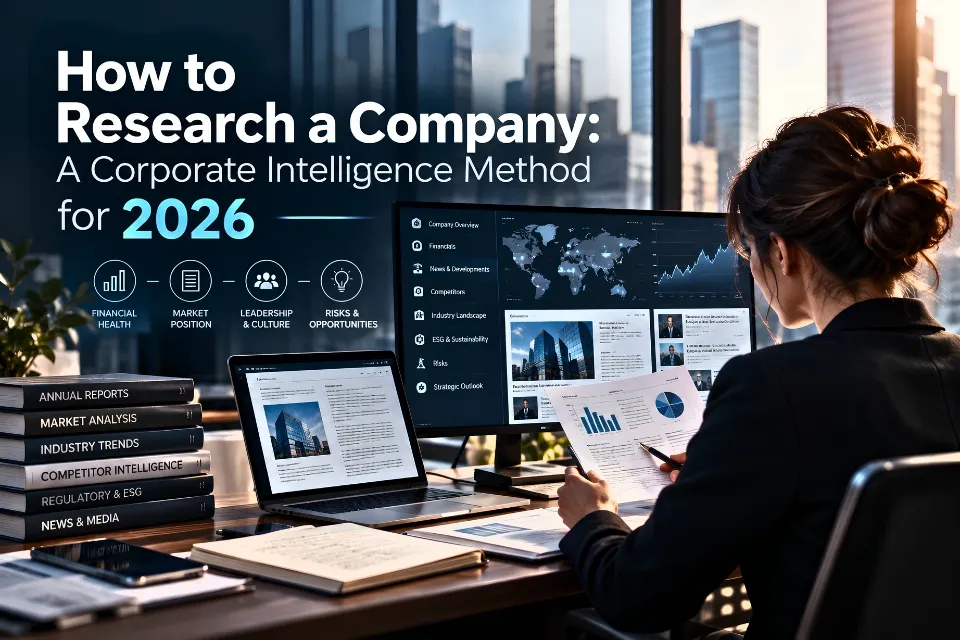
Researching a company properly means doing more than reading its website, checking recent headlines, or asking an AI tool for a summary.
A professional company research process tries to establish the organization’s legal identity, ownership, leadership, financial position, regulatory history, litigation exposure, business activities, recent developments, and public claims using evidence that can be traced back to reliable sources.
This process is often described as corporate intelligence research. It can support vendor screening, investment research, journalism, competitive intelligence, employment decisions, partnership due diligence, market research, risk assessment, and pre-interview preparation.
The central question is not simply:
What information can I find about this company?
It is:
What can I verify about this company, how current is the evidence, and what remains uncertain?
What Is Corporate Intelligence Research?
Corporate intelligence research is the structured collection, verification, and analysis of publicly accessible information about a business or organization.
A researcher may investigate:
- Legal company identity
- Incorporation jurisdiction
- Registration status
- Parent and subsidiary relationships
- Directors and officers
- Significant shareholders or owners, where disclosed
- Financial filings
- Revenue and business segments
- Acquisitions and divestitures
- Regulatory actions
- Court proceedings
- Intellectual property
- Executive changes
- Partnerships
- Customers and markets
- Competitors
- Hiring activity
- Archived company statements
- Media coverage
- Material business risks
This is different from a basic company search.
A search engine helps retrieve documents. Corporate intelligence requires the researcher to decide which documents matter, whether they refer to the correct legal entity, whether they are current, what they actually prove, and how different pieces of evidence fit together.
AOFIRS describes professional internet research as a structured process in which researchers identify suitable evidence, evaluate reliability, reconcile contradictions, and record how conclusions were reached. That same discipline is essential in corporate intelligence research because company research often spans government records, filings, court databases, archives, news sources, and other evidence types that must be compared rather than read in isolation.
Start With the Company’s Legal Identity
One of the most common mistakes in company research is starting with news articles before confirming exactly which legal entity is being researched.
A brand name and a legal company name are not necessarily the same thing.
A business may operate under:
- A trade name
- A parent company
- One or more subsidiaries
- Different legal entities in different countries
- An acquired brand that retains its original name
- A holding company that conducts little operating activity itself
Before deeper research, establish the entity as precisely as possible.
| Identity Check | What to Establish |
|---|---|
| Legal name | Registered company name |
| Trade name | Public-facing brand name |
| Jurisdiction | Country, state, or province of registration |
| Registration number | Official company identifier where available |
| Status | Active, dissolved, inactive, suspended, or equivalent |
| Registered office | Official registered address |
| Formation date | Date the entity was created |
| Officers | Directors, managers, or other listed officials |
| Parent company | Controlling corporate entity, if known |
| Subsidiaries | Material related companies, where identifiable |
Do not assume that two companies with similar names are related.
Search Official Corporate Registries First
Corporate registries are among the strongest starting points for identifying a company because they help establish that the legal entity exists and show how the relevant jurisdiction records it.
United States
The United States does not use one universal public state-company registry for all corporations and LLCs. Business registration usually occurs through state-level authorities.
The U.S. Small Business Administration notes that many LLCs, corporations, partnerships, and nonprofit corporations register with a state’s Secretary of State, Business Bureau, or similar state agency.
A researcher should therefore identify the company’s state of formation and search that jurisdiction’s official entity database.
Depending on the state, available information may include:
- Entity name
- Entity number
- Formation date
- Status
- Registered agent
- Registered address
- Officers or managers
- Filing history
Availability differs significantly between jurisdictions.
United Kingdom
Companies House provides an official register through which researchers can search companies, company numbers, and officers. Its service can provide company information and document images, among other records.
The broader principle is more important than the specific database:
Whenever possible, move from a commercial company profile to the original government register behind it.
Commercial databases can be excellent discovery tools, but the official register is normally the better source for verifying registration facts.
Understand What a Registry Does Not Prove
A registered company record can establish important facts, but it should not be treated as proof that every claim made about the company is true.
For example, registration alone does not prove:
- Revenue
- Profitability
- Number of employees
- Customer count
- Market share
- Operational scale
- Product quality
- Financial stability
- Reputation
- Ownership beyond what is legally disclosed
- Whether a company is actively trading at the scale it claims
This distinction prevents a common research error: turning one valid record into a much broader conclusion than the evidence supports.
Use Regulatory Filings to Understand Public Companies
For companies subject to securities reporting requirements, regulatory filings can reveal substantially more than a corporate website.
In the United States, SEC EDGAR makes filings searchable and allows researchers to examine annual reports, quarterly reports, current reports, proxy statements, ownership disclosures, and other documents. Current EDGAR company pages categorize filings such as 10-K, 10-Q, and 8-K and allow filing dates and reporting periods to be reviewed directly.
Important SEC Filings to Review
Form 10-K
A 10-K can help researchers examine:
- Company operations
- Business segments
- Risk factors
- Financial statements
- Competition
- Legal proceedings
- Management discussion
- Material properties
- Acquisitions
- Debt
- Geographic exposure
Do not read only the financial tables. Risk factors, business descriptions, legal proceedings, and management commentary can provide important corporate intelligence.
Form 10-Q
Quarterly reports can help identify changes since the annual filing, including:
- Revenue changes
- Profit or loss
- Cash position
- New risks
- Litigation updates
- Debt developments
- Changes in operations
Form 8-K
Current reports can be particularly useful for recent events.
Depending on the event, an 8-K may disclose matters such as:
- Executive departures
- Executive appointments
- Material agreements
- Acquisitions
- Financing
- Financial results
- Restructuring
- Other significant corporate developments
Do not assume a company press release tells the complete story. Compare it with any corresponding regulatory filing.
Research Private Companies Differently
Private companies usually provide less financial information than listed companies.
That does not make them impossible to research, but it changes the method.
Useful signals can include:
- Corporate registry filings
- Funding announcements
- Investor websites
- Acquisition records
- Government contracts
- Regulatory licenses
- Patent and trademark activity
- Job postings
- Office openings
- Leadership changes
- Partnership announcements
- Customer case studies
- Court records
- Industry publications
- Archived website pages
Revenue and employee numbers reported by commercial databases should be treated carefully unless their methodology and source are clear.
If three databases provide three different revenue estimates, the correct conclusion may simply be:
Reliable public revenue information is unavailable.
That is better research than choosing whichever number looks most plausible.
Investigate Ownership and Corporate Relationships
A company rarely exists in isolation.
Corporate research should determine whether the entity is:
- Independently owned
- Publicly listed
- Private-equity controlled
- Venture backed
- A subsidiary
- Part of a multinational group
- Recently acquired
- Recently merged
- Operating through multiple subsidiaries
Start with official filings and registry records, then compare them with:
- Investor relations material
- Acquisition announcements
- Regulatory filings
- Parent-company annual reports
- Competition authority records
- Credible financial journalism
Pay attention to dates.
A company described in a 2022 article as independently owned may have been acquired in 2025.
Build a Leadership Verification Record
Leadership pages are useful, but they are not always current.
Companies sometimes leave former executives on older webpages, press releases, conference biographies, or cached documents.
For key leaders, establish:
- Full name
- Current position
- Appointment date where available
- Previous role
- Board membership
- Relevant subsidiary roles
- Recent departure or appointment announcements
- Public statements related to company strategy
Cross-check leadership using several source types:
- Official company leadership page
- Regulatory filing
- Company announcement
- Government registry where officers are disclosed
- Recent interview or conference biography
- Reputable independent reporting
If sources conflict, identify which source is newer and which source has the strongest authority for the particular fact.
Research Litigation, but Interpret It Carefully
Court records can reveal information that does not appear on company marketing pages.
They can expose:
- Contract disputes
- Employment cases
- Patent disputes
- Antitrust claims
- Bankruptcy proceedings
- Regulatory disputes
- Product liability cases
- Shareholder litigation
- Government enforcement actions
For U.S. federal litigation, PACER provides electronic public access to federal court records and a nationwide case locator.
However, the existence of a lawsuit does not prove wrongdoing.
Researchers should distinguish between:
- Allegation
- Complaint
- Motion
- Judicial ruling
- Settlement
- Consent decree
- Dismissal
- Guilty plea
- Conviction
- Final judgment
A complaint tells you what one party alleges.
A judgment tells you what a court determined.
Those are not the same form of evidence.
Search Regulatory and Enforcement Databases
Court databases are only part of legal research.
Regulators may publish cases, administrative proceedings, enforcement actions, consent orders, penalties, closing letters, or other documents.
For example, the Federal Trade Commission maintains searchable cases and proceedings covering competition and consumer-protection matters.
The U.S. Department of Justice also maintains resources such as its Antitrust Case Filings database and Corporate Crime Case Database.
The relevant regulator depends on the company and industry.
A researcher examining a financial institution, pharmaceutical company, telecom provider, airline, energy business, healthcare organization, or defense contractor should identify the regulators that actually oversee that activity.
Use News Archives as a Timeline, Not as a Final Authority
News research becomes much more useful when organized chronologically.
Instead of searching only:
"Company Name"divide searches into specific events and time periods.
Examples:
"Company Name" acquisition
"Company Name" lawsuit
"Company Name" regulator
"Company Name" CEO
"Company Name" funding
"Company Name" layoffs
"Company Name" restructuring
"Company Name" partnership
"Company Name" investigation
"Company Name" expansion
Then review results across different time windows. For ongoing competitor, executive, acquisition, partnership, or litigation monitoring, AOFIRS’s guide to Boolean search for news and OSINT monitoring shows how to combine entity names, former names, products, executives, and event terms without treating repeated news coverage as independent confirmation.
Build a Corporate Timeline
Create a working chronology. The entries below are illustrative, not findings about a specific company:
| Date | Event | Source | Verification Status |
|---|---|---|---|
| Jan. 2025 | Executive appointed | Company announcement | Verified |
| May 2025 | Acquisition reported | News report | Check filing |
| Nov. 2025 | Lawsuit filed | Court record | Verified |
| Feb. 2026 | Expansion announced | Company newsroom | Claim verified as announcement |
| Aug. 2026 | New regulator action | Regulator | Verified |
This prevents unrelated developments from being blended together.
It also makes contradictions easier to detect.
Distinguish the Date of Reporting From the Date of the Event
A September 2026 article may be describing:
- A lawsuit filed in 2024
- An acquisition completed in 2025
- A regulatory investigation opened months earlier
- Statements originally made in an old earnings call
Always record both:
Publication date
and
Underlying event date
This matters because search engines often rank newer reporting about older events.
Without checking dates carefully, a researcher can mistakenly present historical information as a current development.
Search Archived Company Pages
Current webpages show what a company says now.
Archived pages can show what it said before.
Historical web research can help identify:
- Previous executives
- Removed products
- Earlier pricing
- Old office locations
- Former business claims
- Previous partnerships
- Changes in positioning
- Rebranding
- Acquired or discontinued brands
- Deleted announcements
Historical pages are especially useful when a current claim appears inconsistent with earlier public information. Researchers who need to locate older PDFs, hard-to-find public pages, or material that no longer surfaces prominently in ordinary results can use AOFIRS’s guide to finding hidden PDFs and hard-to-find web pages as a retrieval companion before moving to archived copies or publisher records.
However, an archived page proves that content appeared on a website at a particular point in time. It does not automatically prove the underlying statement was true.
Verify Corporate News Against Primary Evidence
Company news often passes through several layers:
Company filing → press release → news article → aggregator → AI summary
Each layer can remove context.
When an article says, “Company X acquired Company Y,” ask:
- Was an acquisition agreement signed or was the deal completed?
- Was regulatory approval still required?
- Was the transaction later abandoned?
- Was the target company acquired in full?
- Was only one business unit purchased?
- What was the effective date?
Whenever the distinction matters, trace the claim back to the strongest available evidence.
A useful workflow is:
Search result → article → original announcement → filing or registry record → conclusion
Separate Company Claims From Independently Established Facts
A company website is a primary source for what the company says about itself.
It is not necessarily independent evidence that the claim is correct. When a corporate page, trade publication, or unfamiliar research site becomes part of the evidence trail, apply explicit website credibility checks to its ownership, authorship, date, sourcing, commercial interests, and supporting evidence before relying on it for a material conclusion.
For example:
Company statement:\
“We are the leading provider in our market.”
This proves the company makes that claim.
It does not by itself establish market leadership.
The researcher would need appropriate market data or independent evidence to support that broader conclusion.
Use precise language:
- “The company states…”
- “The annual report reports…”
- “The regulator found…”
- “The complaint alleges…”
- “The court ruled…”
- “Independent reporting indicates…”
- “Public records show…”
These distinctions make corporate intelligence more reliable.
Create a Corporate Source Hierarchy
Not every source deserves equal evidentiary weight.
A practical framework is:
Tier 1: Direct Official Records
Examples:
- Corporate registries
- Regulatory filings
- Court documents
- Government enforcement records
- Official licenses
- Patent and trademark records
Best used to establish formal or legal facts.
Tier 2: Company-Originated Records
Examples:
- Company annual reports
- Investor presentations
- Press releases
- Executive biographies
- Corporate blogs
- Product documentation
Best used to establish what the company reports or claims.
Tier 3: Independent Professional Sources
Examples:
- Established business journalism
- Trade publications
- Industry research
- Academic studies
- Analyst research where methodology is clear
Useful for independent context and interpretation.
Tier 4: Discovery Sources
Examples:
- Search-engine snippets
- Aggregators
- Company-profile websites
- Social platforms
- Employee-review websites
- AI-generated answers
Useful for discovering leads.
They should rarely be the stopping point for a consequential claim.
Search Strategically Instead of Searching Broadly
Generic company-name searches quickly become noisy.
Build queries around specific evidence types. For reproducible web research, the current AOFIRS guide to Google Search operators in 2026 is useful for checking which commands are documented, which are experimental or inconsistent, and which older operators should no longer anchor a research workflow.
Registry and Filing Searches
"Company Name" registration
"Company Name" annual report filetype:pdf
"Company Name" 10-K
"Company Name" 8-K
site:sec.gov "Company Name"
Litigation Searches
"Company Name" lawsuit
"Company Name" complaint
"Company Name" settlement
"Company Name" court
"Company Name" antitrust
Leadership Searches
"Executive Name" "Company Name"
"Executive Name" appointed
"Executive Name" resigned
site:company.com "Executive Name"
News and History Searches
"Company Name" acquisition
"Company Name" investigation
"Company Name" 2026
"Company Name" partnership
"Company Name" restructuring
Use search operators only when the search engine currently supports them reliably. For a broader framework, The Search Architect’s Toolkit connects advanced query construction, Boolean logic, source evaluation, and AI-assisted retrieval. The practical principle remains the same: query construction should support evidence discovery rather than replace verification.
Research Competitors Through Evidence, Not Listicles
Competitor analysis can become unreliable when researchers copy “top competitors” lists from commercial websites.
A stronger method is to look for competitor evidence in:
- Annual reports
- Regulatory filings
- Government competition cases
- Investor presentations
- Procurement records
- Industry reports
- Customer comparisons
- Market-entry announcements
Public companies sometimes identify important competitors directly in filings.
Competition regulators can also reveal how authorities define the relevant market in merger or antitrust matters.
Treat competitive relationships as contextual. Two companies may compete in one product category while partnering in another.
Examine Hiring as a Business Signal
Job listings can provide clues about what a company is building or prioritizing.
Repeated hiring in areas such as:
- Artificial intelligence
- Compliance
- Cybersecurity
- Enterprise sales
- New geographic markets
- Manufacturing
- Supply chain
- Research and development
may indicate areas of investment.
But hiring activity is a signal, not proof of a completed strategic shift.
A listing shows that the organization advertised a position. It does not prove the role was filled, the project succeeded, or the strategy remains unchanged.
Check Intellectual Property When It Is Relevant
Patent and trademark research can add another layer to corporate intelligence.
It may help identify:
- New product areas
- Brand launches
- Technology development
- Inventor relationships
- Historical ownership
- Acquired intellectual property
Do not equate a patent filing with a commercially successful product.
A company may patent technologies it never launches.
Use AI as a Research Assistant, Not as Corporate Evidence
AI tools can accelerate corporate intelligence work by helping researchers:
- Generate research questions
- Extract themes from filings
- Summarize lengthy reports
- Compare documents
- Build company timelines
- Identify possible contradictions
- Generate follow-up searches
- Organize leadership information
- Analyze multiple job descriptions
- Explain unfamiliar financial terminology
But AI-generated statements should not automatically enter the final research record as verified facts.
AI-assisted research still requires source-level verification. AOFIRS’s research report Information Retrieval in the Age of AI examines how semantic search, conversational retrieval, automated synthesis, algorithmic bias, and source reliability change the discovery process without removing the need for human validation.
Use this sequence:
AI output → identify factual claim → open cited source → verify entity → verify date → verify context → locate original evidence → record conclusion
A citation can exist and still fail to support the claim attached to it. A useful companion is AOFIRS’s learning publication on integrating traditional information retrieval with generative AI, which frames AI as an analysis and organization layer around a traceable search-and-verification workflow rather than as a substitute for primary evidence.
Watch for Corporate Identity Confusion
Company-name ambiguity is a major source of research errors.
Before attaching a record to a company, compare:
- Legal name
- Registration number
- Jurisdiction
- Address
- Executive names
- Parent company
- Industry
- Filing identifiers
- Dates
A lawsuit involving “ABC Holdings LLC” in Texas may have nothing to do with a similarly named company in Delaware.
A people-search or corporate-data aggregator match should therefore be treated as a lead until the entity is confirmed.
This follows the same verification principle AOFIRS applies to people-search research: a result is not verified merely because the name appears to match.
What to Do When Sources Contradict One Another
Contradictions are normal in corporate intelligence.
You may find:
- Two formation dates
- Different employee counts
- Conflicting revenue estimates
- Different headquarters addresses
- An executive listed as current in one source and former in another
- A company describing expansion while reports describe layoffs
- Conflicting acquisition dates
- Different descriptions of ownership
Do not hide the disagreement.
Investigate it.
Ask:
- Are the sources describing the same legal entity?
- Which source is newer?
- Which source is closer to the original record?
- Could both claims refer to different reporting periods?
- Is one number an estimate?
- Did the corporate structure change?
- Is a news article describing an announcement rather than completion?
- Has the record been amended?
If the conflict cannot be resolved, document the uncertainty.
“Public sources conflict” is sometimes the most accurate conclusion.
A Practical Corporate Intelligence Research Workflow
A structured investigation can be organized into ten stages.
1. Define the Research Question
Decide what you are trying to establish.
Examples:
- Who owns the company?
- Is it active?
- Has leadership changed?
- What legal disputes exist?
- What does it disclose financially?
- Has it recently been acquired?
- What market does it operate in?
2. Resolve the Entity
Confirm legal name, jurisdiction, registration number, and related entities.
3. Search the Official Registry
Review the legal existence, status, officers, addresses, and filing history available in the jurisdiction.
4. Review Regulatory Filings
For companies subject to reporting requirements, examine financial, ownership, governance, and material-event filings.
5. Map Leadership and Ownership
Verify directors, executives, major shareholders, parent entities, and material subsidiaries.
6. Search Litigation and Enforcement Records
Check appropriate courts, regulators, and enforcement databases.
7. Build a News Timeline
Search credible reporting across multiple dates and event categories.
8. Check Historical Records
Use archived pages, previous filings, earlier announcements, and historical leadership information.
9. Cross-Check Material Claims
Trace high-impact claims to the strongest available source.
10. Record Facts, Claims, and Unknowns Separately
Your final research notes should clearly distinguish:
Verified fact\
Supported by appropriate evidence.
Company claim\
Published by the organization but not independently established.
Independent report\
Reported by an outside source.
Estimate\
Based on modeling or incomplete information.
Allegation\
Claim made in litigation or enforcement proceedings.
Unknown\
Evidence is insufficient to reach a reliable conclusion.
Corporate Intelligence Research Checklist
Before completing a company profile, ask:
- Have I identified the correct legal entity?
- Have I checked the relevant official company registry?
- Do I know its registration jurisdiction?
- Have I identified parent companies and significant subsidiaries?
- Have I checked regulatory filings where applicable?
- Have I verified current leadership?
- Have I reviewed recent executive changes?
- Have I searched relevant court databases?
- Have I checked regulatory enforcement records?
- Have I built a dated news timeline?
- Have I checked older or archived company information?
- Have I separated company claims from independent findings?
- Have I identified estimates as estimates?
- Have I checked whether important events were announced or actually completed?
- Have I documented unresolved contradictions?
- Can another researcher trace my important conclusions back to evidence?
If the answer to the final question is no, the research record probably needs more work.
How Corporate Intelligence Differs for Public and Private Companies
| Research Area | Public Company | Private Company |
|---|---|---|
| Legal registration | Registry | Registry |
| Financial reporting | Often extensive | Usually limited |
| Securities filings | Often available | Usually unavailable |
| Ownership | May be disclosed extensively | Often harder to establish |
| Revenue | Financial statements | Frequently private or estimated |
| Leadership | Filings and company sources | Registry and company sources |
| Litigation | Court records | Court records |
| Regulatory actions | Regulator databases | Regulator databases |
| Strategy | Filings, earnings calls, investor materials | News, interviews, hiring, and announcements |
| Funding | Filings and investor records | Funding announcements and investor sources |
| Historical research | Archives and filings | Archives, registry changes, and news |
The most important difference is not that private companies cannot be researched.
It is that researchers must be more disciplined about acknowledging what public evidence cannot establish.
Ethical Boundaries in Company Research
Corporate intelligence research should rely on lawful, relevant, and professionally obtained information.
Do not treat “open-source research” as permission to:
- Circumvent access controls
- Misrepresent your identity
- Obtain stolen credentials
- Use leaked private records
- Harass employees
- Publish unnecessary personal information
- Access restricted systems without permission
- Confuse personal information with legitimate corporate evidence
Public availability does not automatically make every piece of information relevant or appropriate to use.
Professional research requires judgment as well as search skill.
The AOFIRS Certified Internet Research Specialist framework places online search, research methodology, AI-assisted research, data analysis, and internet law and ethics within the same professional research discipline. Those skills are directly relevant when corporate investigations move beyond ordinary web searching.
Common Corporate Research Mistakes
Searching the Brand Instead of the Legal Entity
This can cause missed filings, court cases, and corporate relationships.
Treating Search Results as Evidence
A search-result snippet is a retrieval aid, not a reliable final source.
Using Only Recent News
Older filings and archived records may explain the current situation.
Ignoring Jurisdiction
Registries, courts, reporting duties, and disclosure rules differ by country and state.
Treating a Lawsuit as Proof of Misconduct
A filed allegation is not the same as a judicial finding.
Treating Company Marketing as Independent Evidence
Corporate websites are useful primary sources for company statements, but they have an obvious institutional perspective.
Copying Commercial Database Estimates
Always determine whether figures such as revenue, headcount, valuation, and market share are reported facts or estimates.
Relying on AI Without Opening the Sources
AI can accelerate discovery but can also combine entities, dates, estimates, and outdated information incorrectly.
Ignoring Contradictions
Conflicting records are not an inconvenience to remove. They are part of the research problem.
Frequently Asked Questions
What Is Corporate Intelligence Research?
Corporate intelligence research is the systematic investigation of a company’s legal identity, ownership, leadership, filings, litigation, regulatory history, business activity, and public record. It uses multiple sources and verifies material findings rather than relying on a single company profile.
What Is the Best Place to Start Researching a Company?
Start by identifying the correct legal entity and searching the official corporate registry for its jurisdiction. Once the entity is confirmed, move to regulatory filings, litigation records, company reports, news archives, and other relevant evidence.
How Do I Research a Private Company?
Use corporate registries, court records, regulator databases, funding announcements, investor websites, job postings, intellectual-property records, archived webpages, industry reporting, and company announcements. Accept that some financial and ownership information may not be publicly available.
How Do I Check Whether a Company Has Been Sued?
Identify the relevant jurisdiction and search the appropriate court system. In the United States, PACER covers federal court records, while state litigation generally requires searching the applicable state or local court system.
Does a Lawsuit Mean a Company Did Something Wrong?
No. A lawsuit may contain allegations that have not been proven. Researchers should review the case status and distinguish complaints, settlements, dismissals, judgments, pleas, and other outcomes.
Are Company Websites Reliable Research Sources?
They are useful primary sources for establishing what a company officially says, publishes, sells, or announces. They should not automatically be treated as independent proof of promotional claims.
Can AI Be Used for Corporate Intelligence Research?
Yes. AI can help organize documents, generate queries, summarize filings, identify potential inconsistencies, and structure timelines. Important factual findings should still be verified against the underlying source.
How Do I Know Whether Corporate Information Is Current?
Check the source’s publication or filing date and the date of the underlying event. Compare recent filings, registry records, leadership pages, regulatory databases, and independent reporting before treating a fact as current.
Conclusion
Effective corporate intelligence research depends on more than finding information. Researchers need to confirm the correct legal entity, review official registries and filings, examine litigation and regulatory records, verify leadership, track news over time, and compare company claims with independent evidence. The goal is to build a reliable picture of the company based on sources that are current, traceable, and appropriate for the specific question being investigated.
A strong company research process also makes uncertainty visible. When sources conflict, figures are estimated, or ownership and financial details are not publicly available, those limitations should be documented rather than filled with assumptions. By combining structured search, source verification, historical checks, and careful analysis, researchers can produce corporate intelligence that is more accurate, defensible, and useful for due diligence, competitive research, journalism, investment analysis, and professional decision-making.