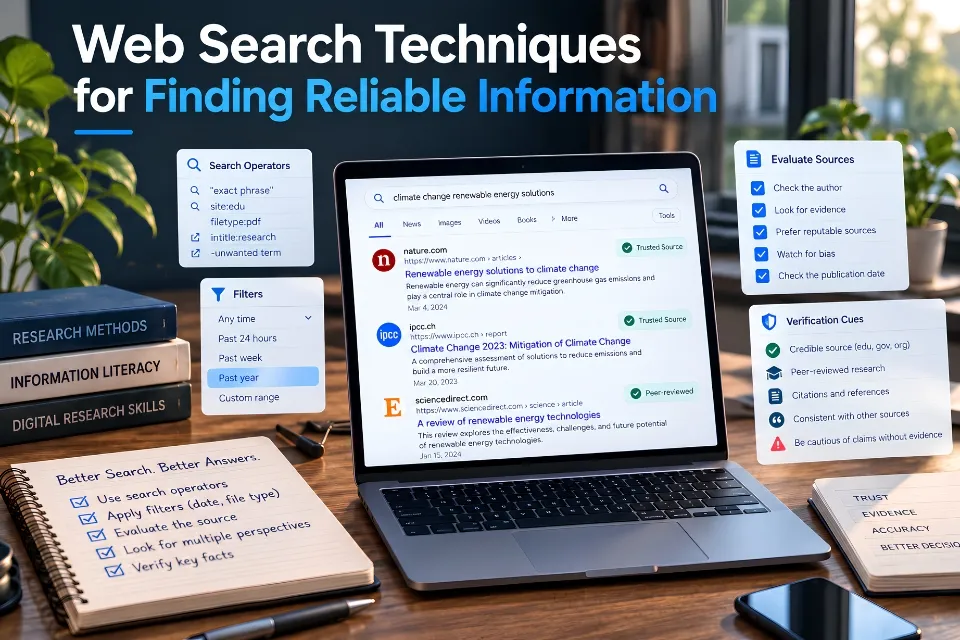
Finding information online is easy. Finding information that is accurate, current, relevant, and supported by trustworthy evidence requires a more systematic approach.
Search engines can retrieve millions of pages, but their results may include outdated studies, promotional material, misleading statistics, duplicated reporting, and unsupported claims. AI-powered search tools introduce another challenge: they can produce convincing summaries that contain factual errors or citations that do not support their conclusions.
Effective web searching combines precise queries, advanced search operators, date filters, primary-source discovery, and independent verification. The aim is not simply to find an answer quickly. It is to establish whether the available evidence justifies that answer.
This guide explains ten practical techniques for finding reliable information using Google, Bing, academic databases, visual search tools, and AI-powered research systems. It also shows how to check sources, recognize common research mistakes, and document findings so they can be reviewed or reproduced.
What Makes a Web Search Result Reliable?
A reliable search result leads to information that is relevant to the research question, supported by appropriate evidence, accurately represented, and sufficiently current for its intended use.
Reliability involves several related qualities:
- Relevance: Does the information address the actual research question?
- Accuracy: Are the facts, figures, and statements correct?
- Credibility: Can the source’s methods, claims, and evidence be trusted?
- Authority: Does the author or organization have relevant expertise or direct knowledge?
- Currency: Is the information appropriate for the period being investigated?
- Independence: Is the evidence genuinely corroborated, rather than repeated from one original claim?
These qualities must be evaluated separately. A government report can be authoritative but outdated. A recently published blog post may be relevant but inaccurate. A peer-reviewed study may be methodologically strong yet unsuitable for a different population or research question.
Primary, secondary, and tertiary sources
| Source type | Description | Example |
|---|---|---|
| Primary | Original evidence, observations, records, or findings | Census dataset, original clinical study, court judgment |
| Secondary | Analysis or interpretation of primary evidence | Research review, investigative analysis |
| Tertiary | Collection or summary of established information | Encyclopedia, reference guide |
Primary sources are often the strongest starting point for verifying what a particular study, organization, or official record actually says. However, being a primary source does not automatically make information correct.
Search engines rank results using multiple signals designed to identify useful and relevant material. Their ranking systems are not a substitute for independently examining the evidence. Google itself emphasizes originality, accuracy, and trustworthy content in its guidance on creating helpful, reliable content.
1. Build Precise Search Queries Using Keywords and Search Intent
The quality of a search often depends on how clearly the researcher defines the information needed.
Broad queries can produce thousands of loosely related results. More precise searches identify the subject, the question being investigated, relevant terminology, geographical scope, and time period.
For example, searching for AI in education might return advertisements, general opinion articles, software comparisons, and academic studies.
A more useful query could be:
generative AI university assessment academic integrity 2025 2026
This identifies the technology, educational setting, research issue, and period.
Break the research question into concepts
Consider the question: How has remote work affected employee productivity in the United States?
The major concepts are remote work, productivity, employees, and the United States.
Researchers should also consider alternative terminology, including telework, working from home, workplace performance, and hybrid working.
| Search stage | Example query | Purpose |
|---|---|---|
| Broad | remote work productivity |
Explore the topic |
| Focused | remote work employee productivity United States |
Add context |
| Expanded | "working from home" productivity study |
Explore alternative terminology |
| Source-focused | site:bls.gov telework productivity |
Look for official information |
Search intent matters as well. A navigational search aims to locate a particular website or document, while an informational search seeks an explanation or evidence. A researcher looking for original data should avoid queries that primarily attract general advice articles.
Refine searches rather than making them unnecessarily long
Begin with the central concepts and inspect the first group of results. Identify the terminology used by relevant sources, then revise the query.
If results are too broad, add another concept. If they are too narrow, remove restrictions or test synonyms.
This iterative method is more dependable than creating one elaborate query and assuming it will retrieve every relevant document.
2. Use Advanced Search Operators to Narrow Results
Advanced search operators are commands that help restrict results by phrase, website, document type, or other supported characteristics.
They are particularly useful when ordinary keyword searches return too many unrelated pages.
Google and Bing both provide advanced search features, but their syntax is not identical. Microsoft’s Bing documentation includes several operators and keywords beyond those listed in Google’s general search help.
Common search operators and examples
| Operator | Purpose | Example | Limitation |
|---|---|---|---|
" " |
Search for an exact phrase | "digital research methods" |
May miss different wording |
- |
Exclude a term | jaguar habitat -car |
May remove relevant results |
site: |
Focus on a domain or website | site:nasa.gov climate data |
Limited to indexed or retrievable results |
filetype: |
Find specific document types | water quality filetype:pdf |
Not every relevant document is a PDF |
before: |
Restrict by date in Google | climate policy before:2024-01-01 |
Date signals may not equal original publication |
after: |
Restrict by date in Google | climate policy after:2025-01-01 |
Does not guarantee newly written content |
intitle: |
Target title terms on supported platforms | intitle:research cybersecurity |
Syntax and behavior vary |
OR |
Search alternative concepts | telework OR "remote work" |
Grouping behavior varies by engine |
Combine operators to target specific sources
A researcher looking for official material on artificial intelligence policy could enter:
site:nist.gov "artificial intelligence" filetype:pdf
This is designed to retrieve indexed PDF documents associated with the National Institute of Standards and Technology.
Another example is:
site:who.int "antimicrobial resistance" filetype:pdf
This narrows discovery to documents from the World Health Organization’s website.
Such queries improve retrieval precision. They do not guarantee that the results contain the newest, most comprehensive, or most appropriate evidence.
Google’s official documentation confirms site: and filetype: support and cautions that search operators are affected by indexing and retrieval limits.
For additional guidance, see AOFIRS’ Boolean search guide for researchers, which explains how to adapt query logic across different platforms.
3. Apply Boolean Logic and Combine Search Concepts
Boolean searching uses logical relationships to combine terms and control which concepts must be represented in the results.
The three foundational operators are AND, OR, and NOT.
AND connects required concepts, OR connects alternatives, and NOT excludes unwanted concepts where supported.
These principles are particularly useful for literature reviews, business intelligence, recruitment research, and investigative searching.
Understand the three Boolean relationships
Suppose a researcher is investigating how artificial intelligence affects healthcare administration.
An academic database may accept:
("artificial intelligence" OR "machine learning") AND ("hospital administration" OR "healthcare management")
The first group contains alternative technology terms. The second contains alternative administrative terms. AND connects the two concepts.
A second query might be:
("remote work" OR telework) AND productivity NOT students
The NOT command excludes a concept on platforms where that syntax is supported. Exclusions must be used carefully because a relevant publication might mention students as a comparison group.
Boolean syntax differs between platforms
Microsoft explicitly documents AND, OR, NOT, parentheses, and quotation marks for Bing. It also specifies operator precedence and notes that OR and NOT should be capitalized.
Academic databases may provide additional controls such as field searching, proximity operators, and truncation. Their syntax depends on the database.
For example, a research database might support a proximity command requiring climate and adaptation to appear within a specified number of words. Researchers must consult that platform’s documentation rather than assume a command works across Google, Bing, and scholarly databases.
Use Boolean search as part of a documented strategy
A strong search strategy records the exact query, platform, search date, filters, and important revisions.
AOFIRS’ Search Query Matrix explains why query syntax differs across search engines and how researchers can adapt Boolean logic and metadata filters to each platform.
For professional investigations or academic reviews, documenting query changes is important. It makes the evidence-gathering process more transparent and helps another researcher understand how the findings were obtained.
4. Use Date Filters to Find Current and Historical Information
Date filters allow researchers to focus searches on a particular time period. They are useful when information changes frequently or when historical accuracy matters.
A search about cybersecurity recommendations from 2026 should not automatically treat a 2019 guidance document as current. Conversely, a researcher investigating an event in 2019 may specifically need the earliest available reporting rather than an updated retrospective.
Search within a defined date range
Google documents before: and after: as search refinements based on document update dates.
For example:
"artificial intelligence regulation" after:2025-01-01 before:2026-10-06
This is a useful way to narrow Google results toward the requested period, although the dates still require checking within each source.
For historical searching:
"renewable energy policy" before:2020-01-01
A researcher can also use search interface date controls where available.
Understand the limits of publication dates
Search engines may rely on signals associated with publication, modification, indexing, or content updates. A page shown in a recent-results filter is not necessarily newly written.
A website might update its template, refresh a timestamp, or revise a small section without changing the underlying research findings.
Researchers should therefore examine the original publication date, latest substantive revision, dates of the cited evidence, and whether the information applies to the period being studied.
Example: A page titled Best AI Research Tools in 2026 may include product descriptions based on 2024 documentation. Its headline alone cannot establish that the content reflects current features.
For fast-changing topics such as AI systems, regulations, security vulnerabilities, and search technology, dates are part of the evidence, not merely background details.
5. Search Within Authoritative Websites and Primary Sources
Primary-source searching helps researchers locate original documents instead of relying entirely on interpretations published elsewhere.
The best primary source depends on the question.
For example, official legislation is appropriate for confirming the wording of a law. A company’s filing may establish what it formally disclosed. A scientific article may provide original experimental results. A national statistics agency may publish the underlying data behind an economic indicator.
Target official sources
A useful strategy combines topic keywords with the relevant organization or domain.
Examples include:
site:sec.gov "annual report" cybersecurity
site:cdc.gov influenza surveillance
site:census.gov household income data
These queries focus discovery on relevant official websites.
A researcher investigating an organization’s financial disclosures should locate its original filings and identify the reporting period. News coverage may provide useful interpretation, but it should not replace the original record when exact figures matter.
Identify the source closest to the evidence
Consider a claim that a government agency introduced a new reporting requirement.
A practical verification sequence is to locate the agency’s official announcement, identify the corresponding regulation or notice, confirm its effective date, and compare the claim with the actual wording.
A second source may help explain its impact, but the legal or regulatory text should remain central to establishing what the requirement says.
Primary does not always mean reliable
An official company statement can accurately reveal the company’s position while omitting unfavorable information. A preliminary study can present original evidence that later research challenges.
A primary document should therefore be assessed for its purpose, methodology, completeness, and possible limitations.
Researchers can explore the broader principles of credibility and evidence assessment in AOFIRS’ guide to verifying AI-generated answers and citations.
6. Find Research Papers, PDFs, Reports, and Public Datasets
General search engines are valuable for discovering information, but specialized academic databases and institutional repositories are often more appropriate when research requires published studies, technical reports, or original datasets.
The first task is to identify the kind of evidence needed. Someone researching a country’s unemployment rate may need an official statistical dataset. Someone investigating the relationship between sleep and cognitive performance may need peer-reviewed studies and systematic reviews.
Search for scholarly research
Google Scholar provides a broad starting point for finding academic literature across disciplines.
Its features include publication-year filters, author searches, citation tracking, related articles, and links to available versions of publications.
For example, a researcher investigating generative AI in higher education could search:
"generative artificial intelligence" "higher education" assessment
After identifying a relevant paper, the researcher should examine its methodology, publication status, references, and subsequent citations.
Google Scholar’s official search documentation explains how to use publication-date filters, Cited by, Related articles, and All versions to discover related literature.
Find research documents using file-type filters
A search for original reports might use:
"digital literacy" research report filetype:pdf
A more targeted query could be:
site:unesco.org "digital literacy" filetype:pdf
These commands help narrow the search to potentially relevant documents. However, researchers should still inspect the document’s publisher, publication date, scope, and references.
PDF format does not indicate scientific quality. A downloadable report may be peer-reviewed research, an institutional working paper, or an unsupported opinion document.
Explore public datasets and repositories
Useful sources include Data.gov for US government datasets, World Bank Open Data for international development indicators, and PubMed for biomedical literature.
Researchers can also use institutional repositories, discipline-specific databases, and open scholarly metadata services.
When evaluating a dataset, inspect the collection method, coverage period, geographic scope, variable definitions, missing values, and licensing conditions.
A dataset may be authentic but unsuitable for a particular conclusion. For example, figures collected from urban households should not automatically be generalized to an entire national population.
Distinguish publication types
A peer-reviewed journal article, preprint, technical report, and systematic review serve different purposes.
A preprint may provide timely findings, but it has not necessarily undergone formal peer review. A systematic review may synthesize a wider body of evidence, although its reliability depends on how studies were selected and assessed.
For a broader comparison of research platforms, AOFIRS provides a guide to academic search engines, scholarly databases, and AI research tools.
7. Compare Results Across Multiple Search Engines
Different search engines may retrieve different sources for the same query. This happens because their indexes, ranking systems, content coverage, language handling, and personalization mechanisms are not identical.
Comparing results can reveal sources overlooked during the initial search and help researchers recognize when one platform presents a narrow view of a topic.
Choose search tools according to the research question
| Search platform | Suitable research use | Main limitation |
|---|---|---|
| Google Search | Broad web discovery, official sites, documents, current topics | Ranking does not establish accuracy |
| Microsoft Bing | General web research and additional search results | Coverage and operator behavior differ |
| DuckDuckGo | General web searches with a privacy-oriented approach | Results may depend on external search sources |
| Google Scholar | Scholarly publications and citation discovery | Includes non-peer-reviewed material |
| PubMed | Biomedical and life-sciences literature | Specialized subject coverage |
| AI-powered search tools | Topic exploration, summarization, source suggestions | Answers and citations require verification |
Run a cross-engine search
Suppose a researcher wants to investigate the environmental impact of lithium-ion battery recycling.
The process could begin with a Google search to identify relevant terminology and organizations. A Bing search may uncover additional reports or different pages. A scholarly database can then help identify scientific studies evaluating recycling methods.
The researcher should compare relevant sources, not simply the number of results returned.
If several engines surface the same report, that may indicate visibility rather than independent confirmation. The report’s underlying methodology remains the relevant evidence.
Account for geographic and language differences
Search results can vary according to location, language, regional availability, and other settings.
When investigating policies in a particular country, specify the jurisdiction and search relevant official sources. Where appropriate, search in the country’s official language and compare local terminology with English-language reporting.
For example, searching for employment regulations without specifying a country can mix incompatible legal requirements.
AI-powered search platforms can help identify terms and summarize different viewpoints, but their conclusions should be checked against the original material.
8. Use Reverse Image Search and Visual Verification
An image can appear convincing while having little relationship to the event or claim associated with it.
A genuine photograph may be shared with a false location, an incorrect date, or a misleading description. Digitally manipulated and AI-generated images introduce additional complications.
Reverse image searching helps investigators discover where an image or visually similar material appears online.
Search for earlier appearances and visual matches
Tools such as Google Lens and other image-search services can help identify visually similar photographs, websites displaying an image, and related visual material.
Google’s official Lens search instructions describe searching through uploaded images, image URLs, and browser-based visual search.
A basic image-verification process involves identifying the most distinctive visual features, searching with the full image, checking similar images, and examining the associated webpages.
Researchers should then investigate the context in which each matching image appears.
Example: A photograph linked to a recent natural disaster
Imagine a social media post claiming that a photograph shows flooding in a particular city in September 2026.
A reverse image search reveals an identical photograph on a news website dated several years earlier.
That earlier publication raises a serious question about the new claim. The researcher should examine the older article, its photo credit, and any other independently documented appearances.
If the older source reliably establishes that the photograph depicts a different event, the recent caption can be challenged.
However, the oldest result found through a search engine is not necessarily the original publication.
Distinguish image matches from proof of origin
An image match does not prove who created the image, where it was taken, when it was captured, or whether it has been manipulated.
The absence of reverse-image matches also does not establish authenticity.
A newly generated image, an edited photograph, or a previously unpublished image may have no searchable history.
Researchers may need to combine visual matches with original photo credits, geographic landmarks, weather records, credible eyewitness reporting, metadata where available, and other independent evidence.
Google’s About this image feature can provide additional context in supported regions, although availability varies.
For further investigation methods, consult AOFIRS’ guide to reverse image searching for investigations.
9. Evaluate Website Credibility and Cross-Check Claims
Finding several websites that support a claim can create a false impression of certainty. The sources may all depend on one original report, press release, or unverified social media post.
Effective verification requires investigating the evidence behind each claim and determining whether sources are genuinely independent.
Assess the credibility of the source
Start by identifying who produced the material, why it was published, and what evidence supports its conclusions.
Check whether the author has relevant expertise, whether the organization explains its methods, and whether readers can inspect the underlying data or references.
Consider potential commercial, political, institutional, or personal interests.
A professional-looking website may still publish unreliable information. Equally, an older or visually simple website may contain valuable archival records.
Neither appearance nor domain extension should replace evidence assessment.
Use lateral reading
Lateral reading means leaving the webpage being evaluated to investigate what independent sources say about the publisher and its claims.
Suppose a website states that a particular technology reduces business operating costs by 70%.
Rather than relying on testimonials presented on that website, search for the original research, examine how savings were calculated, and compare findings from independent studies.
Questions worth answering include:
- Who conducted the research?
- What was measured?
- How large was the sample?
- Were results independently assessed?
- Does the stated percentage apply to all users or only a particular setting?
A credible source should make it possible to understand how it reached its conclusions.
Apply source triangulation
Source triangulation compares evidence from different sources or methods.
For example, a researcher investigating a company’s announced investment could examine its official disclosure, relevant regulatory filings, and independently reported business information.
Agreement between these sources can strengthen confidence, provided they are not all repeating the same unsupported statement.
Where sources disagree, investigate whether the difference comes from measurement periods, definitions, methodology, or factual errors.
The goal of triangulation is independent corroboration, not simply collecting more links.
10. Verify AI-Generated Answers and Their Citations
AI-powered search systems have made it easier to explore unfamiliar subjects, summarize documents, and identify possible research sources.
However, generative AI can produce answers that sound authoritative even when individual statements are incorrect.
A system may misinterpret a document, combine information from different periods, provide outdated figures, attribute statements to the wrong source, or generate an unsupported conclusion.
These problems can occur even when the answer includes clickable citations.
Understand the limits of AI-assisted search
AI search systems may combine information retrieval with language generation.
Retrieval-augmented generation, often called RAG, uses retrieved material to help produce a response. This can improve grounding, but it does not guarantee that the generated answer accurately represents the retrieved evidence.
For research purposes, an AI answer should be treated as a collection of claims to evaluate.
A relevant source may exist without supporting the statement for which it was cited.
For example, an AI answer might claim that a study demonstrated a 40% improvement in productivity. The cited paper may actually describe a 40% improvement in one narrow task under controlled conditions.
The reference could be genuine, while the broader claim remains misleading.
A practical AI-answer verification framework
| Verification layer | Question | Possible problem |
|---|---|---|
| Claim accuracy | Is the statement correct? | Incorrect facts or numbers |
| Citation existence | Does the source exist? | Fabricated reference |
| Citation identity | Is it the claimed document? | Wrong author or publication |
| Claim support | Does it support this statement? | Citation mismatch |
| Source quality | Is the evidence appropriate? | Weak or biased material |
| Currency | Does it apply to the relevant period? | Outdated information |
| Independence | Is there independent confirmation? | Circular reporting |
Verify AI-generated research step by step
- Separate the answer into factual claims. Identify names, dates, figures, quotations, technical assertions, and conclusions that can be checked.
- Open the original citations. Do not assume a citation is correct merely because it contains a valid URL.
- Confirm source identity. Compare the document title, authors, publisher, publication date, and identifiers where applicable.
- Locate the supporting passage. Find the exact section, table, or result that supposedly supports the claim.
- Check context and limitations. Determine whether the statement accurately reflects the evidence.
- Find independent corroboration. Use another suitable primary or authoritative source for significant claims.
- Record discrepancies. Mark unsupported, incomplete, and contradictory findings.
- Revise the conclusion. Remove unverified claims or qualify them appropriately.
Example: Checking an AI-generated statistical claim
Suppose an AI system states:
An industry study found that generative AI increased overall employee productivity by 35% in 2025.
The researcher should first locate the named study and verify that it exists.
Next, inspect how the researchers defined productivity, the population studied, the tasks evaluated, and the time period covered.
If the paper reports a 35% improvement for one measured activity rather than overall employee performance, the AI answer should be corrected.
If the study cannot be located, the claim remains unverified.
This distinction between source existence and source support is fundamental to research integrity.
AOFIRS’ research report on verification debt in online research examines the gap between generated answers and checked evidence, including citation errors and the risks of allowing unsupported claims to accumulate.
AI is useful for suggesting keywords, identifying research directions, organizing documents, and highlighting possible evidence gaps. Human researchers remain responsible for confirming the findings before using them in reports, publications, or decisions.
A Step-by-Step Workflow for Finding and Verifying Reliable Information
Reliable web research becomes more consistent when the search and verification stages follow a repeatable process.
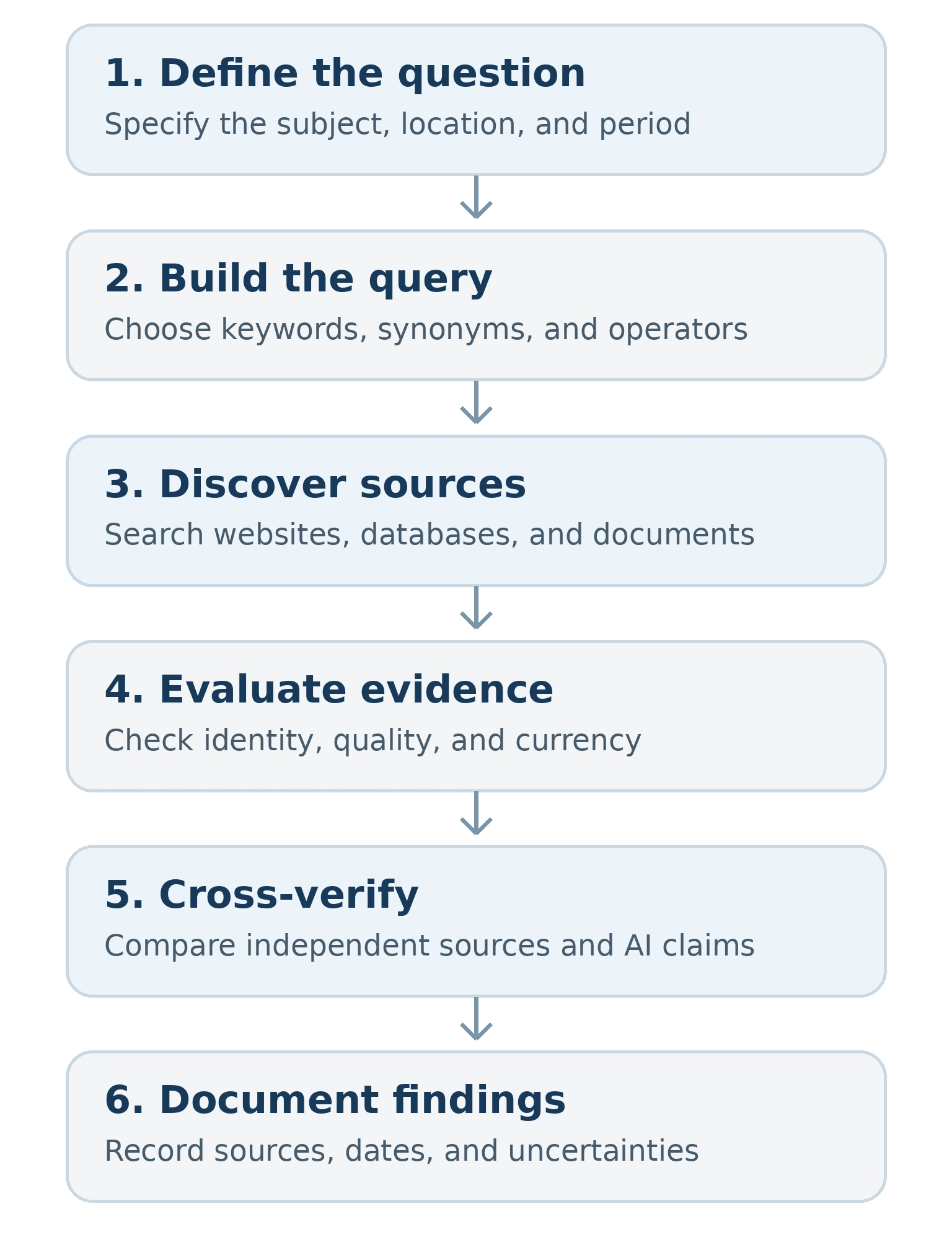
Research workflow: from a focused question to a documented, verified conclusion.
Example: Investigating a claim about remote work
Imagine a researcher wants to determine whether remote work improves employee productivity.
The research question must first define what productivity means, which workforce is being examined, and what period is relevant.
An initial query might be:
remote work employee productivity research 2024 2025
The researcher could then search academic databases and official statistical sources, refining terminology to include telework, working from home, and hybrid work.
After locating relevant studies, the researcher should compare the research designs and populations. A survey measuring employees’ perceptions of productivity is not equivalent to a controlled study measuring output.
Any AI-generated summary should be checked against those original studies.
A defensible conclusion may be that findings differ according to occupation, work arrangement, measurement method, and study design.
That is more useful than declaring that remote work universally increases or decreases productivity.
Search techniques at a glance
| Technique | Best use | Essential verification |
|---|---|---|
| Precise queries | Narrow a broad topic | Check relevance |
| Search operators | Target domains and documents | Confirm source identity |
| Boolean logic | Combine research concepts | Review missing results |
| Date filters | Focus on a period | Check actual dates |
| Primary-source search | Find original records | Assess authenticity |
| Scholarly search | Find studies and datasets | Check methodology |
| Multiple engines | Expand discovery | Compare independent sources |
| Reverse image search | Investigate image context | Confirm origin and date |
| Credibility assessment | Evaluate claims | Inspect supporting evidence |
| AI-answer verification | Check generated responses | Verify claims and citations |
Common Web Search Mistakes That Lead to Unreliable Information
Even experienced researchers can make mistakes when a search produces convincing-looking results.
One common problem is using queries that are too broad. This introduces unrelated information and makes it harder to identify useful sources. Refining the research question and introducing relevant terminology can improve precision.
Another is trusting the first result. Search placement may reflect relevance and ranking signals, not an independent evaluation of the accuracy of every statement.
Researchers also make mistakes by treating publication dates as proof of freshness, assuming operators work identically across databases, or overlooking original documents in favor of third-party summaries.
AI tools introduce additional risks when users accept fluent explanations without opening the citations.
A good correction is to separate discovery from evaluation. First, identify candidate sources. Then inspect their evidence, examine limitations, and document what can actually be established.
Avoid counting several websites as independent confirmation when they repeat one original statement.
Finally, do not assume that the absence of search results proves that information does not exist. Relevant records may be unindexed, restricted, archived, described using unfamiliar terminology, or available through specialized databases.
Frequently Asked Questions
What are the most effective web search techniques in 2026?
Effective techniques include precise keyword searching, advanced operators, Boolean queries, date filtering, primary-source discovery, and cross-engine searching. Researchers should combine these methods with source evaluation and independent verification.
How can I find reliable information using Google?
Use focused keywords, quotation marks, site: restrictions, and appropriate date filters to find relevant sources. Open the original pages and evaluate their evidence rather than relying only on search snippets or rankings.
What are advanced search operators?
Advanced search operators are special commands that restrict or refine search results. Examples include site:, filetype:, quotation marks, and the minus sign, although support varies between search platforms.
How does Boolean searching improve research results?
Boolean logic combines related concepts using AND, OR, and NOT where supported. It helps researchers broaden searches with alternative terminology or narrow them to more relevant documents.
How can I search for information published within a specific date range?
Google supports before: and after: date refinements, while other platforms may offer date-filtering controls. Researchers should check the original publication and revision dates because filtered results may not precisely reflect when the information was first published.
What is the difference between a primary source and a secondary source?
A primary source provides original evidence, such as a dataset, study, or official record. A secondary source interprets or analyzes existing evidence, and its reliability depends on how accurately it represents that material.
Can AI-powered search engines provide reliable research information?
AI-powered search tools can help discover sources and summarize complex subjects. Their answers may still contain factual errors, outdated statements, or unsupported citations, so important claims require independent verification.
How do I verify AI-generated answers and citations?
Identify the factual claims, open each relevant citation, and check whether the original source supports the precise statement. Verify important dates, figures, and quotations, then compare significant findings with independent sources.
Conclusion
Effective web research requires more than knowing which keywords to enter into a search engine. It involves understanding how information is retrieved, recognizing the limitations of search tools, and systematically checking whether the evidence supports the conclusions.
Advanced queries and Boolean logic help researchers locate relevant information efficiently. Date filters support time-sensitive investigations, while primary-source searches and academic databases provide access to more authoritative records and original research.
However, improved search precision does not automatically produce reliable findings. Source credibility, methodological quality, contextual accuracy, and independent corroboration remain essential.
AI-powered search systems have expanded what researchers can discover and summarize, but they also make careful verification more important. Generated answers should be tested against original sources, particularly when they contain statistics, quotations, technical claims, or consequential recommendations.
Professional internet research depends on a repeatable method that combines technology with informed human judgment. These competencies are also reflected in AOFIRS’ Certified Internet Research Specialist (CIRS) curriculum, which covers advanced searching, research methodology, AI-assisted research, data analysis, and research ethics.
The most important principle is straightforward: search to discover, evaluate to understand, and verify before concluding.