Quick answer: where should you start?
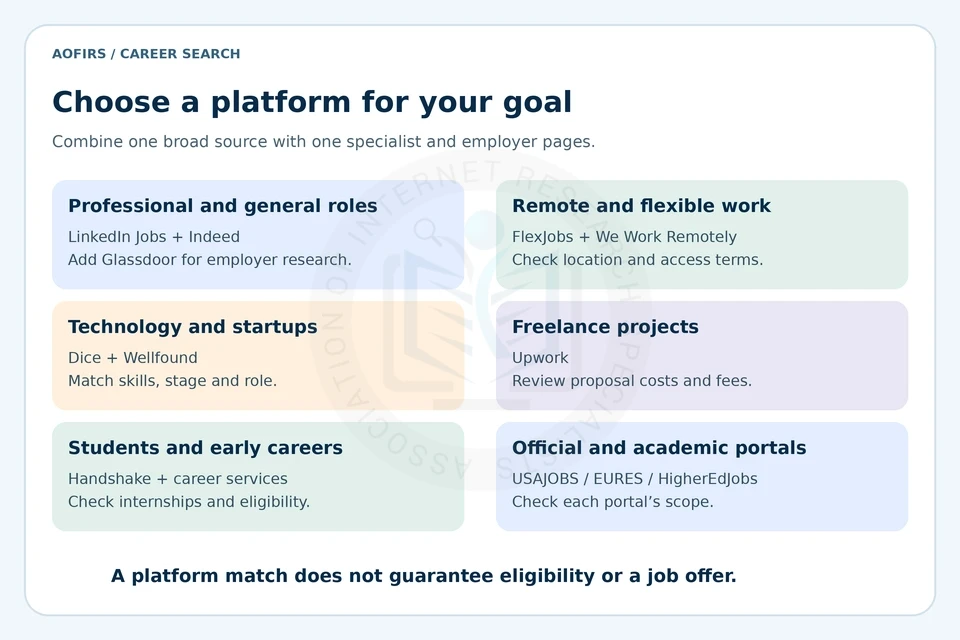
Use one broad platform, one specialist source and employers’ own career pages. Try LinkedIn for networking, Indeed for broad discovery, Wellfound for startups, Dice for technology, and FlexJobs or We Work Remotely for remote opportunities. Research employers with Glassdoor, and verify every promising vacancy before sharing sensitive information.
This is a category-based selection, not a ranking by hiring success or vacancy totals. We compared platform purpose, market coverage, candidate access and practical limitations using provider information. Features, availability and subscription terms can change.
Best job search websites at a glance
Job boards advertise vacancies, review sites support employer research, and freelance marketplaces connect clients with independent professionals. Choose the type that matches the work you want.
| Platform | Best use | Coverage | Candidate access |
|---|---|---|---|
| 1. LinkedIn Jobs | Professional roles and networking | International | Free core; optional Premium |
| 2. Indeed | Broad vacancy discovery | Multiple countries | Free core search |
| 3. Glassdoor | Employer and salary research | Multiple countries | Core access; account conditions apply |
| 4. ZipRecruiter | General employment | US-focused | Free candidate account |
| 5. Wellfound | Startups and technology | International listings | Free candidate profiles and applications |
| 6. Dice | Specialist technology roles | US-focused | Free candidate profile |
| 7. FlexJobs | Remote and flexible employment | US and international listings | Paid access to full details and applications |
| 8. We Work Remotely | Remote professional roles | International listings | Public listings; paid services available |
| 9. Upwork | Freelance projects | International | Registration plus applicable proposal costs and fees |
| 10. Handshake | Students and early careers | Participating markets and institutions | Free to get started |
| 11. USAJOBS | US federal recruitment | United States | Free |
| 12. EURES | European employment mobility | Participating European countries | Free jobseeker services |
| 13. HigherEdJobs | Higher education careers | Primarily United States | Public job search |
| 14. Behance Jobs | Creative and design roles | International listings | Public listings; account needed to apply |
General job search websites
1. LinkedIn Jobs: professional careers and networking
LinkedIn Jobs combines job listings with professional profiles, employer pages, and recruiter connections. Search for relevant roles, follow organizations, and keep your profile consistent with your CV. LinkedIn’s AI-powered search can interpret descriptions written in everyday language, alongside filters.
Watch for: intense competition and optional paid features. A connection request or recruiter message does not establish someone’s identity.
2. Indeed: broad job discovery
Indeed covers many occupations and experience levels across multiple countries. Search by title, skill, employer, and location, then create focused alerts. Its breadth makes it useful for administrative, healthcare, retail, technical, and business roles.
Watch for: overlapping or outdated listings. Confirm availability and application instructions with the employer.
3. Glassdoor: employer and salary research
Use Glassdoor to explore employee reviews, salary information, and interview experiences. Look for repeated themes across recent reviews, considering role and location. Treat salary figures as context rather than a guaranteed offer.
Watch for: individual experiences may not represent the whole organization. Pair employer research with a primary vacancy source.
4. ZipRecruiter: general US employment
ZipRecruiter offers job discovery, candidate profiles and matching features, particularly for the US market. It can complement other sources across business, customer service, and operational roles.
Watch for: recommendations still require a careful fit check; platform prominence does not guarantee an interview.
Technology and startup job websites
5. Wellfound: startup careers
Wellfound focuses on startups and technology-related businesses, including engineering, product, design, marketing, and operations. Candidate profiles and applications are free; many listings show salary and equity information.
Watch for: evaluate funding stage, compensation, equity conditions, and responsibilities. International listings may have country restrictions.
6. Dice: specialist technology roles
Dice is useful for technology professionals searching by precise skills, such as cloud platforms, software languages, cybersecurity, or data tools. It is particularly relevant to the US technology market.
Watch for: distinguish employer openings from staffing-agency listings, and check contract terms and work-authorization requirements.
Remote and flexible job websites
7. FlexJobs: screened flexible opportunities
FlexJobs covers remote, hybrid, part-time, and other flexible arrangements. The company says it screens job and employer information. A paid subscription is required to view full job details and apply through the service.
Watch for: review renewal and cancellation terms before subscribing. Flexible work does not always mean fully remote work.
8. We Work Remotely: remote professional roles
We Work Remotely advertises remote openings in areas such as programming, design, marketing, and customer support. Public listings can help you discover employers beyond conventional local boards; additional paid services are available.
Watch for: remote roles can restrict residence, time zone, or working hours. Read the individual listing and application terms.
Freelance, student, and specialist platforms
9. Upwork: freelance projects
Upwork connects independent professionals with clients seeking project-based services. Review scope, milestones, client history, proposal costs, and service fees before accepting work. Payment protection has conditions, so read the current rules.
For research services, AOFIRS’s guide to becoming a freelance researcher explains choosing a niche, building evidence-based portfolio samples, and defining deliverables.
10. Handshake: students and early careers
Handshake supports early-career recruitment, including internships and entry-level opportunities. Use your institution’s career service alongside platform searches for employer events, application support, and local programs.
Watch for: availability, institutional connections, and employer eligibility differ by market.
11. USAJOBS: US federal employment
USAJOBS is the US federal government’s official employment site. Read the hiring path, eligibility criteria, closing date, and required documents before preparing an application.
Watch for: citizenship, experience, and other requirements vary. Follow the announcement’s instructions rather than assuming a standard application fits every vacancy.
12. EURES: European employment mobility
EURES provides European job-mobility information, vacancies, and adviser support. Use it to investigate opportunities and living and working conditions across participating countries.
Watch for: a listing does not establish your right to work or promise visa sponsorship. Confirm language and professional-recognition requirements.
13. HigherEdJobs: academic and university careers
HigherEdJobs focuses on higher education, including faculty, administrative, and executive roles. Check each institution’s career page for application materials, deadlines, and appointment conditions.
Research professionals can also use AOFIRS’s guidance on career searches for independent online research specialists to connect a focused niche with appropriate employers and clients.
14. Behance Jobs: creative and design opportunities
Behance Jobs connects creative vacancies with portfolio-based profiles. Select work samples that demonstrate the employer’s required skills and explain your contribution accurately.
Watch for: check whether the application stays on the platform or moves to an external employer site. Treat unfamiliar destinations cautiously.
How to choose the right platform
Consider location, specialization, experience level, working arrangements, and cost. A software developer might combine LinkedIn, Dice, and company career pages. A student could start with Handshake and university career services. A freelancer needs to assess project terms as carefully as the platform.
For country-specific searches, use official services such as the UK’s Find a job and Canada’s Job Bank. These advertise wider employment opportunities, not only government jobs. International applicants should check which employers accept applications from abroad.
A practical online job search workflow
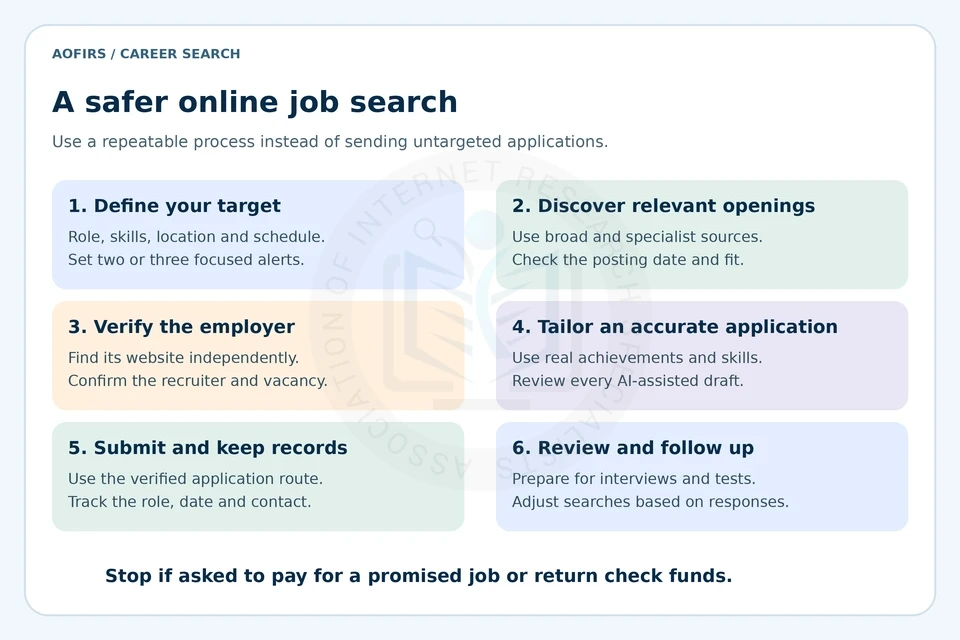
- Define your target. List suitable titles, skills, locations, and working arrangements.
- Discover relevant openings. Combine broad and specialist sources with employer pages. Create alerts using relevant skills and alternative titles.
- Verify the vacancy and recruiter. Find the employer’s website independently and confirm the application route.
- Tailor accurate materials. Align your CV, portfolio, and profile with real achievements and the role’s requirements.
- Submit and track. Record the employer, role, application date, source and contact details.
- Prepare and review. Practice interviews, follow stated instructions, follow up professionally, and refine unsuccessful searches.
Try specific queries such as “SEO specialist remote” or “graduate marketing assistant London.” Where supported, quoted phrases and Boolean operators can improve precision. Syntax differs between platforms: the AOFIRS cross-engine search query matrix explains why search expressions need adapting rather than copying unchanged.
How to use AI in your job search
AI can suggest alternative titles, compare a vacancy with your experience, improve wording, and generate interview practice questions. Check every output. Do not invent qualifications, disclose unnecessary personal information, or submit applications you have not reviewed.
Employers use applicant tracking systems in different ways. Not every ATS uses AI, and there is no universal score that guarantees selection. Clear formatting and accurate evidence are more useful than trying to satisfy an imagined algorithm.
How to identify fake job listings
The Federal Trade Commission’s job-scam guidance warns about offers designed to take your money or personal information. A familiar platform or convincing logo does not establish that a recruiter is genuine.
- Do not pay a recruiter for a promised job. A disclosed job-board subscription is a different service and still needs a cost assessment.
- Never deposit an employer’s check and send part of the funds elsewhere.
- Question urgent offers with no meaningful assessment.
- Check email domains and contact the company through independently found details.
- Delay sharing identity or banking information until legitimate onboarding is established.
- Confirm suspicious vacancies through a credible employer channel.
AOFIRS’s report on email verification and fraud prevention provides further context for examining suspicious messages. Its learning guide to identifying fake websites explains why a professional appearance or HTTPS padlock is insufficient evidence of legitimacy.
Frequently asked questions
What is the best website to find a job in 2026?
LinkedIn Jobs and Indeed are useful general starting points. Your profession, country, and experience determine which specialist sources to add.
Which job search websites are free?
Several offer free core access, including LinkedIn, Indeed, and Wellfound. FlexJobs requires paid access to full details and applications; freelance marketplaces can charge proposal costs and service fees.
Is LinkedIn or Indeed better?
LinkedIn adds professional networking and visibility. Indeed supports broad vacancy discovery. Using both can expand coverage without replacing employer checks.
Can remote jobs be done from any country?
Only when the employer allows it. Residence, payroll, work authorization, and time-zone requirements may restrict remote roles.
Should I apply through a board or the employer?
Both can be legitimate. Verify the vacancy and use the application route specified by the employer. Avoid duplicate submissions unless requested.
Can AI guarantee interviews?
No. It can support preparation and discovery, but it cannot guarantee selection or employment.
Conclusion
A focused search is easier to evaluate
Choose platforms that match your goals, maintain accurate application materials, and investigate employers independently. Review your results regularly. A small set of relevant sources and well-prepared applications gives you a clearer process than indiscriminate submissions across dozens of sites.