Not long ago, research followed a predictable pattern. You opened a browser, typed a few keywords into a search box and spent the next hour working through pages of blue links. You skipped the ads, ignored the clickbait and hoped the fact you needed was not buried on page three. It was a manual process of search and rescue.
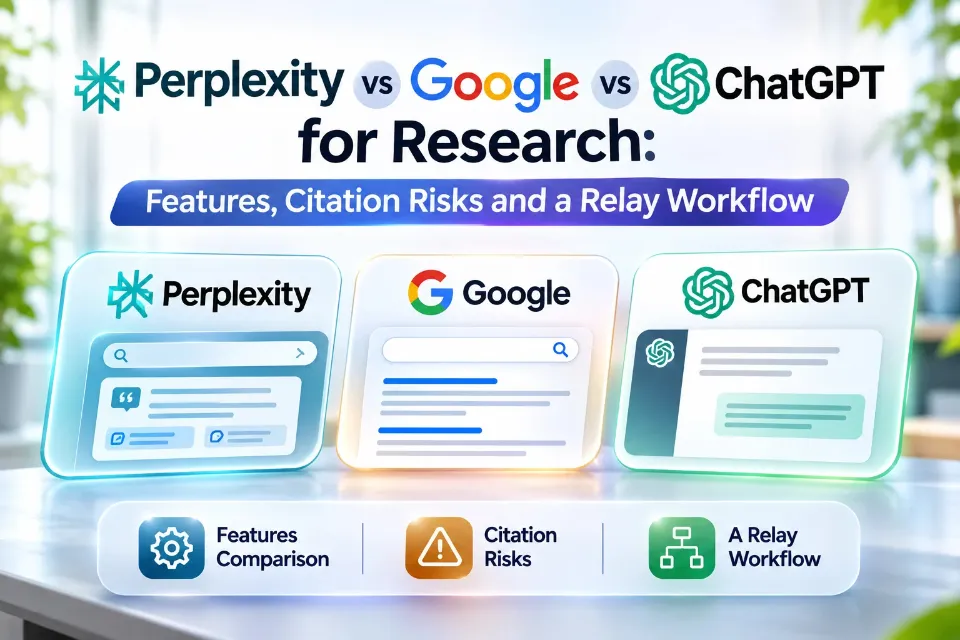
AI tools have changed that routine. Much of the effort has moved from finding pages to making sense of them, and the tools now do a good deal of the fetching and organizing. That raises a different question: which tool, used in which way, deserves your trust? This guide compares Google Search, Perplexity and ChatGPT on three points: how each finds information, how it shows its sources and how it typically goes wrong. It then sets out a workflow that uses all three. For the wider picture of how AI tools are changing professional research, see AI research career changes. If you only need to choose between two tools, ChatGPT vs Google research covers that. For the technical reasons behind the differences, see AI platform technical comparison.
How this comparison was made
- Documentation review. Each tool’s search, citation and accuracy features were checked against the vendor’s own help pages and documentation on 4 November 2026. The sources are linked in the table and text.
- Independent evidence. Statements about accuracy rely on published, independent research, mainly the Tow Center for Digital Journalism’s controlled test of eight AI search tools in February 2025, not on our impressions.
- Worked example. The workflow below illustrates a real research question using European Commission primary sources. It is a reusable protocol, not a recorded live run of all three tools.
- What this is not. This is not a scored product review, and AOFIRS has not published its own scored test of these three tools. The “Test it yourself” protocol at the end shows how to run a dated comparison for your own work.
At a glance: how the three tools handle research
AI can scan, summarize and answer in seconds, so speed is no longer the scarce resource; certainty is. Whether you are a researcher vetting a market or students using AI tools, the useful question is what each tool does with sources. The table summarizes documented behavior, not a ranking.
| Feature | Google Search | Perplexity | ChatGPT |
|---|---|---|---|
| Primary role | Ranked web links, alongside AI Overviews and AI Mode. | A web-oriented answer engine with cited summaries. | A conversational assistant using learned knowledge, supplied material, or enabled tools. |
| Information discovery | Crawls and indexes pages; AI Mode can search subtopics (Google Search documentation); (Google AI Mode guidance). | Real-time web search; advanced research modes can run multiple searches (Perplexity search documentation). | Can decide to search automatically or accept a manually started search (ChatGPT search guidance). |
| Sources | Result links and supporting links in AI features (Google AI search documentation). | Numbered source citations (Perplexity search documentation). | Search responses may show inline citations and a Sources list. Without retrieval, generated references still need checking (ChatGPT search guidance). |
| Freshness | Depends on crawling and indexing; inclusion is not guaranteed (Google Search documentation). | Web retrieval can find recent material; verify each source date (Perplexity search documentation). | Search can retrieve current pages. Learned knowledge has a model-specific cutoff; GPT-6 Astra lists April 30, 2026 (GPT-6 Astra documentation). |
| Documented risks | Sponsored results, affiliate-heavy product review results, and possible mistakes in AI summaries (Google sponsored results label); (Search engine SEO study); (Google AI Mode guidance). | 37% incorrect in the Tow Center’s February 2025 news-source identification test; not a current general accuracy rate (Tow Center citation study). | Can invent claims and citations; ChatGPT Search misidentified 134 of 200 articles in the same 2025 test (ChatGPT accuracy guidance); (Tow Center citation study). |
| Useful research role | Locate official sites, primary documents, and local information. | Build an initial topic overview and a list of sources to inspect. | Brainstorm, structure, and synthesize verified material. |
| Required checks | Evaluate every selected publisher and document. | Confirm that each citation supports the attached claim. | Check every fact and reference, and determine whether search or supplied sources were used. |
Three different jobs: who are you hiring?
It helps to stop treating these platforms as lines of code and see them as different kinds of assistant. Each has its own way of handling sources and its own typical failure.
1. Google: the traditional librarian
Google does not set out to explain things; it shows you where the sources are kept. Classic Search crawls the web, stores what it finds in an index and returns ranked pages for each query. Google says plainly that it does not guarantee any page will be crawled, indexed or shown (Google Search documentation). Its strength is that you see the publisher before you read the claim, which suits hard sources such as a government PDF, a court docket, a company’s own website or a local business listing. Two things clutter the view. Ads appear among the results, grouped under a “Sponsored results” label (Google sponsored results label). And for some kinds of query, notably product reviews, a year-long study of Google, Bing and DuckDuckGo found that top-ranked pages were heavily affiliate-driven and SEO-optimized (Search engine SEO study). Google now adds AI Overviews and AI Mode, which run several related searches and summarize the results with links. Google’s own help page warns that these AI responses can contain mistakes and suggests checking important information in more than one place (Google AI Mode guidance). For specialized material, dedicated databases and strong online information search skills often reach further than the general index.
The experience: using classic Google Search is like walking into a large library. You locate the source, check its context, and read the page yourself. Reliability still depends on the source you select.
2. ChatGPT: the conversational polymath
ChatGPT is like a colleague who has read widely but does not always remember which book said what. Its strengths are turning disorganized notes into a structured outline, explaining a difficult idea in plain language and drafting from material you supply. For research, what matters most is which mode it is working in:
- Without search or supplied sources, answers rely primarily on the model’s learned knowledge. Cutoffs vary by model: OpenAI’s API documentation gives April 30, 2026 for GPT-6 Astra, which should not be treated as a universal ChatGPT cutoff (GPT-6 Astra documentation).
- With search, ChatGPT decides for itself when a question would benefit from web results, or you can start a search yourself. Search responses can include inline citations and a Sources list (ChatGPT search guidance).
- Deep research runs a multi-step web investigation and returns a cited report. At launch OpenAI said this could take 5 to 30 minutes. It also warned that the feature can still state false facts and may struggle to tell authoritative information from rumor (Deep research launch report).
Used well, AI research assistant speeds up synthesis, provided you supply or verify the facts.
The experience: it is a conversation, collaborative and iterative, closer to a brainstorming session over coffee than to a search.
3. Perplexity: the cited research intern
Perplexity behaves like a search engine that reads the pages for you. For each question it searches the web in real time and writes an answer with numbered citations linked to the sources. Pro Search and Deep Research run many searches for complex questions, and Pro subscribers can choose which model writes the answer (Perplexity search documentation). This design makes answers quick to verify, but a citation is not proof. In the independent Tow Center test described below, Perplexity answered 37% of queries incorrectly (Tow Center citation study).
The experience: using Perplexity is like having a fast research intern who hands you a one-page summary with the supporting documents attached. You still need to read those documents.
Navigating the “hallucination tax”
Fabrication by AI is not hypothetical. In Mata v. Avianca, Inc., lawyers filed a brief citing judicial opinions that did not exist. The federal court in Manhattan found that ChatGPT had generated the fake cases, complete with invented quotations and citations. It held that the lawyers had “abandoned their responsibilities”, and on 22 June 2023 it imposed a $5,000 penalty along with other sanctions (Mata v. Avianca ruling). Call the time you spend checking an assistant’s work the “hallucination tax”. Every tool creates verification work. The descriptions below identify checking tasks rather than measured error-rate rankings.
- Google requires source selection and page-level checking. You see who published a page before you read it, so you can judge the source directly. An unfamiliar or sensational site is a cue to look harder. AI Overviews and AI Mode add a summary layer that Google itself says can be wrong.
- Perplexity requires citation-level checking. Numbered references make sources easier to open, but do not establish support for every claim. Open each relevant source and confirm that it supports the attached sentence. The independent results below show that this step cannot be skipped.
- ChatGPT requires explicit checks of source use, especially when it is not searching. Fluent prose is no sign of accuracy. OpenAI’s own help center says ChatGPT can sound convincing while being wrong and can invent quotes or citations (ChatGPT accuracy guidance). Treat uncited claims as leads and check every reference it gives you.
What independent testing found
In February 2025 the Tow Center for Digital Journalism gave eight AI search tools 200 news excerpts each, 1,600 queries in all, and asked each tool to identify the source article’s headline, publisher, date and URL. Taken together, the tools answered more than 60% of queries incorrectly. Perplexity was wrong on 37% and ChatGPT Search on 134 of 200 (about 67%). Premium versions often gave confident wrong answers where free versions declined (Tow Center citation study). Google Search itself was not tested; Google’s Gemini chatbot was. The study measured news citation only, used versions available in early 2025 and is a single study. Read it as a warning about citation reliability, not as a ranking of today’s tools.
The relay race: a workflow that uses all three
You do not have to pick one tool; the skill is knowing when to pass the baton.
- The survey (Perplexity). Ask an orienting question and collect the cited sources. Treat the answer as a map, not a finding.
- The deep dive (Google). Use the map to reach primary sources: the regulator, the court, the original report or the dataset. Operators such as site: and filetype: take you straight to official documents.
- The synthesis (ChatGPT). Paste in the verified facts and their sources, ask for the summary or draft you need, and tell it to use only the material you supplied.
- The check (you). Compare the draft against your primary sources before it leaves your desk.
Worked example: one real query through the relay
The query: When do the EU AI Act’s obligations for providers of general-purpose AI models start to apply?
- Survey. Put the question to Perplexity and list the sources it cites. Sort them into primary sources, such as pages on europa.eu, and commentary from law firms, consultancies and news sites. The commentary helps you understand the issue; only the primary sources settle it.
- Deep dive. Search Google with site:digital-strategy.ec.europa.eu general-purpose AI obligations. The European Commission’s press release of 1 August 2025 states that the obligations for providers of general-purpose AI models, including transparency and copyright duties, apply from 2 August 2025. Models already on the market before that date must comply by 2 August 2027 (EU AI obligations announcement). The Commission’s fact page on these obligations confirms the 2 August 2025 date (EU AI obligations overview). The dates are supported by the Commission pages linked here.
- Synthesis. Give ChatGPT the two dates and the relevant passages from the Commission’s pages. Ask for a 150-word briefing note for a non-specialist, and tell it not to add dates or obligations that are not in the text you supplied.
- Check. Compare every date in the note with the Commission’s text. The AI Act’s obligations apply in stages, so a summary can easily attach the wrong date to the wrong obligation. Where a sentence goes beyond the source, delete it or find a primary source for it.
The workflow ends on the primary source, not on any AI answer. That is the habit that keeps the hallucination tax affordable.
Test it yourself: a simple, dated protocol
These tools change every few months, so the most useful comparison is one you run yourself and date.
- Choose three to five questions with documented answers, such as a regulation’s start date, a figure from an official statistical release or the outcome of a court decision.
- Run each question in all three tools on the same day. Record the tool, plan, model or mode, and date.
- Open every cited source and mark each claim as supported, unsupported or wrong.
- Note how each tool behaved when it was unsure: did it decline, hedge or answer confidently?
- Repeat after major updates and keep the log with your project files.
To write better test questions, see our guide to prompt engineering for researchers.
Why the human still matters
As these tools improve, it is tempting to let them do the thinking. Some parts of the job stay with you:
- Original thought. An AI system works from patterns in what it has already seen. It does not have your lived experience or the specific context of your project, and it cannot supply the insight that comes from them.
- Tone and fit. A source can be factually correct and still wrong for your audience. Judging that remains your job.
- Ethics and accountability. An AI may give the most efficient answer without knowing whether it is appropriate for your audience. As Mata v. Avianca shows, responsibility rests with the person who submits the work.
Final thoughts
The search bar is turning into a conversation, and research increasingly feels like a dialogue with a consultant. As these tools sound more human, researchers need to become more expert-like in how they oversee them. The useful tool is the one that helps you think clearly and shows you where its claims came from. The digital haystack is bigger than ever; these tools can help you find the needle, but confirming it is a needle is still your job.
References
- Bevendorff, J., Wiegmann, M., Potthast, M., & Stein, B. (2024). Is Google getting worse? A longitudinal investigation of SEO spam in search engines. In Advances in Information Retrieval: 46th European Conference on Information Retrieval, ECIR 2024 (pp. 56–71). Springer. Search engine SEO study
- European Commission. (2025, August 1). EU rules on general-purpose AI models start to apply, bringing more transparency, safety and accountability. Shaping Europe’s Digital Future. EU AI obligations announcement
- European Commission. General-purpose AI obligations under the AI Act. Shaping Europe’s Digital Future. Retrieved November 4, 2026, from EU AI obligations overview
- Google. (2025, October 13). New sponsored results label in Google Search. The Keyword. Google sponsored results label
- Google Search Central. (2025a). In-depth guide to how Google Search works (last updated December 18, 2025). Google for Developers. Google Search documentation
- Google Search Central. (2025b). AI features and your website (last updated December 10, 2025). Google for Developers. Google AI search documentation
- Google Search Help. Get AI-powered responses with AI Mode in Google Search. Retrieved November 4, 2026, from Google AI Mode guidance
- Jaźwińska, K., & Chandrasekar, A. (2025, March 6). AI search has a citation problem. Columbia Journalism Review, Tow Center for Digital Journalism. Tow Center citation study
- Mata v. Avianca, Inc., No. 1:22-cv-01461-PKC, Opinion and Order on Sanctions (S.D.N.Y. June 22, 2023). Mata v. Avianca ruling
- OpenAI. (2025, February 2). Introducing deep research. Deep research launch report
- OpenAI. ChatGPT search. OpenAI Help Center. Retrieved November 4, 2026, from ChatGPT search guidance
- OpenAI. Does ChatGPT tell the truth? OpenAI Help Center. Retrieved November 4, 2026, from ChatGPT accuracy guidance
- OpenAI. GPT-6 Astra. OpenAI API documentation. Retrieved November 4, 2026, from GPT-6 Astra documentation
- Perplexity. How does Perplexity work? Perplexity Help Center. Retrieved November 4, 2026, from Perplexity search documentation