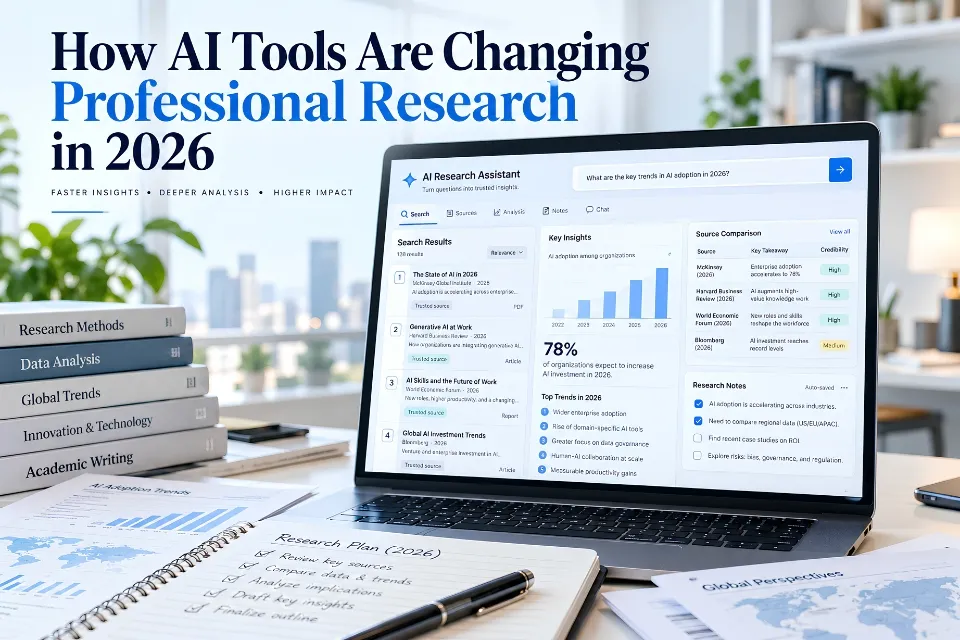
AI is changing how researchers find information, analyze documents, interpret data and prepare reports. Tasks that once required extensive manual searching can now be supported by systems that process large text collections and produce structured summaries.
But does producing a convincing research report mean that someone has gained a sound understanding of the subject?
Not necessarily.
AI tools used in professional research can increase efficiency, aid analysis, and broaden access to information. Yet reliable knowledge still depends on evidence, an understanding of the subject, critical evaluation, and human accountability.
In 2026 the greatest challenge facing professional researchers is not merely finding information but deciding which information is reliable, what the evidence really shows, and how conclusions should be justified.
How Is Artificial Intelligence Changing Professional Research?
AI-assisted research is used to support various stages of the research process by employing machine learning, natural language processing, information retrieval, and data analysis.
Traditional online research usually meant searching databases, reading the documents one at a time, comparing the different sources, and then arranging the results manually.
Modern AI research tools can help with many of these tasks.
Faster Information Discovery and Literature Exploration
Researchers can use natural language rather than depending solely on keywords when employing AI-powered search systems.
Even when documents use different terminology from the original question, semantic search is able to identify those that might be relevant.
Specialized tools such as Semantic Scholar and Elicit can help researchers discover publications and explore relationships between studies.
Yet the coverage provided by retrieval methods is still incomplete, since publications that are behind a paywall, material that is poorly indexed, unpublished research, and specialist databases will need individual searches.
Document Analysis and Evidence Synthesis
Large language models can assist researchers by:
- Summarizing lengthy publications.
- Extracting relevant passages from documents.
- Comparing findings across multiple sources.
- Identifying research themes and possible gaps.
- Organizing qualitative data into preliminary categories.
- Drafting evidence tables and research summaries.
These capabilities can reduce repetitive work, but generated summaries require checking against the underlying material.
A source might have a significant qualification which is lost when it is summarized. In the same way, findings from different populations or using different methods may be brought together in a manner that hides the meaningful differences.
AI-Assisted Data Analysis
Certain AI platforms are capable of producing code, processing datasets, suggesting visualizations, and explaining statistical methods.
They are especially useful for use in exploratory analysis and for carrying out routine data preparation.
AI-generated calculations and interpretations have to be validated. The researchers are responsible for checking the quality of the data, the statistical assumptions, the methodological decisions, and the reproducibility.
Research into workplace productivity shows the potential advantages of generative AI, even though the size and kind of the improvements differ according to the task and the user’s experience.
What Can AI Research Tools Reliably Do in 2026?
Various AI systems enable different kinds of research. The extent of their capabilities is determined by the model used, the tools available, the retrieval access, the subscriptions, and the institutional arrangements.
| Technology | Research application | Important limitation |
|---|---|---|
| Large language models | Explanation, summarization, drafting | May produce unsupported statements |
| Retrieval-augmented generation | Answers grounded in retrieved documents | Retrieval does not guarantee source quality |
| AI search engines | Discovery and source-linked answers | May miss relevant material |
| Deep research agents | Multi-stage searching and synthesis | Findings still require verification |
| Semantic search | Concept-based document discovery | Relevance does not establish credibility |
| AI data analysis | Coding, classification, statistics | Results require methodological checks |
| Multimodal AI | Interpretation of text, images and tables | May misread visual or numerical information |
Research tools such as ChatGPT, Claude, Google Gemini, and Perplexity offer various ways of carrying out information exploration.
The choice of a tool should be based on the research question, the sources needed, and the degree of uncertainty that can be accepted, not on how sophisticated the answer appears to be.
For a practical comparison of research approaches, see the AOFIRS deep research guide.
Information Is Not the Same as Knowledge
A key distinction in professional research is the one between acquiring information and arriving at knowledge which is justified.
The information given in a search result, in a database entry, or in an AI-generated summary depends on how it is examined to determine whether it supports reliable knowledge.
Five Stages of Developing Research Knowledge
- Accessing information. Finding potentially relevant facts, documents, observations, or datasets.
- Understanding information. Interpreting what the material means, including its context, terminology, assumptions, and limitations.
- Verifying evidence. Checking original sources, methods, dates, accuracy, and independent corroboration.
- Developing justified conclusions. Combining credible evidence with careful analysis while acknowledging uncertainty and alternative explanations.
- Building expertise. Applying accumulated knowledge and methodological judgment to new questions, unfamiliar evidence, and practical decisions.
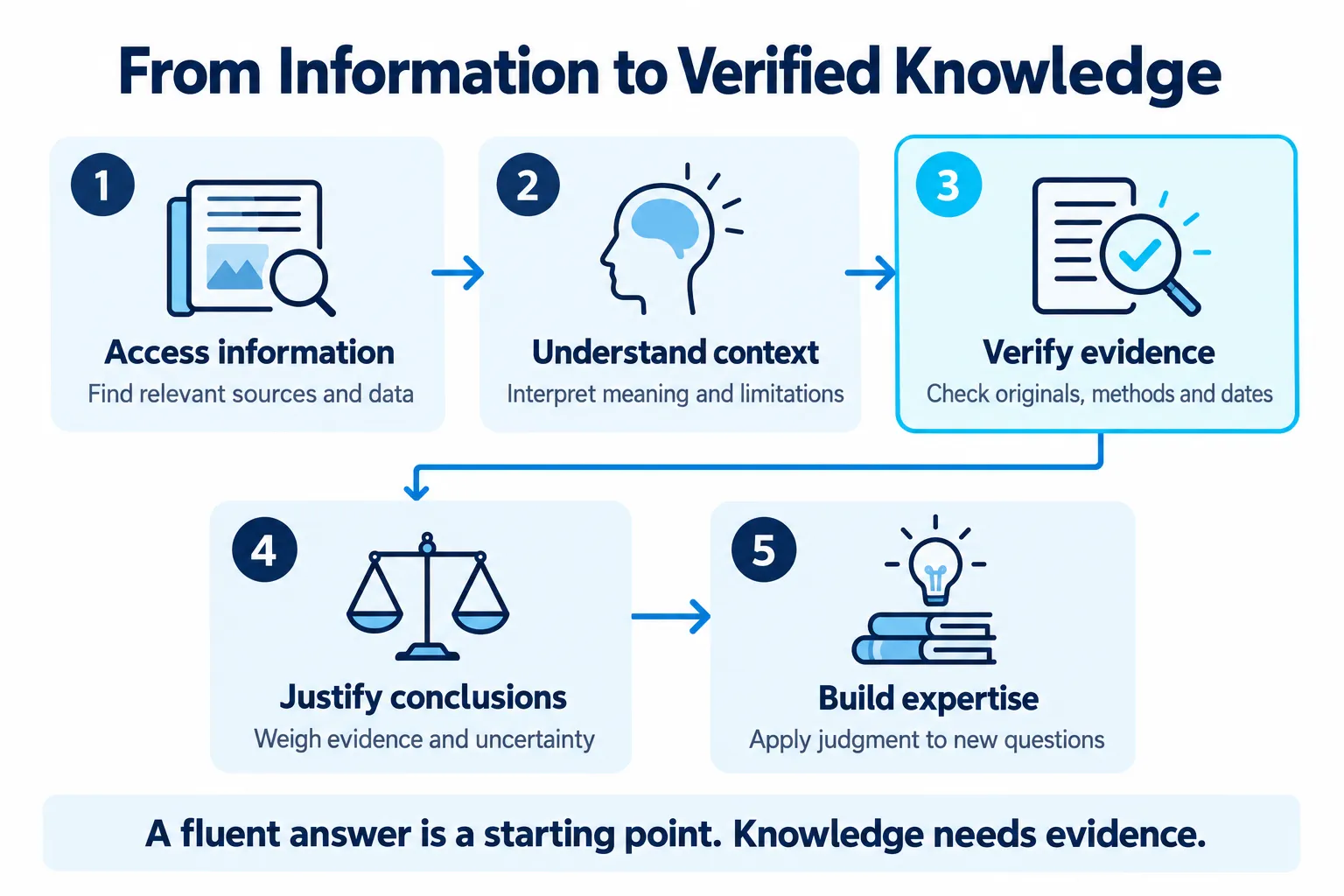
These stages describe a practical model of professional research competence, rather than a universal philosophical definition of knowledge.
A researcher who receives an AI-generated explanation may understand its basic message. That does not automatically mean they can assess its reliability, reproduce its analysis, or defend its conclusions.
What Does It Really Mean to Earn Knowledge?
Gaining knowledge requires more than just remembering facts or putting together text that looks accurate.
One has to be able to give a reason for why a conclusion is justified, be capable of spotting evidence that might contradict it, and also be aware of the fact that the information at hand is not enough.
Imagine that two researchers are looking at the same issue.
The first one produces an AI-generated report without looking at its citations.
The other one looks at the original studies, compares the methods, checks the main claims, and records the questions that have not yet been resolved.
Both of them can produce reports that are easy to read; yet the second researcher has a more solid foundation for professional knowledge since their conclusions are based on a research process that can be examined.
The importance of knowledge consists not just in the ability of a person to give an explanation, but also in the extent to which they can justify that explanation.
Why Human Judgment Still Matters in AI-Assisted Research
AI may assist with complex analysis and structured reasoning; yet this does not mean that the output is correct or suitable for a given research problem.
People who research things are still in charge of a number of important decisions.
Research Design
A research question should be accompanied by appropriate evidence and methodology.
A survey can describe the attitudes that are reported, while a controlled experiment can provide stronger evidence of a specific causal effect.
Although AI can explain these differences, it is up to the professional researchers to decide whether the methods suggested actually address their own question.
Source Credibility and Independence
Just because a website appears credible doesn’t mean that it offers reliable evidence.
The researchers should look into the question of authorship, the context in which the work was published, the research methods used, any possible conflicts of interest, and the relationships between the various sources.
The fact that several articles make the same unsubstantiated claim does not amount to independent corroboration.
Interpretation and Accountability
The conclusions of research usually include an element of uncertainty.
A professional should realize that when the evidence supports a limited conclusion it does not support a general one.
For medical-journal submissions, ICMJE guidance places responsibility for AI-assisted material on human authors and calls for disclosure of relevant AI use. Researchers should also follow their journal’s and institution’s requirements.
| Research activity | AI contribution | Human responsibility |
|---|---|---|
| Question development | Suggests research directions | Defines purpose and scope |
| Literature discovery | Identifies candidate sources | Checks coverage and relevance |
| Evidence extraction | Organizes text and findings | Verifies accuracy and context |
| Data analysis | Supports coding and computation | Validates assumptions and results |
| Interpretation | Proposes explanations | Evaluates competing explanations |
| Reporting | Drafts summaries | Approves defensible conclusions |
A useful approach combines AI efficiency with responsible human judgment, keeping evidence and consequential decisions open to review.
The Risks of Relying Too Heavily on AI-Generated Research
Hallucinated Facts and Fabricated References
Generative AI systems can make incorrect statements, produce fake publications, quote things that are not true, or give citations that do not support the claims mentioned.
The U.S. National Institute of Standards and Technology identifies confidently generated false content, including fabricated references, as a generative AI risk in its Generative AI Profile.
Citations, even if they are based on actual research, can be misleading if the source deals with a different population, employs a method that is not compatible, or arrives at a more limited conclusion.
A detailed checking process appears in the AOFIRS verification guide.
Automation Bias and Reduced Critical Engagement
Automation bias is the tendency for people to place too much importance on the recommendations given by automated systems.
A well-polished reply from an AI might lead people to stop investigating, especially in cases where the users do not have specialist knowledge.
Lee and colleagues surveyed 319 knowledge workers about their critical-thinking practices when using generative AI. Their 2025 study examined self-reported cognitive effort and confidence. It raises concerns about overreliance, but its survey design does not establish that AI use causes a permanent decline in critical-thinking ability.
Source Bias and Incomplete Retrieval
AI-assisted research systems may miss important evidence because of:
- Restricted database access.
- Indexing and retrieval limitations.
- Language or regional coverage gaps.
- Overrepresentation of widely published perspectives.
- Inaccessible full-text publications.
- Differences between training data and current information.
A source-linked answer therefore should not be mistaken for an exhaustive literature search.
Privacy, Confidentiality and Research Ethics
It is necessary for researchers to understand how the platforms they have selected deal with information that has been uploaded.
Confidential interviews, unpublished manuscripts, personal records and proprietary business documents may require restricted systems, suitable agreements or institutional approval.
UNESCO guidance on generative AI in education and research emphasizes human-centered use, data protection and institutional responsibility.
How to Combine AI Efficiency With Professional Research Standards
A dependable method considers AI to be an assistant as part of a research process that is properly documented.
A Practical Research Workflow
- Define the question. Set scope, audience and evidence requirements.
- Plan the search. Choose sources, terms and inclusion criteria.
- Explore with AI. Identify concepts and possible gaps.
- Retrieve evidence. Find original documents and datasets.
- Verify claims. Check sources, dates and supporting passages.
- Compare findings. Assess disagreements and uncertainty.
- Analyze independently. Test assumptions and interpretations.
- Document methods. Record tools, searches and decisions.
- Prepare the report. Write from evidence that has been checked.
- Review and disclose. Confirm accuracy and relevant AI use.
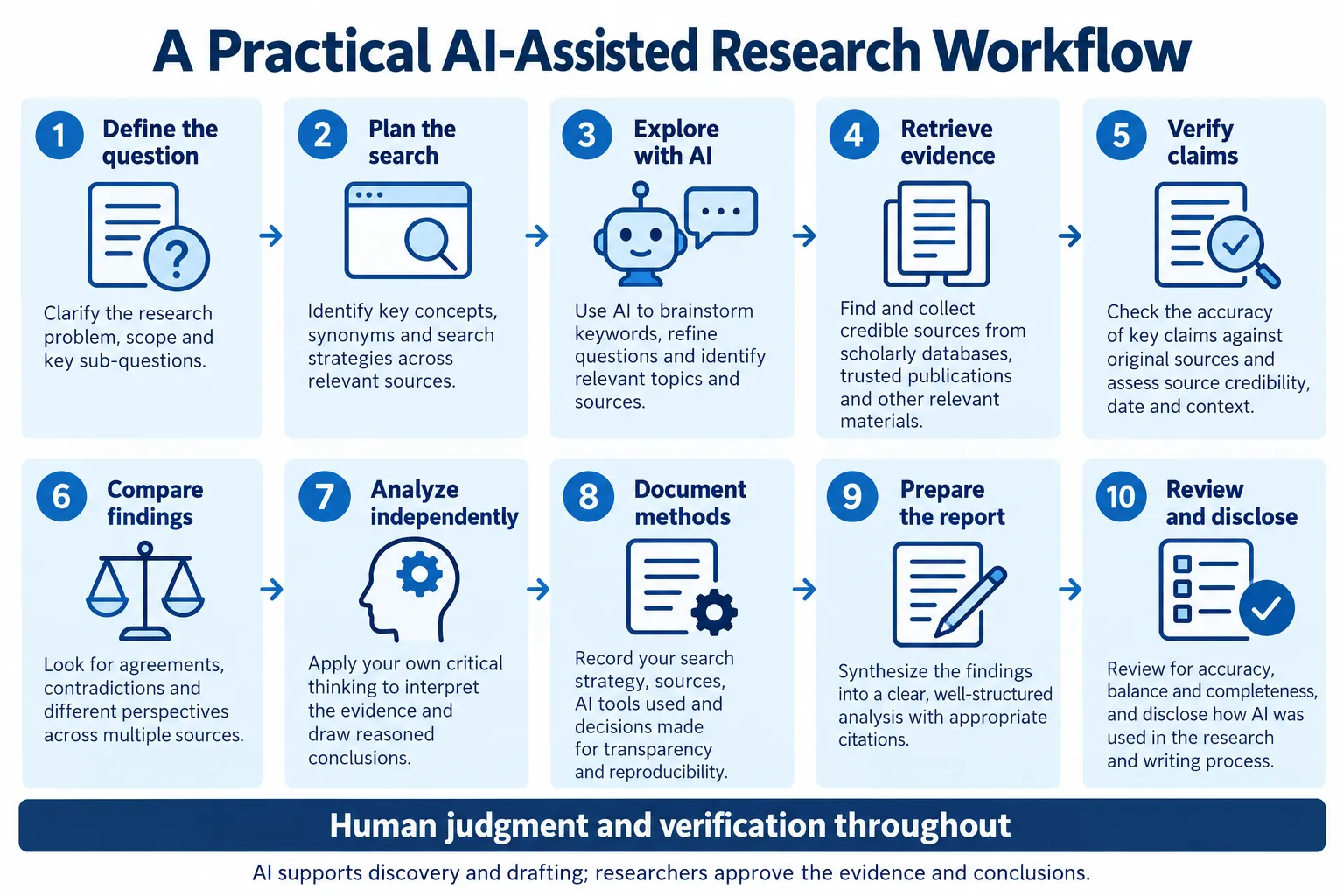
For academic systematic reviews, an AI-assisted workflow must also follow the relevant review methodology and reporting standards. PRISMA 2020 provides established reporting guidance for systematic reviews.
Practical Example: Turning an AI Answer Into Verified Research
Imagine a market research analyst looking into whether generative AI has an effect on workplace productivity.
The research question is:
Does generative AI have an effect on employee productivity, and if so, does this effect vary depending on the kind of work and the level of experience of the employee?
Stage 1: The Initial AI Answer
A hypothetical AI-generated response might state:
Generative AI boosts employee productivity since it automates routine tasks, speeds up the process of writing, and enables less experienced employees to carry out complicated work.
Although this explanation is reasonable, it doesn’t clarify by how much productivity increases, under what conditions, or explain how the effect was measured.
Stage 2: Locate Primary Research
The analyst spots two studies which are relevant.
In a 2023 experiment, Noy and Zhang assigned professional writing tasks to 453 college-educated professionals. Access to ChatGPT reduced average completion time by 40% and improved rated output quality by 18% for the tasks studied.
Brynjolfsson, Li and Raymond’s 2025 study, published in The Quarterly Journal of Economics, examined 5,172 customer-support agents. Access to AI assistance increased issues resolved per hour by 15% on average, with substantial differences across workers.
Stage 3: Evaluate What the Findings Actually Establish
The studies do provide evidence of productivity gains, but the activities that they measure are different.
The first one looks at controlled writing tasks while the second one looks at customer-support work within a particular organizational setting.
That does not prove that every kind of professional research will become more accurate or efficient as a result of AI.
The analyst has to tell the difference between the speed with which a task is completed, the quality of the output as assessed, the amount the employee learns, and the accuracy of the research.
Stage 4: Develop a Defensible Conclusion
A more careful conclusion would be:
Evidence obtained from professional writing and customer-support situations shows that generative AI can lead to increased productivity. Nevertheless, the benefits depend on the particular task, the level of experience of the worker, and the way it is implemented. It is therefore incorrect to automatically generalize these findings to regard them as applicable to research quality, scientific accuracy, or to all professional occupations.
The conclusion shows what is involved in being given a summary and in acquiring justified knowledge.
The analyst has looked at the source methods, understood the differences in measurement, and has restricted the claim to only that which is supported by the evidence.
The Professional Research Skills That Matter Most in 2026
As AI research tools develop, professional competence increasingly depends on combining technical fluency with a solid understanding of research principles.
Advanced Information Retrieval
Researchers should understand Boolean searching, database filters, controlled vocabularies, citation searching, and source-specific query strategies.
These skills remain necessary because AI search systems do not provide uniform access to every relevant document.
Research Methodology and Evidence Evaluation
The ability to select suitable methods, evaluate study quality, recognize confounding factors, and interpret uncertainty is essential.
An advanced AI interface does not remove the need to understand how evidence was produced.
AI Literacy and Output Evaluation
Researchers should know when AI tools are appropriate, what information they can access, how to test their outputs, and when manual investigation is necessary.
Strong prompts can improve research organization but cannot guarantee factual accuracy.
Data Literacy and Reproducibility
Professional researchers need to understand data quality, basic statistics, documentation, and reproducible analytical practices.
Records should identify the tools used, relevant settings, source material, and important analytical decisions.
Research Ethics and Professional Accountability
Knowledge professionals must understand confidentiality, intellectual property, research integrity, disclosure, and applicable institutional policies.
Professional training, including programs such as the AOFIRS Certified Internet Research Specialist, can support skill development. However, competence should ultimately be demonstrated through the ability to conduct and defend reliable research.
The Future of AI and Professional Research
The future of professional research is probably going to see the use of systems with ever-increasing capabilities which coordinate searches, deal with documents, analyze datasets, and produce draft findings.
This could shift some human effort away from repetitive collection and toward research design, critical evaluation, interpretation, and quality assurance.
However, the direction and magnitude of these changes will depend on technological reliability, professional requirements, organizational adoption, and the quality of human oversight.
The essential distinction will remain between generating an answer and establishing why that answer deserves confidence.
AI can help researchers reach information more efficiently. Professional expertise determines whether that information can support a valid conclusion.
Frequently Asked Questions
1. How is AI changing professional research in 2026?
AI supports faster information discovery, literature exploration, document analysis, data processing, and research reporting. Some systems can coordinate multi-stage investigations and produce source-linked summaries. However, these capabilities do not remove the need to verify evidence, assess methodological quality, and review conclusions independently.
2. Can AI replace professional researchers?
AI can automate or assist with specific research activities, but it cannot independently guarantee reliable methodology, source credibility, ethical compliance, or accountable interpretation. Professional researchers remain responsible for the quality of evidence and conclusions. The degree of automation possible varies by task, field, and organizational requirements.
3. What is the difference between information and knowledge?
Information consists of facts, observations, or statements that may be relevant to a question. Knowledge involves understanding and justified acceptance of claims based on suitable evidence. In professional research, knowledge also requires recognizing uncertainty, evaluating competing explanations, and explaining why particular conclusions are supported.
4. Can AI-generated research be trusted?
AI-generated research should be evaluated rather than automatically accepted or rejected. Its reliability depends on source access, retrieval quality, task complexity, verification procedures, and human review. Researchers should inspect original citations, confirm important facts, and independently check conclusions before using them in professional or academic work.
5. How can researchers verify AI-generated information?
Researchers should locate the original source, confirm its authorship and publication details, examine the relevant passage, and assess whether it supports the claim. Important findings should be compared with independent evidence where possible. Dates, statistics, quotations, and methodological qualifications require particular attention.
6. Does using AI reduce critical thinking skills?
Current research raises concerns about excessive reliance on automated outputs, but it does not establish that AI inevitably reduces critical thinking ability. Effects may depend on how tools are used, the researcher’s experience, and whether the task encourages independent evaluation. AI can also support learning when its outputs are actively questioned and checked.
7. Which research skills are most important in the AI era?
Important skills include advanced information retrieval, source verification, research design, statistical literacy, AI output evaluation, critical reasoning, research documentation, and ethical decision-making. Researchers also need sufficient subject knowledge to recognize when generated explanations are incomplete or misleading.
8. What are the main ethical risks of AI-assisted research?
Major concerns include confidentiality breaches, inadequate consent, biased interpretation, fabricated references, improper attribution, undisclosed AI contributions, and misuse of copyrighted or restricted materials. Appropriate safeguards depend on the research context, institutional rules, applicable laws, and the technology being used.
9. How can researchers use AI without losing independent judgment?
Researchers should define questions and evidence standards before using AI, inspect original sources, test important claims, and document methodological decisions. AI-generated interpretations should be treated as suggestions rather than conclusions. Regular independent analysis helps preserve the researcher’s ability to evaluate findings without relying entirely on automated responses.
10. What does professional research competence mean in 2026?
Professional competence means being able to formulate questions, select suitable methods, discover relevant evidence, assess its reliability, and communicate justified conclusions. Familiarity with AI tools is useful, but producing a sophisticated generated report is not sufficient evidence of expertise. A competent researcher can explain and defend the underlying research process.
Conclusion
Artificial intelligence has made research tools more capable and information easier to process. It can support discovery, summarization, analysis, and communication across many professional fields. Yet these improvements do not eliminate the distinction between information and knowledge. Reliable professional research requires a clear question, appropriate methods, credible sources, careful reasoning, and accountability for conclusions.
The central responsibility of the modern researcher is not simply to produce answers more quickly. It is to establish which answers are supported by evidence, explain their limitations, and ensure that research findings can withstand independent examination. AI may accelerate the process of discovering information. Earning knowledge still requires understanding, verification, judgment, and intellectual responsibility.