The internet produces an overwhelming stream of news, social posts, research papers, public records, corporate updates, videos, and commentary. For researchers, journalists, analysts, investigators, and communications teams, the problem is no longer finding information. It is finding the right information, from credible sources, at the right time.
Boolean search provides the structure needed to turn broad keywords into reproducible queries. It remains a core part of professional internet research even as AI answer engines change how people explore and summarize information. The wider AOFIRS guide to professional internet research explains how query design fits into a complete evidence workflow that continues through source evaluation, corroboration, analysis, and reporting.
Quick Answer: What Is Boolean Search?
Boolean search is a query-building method that combines concepts with logical operators such as AND, OR, and NOT, together with quotation marks and parentheses. It helps researchers narrow, broaden, or exclude concepts so that search engines, databases, social listening platforms, and research tools return more relevant results.
Broad query: AI regulation
Structured Boolean query: ("artificial intelligence" OR AI) AND (regulation OR legislation OR policy)
The second query captures alternative terminology while requiring a regulatory concept. It gives the researcher a clearer, testable starting point rather than an uncontrolled collection of loosely related results.
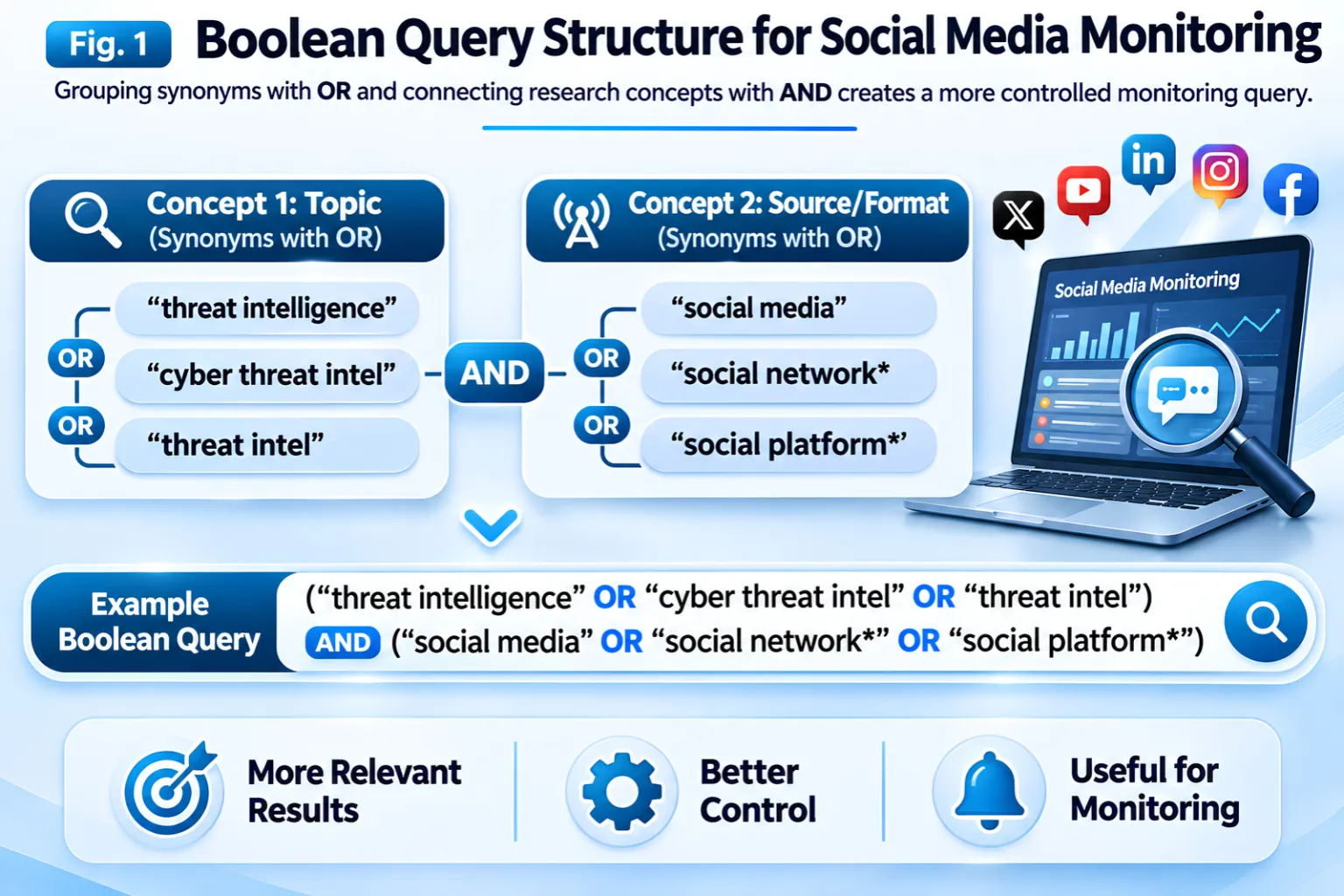
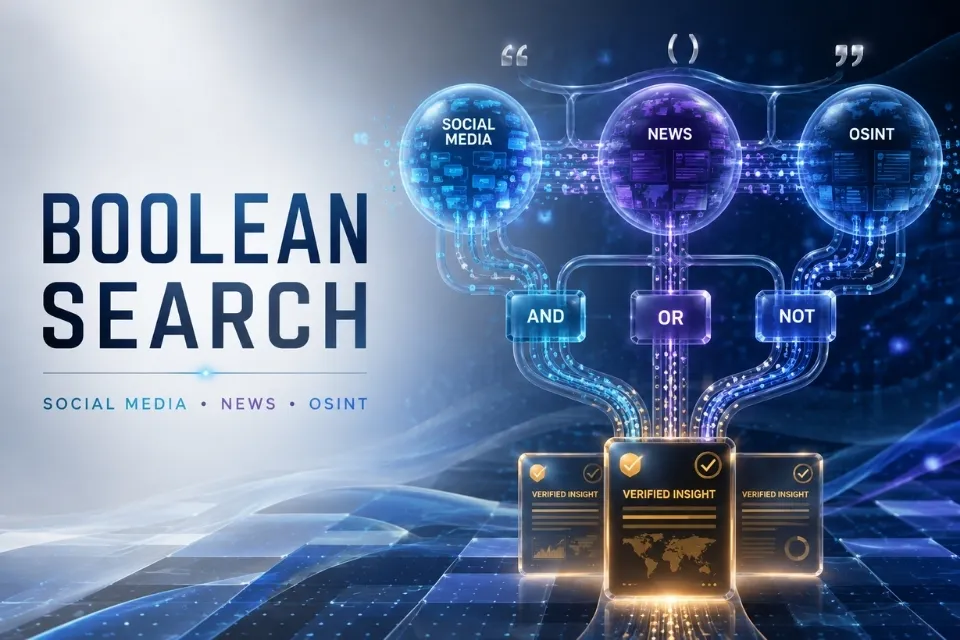
Boolean query structure showing OR groups connected by AND for social media monitoring. Grouping synonyms with OR and connecting research concepts with AND creates a more controlled monitoring query.
Why Boolean Search Still Matters in the Age of AI
AI search systems can summarize documents, propose queries, extract entities, and identify possible patterns. They do not remove the need to control what evidence enters the research process. A poorly scoped question can still produce incomplete, biased, or confidently incorrect output.
Define the Scope
Specify entities, topics, locations, time periods, products, risks, and exclusions before collecting material.
Improve Precision
Require important concepts and remove predictable noise when a plain-language search is too broad.
Capture Variations
Include synonyms, abbreviations, former names, misspellings, hashtags, and multilingual alternatives.
Support Verification
Repeat queries across engines and record what was searched, when it was searched, and which filters were applied.
AOFIRS explores this human-and-AI relationship in its research integrity guide, which positions structured retrieval as a control layer rather than an obsolete skill. The practical goal is not “Boolean versus AI”; it is Boolean retrieval + AI-assisted analysis + human verification.
The Core Boolean Operators
Boolean syntax is not implemented identically everywhere. Database platforms often support formal Boolean logic, while public search engines may interpret the same words differently or use their own exclusion syntax. Treat every query as a hypothesis to test, and consult the AOFIRS Search Query Matrix when moving a query between search engines because syntax portability cannot be assumed. The notes below identify which platforms documented each operator in their own help pages as checked on 9 November 2026.
AND: Require More Than One Concept
AND narrows a result set by requiring multiple ideas to be present. Bing states that all searches are AND searches by default, while X uses a space between terms to represent AND in its query language. Reddit behaves differently because its post search can match only some query words by default, so explicit AND can change the result set (Microsoft search options; X query documentation; Reddit search features).
Example: "artificial intelligence" AND cybersecurity AND regulation
This query focuses on material connecting all three concepts. Use AND when results are broad and the research question depends on a relationship between topics.
OR: Capture Synonyms and Alternative Language
OR broadens a search by accepting any listed alternative. It is essential for monitoring because journalists, communities, companies, and government agencies may describe the same subject differently. Bing, Brave Search, X, and Reddit document OR, while Bing and Reddit require it in capitals. Google’s documented search-help page does not list OR, so test it before relying on it in a Google query (Microsoft search options; Brave search operators; Reddit search features; Google search help).
Example: ("electric vehicle" OR EV OR "electric car") AND (battery OR charging)
Build OR groups for brand names, abbreviations, product names, former names, hashtags, spelling variants, translations, and technical terminology.
NOT or Minus: Exclude Predictable Noise
Exclusion syntax differs by platform. Google documents a minus sign before the word to leave out, as in jaguar speed -car. Bing accepts NOT, which must be capitalized, or a dash. Brave Search lists both NOT and a minus sign, while X uses a dash before an operator and does not allow a dash in front of a parenthesized group. Reddit documents capitalized NOT (Google search help; Microsoft search options; Brave search operators; X query documentation; Reddit search features).
Because exclusion behavior varies, test the query and compare the result count before expanding it.
Common mistake: excessive exclusions can hide useful evidence. Exclude only a clearly irrelevant meaning, and keep a copy of the broader query in the search log.
Quotation Marks: Search an Exact Phrase
Quotation marks tell many search systems to look for words in a specific order. Google, Bing, and Brave document exact-phrase searching, while X provides an exact-phrase field through advanced search.
Useful examples include "zero trust architecture", "artificial intelligence governance", and "misinformation campaign".
Exact-phrase searching is especially useful for names, quotations, report titles, error messages, policy language, and distinctive wording. It may reduce recall, so repeat the search without quotation marks when coverage matters.
Parentheses: Control the Logic
Parentheses group alternatives so the search engine or database evaluates them together. They are central to complex monitoring queries. Precedence matters when they are missing. Bing evaluates OR according to its documented precedence rules, while X evaluates AND before OR (Microsoft search options; X query documentation).
Example: (deepfake OR "synthetic media") AND (election OR campaign) AND (misinformation OR disinformation)
Read a Boolean query as a sentence. Each OR group represents a concept family; each AND connects concept families; exclusions remove specific noise.
Which Platforms Document Which Operators?
The table below summarizes what each platform’s own help or developer documentation listed on 9 November 2026. “Not documented” means the operator does not appear on that page. It does not necessarily mean the operator never works.
| Operator | Google Search | Bing | Brave Search | X | |
|---|---|---|---|---|---|
AND |
Not documented | AND or &; default | AND | Space between terms | AND, capitals |
OR |
Not documented | OR, capitals | OR | OR | OR, capitals |
| Exclude | -term |
NOT or dash | NOT or -term |
-term, not before group |
NOT, capitals |
| Exact phrase | Quotes | Quotes | Quotes | Exact phrase field | Quotes around multi-word filters |
| Grouping | Not documented | () |
Not documented | () |
() |
| Field filters | site:, filetype:, before:, after: |
site:, filetype:, intitle:, inbody:, language:, loc: |
site:, filetype:, intitle:, inbody:, lang:, loc: |
from:, lang:, has:links, has:media, is:retweet |
author:, flair:, self:, site:, subreddit:, title:, url: |
| Documented limits | No space after operator colon | Only first 10 terms are used | Operators described as experimental | 512 characters for recent search, up to 4,096 for enterprise | Filter name, colon, and term with no space |
Sources: Google search help, Microsoft search options, Microsoft search keywords, Brave search operators, X advanced search, X query documentation, and Reddit search features.

How to Build a Professional Boolean Query
- Define the decision or research question. Replace a vague topic such as “What is happening with AI?” with a bounded objective such as “How are new AI regulations affecting healthcare organizations in North America?”
- Identify the main concepts. Separate the objective into topic, action, industry, geography, time, and named entities.
- Build synonym groups. List abbreviations, alternative spellings, product names, old names, translations, hashtags, and commonly used informal terms.
- Add exclusions carefully. Remove only predictable noise that has been observed in test results.
- Adapt the syntax for each source. Translate the query for the platform instead of pasting one universal string everywhere. Check platform limits before relying on a long query.
- Test and log the query. Record the exact query, platform, date, filters, useful results, and important gaps.
- Verify before reporting. Trace claims to original material and corroborate important findings across independent sources.
Objective: monitor the effect of AI regulation on healthcare organizations.
("artificial intelligence" OR AI OR "machine learning") AND (regulation OR legislation OR compliance OR policy) AND (healthcare OR hospital OR pharmaceutical)
Boolean Search for Social Media Monitoring
Social platforms can surface early signals, eyewitness accounts, public reactions, product complaints, and emerging narratives. They also contain anonymity, reposting, manipulation, missing context, and demographic bias. Boolean search helps locate relevant conversations, but it does not authenticate them.
Audience size also differs by platform. In Pew Research Center’s survey of U.S. adults in August 2026, 34% said they regularly get news on YouTube, 10% on X, 9% on Reddit, and 6% on LinkedIn. These are U.S. figures, so local data should be checked before generalizing to other markets (Pew social media data).
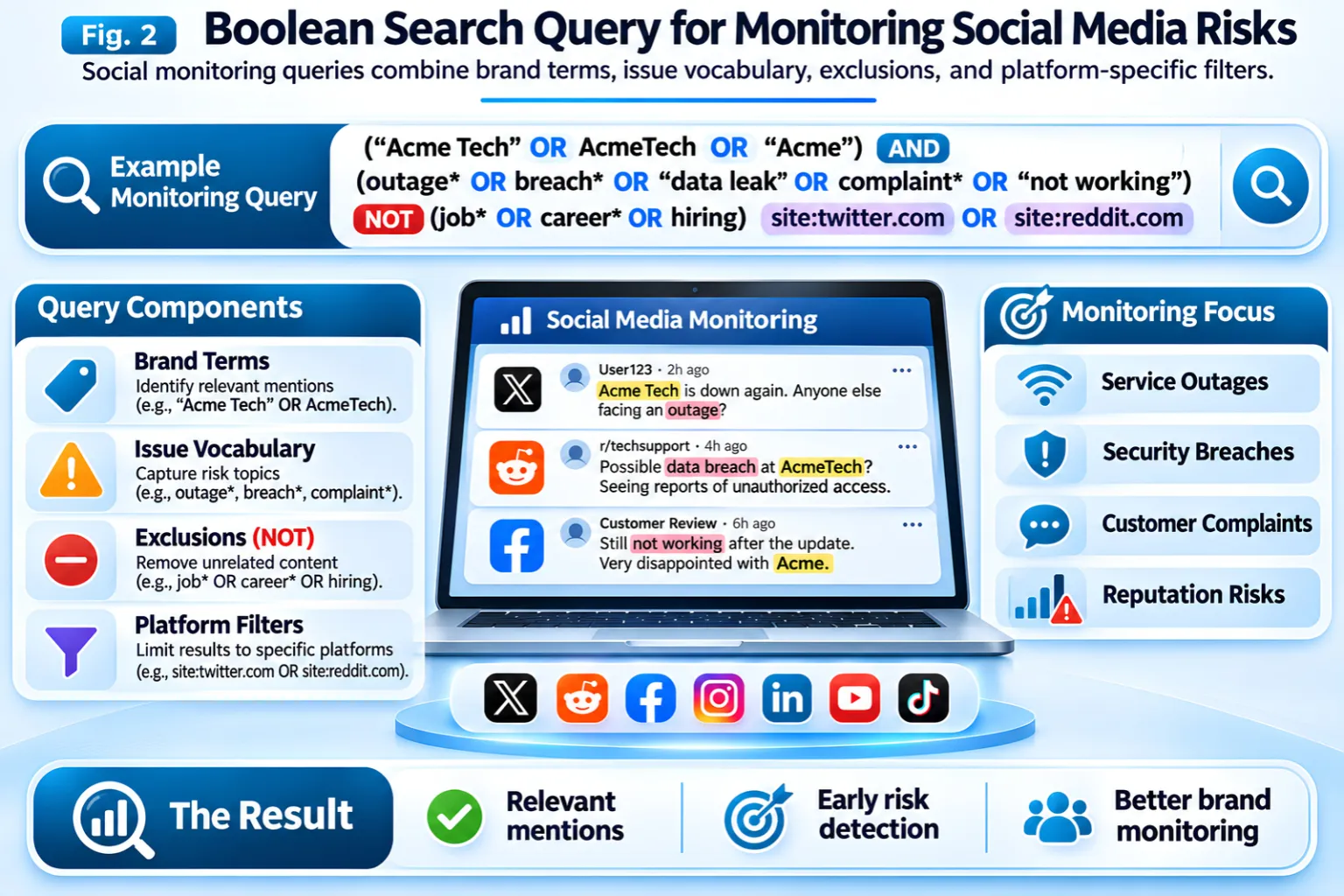
Boolean search query used to monitor social media conversations about outages, breaches, complaints, and reputation risks. Social monitoring queries combine brand terms, issue vocabulary, exclusions, and platform-specific filters.
X: Real-Time Events and Crisis Signals
X can support monitoring of breaking developments, customer complaints, service interruptions, public announcements, and reputation risks. In the same Pew survey, 57% of X users said they regularly get news there (Pew social media data).
A strong query includes official names, abbreviations, product names, common misspellings, and issue vocabulary.
Brand-risk example:
("company name" OR "product name" OR abbreviation) (outage OR breach OR complaint OR boycott) -jobs -hiring lang:en -is:retweet
X’s Help Center documents advanced search as a form rather than a typed operator reference. It offers fields for all words, an exact phrase, any of the words, excluded words, hashtags, language, posts from, replying to or mentioning an account, a place, and a date range, and it requires users to be logged in. The typed syntax above, including a space for AND, OR, a dash for exclusion, and operators such as lang: and is:retweet, is documented in X’s API query guide. Test typed syntax in the current interface before relying on it (X advanced search; X query documentation).
Preserve URLs or screenshots when a post may later be removed.
LinkedIn: Professional and Organizational Intelligence
LinkedIn can support expert discovery, executive monitoring, company research, recruitment intelligence, and professional trend analysis. Boolean functionality differs between general LinkedIn search and its paid recruitment and sales products. Researchers should check LinkedIn’s own help documentation for the search interface being used before relying on a specific operator.
Expert-discovery example:
("Chief Information Officer" OR CIO) AND (AI OR "artificial intelligence") AND healthcare
Do not rely on job titles alone. Combine role, industry, skills, technology, location, and organization names, then verify employment claims through corporate pages or other reliable records.
Reddit: Community Signals and Qualitative Research
Reddit discussions can reveal product frustrations, alternative terminology, niche communities, and questions that have not reached mainstream coverage. Search results should be treated as qualitative leads, not representative public opinion.
Product-research example:
title:"product name" AND (problem OR issue OR complaint OR alternative)
Reddit documents case-sensitive AND, OR, and NOT, parentheses for grouping, and manual filters typed as the filter name, a colon, and the term with no space. Examples include author:, flair:, self:, selftext:, site:, subreddit:, title:, and url:. Filters can be combined, such as subreddit:sysadmin title:"product name" (Reddit search features).
Consider community rules, account history, self-selection bias, coordinated promotion, and the possibility that the same claim has been copied across threads.
YouTube: Video Titles, Transcripts, and Audience Discussion
YouTube monitoring can cover expert interviews, product reviews, creator commentary, conference talks, and video comments. Researchers can combine Boolean discovery with transcript review and AI-assisted summarization, but quotations and claims must be checked against the video itself.
Topic-monitoring example:
site:youtube.com "future of work" automation
As of 9 November 2026, no YouTube Help page was found that lists YouTube-specific search operators. YouTube’s own search interface provides result filters instead. For operator-based discovery, Google’s documented site: operator, which Google itself illustrates with YouTube searches, combined with exact phrases is the more defensible documented route (Google search help).
Boolean Search for News Intelligence
News monitoring supports crisis response, policy tracking, competitor intelligence, security research, market analysis, and investigative reporting. A professional workflow combines broad discovery with primary documents and verification. The AOFIRS news verification guide provides a complementary framework for tracing claims, comparing coverage, and assessing the reliability of news evidence.
Technology and Regulation Monitoring
Policy example:
("generative AI" OR "large language model" OR LLM) AND (governance OR regulation OR compliance) AND (Europe OR "United States" OR global)
Separate proposals, consultations, court decisions, enacted law, regulatory guidance, and company statements. These sources carry different legal and evidentiary weight.
Cybersecurity Monitoring
Incident example:
(ransomware OR malware OR "data breach") AND ("company name" OR "product name")
Vulnerability example:
("zero day" OR vulnerability OR exploit OR CVE) AND ("product name" OR vendor)
Do not treat an early social post or duplicated news report as confirmation. Check vendor advisories, government alerts, technical documentation, and the earliest credible source.
Competitor and Market Monitoring
Competitor example:
("competitor name" OR "product name") AND (launch OR acquisition OR partnership OR pricing OR expansion)
Add executives, subsidiaries, product families, trademarks, and former names to improve coverage. A change log helps distinguish new developments from repeatedly indexed older material.
Combining Boolean Logic With Search Operators
Search operators control where terms appear or which kinds of documents are returned. Support changes over time and differs across engines, so researchers should use documented operator support to translate rather than blindly reuse commands. Google’s search help, Microsoft’s operator documentation, and Brave’s search documentation should be checked when syntax matters (Google search help; Microsoft search keywords; Brave search operators).
| Operator | Purpose | Example | Documented by 9 Nov 2026 |
|---|---|---|---|
site: |
Restrict results to a domain or site | site:gov "AI regulation" |
Google, Bing, Brave |
filetype: |
Request a document format | "AI policy" filetype:pdf |
Google, Bing, Brave |
intitle: |
Look for terms in page titles | intitle:"cybersecurity report" |
Bing, Brave |
before: / after: |
Limit by date | "AI policy" after:2026-01-01 |
|
-term |
Exclude a term | python programming -snake |
Google, Brave; Bing also accepts NOT |
Researcher tip: start with the simplest query that expresses the objective. Add operators only when the result set demonstrates a specific problem.
Cross-Engine Research: Google, Bing, and Brave Search
No single index provides complete coverage. Search engines crawl, rank, refresh, and filter information differently, so important results may appear in one engine but not another. AOFIRS discusses this coverage problem further in its guide to searching the invisible web, where database search and specialized sources become necessary when ordinary indexes cannot reach the material.
Google Search
Google is useful for broad web discovery, site-restricted research, file discovery, and date filtering. Google’s help page documents exact-match quotes, site:, the minus sign, filetype:, and before: and after: for dates. It also warns not to put a space between an operator and its search term (Google search help).
Bing
Bing provides an alternative index and ranking system that can reveal pages missed or buried elsewhere. Bing documents a broader Boolean set including AND or ampersand, capitalized OR and NOT, plus, parentheses, and quotation marks. It also documents field keywords such as intitle:, inbody:, language:, loc:, and feed:, and notes that only the first 10 terms are used (Microsoft search options; Microsoft search keywords).
Brave Search
Brave Search offers its own search index and a privacy-focused alternative for general discovery. Brave documents AND, OR, and NOT as well as site:, filetype:, intitle:, inbody:, lang:, and loc:, but describes its operators as experimental. Coverage can differ by topic, language, region, and freshness, so it works best as one layer of a multi-engine workflow (Brave search operators).
Specialized Sources
Academic databases, public-record portals, archives, and deep-web research tools often provide fields and filters that web engines do not. The AOFIRS list of deep-web research tools helps researchers move beyond general search when the question requires specialist coverage.
Boolean Search and AI Search Work Better Together
AI systems can help expand synonym lists, translate queries, summarize retrieved documents, extract entities, compare sources, and organize notes. They should not be treated as original evidence or as a substitute for reviewing the source material.
| Research stage | Boolean contribution | AI contribution | Human responsibility |
|---|---|---|---|
| Scoping | Defines concepts and exclusions | Suggests terminology and variants | Sets the question and boundaries |
| Discovery | Controls retrieval | Supports conversational exploration | Chooses suitable sources |
| Analysis | Keeps the corpus relevant | Summarizes and extracts patterns | Checks context and evidence |
| Verification | Re-runs targeted searches | Flags inconsistencies for review | Confirms claims through primary sources |
| Reporting | Documents reproducible queries | Helps organize drafts | Owns conclusions, citations, and limitations |
ChatGPT
ChatGPT can be useful for query brainstorming, terminology expansion, document comparison, structured extraction, and research-note organization. Important claims, quotations, identities, and citations must be checked against original sources.
Perplexity
Perplexity can support source-oriented conversational exploration and quickly identify candidate pages. Citations indicate where to look, not that the associated claim has already been verified.
Gemini
Gemini can support AI-assisted research and workflows connected to Google services. Output quality varies by question, source availability, and model behavior, so primary-source review remains essential.
Claude
Claude can be useful for reading and comparing long documents, extracting structured information, and drafting analytic summaries. Researchers should verify factual outputs and preserve the source documents used.
Professional Social Listening and Media Monitoring Tools
Enterprise monitoring platforms can apply Boolean-style logic across large source collections, dashboards, alerts, and analytics. Syntax, data access, historical coverage, and pricing vary considerably. The access notes below were checked against each vendor’s official pages on 9 November 2026. They are descriptions, not endorsements or test results. Test queries with known examples before relying on a dashboard for operational decisions.
Brandwatch
Brandwatch is designed for enterprise consumer intelligence, social listening, trend analysis, and reputation monitoring, and describes itself as a Cision company. It is suited to complex topic definitions and large-scale brand or market research programs. Access: no public prices were listed; access is through a demo or plans process (Brandwatch website).
Meltwater
Meltwater combines media intelligence, social listening, monitoring, and communications workflows. It is commonly evaluated by PR, corporate intelligence, and reputation teams that need cross-channel coverage. Access: no prices were published on the main site; pricing is provided through sales or a demo (Meltwater website).
Talkwalker
Talkwalker supports global social and media monitoring, analytics, trend discovery, and brand intelligence, and its current branding describes the platform as Lumen by Talkwalker. Query testing is important when projects span languages, regions, and multiple naming conventions. Access: quote-based plans are provided through a demo request; no public prices were listed (Talkwalker pricing).
Sprout Social
Sprout Social combines social management, engagement, listening, reporting, and customer intelligence features. It can be more relevant to communications and social teams than to deep investigative research. Access: published per-seat prices ranged from US$79 a month for Essentials, billed annually, to US$399 for Advanced, with Enterprise by quote. Listening is a separate add-on for Standard and above (Sprout Social pricing).
OSINT and Investigation Tools
Boolean searching is often the first stage of an OSINT investigation, followed by entity resolution, archive research, public-record checks, infrastructure analysis, geolocation, or relationship mapping. Search results are leads and evidence sources, not finished intelligence.
Maltego
Maltego supports link analysis and relationship mapping across people, organizations, domains, infrastructure, and other entities. Investigators must assess the provenance and reliability of every transform result. Access: the document records a free Basic plan with 200 credits, Entry at €3,000 a year, Professional at €7,500 a year per seat, and Enterprise by quote (Maltego pricing).
SpiderFoot
SpiderFoot automates collection from many OSINT data sources to surface possible relationships and indicators. Automated findings require validation because matching strings do not necessarily prove identity or ownership. The open-source edition is available on GitHub under an MIT license, version 4.0, with more than 200 modules (SpiderFoot GitHub).
On 9 November 2026, the former product site redirected to Intel 471, so the GitHub repository is the more appropriate reference point for the open-source project.
OSINT Framework
OSINT Framework provides a categorized directory of tools and resources for different investigative tasks. It helps with source discovery but does not determine whether a tool is lawful, reliable, current, or appropriate for a particular investigation.
AOFIRS OSINT User Guide
The downloadable AOFIRS OSINT Framework user guide covers structured methodology, SOCMINT, multimedia verification, technical reconnaissance, and legal-compliance considerations for modern investigators.
News Discovery and Intelligence Platforms
Google News
Google News is useful for broad news discovery, topic monitoring, source comparison, and tracking coverage over time. Ranking and personalization do not establish credibility, so researchers should identify the original report and primary evidence.
GDELT
GDELT provides large-scale global news data for event, theme, entity, geographic, and media analysis. It is powerful for pattern discovery, but automated coding and source coverage must be understood before drawing conclusions. The project describes its main data streams as updating every 15 minutes and monitoring news in more than 100 languages. Access is free and open (GDELT Project).
Factiva
Factiva is a professional news and business-information platform from Dow Jones used for company, industry, media, and market research. Its controlled source collection and filtering can support precise monitoring programs. Access: paid subscription; current terms should be checked with Dow Jones or through the researcher’s organization or library.
LexisNexis
LexisNexis provides legal, news, corporate, public-record, and business research products. Nexis is its news and business research service. Coverage and functionality depend on the subscribed service and jurisdiction. Nexis lists plans for individuals and teams, a trial request, a demo, and search options ranging from basic to Boolean (Nexis information).
Lawful and Ethical Monitoring
Boolean monitoring makes it easy to collect large volumes of public posts about people, so the limits need to be established before the query runs.
The Berkeley Protocol on Digital Open Source Investigations, published by the United Nations Office of the High Commissioner for Human Rights and the UC Berkeley Human Rights Center, sets minimum standards for identifying, collecting, preserving, verifying, and analyzing open-source information. It calls for investigators to work in a professional, legal, and ethical manner and emphasizes data minimization, security by design, and protection of investigators and other people involved in the research (OHCHR & Human Rights Center, 2022).
Platform rules also apply, especially when monitoring is automated. X’s Developer Policy addresses privacy expectations, matching an X account to an off-platform identifier, location data, and storage of non-public content. Researchers should read the current policy and terms of every platform and tool they use and consider the data-protection law that applies to both the researcher and the people represented in the data (X developer policy).
In practice:
- Monitor topics, organizations, and public statements rather than private individuals unless there is a documented lawful purpose.
- Collect only what the research question requires.
- Do not use fake accounts or access content you are not authorized to see.
- Record how and when each item was collected.
- Store and share personal data securely.
- Respect platform terms, applicable privacy laws, and research ethics.

The Boolean Intelligence Workflow
- Define the intelligence requirement. State what must be known, why it matters, and which decision the research will support.
- Create an entity and terminology map. List people, companies, products, locations, aliases, former names, hashtags, translations, and related concepts.
- Build modular Boolean strings. Create reusable OR groups, connect them with AND, and document exclusions separately.
- Run the query across suitable sources. Use more than one search engine and add specialist databases, news sources, or platform search where relevant.
- Monitor change over time. Track new mentions, altered language, emerging narratives, official updates, and shifts in sentiment or volume.
- Analyze without losing provenance. AI can help summarize and categorize, but every note should remain traceable to the source that supports it.
- Verify and report limitations. Confirm key claims, disclose uncertainty, and distinguish fact, allegation, inference, and opinion.
Source Verification Checklist
| Check | Questions to Ask | Action |
|---|---|---|
| Authority | Who published it, and are they in a position to know? | Check author, organization, expertise, and accountability. |
| Originality | Is this the original source or a repetition? | Trace quotations, statistics, images, and claims to their earliest reliable source. |
| Date and context | Is the material current and presented in its original setting? | Check publication date, event date, location, audience, and later corrections. |
| Evidence | Does the source show documents, data, methodology, or direct observation? | Examine supporting evidence rather than relying on the headline or summary. |
| Corroboration | Do independent sources agree? | Look for genuinely independent confirmation, not copied reporting. |
| Bias and incentives | What might the publisher gain by framing the issue this way? | Compare language, omissions, funding, ownership, and conflicts of interest. |
For a practical demonstration of how conversational discovery can supplement structured searching, the AOFIRS material on conversational search can be paired with this checklist so that speed does not replace verification.
AOFIRS Resources for Deeper Learning
AOFIRS publishes several resource types because a single article cannot cover every research context. These related resources extend the method into visual syntax comparison, news verification, OSINT practice, professional development, and AI-search limitations.
Articles
The AOFIRS article on high-precision Boolean search expands the operator fundamentals, while the wider articles library covers tools, verification, search technology, and research methods.
Visual Guide
The Search Query Matrix visualizes cross-engine syntax so researchers can compare command support before translating queries between platforms.
Research Report
The AOFIRS Online News Search & Verification report extends Boolean discovery into claim tracing, source assessment, corroboration, and news-evidence management.
User Guide
The OSINT Framework user guide applies search techniques within a broader investigative framework that includes ethics, verification, and specialized collection methods.
Video
The AOFIRS video on Mastering Conversational Search demonstrates how natural-language exploration can complement structured queries without removing the researcher’s verification duties.
White Paper
The AOFIRS white paper on generative AI and research integrity explains why precise retrieval remains necessary when AI systems mediate access to information.
Frequently Asked Questions
Are Boolean operators still useful?
Yes. Boolean logic remains useful because it makes research scope explicit, captures alternative terminology, reduces predictable noise, and produces queries that can be tested and documented.
Can AI replace Boolean search?
No. AI can accelerate query development and analysis, but Boolean search gives researchers more control over discovery. Both methods still require source verification and human judgment.
Does the same Boolean query work on every platform?
No. Search engines, databases, social platforms, and listening tools implement different syntax and limits. For example, Bing and Reddit use capitalized OR and NOT, X uses a space instead of the word AND, and Google’s help page documents the minus sign rather than NOT. Translate and test the query for each platform.
How do researchers monitor social media effectively?
They combine Boolean queries, platform search, social listening tools, alerting, AI-assisted analysis, and human verification. They also account for anonymity, reposting, sampling bias, manipulation, and missing context.
Which tools support Boolean search?
The right combination depends on the question. General search engines support broad discovery; news databases support media intelligence; listening tools support high-volume monitoring; OSINT tools support investigation; and AI tools support analysis.
How do journalists use Boolean search?
Journalists use Boolean queries to monitor breaking news, track organizations, identify sources, locate primary documents, compare terminology, investigate claims, and follow a story over time.
Conclusion: Boolean Search Turns Information Into a Researchable Evidence Set
Boolean search remains a foundational skill in professional online research. AI has changed discovery and analysis, but it has not removed the need for controlled retrieval, source evaluation, reproducible queries, and accountable judgment.
The strongest workflow combines advanced queries, multiple sources, AI assistance, verification, and human analysis. For social monitoring, news intelligence, and OSINT, that combination turns an overwhelming information stream into a focused and defensible research process.
Boolean logic is one part of a wider skill set that also includes source evaluation, AI literacy, verification, legal awareness, and transparent reporting. The AOFIRS Certified Internet Research Specialist (CIRS™) curriculum covers these areas for readers who want structured training.
References
- Brandwatch. Brandwatch. Brandwatch website.
- Brave Software. Search operators. Brave Search Help. Brave search operators.
- GDELT Project. The GDELT Project. GDELT Project.
- Google. Refine Google searches. Google Search Help. Google search help.
- LexisNexis. Nexis. Nexis information.
- Maltego Technologies. Pricing. Maltego pricing.
- Meltwater. Meltwater. Meltwater website.
- Micallef, S. SpiderFoot, version 4.0. GitHub. SpiderFoot GitHub.
- Microsoft. Advanced search options. Microsoft Support. Microsoft search options.
- Microsoft. Advanced search keywords. Microsoft Support. Microsoft search keywords.
- Office of the United Nations High Commissioner for Human Rights & Human Rights Center, University of California, Berkeley, School of Law. (2022). Berkeley Protocol on Digital Open Source Investigations. United Nations. Berkeley Protocol.
- Pew Research Center. (2026, October 19). Social media and news fact sheet. Pew social media data.
- Reddit. Available search features. Reddit Help. Reddit search features.
- Sprout Social. Pricing. Sprout Social pricing.
- Talkwalker. Pricing. Talkwalker pricing.
- X Corp. How to use advanced search. X Help Center. X advanced search.
- X Corp. Build a query. X API documentation. X query documentation.
- X Corp. Developer policy. X Developer Platform. X developer policy.